
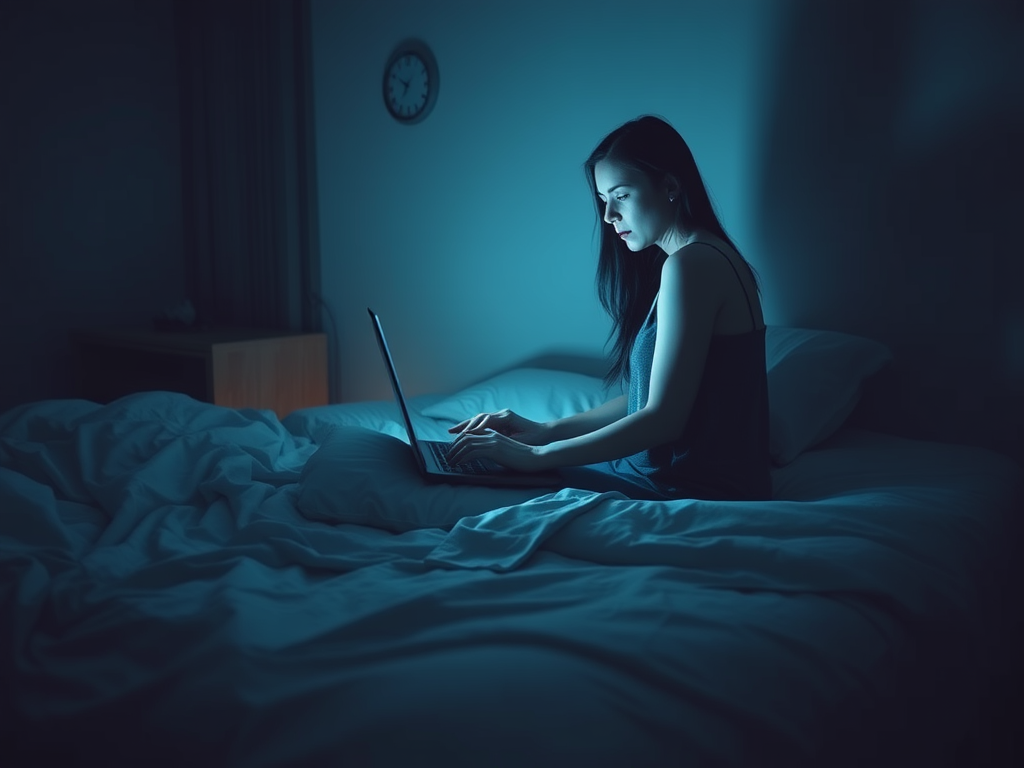
I’m pretty sure there’s a fancy word for the fear of sleep – one of those delightfully pretentious terms that would make me sound sophisticated at dinner parties, if I ever went to dinner parties instead of staying up until 1 AM writing blog posts in my pajamas.
The word is somniphobia, by the way. I looked it up after I wrote this, because apparently even my sleep-deprived brain has some academic pride left.
But here’s the thing about fancy words – they don’t make the experience any less messy or real. And right now, sitting in my dark room with only the laptop screen illuminating my face like some modern-day campfire, impressing anyone with my vocabulary isn’t exactly on tonight’s agenda.
The Cruel Irony of Wanting What You Fear
All I want is to sleep. To crawl into bed, close my eyes, and wake up feeling like a functional human being instead of a zombie extra from a low-budget horror film. I want to be one of those people who has a “nighttime routine” that actually involves sleeping at night.
But wanting something and being able to do it are two completely different beasts, aren’t they?
The cruel irony is that I’m exhausted – bone-deep, soul-crushing tired – yet terrified of actually going to bed. Because apparently, according to sleep experts (and basic human biology), closing your eyes is a pretty important requirement for sleeping. Who knew?
This fear didn’t materialize out of thin air like some nocturnal magic trick. Last night, in a moment of what I can only describe as emotional masochism, I decided to scroll through my photo gallery. Not just the recent ones, mind you, but the archaeological dig of memories going back at least a decade.
There I was, crying over pictures of people who used to matter, places I used to call home, and versions of myself I barely recognize anymore. It was my choice to open that particular Pandora’s box instead of sleeping, and now here I am, making the same mistake on a different night with a different device.
The Prison of Self-Awareness
Here’s what’s maddening: I know better. I know I should be in bed. I know I should be catching up on sleep instead of adding to my growing collection of dark circles. I know this isn’t healthy, sustainable, or remotely resembling adult behavior.
We all know these things, don’t we?
But there’s something almost laughable about self-awareness without self-control. It’s like being a prisoner who holds the keys to their own cell but keeps choosing to stay locked up. What’s the use of knowing exactly what I should do when I have no intention of actually doing it?
I can craft the perfect evening routine in my head: healthy dinner (no dessert!), early bedtime, maybe some meditation, definitely no screens. I can envision waking up refreshed, doing yoga, making breakfast from scratch like some wellness influencer who has their life together.
But even as I’m making these plans, there’s a voice in the back of my head whispering the truth: You’re not going to do any of that. You’re not going to change overnight.
The Universal Art of Self-Sabotage
The thing is, I know I’m not alone in this bizarre dance of self-sabotage. We’ve all been there – planning to sleep early, only to find ourselves three hours deep in whatever rabbit hole the internet has to offer. It doesn’t even matter what we’re consuming; as long as it’s keeping us from facing the quiet of our own minds, it serves its purpose.
We make this choice consciously, night after night. We feel guilty about it, sure, but we keep choosing it anyway. Why do we do this to ourselves?
I think it’s because we know ourselves better than we want to admit. We know ourselves with an uncomfortable intimacy, and the more we know, the more we want to run away. But here’s the cosmic joke: wherever you go, there you are.
Masters of Escape
I’ve become something of an expert in avoiding myself. My preferred method? Disappearing into fictional worlds where other people’s problems are more interesting than my own. Books, shows, podcasts, articles about celebrities I don’t care about – anything to keep my mind occupied with external noise.
Most of the time, this escapism works like a charm. It’s like having a secret trapdoor in the floor of my consciousness that I can disappear through whenever reality gets too heavy.
But then there are nights like last night, when nothing works. When the fictional worlds feel hollow, when the distractions feel transparent, when you find yourself staring at old photos and crying for hours because somewhere in those pixels are echoes of a happiness that feels impossibly distant.
I understand why I do this, even if I don’t feel good about it. There’s something about revisiting happy memories, even when they make you cry, that feels like touching something real in a world that often feels synthetic.
The Real Fear Behind the Fear
Which brings me back to tonight’s particular flavor of insomnia. Technically, it’s not really a fear of sleep – it’s a paralyzing fear of meeting whatever emotions are waiting for me in the dark.
During the day, we can distract ourselves with work, with noise, with the endless parade of tasks that make up adult life. We can avoid our inner landscape like it’s a neighborhood we don’t want to walk through alone at night.
But sleep requires surrender. It requires letting go of control, turning off the lights, and trusting that whatever rises from the depths of our subconscious won’t completely destroy us.
Escapism works beautifully when we’re trying to escape external factors – difficult jobs, complicated relationships, the general chaos of the world. But escaping our inner demons? That’s a much more complex operation.
The Paradox of Rest
Here’s what I’m learning, one sleepless night at a time: sometimes the fear of facing ourselves is stronger than our need for rest. Sometimes we’d rather be exhausted than vulnerable. Sometimes staying awake feels safer than the uncontrolled territory of dreams and darkness.
But exhaustion has its own kind of honesty. When you’re tired enough, your defenses crumble. The masks slip. The carefully constructed walls start to show cracks. Maybe that’s what I’m really afraid of – not sleep itself, but the raw truth that emerges when I’m too tired to keep pretending.
As I write this, my eyelids are finally getting heavy. Not because I’ve solved anything or found some profound insight, but because even fear gets tired eventually.
Tomorrow, I’ll probably make the same plans I always make – early bedtime, no screens, proper self-care. And tomorrow night, I’ll probably find myself in the same place, staring at the same screen, making the same choices.
But maybe that’s okay. Maybe accepting this pattern is the first step toward changing it. Maybe being honest about our fears – even the seemingly irrational ones – is how we begin to befriend them.
For now, though, I think I’ll try to make friends with my pillow. The emotions will still be there when I wake up, but at least I’ll be better equipped to face them.
Sweet dreams, fellow insomniacs. May we all find peace in the darkness we’re so afraid to meet.
Leave a Reply