
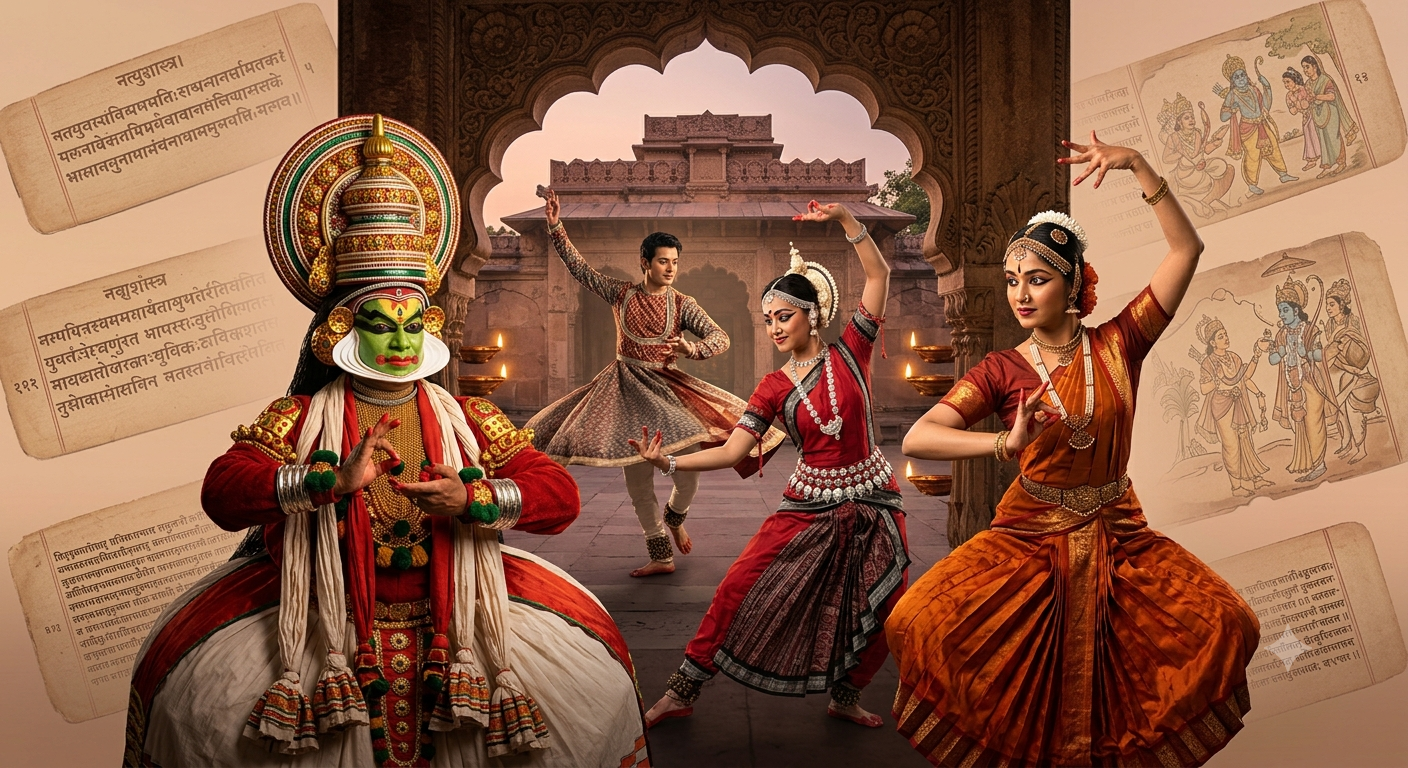
Long before written scripts and stage directions, storytellers across India found a way to make myths, epics, and philosophy come alive through the human body. In Indian classical dance, movement is not decoration—it is language. A tilt of the head, a specific curl of the fingers, a flicker of the eyes: each carries precise meaning, capable of conjuring a mountain, a river, a god, or a broken heart without a single word being spoken.
This is what makes Indian classical dance so distinctive on the world stage. It is simultaneously a physical discipline, a devotional practice, and a fully coded narrative system—one that has been refined and transmitted for roughly two thousand years.
The Textual Foundation: How Dance Learned to Speak
The “grammar” behind this narrative art form comes from two foundational Sanskrit texts.
The first is the Natyashastra, attributed to the sage Bharata Muni and dated somewhere between 200 BCE and 200 CE. Frequently called the “Fifth Veda,” it is an extraordinarily comprehensive manual covering aesthetics, stagecraft, dramaturgy, and the theory of emotion. It is, in effect, the constitutional document of Indian performing arts.
The second is the Abhinaya Darpana (“The Mirror of Gesture”), composed by Nandikesvara around the 4th–5th century CE. Where the Natyashastra lays out the philosophy, the Abhinaya Darpana is the practical field guide—cataloguing the precise hand gestures, head positions, and facial movements a dancer must master.
Three Layers of Performance
Classical theory divides dance performance into three functional layers, each serving a different purpose:
- Nritta — Pure, non-narrative dance. This is rhythm, tempo, and geometry for their own sake, with no story being told.
- Nritya — Expressive, interpretive dance. Here, lyrics and emotional themes are translated directly into gesture and facial expression.
- Natya — Full dramatic theatre, incorporating dialogue, characterization, and ensemble storytelling.
A single performance often moves fluidly between all three, alternating passages of pure technical virtuosity with moments of intense emotional storytelling.
The Fourfold Expressive Code: Abhinaya
The mechanism that allows a dancer to “speak” without words is called Abhinaya, a term that roughly translates to “leading the audience toward a meaning.” It operates through four interconnected channels:
- Angika Abhinaya — Bodily gestures: head movements, eye movements, and especially Hasta Mudras (hand signs). A single hand position can represent a mountain, a lotus, a weapon, or a deity, depending entirely on context.
- Vachika Abhinaya — The vocal element: sung lyrics, chanted rhythm syllables (bols or sollukattu), and the accompanying musical score.
- Aharya Abhinaya — Visual characterization achieved through costume, jewelry, headgear, and facial makeup.
- Sattvika Abhinaya — The internal, involuntary emotional state made physically visible—goosebumps, welling tears, or a sudden widening of the eyes.
Together, these four channels allow a solo dancer to portray an entire cast of characters, shifting identity from one phrase of music to the next.
The Theory of Rasa
The ultimate purpose of all this technical machinery is to evoke Rasa—an emotional “flavor” or essence—in the audience. The Natyashastra defines nine primary emotional states, the Navarasas:
Shringara (love/devotion), Veera (heroism), Karuna (compassion), Adbhuta (wonder), Hasya (laughter), Bhayanaka (fear), Beebhatsa (disgust), Raudra (anger), and Shanta (peace).
A well-trained dancer doesn’t simply act out a story; they engineer a specific emotional experience for the viewer, moment by moment.
Major Classical Dance Forms and Their Narrative Techniques
While all Indian classical dance forms share this common grammar, each regional tradition has developed its own distinctive vocabulary and dramatic style.
1. Kathakali (Kerala): Larger-Than-Life Epic Theatre
Originating in southwestern India, Kathakali—literally “story-play”—stages scenes from the Ramayana, the Mahabharata, and the Puranas with an intensity that borders on the superhuman. Dancers train for years to gain independent control over individual facial muscles, particularly the eyelids and cheeks, allowing them to translate every sung verse into vivid physical pantomime while vocalists narrate the story from offstage. The gestural vocabulary draws on 24 root hand positions codified in the text Hasta Lakshana Deepika.
Perhaps Kathakali’s most striking feature is its color-coded facial makeup (Aharya), which lets audiences instantly read a character’s moral nature:
- Pacha (Green): Divine heroes and noble kings, such as Rama or Arjuna.
- Kathi (Knife/Red): Regal but flawed characters marked by arrogance or greed, such as Ravana or Duryodhana.
- Thadi (Bearded): White beards signal divine beings like Hanuman; red beards mark vicious demons like Duhsasana.
- Kari (Black): Demonic characters and forest dwellers.
2. Bharatanatyam (Tamil Nadu): Sacred Geometry and Devotional Poetry
Historically performed in temple sanctums by Devadasis, Bharatanatyam pairs crisp, geometric postures—anchored by the Aramandi, or half-squat—with intricate hand gestures.
The narrative heart of a Bharatanatyam performance is the Varnam and the Padam, extended pieces in which the dancer moves back and forth between technical footwork (Nritta) and emotionally charged storytelling (Nritya). A hallmark of the form is its capacity for multi-role acting: a single dancer will portray both a longing devotee and a distant, unreachable deity within the same piece, distinguishing the two through subtle shifts in gaze, posture, and gesture (Asamyutta and Samyutta Hastas, the single- and double-hand gestures).
3. Kathak (North India): The Art of the Spoken and Danced Tale
Kathak takes its name from the Sanskrit word Katha, meaning story, and traces its roots to the Kathakars—wandering bards who moved between temples in ancient North India, reciting scriptural tales through song and dance.
Two features define its storytelling technique. Gat Nikas and Gat Bhav are specialized solo passages in which the dancer glides seamlessly between characters without speaking a word—conjuring, for instance, Krishna lifting Mount Govardhan or Radha drawing water from the Yamuna. Later, as Kathak moved out of Hindu temples and into the royal courts of the Mughal era, its repertoire absorbed secular love poetry (Ghazals, Thumris) alongside intricate spins (Chakkars) and increasingly delicate facial expression—a fusion of devotional and courtly aesthetics still visible today.
4. Odissi (Odisha): Sculptural Grace and Devotional Lyricism
Born in the temples of Odisha and closely tied to the worship of Lord Jagannath at Puri, Odissi is built on postures that visibly echo the stone carvings adorning ancient temple walls.
Its defining physical feature is the Tribhanga stance—a three-bend posture deflecting the neck, waist, and knees—which produces the flowing, S-shaped silhouette so recognizable in Odissi performance. Narratively, the form draws heavily on Jayadeva’s 12th-century Sanskrit masterpiece, the Gita Govinda, a lyrical and deeply romantic text chronicling the relationship between Radha and Krishna.
Beyond the Big Four: Kuchipudi and Manipuri
Two further traditions round out the classical canon. Kuchipudi, from Andhra Pradesh, is unusual in blending dance, spoken dialogue, and theatrical mime within a single performance, drawing on works like the Bhamakalapam and other Puranic legends. Its most famous set piece, the Tarangam, has a dancer performing intricate footwork while balanced on the rim of a brass plate. Manipuri, from the northeastern state of Manipur, draws its narrative material from the Ras Lila and Vaishnavite devotional texts, expressed through soft, continuous, circular movements of the arms and torso—a marked contrast to the sharper geometry of forms like Bharatanatyam.
Storytelling Across Traditions: A Comparative View
| Dance Form | Primary Literary / Mythological Sources | Primary Storytelling Mechanism | Visual Hallmark |
|---|---|---|---|
| Kathakali | Ramayana, Mahabharata, Nalacharitham | Silent gesture language (24 Hastas) + eye control | Color-coded face paint & heavy headpieces |
| Bharatanatyam | Silappatikaram, Bhagavata Purana, Carnatic poetry | Geometric hand gestures (28 single / 24 double) | Precise geometric Aramandi stance |
| Kathak | Radha-Krishna Leela, Ghazals, Thumris | Rhythmic poetry (Kavitt) & mime walks (Gat Bhav) | Flared skirts & rapid spins (Chakkars) |
| Odissi | Jayadeva’s Gita Govinda, Odia lyrics | Lyrical torso movement + Tribhanga stance | Three-bend posture & silver ornaments |
| Kuchipudi | Bhamakalapam, Puranic legends | Combined dance, spoken dialogue, and theatrical mime | Dancing on a brass rim (Tarangam) |
| Manipuri | Ras Lila, Vaishnavite texts | Soft, continuous circular arm and body movements | Stiff cylindrical skirts (Kumil) |
Why This Tradition Still Matters
What unites all of these forms is a shared conviction: that the body, properly trained, can be as precise and expressive as spoken language. A gesture is never arbitrary—it is drawn from a codified vocabulary thousands of years old, refined through generations of teachers and students, temple performances and royal courts.
In an age of rapid, disposable media, Indian classical dance stands as a reminder that storytelling can be slow, deliberate, and deeply embodied—that an entire epic can live in the turn of a wrist or the flicker of an eye, and that meaning, carefully encoded, can outlast the languages spoken around it.
Leave a Reply