
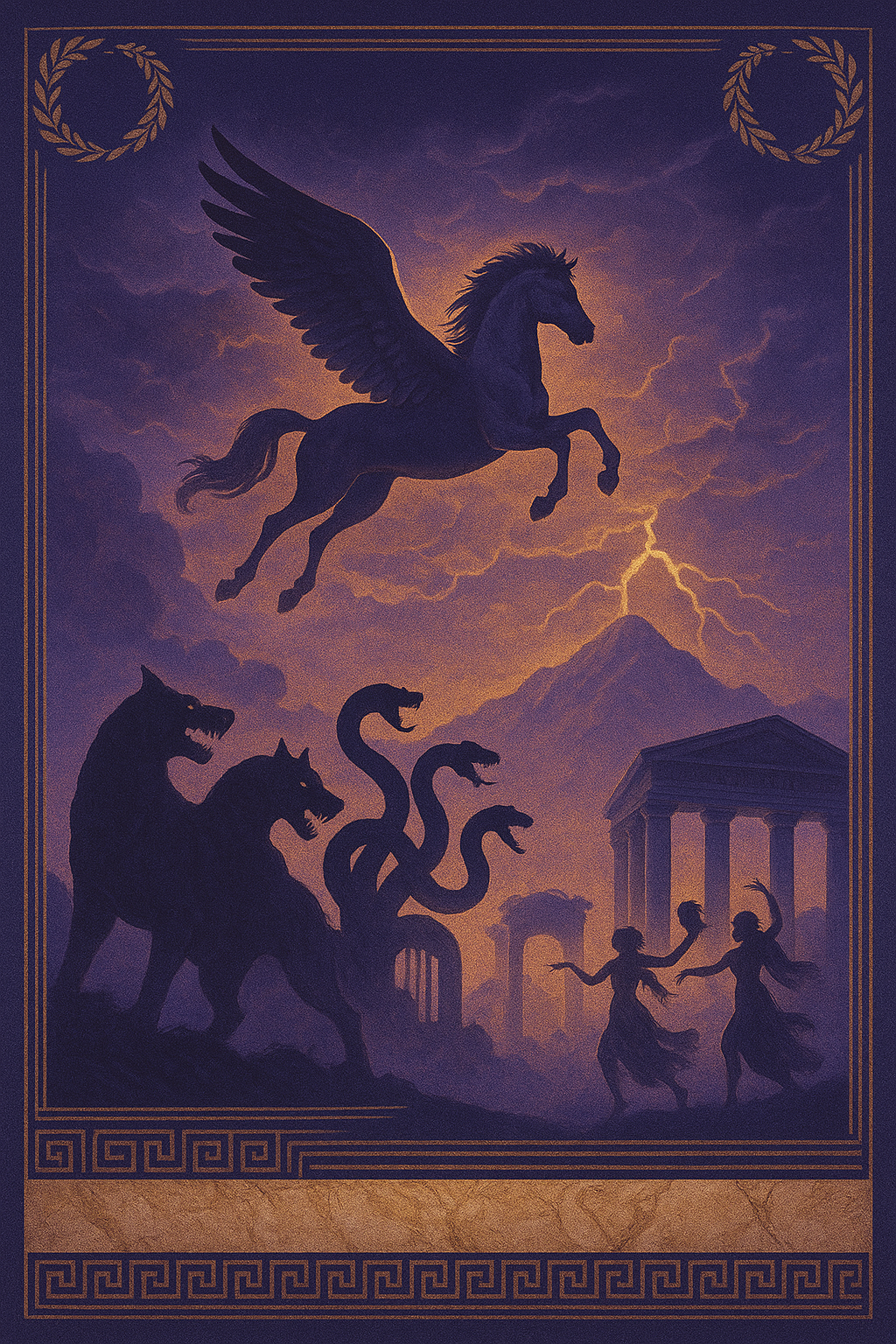
In the ancient Greek imagination, the world teemed with beings that defied natural law and embodied forces beyond human comprehension. From the primordial depths of Chaos to the highest peaks of Mount Olympus, Greek mythology populated every corner of existence with creatures that ranged from sublime divine beings to monstrous entities of terror. These mythological beings weren’t merely fantastical inventions—they represented the Greeks’ profound attempt to understand the mysteries of nature, the complexities of human psychology, and the cosmic forces that shaped their world.
The Primordial Genesis: Titans and the Dawn of Divine Order
Before the familiar gods of Olympus ruled the cosmos, existence emerged from Chaos itself through the Primordial Deities—fundamental forces that gave shape to reality. From this cosmic void came Gaia (Earth), Uranus (Sky), Tartarus (the Underworld), Erebus (Darkness), and Nyx (Night). These weren’t merely personifications but active forces that created the foundation upon which all subsequent mythology would build.
From the union of Uranus and Gaia arose the Twelve Titans—colossal immortal beings who represented the first organized divine generation. The six male Titans—Oceanus, Coeus, Crius, Hyperion, Iapetus, and Cronus—ruled alongside six female Titanides: Theia, Rhea, Themis, Mnemosyne, Phoebe, and Tethys. Each embodied specific cosmic principles: Oceanus governed the world-encircling river, Hyperion controlled celestial light, while Mnemosyne personified memory itself.
The Titans’ reign ended dramatically in the Titanomachy, a ten-year cosmic war against Zeus and the Olympian gods. Their defeat marked a fundamental shift in divine order—from chaotic, primordial rule to organized, justice-based governance. Most Titans were imprisoned in Tartarus, though some received specific punishments that became eternal symbols: Atlas was condemned to bear the heavens on his shoulders, forever supporting the cosmic order he had tried to overthrow.
The Monstrous Legacy: Children of Chaos and Divine Punishment
The Progenitors of Terror
At the dark heart of Greek mythology’s bestiary stood Typhon and Echidna—the “Father and Mother of All Monsters.” Typhon represented primordial chaos incarnate: a colossal giant with one hundred dragon heads, fire-breathing abilities, and wings so vast they could eclipse the sun. His challenge to Zeus himself threatened the very foundations of cosmic order.
Echidna, his serpentine mate, embodied the duality that pervaded Greek thought—beautiful woman above the waist, deadly serpent below. Together, they spawned a lineage of creatures that would torment heroes and test the boundaries between civilization and wild chaos.
Multi-Headed Nightmares
Their offspring inherited their parents’ monstrous nature, each representing different aspects of fear and challenge. The Lernaean Hydra embodied the concept that some problems grow worse when confronted directly—each severed head spawned two more, creating an escalating nightmare that required cleverness rather than brute force to defeat.
Cerberus, the three-headed hound of Hades, represented the ultimate boundary guardian. His presence at the gates of the Underworld symbolized the absolute nature of death—the living could not enter, and the dead could not escape. The Chimera, with its lion’s body, goat’s head rising from its back, and serpent’s tail, represented the unnatural fusion of different threatening elements into a single terrifying whole.
The Gaze That Kills
The Gorgons—particularly Medusa—embodied one of mythology’s most psychologically complex transformations. Medusa’s story reveals the Greeks’ understanding of how beauty and monstrosity could be intimately connected. Originally a beautiful priestess, her transformation into a snake-haired monster whose gaze turned viewers to stone represented divine punishment, but also the terrifying power of the feminine when corrupted or betrayed.
Even in death, Medusa’s power persisted—her severed head became a weapon that could petrify enemies, demonstrating how even defeated monsters retained their essential nature and continued to influence the world.
The Labyrinth of Human Nature: Hybrid Beings
Greek mythology’s fascination with hybrid creatures reflected their deep understanding of human complexity and the thin boundaries between civilization and wildness.
The Beast Within
The Minotaur represented perhaps the most psychologically disturbing fusion—human intelligence trapped within bestial form. Born from Queen Pasiphae’s unnatural union with a sacred bull, the Minotaur embodied the consequences of unchecked desire and divine punishment. Its imprisonment in the labyrinth created a powerful metaphor: the monster at the heart of civilization that must be confronted but cannot be simply ignored or destroyed without great cost.
Centaurs embodied the ongoing struggle between rational thought and wild impulse. With human torsos and horse bodies, they represented the duality of human nature—capable of wisdom and teaching (like the noble Chiron) but also prone to violence and excess when their bestial nature dominated their human reason.
Voices of Temptation and Wisdom
Sirens transformed the power of knowledge and beauty into instruments of destruction. Originally depicted as bird-women, they possessed the dangerous gift of knowing everything that had ever happened and everything that would come to pass. Their songs offered ultimate knowledge, but at the price of death—representing the Greek understanding that some truths are too dangerous for mortals to possess.
The Sphinx combined this theme with divine justice, posing riddles that tested not just intelligence but wisdom. Those who failed to understand the deeper meaning of existence—symbolized by the famous riddle of human life stages—faced death, while those who achieved true understanding could pass safely.
Nature’s Divine Intermediaries
The Living Landscape
Nymphs represented the Greeks’ profound connection to the natural world, embodying the belief that every natural feature possessed its own divine consciousness. These weren’t distant deities but intimate spirits who could be encountered and interacted with directly:
- Naiads dwelt in freshwater sources, representing the life-giving power of springs and rivers
- Nereids embodied the benevolent aspects of the sea, helping sailors navigate treacherous waters
- Dryads lived within trees, particularly oaks, symbolizing the sacred nature of forests
- Oreads inhabited mountains, representing the awesome power of high places
- Oceanids governed the vast oceans, connecting local experiences to cosmic forces
These beings created a world where humans lived in constant relationship with divine forces—every stream, grove, and mountain possessed its own personality and required appropriate respect and interaction.
Divine Guidance and Cosmic Balance
Daemons (distinct from later demonic concepts) served as intermediaries between the divine and mortal realms. These spirits could be beneficial (agathodaimones) or harmful (kakodaimones), representing the Greeks’ understanding that divine influence in mortal life was complex and ambiguous. Each person possessed a personal daemon—a guiding spirit that influenced their fate and character throughout life.
Creatures of Wonder and Cosmic Power
The Magnificent and Magical
Greek mythology celebrated creatures that embodied positive transformation and divine favor. Pegasus, born from Medusa’s blood, represented how even from death and monstrosity, beauty and wonder could emerge. This winged horse became a symbol of poetic inspiration and divine connection—carrying heroes to victory and eventually serving Zeus himself.
The Golden Fleece and its magical ram demonstrated how divine protection could manifest in the natural world, providing salvation for the innocent while creating quests that would test heroic virtue. The various divine horses—from Helios’s sun-drawing steeds to the man-eating Mares of Diomedes—showed how the same essential nature could manifest as either cosmic blessing or terrifying challenge.
Death, Judgment, and Cosmic Order
The Underworld hosted its own unique bestiary, creatures that embodied the mysterious processes of death and divine justice. Charon the ferryman represented the absolute necessity of proper burial rites and respect for the dead. The Erinyes (Furies) embodied the principle that certain crimes—particularly those against family—demanded supernatural punishment that transcended human justice systems.
Empusa and the Keres represented the predatory aspects of death—beings that actively sought to claim lives before their destined time, embodying ancient fears about premature death and the vampiric consumption of life force.
The Philosophy of Mythological Beings
Personified Concepts
Greek mythology’s genius lay in its ability to transform abstract concepts into concrete, relatable beings. Eros (Love), Eris (Strife), Phobos (Fear), Hypnos (Sleep), Thanatos (Death), and Nike (Victory) weren’t merely symbols but active forces with personalities, motivations, and complex relationships with both gods and mortals.
This personification allowed the Greeks to explore psychological and social phenomena through narrative. Nemesis (Divine Retribution) represented the cosmic principle that excessive pride would inevitably be punished, while Dike (Justice) embodied the ideal of cosmic fairness that should govern both divine and human behavior.
Exotic Wonders
Creatures like the Griffin (lion-bodied, eagle-headed), the Manticore (human-headed, lion-bodied, scorpion-tailed), and the immortal Phoenix represented the wider world’s mysteries. These beings, supposedly dwelling in distant lands, embodied the Greeks’ awareness that their known world was part of a larger, more wondrous cosmos filled with possibilities beyond their direct experience.
The Enduring Legacy
The creatures of Greek mythology created a comprehensive worldview that made sense of existence’s fundamental mysteries. They explained natural phenomena, provided moral guidance, and offered thrilling narratives that explored human psychology’s deepest territories. From cosmic Titans to intimate nymphs, from terrifying monsters to benevolent spirits, this vast bestiary reflected the ancient Greek imagination’s power to transform observations about nature, human relationships, and divine forces into enduring mythological narratives.
These beings weren’t mere entertainment but tools for understanding—ways of grappling with questions that remain relevant today: How do we balance reason and passion? What is the relationship between beauty and danger? How do we understand our place in a universe that contains both wonder and terror?
The creatures of Greek mythology continue to captivate us because they embody eternal human concerns dressed in magnificent, unforgettable forms. They remind us that the boundary between the possible and impossible, the natural and supernatural, has always been more fluid than we might assume—and that sometimes the most profound truths can only be expressed through the language of myth and imagination.
Leave a Reply