
Ancient Stories That Shape Modern Language
The threads of ancient Greek mythology weave through our everyday language in ways that might surprise you. Every time you consult an atlas, describe a herculean effort, or experience a moment of panic, you’re invoking the names and stories of gods, heroes, and mythical beings who once dominated the imagination of the ancient world. These words carry within them not just linguistic history, but entire narratives of divine punishment, heroic struggle, and cosmic order that continue to resonate thousands of years after they were first told.
The Burden of Knowledge: Atlas and Eternal Responsibility
The word “atlas” originates from one of mythology’s most enduring images of punishment and responsibility. Atlas was a Titan who defied Zeus during the great war between the Titans and the Olympian gods. His punishment was both simple and profound: to hold up the heavens for eternity, bearing the weight of the sky on his shoulders to prevent it from crashing down upon the earth.
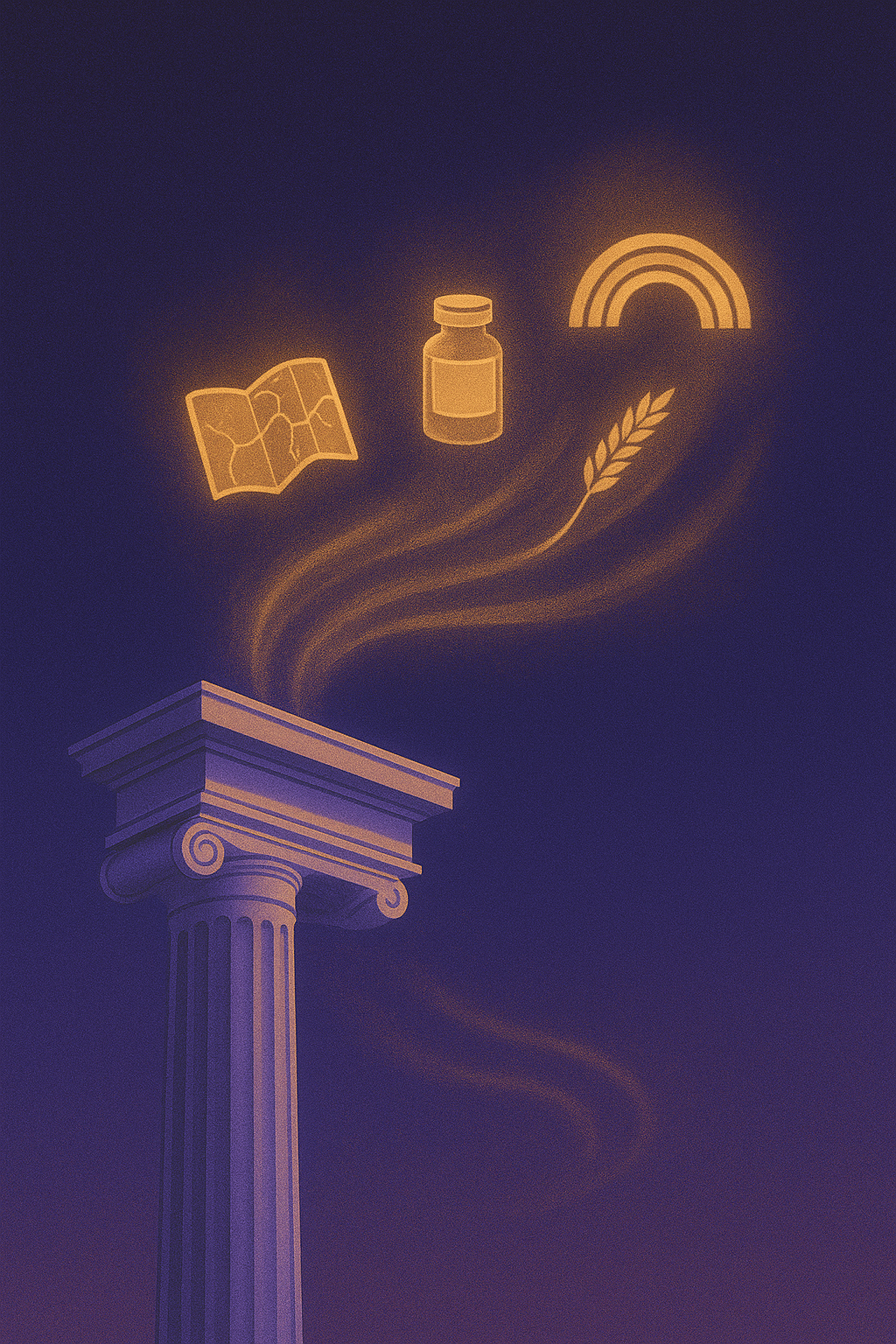
When we open an atlas today—a collection of maps bound together—we’re metaphorically accessing a book that “holds up the world” in cartographic form. The connection runs deeper than mere metaphor; early map collections often featured images of Atlas bearing his cosmic burden on their covers, making the mythological connection explicit. The Titan’s eternal task of supporting the heavens transformed into our modern understanding of comprehensive geographical knowledge, contained and accessible within the pages of a book.
Heroic Endeavors: The Herculean Standard
Few mythological figures have given their name to human effort quite like Heracles (known to Romans as Hercules). The adjective “herculean” doesn’t simply mean difficult—it evokes the specific nature of challenges that require supernatural strength, endurance, and determination.
Heracles’ defining narrative involves the Twelve Labors, seemingly impossible tasks assigned as penance for a crime committed in a fit of divine madness. These labors included slaying the invincible Nemean Lion, capturing the many-headed Hydra, and cleaning the vast Augean stables in a single day. Each task required not just brute strength but cleverness, persistence, and the willingness to face seemingly insurmountable odds.
When we describe a task as herculean today, we invoke this entire tradition of heroic struggle against impossible circumstances. The word carries the weight of mythological precedent—the understanding that some challenges require not just effort, but the kind of extraordinary commitment that borders on the superhuman.
Reflections of the Self: Narcissus and the Psychology of Self-Love
The story of Narcissus explores one of humanity’s most persistent psychological patterns through a tale both beautiful and tragic. This youth of extraordinary beauty caught the attention of the nymph Echo, but he rejected her love with cruel indifference. As divine punishment for his callousness, Narcissus was condemned to fall in love with his own reflection in a pool of water.
Unable to embrace or possess the object of his desire—himself—Narcissus wasted away, staring at his reflection until death. From his remains grew the flower that bears his name. The myth serves as a cautionary tale about the dangers of excessive self-regard and the isolation that comes from being unable to love anyone but oneself.
Modern psychology adopted “narcissism” to describe a personality pattern characterized by grandiose self-regard, lack of empathy, and an excessive need for admiration. The clinical term carries the mythological story within it—the idea that extreme self-focus ultimately becomes self-destructive, leading to an inability to form genuine connections with others.
Eternal Frustration: Tantalus and the Art of Teasing
Perhaps no mythological punishment captures the nature of cruel teasing quite like that of Tantalus. This king had committed the ultimate transgression against the gods—he served his own son as food to test their omniscience. His eternal punishment matched the horror of his crime: condemned to stand in a pool of water beneath a fruit tree, with both food and drink forever receding when he tried to reach them.
The verb “tantalize” perfectly captures this mythological scenario. When we tantalize someone, we offer them something desirable while keeping it perpetually just out of reach. The word contains within it the entire narrative of Tantalus—the proximity to satisfaction, the constant hope, and the inevitable disappointment.
This myth speaks to a fundamental human experience: the psychology of desire and frustration. Tantalus became the archetype for anyone caught in a cycle of wanting what they cannot have, making his name synonymous with a particular kind of psychological torment.
Divine Terror: Pan and the Origins of Sudden Fear
In the wild places of ancient Greece, shepherds and travelers knew to fear the sudden, overwhelming terror that could strike without warning. This inexplicable fright was attributed to Pan, the half-goat god of the wilderness, whose very presence could inspire uncontrollable fear in both humans and animals.
Pan’s dominion over wild, untamed nature made him a figure of primal power. His sudden appearance or cry could send entire armies fleeing in what became known as “panic”—a fear so complete and irrational that it overrode all rational thought and military discipline. The god embodied the kind of terror that emerges from the unknown, the wild, and the uncontrollable aspects of existence.
Modern usage of “panic” retains this sense of sudden, overwhelming fear that seems to come from nowhere and defies rational control. Whether describing a panic attack, market panic, or crowd panic, the word invokes that same sense of primal terror that ancient Greeks attributed to their wild god.
Divine Inspiration: Muses and the Mosaic of Arts
The nine Muses represented the divine source of all artistic and intellectual inspiration in Greek thought. These daughters of Zeus presided over epic poetry, history, music, tragedy, comedy, and other creative endeavors. To be visited by a Muse was to receive divine inspiration that elevated human creativity to celestial heights.
The word “mosaic” originally referred to any work of art inspired by the Muses—”belonging to the Muses.” Over time, the term became specifically associated with the intricate art form of creating images from small, colored pieces of stone, glass, or tile. This evolution reflects how divine inspiration was understood to work: taking small, individual elements and combining them into a greater, more beautiful whole.
The connection between the Muses and mosaic art runs deeper than etymology. Just as a mosaic requires patience, vision, and the careful arrangement of countless small pieces to create a unified image, artistic inspiration was seen as the divine gift of seeing how disparate elements could be woven together into something transcendent.
Echoes of Lost Love: The Nymph’s Eternal Repetition
The story of Echo intertwines with that of Narcissus in a tale of unrequited love and divine punishment. Echo was a nymph who suffered under Hera’s curse for distracting the goddess with chatter while Zeus pursued other lovers. Her punishment was severe: she could only repeat the last words spoken by others, never again able to initiate conversation or express her own thoughts.
When Echo fell in love with Narcissus, her curse became a source of profound tragedy. She could only repeat his words back to him, unable to declare her love or engage in genuine dialogue. After Narcissus rejected her, Echo retreated to caves and mountains, wasting away until only her voice remained, doomed to repeat the words of others for eternity.
The modern word “echo” carries this mythological weight—it’s not just about sound reflection, but about the tragedy of being unable to speak with one’s own voice. Every echo we hear contains within it Echo’s story of lost agency and unrequited love.
Dreams and Healing: Morpheus and Medical Relief
Morpheus, son of the god of sleep, ruled over the realm of dreams. His particular domain was the human form—he could appear in dreams as any person, delivering messages from the gods or simply providing the gift of peaceful sleep. His name comes from the Greek word for “form” or “shape,” reflecting his ability to take any appearance.
When scientists isolated the powerful pain-relieving alkaloid from opium poppies, they named it “morphine” after this dream god. The connection was precise: morphine induces a sleep-like state that provides escape from pain, much as Morpheus provided escape from the waking world through dreams. The drug’s ability to transport users into a dreamlike state of relief and oblivion perfectly matched the mythological function of its namesake.
This naming represents more than medical terminology—it acknowledges the ancient understanding that healing often requires a temporary departure from ordinary consciousness, a journey into an altered state where pain and suffering can be left behind.
Agricultural Abundance: Ceres and the Gifts of the Harvest
Demeter, known to the Romans as Ceres, governed the fundamental processes of agriculture and the harvest. Her mythology centers on the cycle of seasons, created through her grief over her daughter Persephone’s abduction to the underworld. When Persephone was taken, Demeter’s sorrow caused the earth to become barren; when her daughter returned for part of each year, the earth bloomed again.
The word “cereal” derives from Ceres and originally referred to any edible grain. The connection between the goddess and our breakfast foods runs deeper than etymology—it acknowledges the divine nature of agriculture and the miracle of seeds transforming into nourishment. Every bowl of cereal connects us to humanity’s ancient understanding that the ability to grow food was a sacred gift requiring divine blessing.
Demeter’s story also emphasizes the cyclical nature of abundance and scarcity, growth and dormancy—patterns that remain central to agricultural life and, by extension, to human survival itself.
Divine Messages: Iris and the Bridge Between Worlds
Iris served as the divine messenger, creating rainbows as bridges between the realm of the gods and the mortal world. Her ability to traverse these realms made her the perfect intermediary, carrying messages from Zeus and the other Olympians to humans below.
The flower we call “iris” bears her name because of its spectacular range of colors, evoking the goddess’s rainbow bridges. In human anatomy, the colored portion of the eye is also called the “iris,” perhaps because the eye serves as our own bridge between inner consciousness and the external world, much as the goddess bridged divine and mortal realms.
Iris represents the ancient understanding that beauty and communication are intimately connected—that divine messages often come not through words but through the spectacular visual language of natural phenomena.
Harsh Justice: Draco and the Weight of Law
Draco was not a mythological figure but a historical Athenian lawmaker whose legacy became legendary for its severity. In the 7th century BCE, he created Athens’ first written code of laws, which prescribed death as the punishment for most offenses, including theft and idleness. When asked why death was the penalty for so many crimes, Draco reportedly replied that small crimes deserved death, and he could think of no greater punishment for more serious ones.
The adjective “draconian” preserves the memory of these harsh laws, describing any rules or measures that seem unreasonably severe. The word serves as a reminder that justice and cruelty can become dangerously intertwined when authority lacks moderation and mercy.
The Fabric of Time: Chronos and Temporal Order
Chronos (sometimes conflated with the Titan Kronos) represented time as a fundamental cosmic force. In Greek thought, time wasn’t merely a measurement but a divine principle that governed all existence. Chronos embodied both the ordered progression of moments and the inevitable changes that time brings to all things.
Words like “chronology,” “chronometer,” and “chronic” all carry his name, reflecting our continued need to understand and organize temporal experience. The mythological background reminds us that time itself was once understood as sacred—not just a neutral backdrop for events, but an active divine force shaping reality.
The Living Legacy of Ancient Stories
These words represent more than linguistic borrowing—they demonstrate how mythological thinking continues to shape our understanding of the world. Each term carries within it an entire narrative tradition, a way of seeing human experience through the lens of divine action and cosmic order.
When we use these words, we participate in storytelling traditions that stretch back thousands of years. We invoke ancient wisdom about human nature, divine justice, and the fundamental forces that shape existence. Greek mythology didn’t simply give us vocabulary; it provided conceptual frameworks that continue to organize our understanding of psychology, justice, beauty, terror, inspiration, and countless other aspects of human experience.
The persistence of these mythological words in modern language suggests something profound about the stories themselves. They captured something essential about human experience—patterns of behavior, psychological truths, and moral insights that remain relevant across cultures and centuries. In every atlas we consult, every herculean effort we undertake, and every moment of panic we experience, we connect with an ancient understanding of what it means to be human in a world shaped by forces both seen and unseen.
These etymological connections remind us that language itself is a form of cultural memory, preserving not just meanings but entire worldviews within the words we use every day. Greek mythology lives on not only in literature and art but in the very structure of our language, ensuring that these ancient stories continue to shape how we understand and describe our world.
Leave a Reply