
The Culmination of Sacred Transformation
In the grand tapestry of Hindu mythology, few narratives capture the essence of spiritual fulfillment as profoundly as the story of Siddhidātrī, the ninth and final form of Navadurga. As devotees approach the culmination of their nine-day journey through Navaratri, they encounter not just another goddess, but the embodiment of ultimate achievement—the divine grantor of all supernatural powers and spiritual perfections.
The very name “Siddhidātrī” carries within it the promise of cosmic completion. “Siddhi” denotes supernatural power or perfection, while “Dātrī” means giver or bestower. Thus, she stands as the “Bestower of Siddhis,” the divine force who transforms aspirations into reality and potential into perfection.
The Primordial Emergence: When Shakti Shaped Creation
To understand Siddhidātrī’s profound significance, we must journey back to the very dawn of creation itself. In the beginning, before form and formlessness found their balance, the supreme consciousness existed as pure, undifferentiated energy—Mahāśakti in her most primordial state.
From this cosmic void of infinite potential, a remarkable transformation occurred. The formless Mahāśakti manifested as Siddhidātrī from the left half of Lord Śiva, creating the iconic form known as Ardhanārīśvara—the half-male, half-female cosmic being that represents the perfect unity of masculine and feminine principles.
This emergence was not merely symbolic but cosmically functional. When Brahmā, Viṣṇu, and Śiva themselves performed intense penances, seeking the power to fulfill their cosmic roles as creator, preserver, and destroyer, it was Siddhidātrī who appeared before them. Her response to their devotion would shape the very fabric of existence.
The Divine Bestowal: Creating Cosmic Order
In a moment that would echo through all of creation, Siddhidātrī made three profound gifts that established the cosmic order:
First, she bestowed upon the trinity their divine consorts—Lakṣmī to Viṣṇu, Sarasvatī to Brahmā, and returned to Śiva as Pārvatī. These weren’t merely partnerships but cosmic collaborations that would enable the gods to fulfill their universal responsibilities.
Second, she generated the eight principal siddhis—supernatural powers that would become the foundation of all magical and spiritual achievement. These powers: Anima (shrinking to minute size), Mahima (expanding infinitely), Garima (becoming infinitely heavy), Laghima (becoming weightless), Prapti (infinite reach), Prākāmya (fulfilling any desire), Iśitva (absolute dominion), and Vaśitva (controlling all beings)—represented the complete mastery over physical and metaphysical reality.
Third, she granted nine treasures and ten auxiliary supernatural powers, completing the cosmic toolkit necessary for maintaining universal balance and creating all life forms, planets, and the fourteen lokas (realms of existence).
The Sacred Iconography: Understanding Divine Symbolism
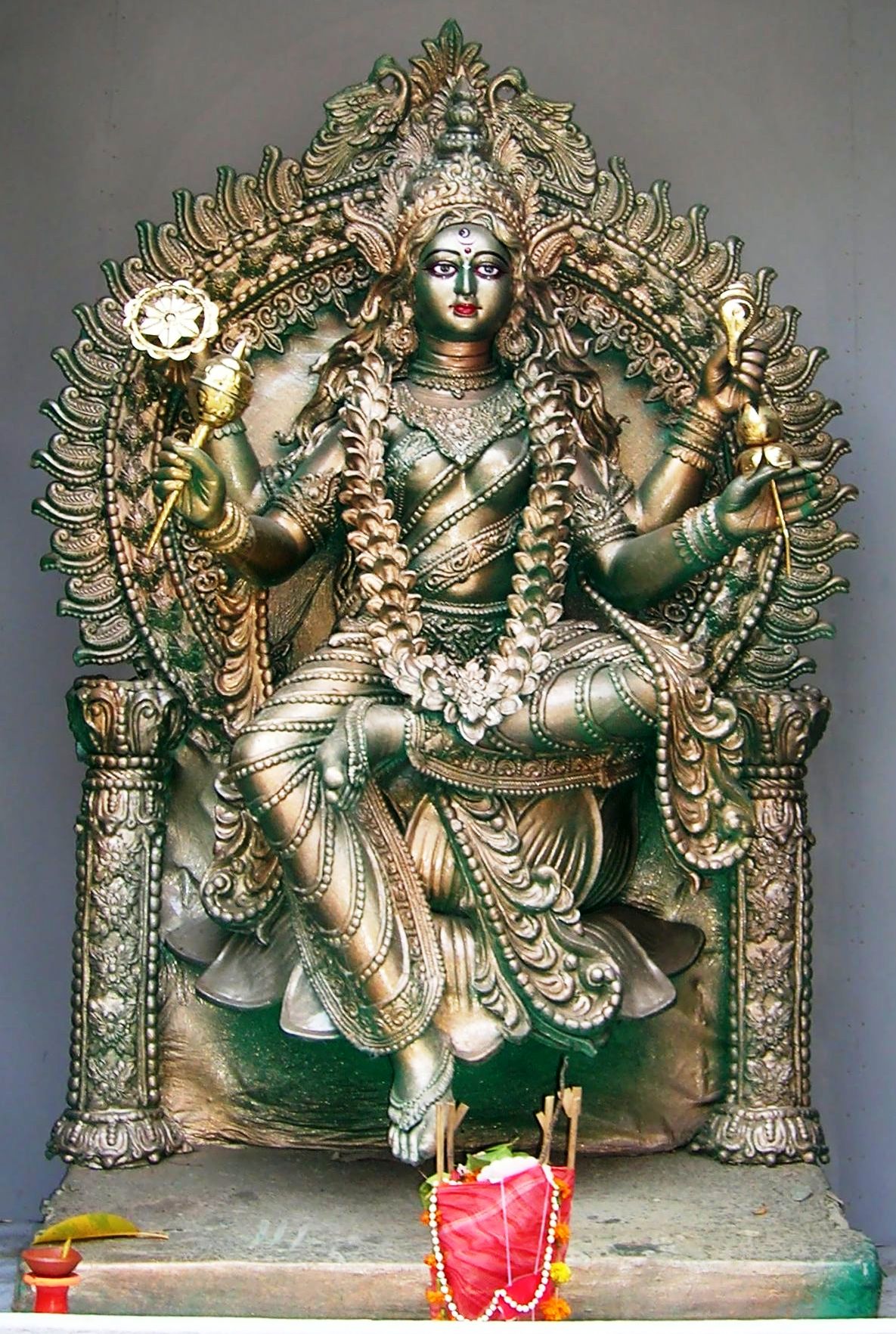
When devotees visualize Siddhidātrī, they encounter a figure of profound symbolic richness. She appears as a four-armed goddess, seated regally upon a fully bloomed lotus—a detail that speaks to the completion of spiritual evolution, as the lotus represents the journey from muddy beginnings to pristine awakening.
Her four arms carry specific implements, each loaded with meaning:
- The chakra (discus) symbolizes the wheel of time and cosmic order
- The śankha (conch shell) represents the primordial sound of creation
- The gada (mace) embodies the power to destroy ignorance
- The lotus signifies purity and spiritual unfoldment
Often, she’s surrounded by Gandharvas, Yakṣas, Siddhas, Asuras, and Devas—celestial beings from across the cosmic spectrum—all paying homage. This gathering represents the universal recognition of her supreme power, transcending the boundaries between different orders of beings.
Clothed in a vibrant red saree with peacock green as her favored color, she embodies both passion and tranquility. The champa flower, her preferred offering, releases a fragrance that’s said to attract divine consciousness, while her governance over the planet Ketu connects her to spiritual liberation and detachment from material illusions.
The Spiritual Journey: From Seeking to Fulfillment
Understanding Siddhidātrī requires recognizing her position as the culmination of the Navadurga journey. While the previous eight forms represent different stages of spiritual struggle, transformation, and growth, Siddhidātrī embodies the arrival—the moment when seeking transforms into finding, when effort transforms into grace.
She governs the Sahasrāra chakra, the crown chakra associated with pure consciousness and unity with the Divine. This is not merely an energetic center but a state of being where individual consciousness merges with cosmic consciousness, where the devotee realizes their fundamental unity with the source of all existence.
In the context of spiritual practice, worshipping Siddhidātrī represents the recognition that ultimate power comes not from personal effort alone, but from divine grace. The siddhis she bestows are not magical tricks but natural expressions of consciousness that has transcended ordinary limitations.
Sacred Worship: The Ninth Day Celebration
The worship of Siddhidātrī on Mahanavami, the ninth day of Navaratri, carries special significance. This is the moment of maximum spiritual intensity, when devotees have completed eight days of purification, devotion, and inner work. The ninth day represents harvest—the gathering of spiritual fruits that have ripened through dedicated practice.
Central to her worship is the beautiful practice of Kanya Pūjā—honoring young girls as living representations of the nine goddess forms. This ritual recognizes the divine feminine as not merely transcendent but immanent, present in the world as pure, unconditioned consciousness.
The key mantras associated with Siddhidātrī create powerful vibrations:
- “Ya Devī Sarvabhūteṣu Mā Siddhidātrī Rupena Saṃsthita” acknowledges her presence in all beings
- “Om Hreem Kleem Aim Siddhye Namah” invokes her power directly
- “Om Devi Siddhidatryai Namah” offers simple, heartfelt surrender
These sacred sounds aren’t merely words but vibrational keys that align the practitioner’s consciousness with the frequency of perfection and fulfillment.
Contemporary Relevance: Ancient Wisdom for Modern Seekers
In our contemporary world, the figure of Siddhidātrī offers profound guidance for modern spiritual seekers. Her message transcends religious boundaries, speaking to the universal human aspiration for growth, achievement, and ultimate fulfillment.
The siddhis she represents—traditionally understood as supernatural powers—can be interpreted as natural human potentials waiting to be unlocked: the ability to think expansively (Mahima), to focus intensely (Anima), to act with authority (Iśitva), and to influence positively (Vaśitva).
Her role as the bestower of completion reminds us that true achievement comes not from accumulating external successes but from internal transformation. In a world often focused on material acquisition, Siddhidātrī points toward the deeper satisfaction that comes from spiritual fulfillment.
The Unity of Opposites: Ardhanārīśvara and Cosmic Balance
Perhaps the most profound teaching of Siddhidātrī lies in her connection to the Ardhanārīśvara form—the perfect unity of Śiva and Śakti, masculine and feminine, consciousness and energy, being and becoming. This isn’t merely a theological concept but a practical guide for living.
In psychological terms, Ardhanārīśvara represents the integration of all aspects of the psyche—rational and intuitive, active and receptive, structured and creative. Siddhidātrī, as the embodiment of this unity, shows us that true power comes not from dominance of one aspect over another, but from their harmonious integration.
Conclusion: The Eternal Bestower
As the Navaratri journey reaches its crescendo with Siddhidātrī, devotees encounter not an ending but a beginning—the beginning of life lived from the place of divine connection and empowered consciousness. She stands as eternal reminder that the ultimate siddhi is not any particular supernatural power, but the recognition of our inherent divine nature.
In temples across India, from the sacred ghats of Varanasi to the mountain shrines of Himachal Pradesh, her image continues to inspire millions. But her true temple resides in the human heart transformed by devotion, where the seeker discovers that they were never separate from the sought, where the journey reveals itself to have been a homecoming.
Siddhidātrī, the bestower of all siddhis, ultimately bestows the greatest siddhi of all: the recognition that we are, and have always been, expressions of the divine consciousness seeking to know itself through countless forms and experiences. In this recognition lies the fulfillment of all seeking, the satisfaction of all longing, and the peace that surpasses understanding.
May the blessings of Mā Siddhidātrī illuminate the path of all seekers, transforming aspiration into realization, effort into grace, and separation into unity.
Leave a Reply