
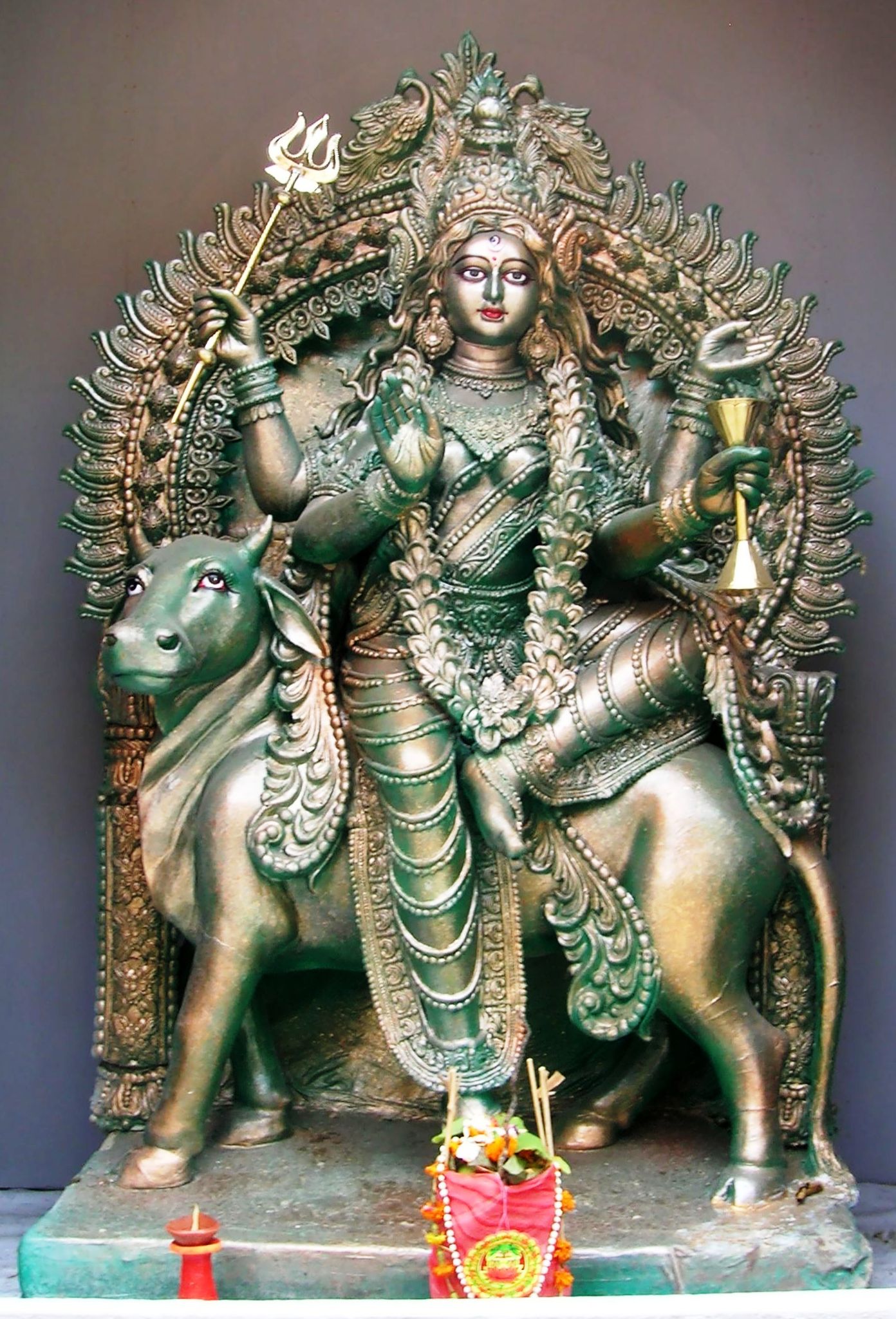
The Eighth Form of Navadurga
In the sacred cycle of Navaratri, when devotees journey through nine nights of divine reverence, the eighth day brings forth one of the most luminous and transformative aspects of the Divine Mother: Mahāgaurī. Her very name whispers of radiance and purity—”Mahā” meaning “great” and “Gaurī” meaning “bright” or “white”—embodying the soul’s ultimate cleansing and the victory of light over darkness.
Unlike the fierce warrior forms that precede her in the Navadurga pantheon, Mahāgaurī represents the serene culmination of spiritual discipline, where the tumultuous journey of the soul finds its peaceful resolution in divine grace.
The Cosmic Dance of Penance and Transformation
The mythological origin of Mahāgaurī reads like a profound allegory of spiritual metamorphosis. Born as Pārvatī, the mountain princess, she was consumed by an all-encompassing devotion to Lord Śiva. Her love was not merely romantic—it was the soul’s yearning for union with the cosmic consciousness.
Driven by this divine longing, Pārvatī embarked upon austere tapasya, a penance so rigorous that it defied the very foundations of comfort and worldly attachment. For countless years, she meditated in the wilderness, her fair skin gradually darkened by the earth’s dust and the elements’ harsh touch. This physical transformation mirrored a deeper spiritual process—the ego’s dissolution through disciplined practice.
The pivotal moment arrived when Lord Śiva, moved by her unwavering devotion, decided to cleanse her of all earthly impurities. From his matted locks, he poured the sacred waters of the Ganges, washing away not just the physical grime but the very karmic residue that binds souls to suffering. In that divine ablution, Pārvatī emerged as Mahāgaurī—radiant with a moon-like luminosity that symbolized the soul’s return to its pristine nature.
This transformation represents more than mythological narrative; it embodies the universal principle that sincere spiritual practice, however arduous, ultimately leads to purification and enlightenment.
The Sacred Iconography: Symbols of Divine Grace
Mahāgaurī’s visual representation is a masterpiece of symbolic communication, where every element speaks to deeper spiritual truths:
The All-White Manifestation: Her entirely white appearance—complexion, attire, and ornaments—transcends mere aesthetic choice. White, in Hindu cosmology, represents the synthesis of all colors, the ultimate unity where all dualities dissolve. It signifies innocence regained, not through ignorance but through wisdom.
The White Bull (Vṛṣabha): Her sacred vehicle carries profound symbolism. The bull represents dharma—righteous duty and steadfast devotion. Unlike the dynamic steeds of other divine forms, the bull’s steady, grounded nature suggests that true spiritual progress comes through consistent, patient practice rather than dramatic spiritual experiences.
The Four-Armed Configuration: Her four hands hold specific implements, each representing different aspects of divine intervention:
- The trident (trishula) embodies the cosmic balance and the power to destroy the three fundamental afflictions: ignorance, attachment, and aversion
- The drum (damaru) represents the primordial sound of creation, the divine vibration from which all existence emerges
- The Abhaya mudrā (gesture of fearlessness) offers protection to devotees, dissolving anxiety and spiritual obstacles
- The Varada mudrā (boon-granting gesture) represents the divine grace that fulfills sincere aspirations
The Spiritual Architecture of Purification
Mahāgaurī’s essence encompasses several profound spiritual principles that guide seekers on their inner journey:
Victory of Light over Darkness: Her luminous form represents the soul’s capacity to transcend ignorance, sin, and suffering through dedicated spiritual practice. This isn’t merely moral purification but a fundamental transformation of consciousness.
Grace through Devotion: Her mythology demonstrates that unwavering faith and devotion possess transformative power. The external penance becomes a catalyst for internal grace, showing that spiritual effort attracts divine intervention.
Cultivation of Virtue: Her peaceful demeanor encourages the development of sattvic qualities—compassion, steadfastness, and moral uprightment—that naturally arise in purified consciousness.
The Sacred Rhythms of Mahāṣṭamī Worship
The eighth day of Navaratri, Mahāṣṭamī, unfolds as a carefully orchestrated spiritual ceremony that recreates the mythological transformation in the devotee’s consciousness:
Purification Rituals (Snāna): The worship begins with the ceremonial bathing of the goddess’s image with Ganga water or pure water, directly echoing her legendary cleansing. This ritual purification serves as both remembrance and invocation—devotees participate in the same divine grace that transformed Pārvatī.
The White Offerings: Devotees present white flowers, white clothes, and white sweets like kheer, creating a visual and energetic field of purity. These offerings aren’t mere formalities but conscious alignments with the goddess’s essence of purification.
Sacred Feast Offerings: Special prasāda including coconut and black gram carries auspicious significance, representing the nourishing aspect of divine grace that sustains spiritual seekers through their transformative journey.
The Ritual Sequence:
- Sankalpa (Sacred Vow): The conscious declaration of intent transforms routine worship into sacred commitment
- Dhyāna (Meditation): Visualization of the goddess seated on her white bull cultivates inner stillness and receptivity
- Japa (Mantra Repetition): The primary mantra “Om Devī Mahāgauryai Namaḥ” creates vibrational alignment with her purifying energy
- Kanyā Pūjā: Honoring nine young girls as living embodiments of the divine feminine recognizes the goddess’s presence in all creation
- Aarti & Bhajans: Devotional songs and lamp ceremonies create collective spiritual resonance
The Transformative Mantras
The sacred sounds associated with Mahāgaurī serve as vibrational keys to her consciousness:
“Om Devī Mahāgauryai Namaḥ” – This primary mantra creates direct connection with her purifying essence.
“Śvete Vṛṣheṣamāruḍha Śvetāmbaradharā Śuciḥ” – This elaborate Sanskrit invocation celebrates her fair form and creates detailed visualization for deeper meditation.
These mantras function as more than prayers; they are sonic formulas that gradually align the practitioner’s consciousness with the divine frequency of purification.
The Living Blessings of Divine Grace
Sincere devotion to Mahāgaurī is believed to confer specific spiritual benefits that address fundamental human challenges:
Removal of Obstacles and Fear: Through her Abhaya mudrā, she dissolves both external impediments and internal anxieties that prevent spiritual progress.
Purification of Mind and Soul: Her grace washes away karmic impurities accumulated through countless lifetimes, offering fresh spiritual possibility.
Inner Peace and Clarity: Devotees report experiencing enhanced tranquility and mental clarity, essential foundations for righteous living and spiritual advancement.
The Contemporary Relevance of Ancient Wisdom
In our modern world, characterized by psychological fragmentation and spiritual uncertainty, Mahāgaurī’s message resonates with particular urgency. Her mythology suggests that no matter how far we’ve strayed from our essential purity, sincere effort combined with divine grace can restore our luminous nature.
Her iconography offers practical guidance: the steady bull reminds us that spiritual progress requires patient consistency rather than dramatic gestures; her white radiance suggests that purity emerges not through rejection of the world but through transformed engagement with it.
The temples dedicated to Mahāgaurī, such as the renowned Mahāgaurī Mandir in Varanasi, continue to serve as focal points where this ancient wisdom encounters contemporary seekers. During Mahāṣṭamī celebrations across India, communities gather in grand processions and elaborate pujas, creating collective fields of spiritual aspiration that transcend individual limitations.
The Eternal Return to Radiance
On Navaratri’s eighth day, Mahāgaurī’s worship offers more than religious observance—it provides a pathway to spiritual purification, fearlessness, and inner tranquility. Her luminous presence guides seekers toward recognition of their own essential nature, which, like hers, is eternally pure and radiant beneath all surface modifications.
In embracing Mahāgaurī’s grace, devotees participate in the cosmic principle of transformation, discovering that the same divine power that cleansed Pārvatī continues to operate in every sincere heart, ready to wash away all that obscures our inherent divinity. Her story reminds us that spiritual transformation, while requiring our sincere effort, ultimately depends on the mysterious grace that transforms seekers into the very light they seek.
Leave a Reply