
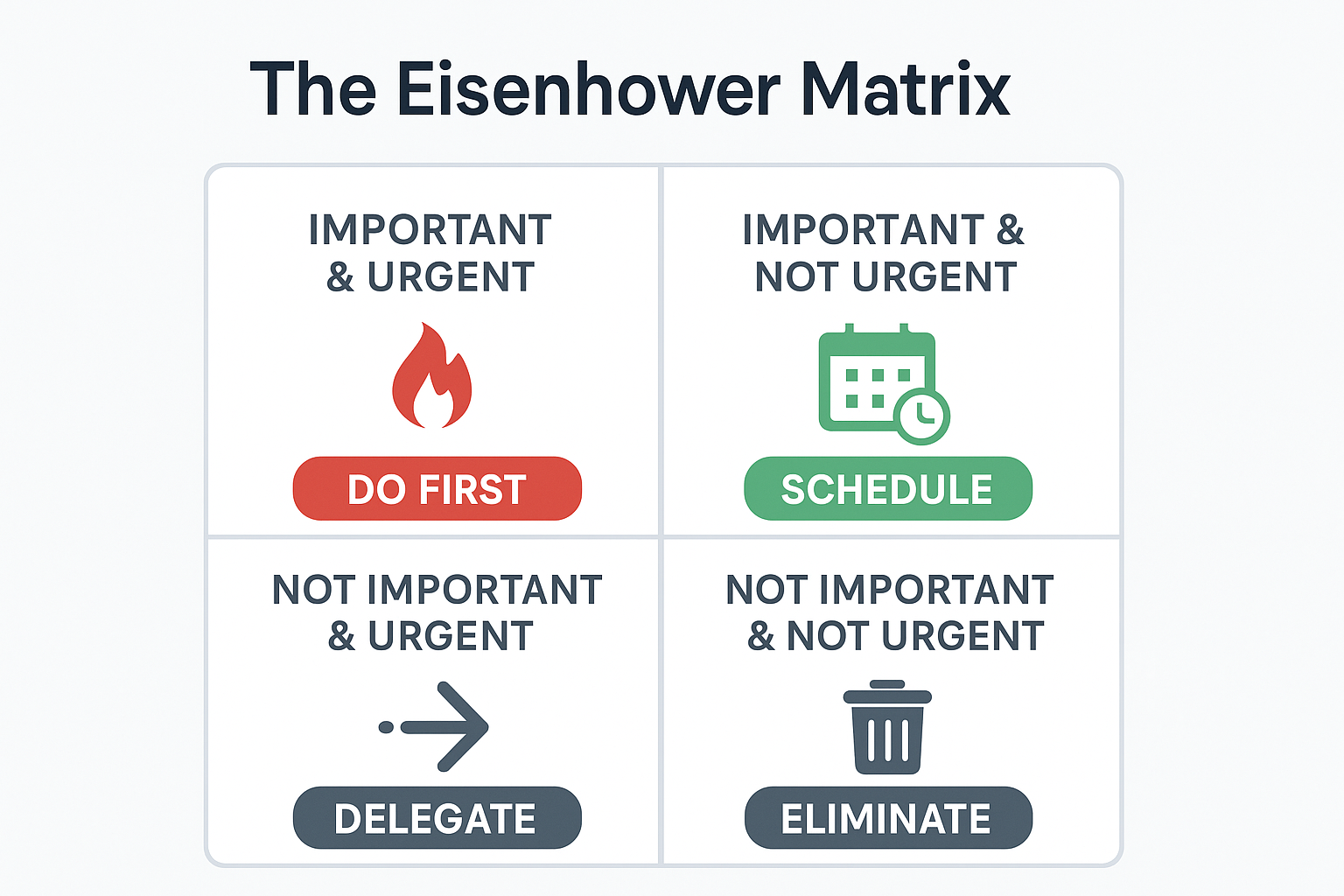
The Eisenhower Matrix stands as one of the most enduring and effective frameworks for task prioritization and time management in both personal and professional contexts. Named after President Dwight D. Eisenhower, who developed this approach while managing the complex demands of military leadership and presidential responsibilities, this tool provides a systematic method for distinguishing between what feels urgent and what truly drives long-term success.
This framework gained widespread adoption through Stephen Covey’s influential work “The 7 Habits of Highly Effective People,” where it became central to the principle of “putting first things first.” The matrix’s enduring popularity stems from its ability to transform how individuals and organizations approach decision-making and resource allocation.
Understanding the Core Distinction: Urgent Versus Important
The fundamental strength of the Eisenhower Matrix lies in its clear differentiation between urgent and important tasks, a distinction that forms the foundation of effective priority management.
Urgent tasks demand immediate attention and typically arrive with clear deadlines or immediate consequences. These tasks often generate stress and push individuals into reactive mode, as they respond to external pressures and other people’s priorities. Common examples include answering urgent communications, addressing client emergencies, or managing crises that require immediate intervention.
Important tasks, conversely, contribute significantly to long-term objectives, strategic goals, and sustainable success. These activities may lack pressing deadlines but possess substantial impact on future outcomes and overall effectiveness. Examples include strategic planning, skill development, relationship building, and preventive activities that reduce future problems.
The critical insight underlying this framework is that urgency and importance represent distinct dimensions of priority. Many professionals fall into what researchers call the “urgency trap,” spending disproportionate time on tasks that feel pressing but fail to advance meaningful progress toward strategic objectives.
The Four-Quadrant Framework
The Eisenhower Matrix organizes all tasks into four distinct categories based on their levels of urgency and importance, creating a comprehensive system for priority management.
Quadrant 1: Execute Immediately (Important and Urgent)
This quadrant contains crisis tasks that demand immediate attention and carry significant consequences if delayed. While these tasks require prompt handling, excessive time spent in this quadrant typically indicates inadequate planning and can lead to sustained stress and reactive management.
Representative activities include medical emergencies, critical project deadlines, major client issues requiring immediate resolution, and genuine crises that threaten important outcomes. The strategic approach involves completing these tasks immediately while working systematically to reduce their frequency through improved planning and prevention.
Quadrant 2: Schedule and Plan (Important but Not Urgent)
This quadrant represents the cornerstone of effective priority management, often referred to as the “quadrant of quality.” Research demonstrates that highly effective individuals and organizations invest the majority of their productive time in these activities, which create the foundation for long-term success and reduced crisis management.
Key activities include strategic planning and goal setting, professional development and skill building, relationship cultivation and networking, health and wellness maintenance, and system improvements that prevent future problems. The strategic approach requires scheduling dedicated time for these activities and protecting this investment from competing demands.
Quadrant 3: Delegate or Minimize (Urgent but Not Important)
Tasks in this quadrant appear urgent but contribute minimally to strategic objectives or personal growth. These activities often represent other parties’ priorities presented as emergencies, requiring careful evaluation to avoid misallocated time and energy.
Common examples include non-critical communications marked as urgent, meetings without clear agendas or outcomes, interruptions from colleagues on non-essential matters, and administrative tasks that could be handled by others. The strategic approach involves delegation when possible, automation where appropriate, and efficient handling when these tasks cannot be eliminated.
Quadrant 4: Eliminate (Neither Important nor Urgent)
This quadrant contains activities that provide minimal value toward strategic objectives and represent potential time drains. While some relaxation and downtime serve important functions, excessive time in this quadrant typically indicates procrastination or lack of clear priorities.
Activities include excessive social media consumption, mindless entertainment, unnecessary web browsing, and unproductive social interactions. The strategic approach focuses on elimination or significant reduction of these activities while maintaining appropriate balance for genuine rest and recreation.
Implementation Framework and Best Practices
Effective implementation of the Eisenhower Matrix requires systematic approach and consistent application across time management practices.
The initial implementation begins with comprehensive task identification, cataloging all responsibilities and commitments across personal and professional domains. Each task requires evaluation and categorization based on its urgency and importance relative to established goals and priorities. Within each quadrant, tasks should be prioritized to determine execution order and resource allocation.
The action planning phase involves developing specific strategies for each quadrant: immediate execution for Quadrant 1 tasks, scheduled time blocks for Quadrant 2 activities, delegation or streamlining for Quadrant 3 items, and elimination strategies for Quadrant 4 activities.
Advanced implementation techniques include time blocking for Quadrant 2 activities, treating them as non-negotiable appointments that create long-term value. Integration with the Pareto Principle helps identify which twenty percent of important tasks will generate eighty percent of desired outcomes. Weekly and daily planning cycles ensure consistent application and regular adjustment based on changing priorities and circumstances.
Common Implementation Challenges and Solutions
Several predictable mistakes can undermine the effectiveness of the Eisenhower Matrix if not properly addressed.
The confusion between urgency and importance represents the most frequent error, driven by what researchers term the “mere urgency effect.” This cognitive bias causes individuals to prioritize tasks simply because they feel pressing, regardless of their actual importance. The solution requires disciplined evaluation of each task’s genuine consequences and contribution to strategic objectives.
Over-prioritization of Quadrant 3 activities occurs when individuals consistently respond to other parties’ urgent requests without evaluating their importance to personal or organizational goals. Addressing this challenge requires developing assertiveness skills and boundary-setting capabilities to protect time for truly important work.
Neglecting Quadrant 2 activities represents perhaps the most damaging long-term error, as these activities create the foundation for sustained success and crisis prevention. The solution involves scheduling these activities first and treating them as protected time investments rather than optional activities to be completed when convenient.
The tendency to classify everything as important undermines the matrix’s effectiveness by failing to establish clear priorities. Effective implementation requires limiting daily important tasks to three to five items, recognizing that if everything is important, nothing truly is.
Strategic Benefits and Organizational Impact
Mastery of the Eisenhower Matrix delivers substantial benefits across multiple dimensions of performance and effectiveness.
Productivity improvements result from focusing effort on high-impact activities rather than simply maintaining busy schedules. The framework helps distinguish between being productive through efficient task completion and being effective through strategic task selection.
Stress reduction occurs through clear prioritization criteria that reduce decision fatigue and the anxiety associated with competing demands. Having a systematic approach to priority management creates confidence in decision-making and reduces the overwhelm that comes from unclear priorities.
Long-term goal achievement benefits from consistent attention to Quadrant 2 activities, ensuring regular progress toward strategic objectives rather than perpetual postponement of important but non-urgent work.
Enhanced decision-making capabilities develop through regular application of clear criteria for time and energy allocation. This systematic approach improves both the speed and quality of daily decisions about resource allocation and activity prioritization.
Integration with Contemporary Productivity Systems
The Eisenhower Matrix complements and enhances numerous modern productivity approaches and organizational methodologies.
Integration with Getting Things Done methodology occurs during weekly reviews, where the matrix provides prioritization criteria for action lists and project planning. Time blocking systems benefit from matrix-based scheduling, ensuring that time allocation reflects strategic priorities rather than reactive responses to daily demands.
Project management applications include backlog prioritization, sprint planning, and resource allocation decisions. The matrix provides objective criteria for determining which features, tasks, or initiatives deserve immediate attention versus strategic scheduling.
Objectives and Key Results frameworks align naturally with the matrix, as Quadrant 2 activities typically support key objectives while Quadrant 1 tasks often represent urgent responses to lagging indicators that key results are not being achieved.
Technological Tools and Implementation Support
Modern digital tools provide sophisticated support for implementing and maintaining Eisenhower Matrix-based priority management systems.
Dedicated applications offer built-in matrix templates with automation capabilities for task categorization and scheduling. Popular project management platforms include matrix-based views and filtering capabilities that align with the four-quadrant framework.
Collaborative tools enable team-based implementation, allowing groups to collectively prioritize initiatives and align on strategic importance versus tactical urgency. Template resources provide starting points for both individual and organizational implementation.
Cloud-based solutions ensure consistency across devices and enable real-time updates as priorities shift and new information becomes available.
Organizational and Team Applications
The Eisenhower Matrix provides valuable frameworks for collective decision-making and strategic alignment within teams and organizations.
Team collaboration benefits from shared understanding of priority criteria, ensuring that group efforts focus on collectively important activities rather than individual urgencies. Leadership decision-making improves through systematic evaluation of strategic initiatives, resource allocation decisions, and development priorities.
Project portfolio management applications help organizations balance immediate operational needs with strategic investments in future capabilities and growth opportunities.
Conclusion
The Eisenhower Matrix represents a fundamental shift from reactive task management to strategic priority management. Its enduring value lies not in its simplicity, but in its ability to consistently direct attention and resources toward activities that create sustainable value and long-term success.
Successful implementation requires discipline to consistently apply the framework’s criteria, courage to say no to urgent but unimportant demands, and wisdom to invest time in important activities that lack immediate deadlines. When properly applied, the matrix transforms both individual effectiveness and organizational performance by ensuring that daily actions align with strategic objectives.
The framework’s greatest contribution may be its role in developing what could be termed “strategic thinking habits” that extend far beyond task management. By consistently choosing importance over urgency, individuals and organizations move from crisis management toward intentional design of their time, energy, and attention. This transformation ultimately leads to both enhanced productivity and greater satisfaction with how precious resources are invested in pursuit of meaningful objectives.
Leave a Reply