
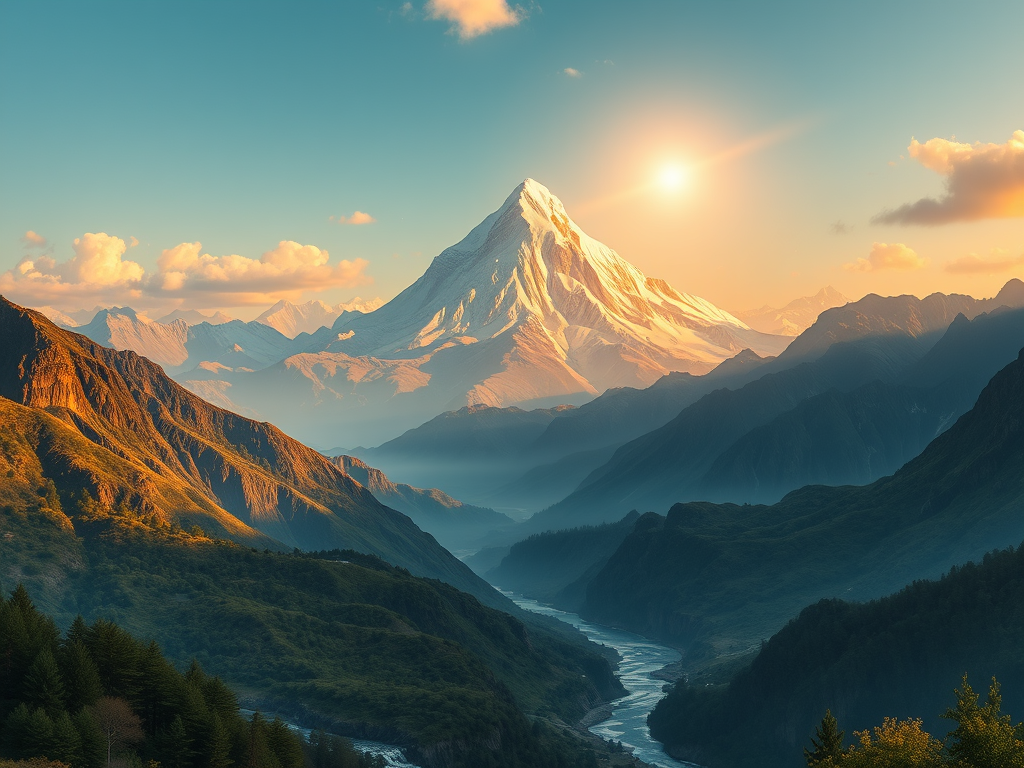
Stand at the base of any great mountain, and you’ll feel it—that ineffable presence, the sense that you’re in the company of something ancient and powerful. This intuition, shared across millennia and continents, reveals a profound truth embedded in human spirituality: mountains are not merely geological formations, but living, conscious beings invested with divine power and sacred purpose.
Across the globe, from the snow-capped peaks of the Himalayas to the volcanic heights of Hawaii, humanity has recognized mountains as far more than stone and earth. They are the dwelling places of gods, the pillars upholding heaven, the ancestors watching over their descendants, and the bridges connecting mortal and divine realms. These towering presences demand reverence, respond to human behavior, and shape the spiritual landscapes of entire civilizations.
The Universal Principle: Why Mountains Become Sacred
Before exploring specific traditions, we must understand why mountains hold such universal spiritual significance. The answer lies partly in their physical nature—they reach skyward, piercing clouds and touching the realm of the gods. This vertical dimension makes them natural symbols of transcendence, cosmic axes connecting the underworld, earth, and heavens.
Mountains serve multiple sacred functions across cultures: they are cosmic centers around which universes revolve, residences where deities dwell beyond mortal reach, places of oracle and revelation where humans encounter the divine, and pilgrimage destinations where spiritual transformation occurs. In creation myths worldwide, mountains frequently represent the first land to emerge from primeval waters, establishing them as primordial witnesses to existence itself.
But mountains are more than symbols—they are participants in cosmic drama. They possess agency, consciousness, and power. They can heal or harm, bless or curse, protect or punish. This understanding transforms our relationship with these geological giants from passive observation to active engagement, where offerings must be made, respect must be shown, and sacred laws must be observed.
The Cosmic Mountains of Hindu and Buddhist Traditions
Mount Meru: The Axis of All Existence
In the cosmological imagination of Hindu, Jain, and Buddhist traditions, one mountain reigns supreme: Mount Meru, the golden peak that serves as the axis of all physical, metaphysical, and spiritual universes. This is no ordinary mountain—it exists as the cosmic pillar upholding the sky, the central point around which sun, moon, and stars revolve, and the meeting place of gods and celestial beings.
According to Hindu texts, Meru gleams like gold under sunlight, its five peaks crowned with palaces of the gods. The Himalayas themselves form merely the foothills of this cosmic giant. Sacred woods carpet its slopes, while healing herbs grow in abundance. Rivers cascade from its heights, and lakes dot its landscape—each element contributing to the mountain’s role as the source of all spiritual and material sustenance.
The Mahabharata presents Meru as a pathway to heaven itself, though only those free from sin can reach its summit. In the epic’s final journey, only the righteous Yudhishthira successfully ascends to Meru’s peak, his brothers falling away due to their individual flaws and attachments. This narrative transforms the mountain into a test of spiritual worthiness, where the climb itself becomes a metaphor for the soul’s journey toward liberation.
Hindu temple architecture embodies this cosmic mountain theology. The tower-like structures of temples, called shikhara or vimana, physically represent Mount Meru, making each temple a microcosm of the universe with the sacred mountain at its center. Worshippers entering these temples symbolically approach the cosmic axis itself.
Mount Kailash: Where Four Faiths Converge
While Meru exists in mythological geography, Mount Kailash rises physically from Tibet’s Trans-Himalayan range—yet it functions no less powerfully as a sacred being. This remarkable peak holds the distinction of being venerated across four major religious traditions: Hinduism, Buddhism, Jainism, and Bon.
For Hindus, Kailash is the eternal abode of Shiva and his consort Parvati, where the great god sits in perpetual meditation. Buddhists identify Kailash with Mount Meru itself and recognize it as the home of Samvara, a guardian deity whose presence imbues the mountain with supernatural powers capable of cleansing a lifetime of accumulated sins. Jains revere Kailash as the site where Rishabhadeva, the founder of their faith, achieved enlightenment. Followers of Bon Po, Tibet’s indigenous religion, believe the mountain houses Sipaimen, a powerful wind goddess.
The mountain’s perfect pyramid shape and the way its faces align with the cardinal directions have only deepened its mystical reputation. Pilgrims from across Asia undertake arduous journeys to circumambulate Kailash’s base—a ritual walk called kora that can take days to complete. The mountain remains unclimbed, protected not by technical difficulty but by sacred prohibition. To set foot on Kailash’s slopes would be to violate the sanctity of a living divine being.
Greek Sacred Geography: Olympus and the Divine Council
While Eastern traditions conceived mountains as cosmic centers, Greek mythology approached sacred mountainology differently. Mount Olympus, rising above the plains of northern Greece, served as the mythological home and political meeting place of the twelve Olympian gods, led by Zeus, the king of heaven.
The ancient Greeks maintained a fascinating duality regarding Olympus. On one hand, they recognized it as an actual mountain visible from much of Greece. On the other, they understood it as a metaphysical realm where gods dwelt in golden palaces above the clouds, removed from mortal affairs yet intimately involved in human destiny. This ambiguity between physical and spiritual reflects a worldview where the boundary between matter and divinity remained permeable.
Zeus occupied his throne on Stefani, the mountain’s second-highest peak, from which he surveyed humanity and hurled thunderbolts at those who provoked his wrath. The perpetual clouds enveloping Olympus’s heights symbolized this connection between earth and sky, creating a liminal space where divine and mortal realms intersected. Ancient Greeks believed that looking directly upon Olympus’s true form—piercing the cloud veil to see the mountain as the gods saw it—would result in fatal punishment. The mountain’s reality existed beyond mortal perception.
Olympus served as a unifying symbol for the fragmented Greek world. Though Greeks lived in independent, often warring city-states, they shared this conception of divine geography. The mountain represented not just where gods lived, but how cosmic order manifested—a hierarchy with Zeus at the summit, literally and figuratively above other deities, just as the mountain peak rose above surrounding landscape.
East Asian Sacred Peaks: Mountains as Living Deities
Mount Fuji: The Goddess’s Protection
Japan’s iconic Mount Fuji embodies sacred mountain spirituality through Shinto belief, where kami (spirits) inhabit natural features. But Fuji is more than inhabited—it is a divine being, with the goddess Konohanasakuya-hime (also known as Sengen-sama) serving as the mountain’s soul and protector.
According to myth, this goddess chose Fuji as her dwelling place, and her presence prevents the volcano’s destructive eruption. As long as proper respect and offerings are maintained, Konohanasakuya-hime contains the mountain’s fiery heart. This relationship establishes a direct link between human behavior and natural phenomena—the mountain responds to reverence or disrespect through calm or catastrophe.
For over a thousand years, pilgrims have ascended Fuji’s slopes as a spiritual discipline. The climb represents a journey toward purification and enlightenment, with the volcanic crater at the summit—known as the “Eight Sacred Peaks”—serving as the ultimate sacred site. In Buddhist interpretation, Fuji represents a portal connecting heaven and earth, where the boundaries between realms thin and spiritual transformation becomes possible.
The mountain’s perfect conical form has made it a symbol of Japanese identity, appearing in countless artworks and serving as a visual shorthand for the nation itself. Yet this aesthetic appreciation never overshadows Fuji’s fundamental nature as a conscious, protective being deserving of reverence.
China’s Five Sacred Mountains: Born from the Creator’s Body
Chinese mythological tradition presents perhaps the most literal conception of mountains as living beings. The Five Great Mountains—Mount Tai (east), Mount Hua (west), Mount Heng in Hunan (south), Mount Heng in Shanxi (north), and Mount Song (center)—originated from the cosmic body of Pangu, the first being and creator of the world.
According to this creation narrative, after Pangu separated heaven from earth through his growth and ultimate death, his body transformed into the world’s fundamental features. His head became Mount Tai, his right arm Mount Heng in Hunan, his left arm Mount Heng in Shanxi, his belly Mount Song, and his feet Mount Hua. These mountains are not merely associated with the creator—they are the creator, his divine essence crystallized into eternal stone.
Mount Tai holds supreme status among these sacred peaks due to its formation from Pangu’s head. Associated with birth, renewal, and the rising sun because of its eastern location, Mount Tai became the site where seventy-two Chinese emperors historically climbed to offer sacrifices to Heaven and Earth. These imperial rituals weren’t symbolic gestures but necessary cosmic maintenance, ensuring proper relationship between human authority and divine order.
Taoist tradition venerates mountains as channels of communication between heaven and earth and as locations where immortality can be attained through spiritual cultivation. The mountains themselves become teachers, their unchanging presence across centuries offering lessons in endurance and transcendence. Taoist hermits and practitioners traditionally withdraw to mountain sanctuaries, seeking wisdom directly from these ancient beings.
Buddhism in China recognizes the Four Sacred Mountains, each associated with a specific bodhisattva. Mount Wutai (“Five-Platform Mountain”) houses Manjusri, the bodhisattva of wisdom, while other mountains serve as earthly residences for bodhisattvas of compassion, practice, and vows. These attributions transform mountains into active expressions of enlightened qualities, their physical forms manifesting spiritual principles.
Andean Mountain Spirits: The Living Apus
The Andean tradition of Apus—mountain spirits understood as lords and guardians—presents mountains not as dwelling places of separate deities but as conscious, protective beings themselves. In Quechua, the language of the Inca and their descendants, “Apu” translates as “lord” or “god,” reflecting the mountain’s sovereign power over its domain.
Apus govern mountains and possess direct ability to influence human lives. They regulate climate, ensure fertile soil, safeguard natural balance, and mediate between the human world (Kay Pacha) and the divine realm (Hanan Pacha). These are not distant, abstract powers but intimate protectors deeply invested in the wellbeing of communities living within their sight.
Apu Ausangate, towering near Cusco, represents one of the most revered mountain beings, serving as protector of the region and guardian of rivers that bring fertility to the valleys below. Apu Salkantay, known as the “wild mountain,” possesses fiercer energy—trekkers traversing its slopes frequently report feeling the mountain’s powerful, untamed presence directly affecting their journey.
The transformation of a mountain into an Apu reveals the Andean understanding of spiritual continuity. Following the death of a respected paqo (spiritual guide), communities perform the Wasichakuy ceremony, inviting the deceased’s soul to inhabit a specific mountain. There, the ancestor-become-Apu continues guiding and protecting the community, maintaining relationships across the boundary of death. The Incas strategically built fortresses and sacred sites where they perceived powerful Apus—Machu Picchu stands under Apu Salkantay’s protection, while Rainbow Mountain resides within Apu Ausangate’s domain.
Communities maintain relationships with Apus through pagos (offerings) consisting of coca leaves, chicha (fermented corn beverage), and llama fat, left at high-altitude shrines. These aren’t superstitious gestures but relational obligations, part of the reciprocal exchange between humans and mountain beings. Shamans traditionally communicated with Apus through dreams, wind signs, animal omens, and visions—a sacred dialogue that few modern practitioners still maintain.
African Sacred Heights: Kilimanjaro and Divine Dwelling
Mount Kilimanjaro, rising from the East African plains, holds profound spiritual significance for the Chagga people and wider Tanzanian culture as a dwelling place of creator gods and ancestral spirits. The mountain’s snow-capped peak, despite its equatorial location, reinforces its otherworldly nature—how else could ice exist under the African sun except through divine power?
The Chagga believe Ruwa, the creator god, observes the land from Kilimanjaro’s icy heights. His presence transforms the mountain into a cosmic watch-tower, from which divine attention monitors human affairs. Ngai, another divine figure associated with the mountain, controls Kilimanjaro’s weather—dispensing blessings like rain or calamities like storms according to human behavior. The Chagga historically held rituals and sacrificed livestock to maintain favorable relationships with this mountain deity.
Guardian spirits believed to inhabit Kilimanjaro appear in dreams and visions, offering guidance or warnings to those approaching with proper respect. But the mountain responds harshly to disrespect. Littering, loud behavior, or reckless climbing angers these spirits, causing accidents or misfortune. This belief establishes an ethical framework for human-mountain interaction, where proper conduct reflects spiritual understanding.
The Chagga celebrate the mountain’s gifts through seasonal festivals featuring singing, dancing, and storytelling, reinforcing cultural and spiritual bonds with their sacred protector. Throughout East Africa, mountains are believed to be dwelling places of heaven and rain gods, their cloud-wrapped peaks interpreted as signs of divine presence. In Zimbabwe, pilgrimages to mountain sanctuaries represent opportunities to seek direct encounter with deity, the difficult ascent purifying pilgrims and preparing them for divine audience.
Indigenous Australian Dreamtime: Uluru as Living Landscape
Uluru (Ayers Rock) in Australia’s Northern Territory represents one of the world’s most powerful examples of landscape as sacred being. For the Anangu people, Uluru is not a rock formation but a living, breathing cultural entity created by ancestral spirits during Dreamtime—the epoch when ancestral beings sang the world into existence.
Ten ancestral beings formed Uluru through their actions and conflicts during creation. Different regions of the rock were shaped by specific ancestral spirits: the southern side through a war between poisonous and carpet snakes, the northwest by Mala (the hare wallaby people), and other areas by Kuniya (the sand python). These aren’t metaphorical descriptions but literal truth—the rock’s physical features embody spiritual narrative.
Tjukurpa—untranslatable sacred law and creation knowledge—manifests physically through Uluru and the nearby Kata Tjuta formation. More than forty sacred Indigenous landmarks exist around Uluru’s base, each holding special spiritual meaning, each a word in the landscape’s ongoing story. Caves adorning Uluru contain ancient rock art revealing creation narratives and marking ceremonial sites where Anangu continue spiritual practices stretching back tens of thousands of years.
The Anangu believe that touching the rock enables communication with Dreamtime and receipt of blessings from ancestors. This direct connection transforms Uluru from monument to medium, a conduit through which past and present, spiritual and physical, remain in constant dialogue. The rock literally contains the presence of ancestral beings, their essence crystallized in sandstone that glows red at sunrise and sunset—moments when the boundary between worlds thins.
Hawaiian Sacred Volcanoes: Mauna Kea and Divine Kinship
Mauna Kea, Hawaii’s highest peak, is revered as the most sacred of five sacred volcanoes on the Big Island. But its significance extends beyond hierarchical ranking—in Hawaiian cosmology, Mauna Kea is literally kin to the Hawaiian people, the first-born son of Wakea (sky father) and Papahanaumoku (earth mother), the same divine parents who created humanity.
This genealogical relationship establishes an intimate connection between mountain and people. Hawaiians don’t worship Mauna Kea as a distant god but honor it as elder family, deserving the respect and reverence given to ancestors. The mountain’s summit houses Poliahu, the snow goddess who acts as guardian of the sacred peak. Lilinoe, goddess of fine mist, and Waiau, who presides over the mountain’s subterranean reservoirs, also dwell on these heights.
An ancient kapu (sacred law) restricted summit access to high-ranking ali’i (chiefs) only, establishing the peak as exclusively sacred space where only those of appropriate spiritual status could venture. Lake Waiau, associated with the god Kane, serves as a location where Native Hawaiians bury children’s umbilical cords, creating physical and spiritual bonds between individual, family, and mountain. Water collected from this lake possesses healing properties used in ceremonies and rituals.
The summer solstice and Makahiki ceremony (marking the Hawaiian new year) represent important rituals observed on Mauna Kea. The mountain embodies mana—the spiritual life force permeating the universe—in concentrated form. This makes Mauna Kea a place where humans should not venture without sacred purpose or invitation. The mountain’s sacredness isn’t abstract theology but practical reality shaping how people move through and relate to this landscape.
North American Indigenous Traditions: Navajo Sacred Mountains
The Navajo (Diné) maintain profound beliefs regarding sacred mountains as protective beings created by First Man, First Woman, and the Yei’i (Holy People) using white shells, white lightning, and rain clouds imbued with positive thoughts and prayers. These mountains represent cardinal directions and define the territorial boundaries of Diné Bikéyah (Navajo land).
Mount Blanca (Sisnaajini, “White Shell Mountain”) marks the eastern sacred boundary, the doorway to Navajo land where the sun rises and each day begins. Traditional Navajos believe mountain spirits can cure the sick, protect people, and bring rain—the mountains actively participate in maintaining the wellbeing of those under their protection.
Navajo Mountain (Naatsis’áán, “Head of the Earth”), though not among the six most sacred peaks, carries such spiritual significance that traditional Navajos refuse to climb above lower elevations. In Navajo creation mythology, mountains and Rainbow Bridge are integral to the story of Monster Slayer, the hero who made the world safe for human habitation, and serve as important ceremonial sites for Protectionway and Blessingway rituals that maintain cosmic balance.
The mountains aren’t passive landscape features but active participants in Navajo ceremonial life. Their presence makes healing possible, their power invoked in songs and prayers, their essence incorporated into sacred sand paintings that channel cosmic forces toward specific purposes.
East Asian Shamanic Traditions: Korean Mountain Gods
Korean shamanism recognizes mountains as sansin (mountain gods), among the most important spirits of the earth. Mudang (shamans, predominantly female) establish shrines on mountains and interact with mountain deities through rituals called gut, featuring offerings, storytelling, song, and dance that create dialogue between human and mountain consciousness.
A widespread Korean mythological theme describes divine encounter: “the Holy Mother of the Heavenly King” appeared on a mountain’s summit, became human to marry a man, and gave birth to eight daughters—the first mudang. This narrative establishes shamanic practice as originating from mountain-human connection, with mountains serving as the primary locations where divine-human boundaries could be crossed.
The mythic Hwanung (“Heavenly Prince”), legendary founder of Korea, established his holy city under a sacred sandalwood tree on a holy mountain. This origin story makes mountains foundational to Korean identity itself—the nation begins on a mountain, blessed by heaven, where divine and earthly realms meet.
Common Threads: Understanding Mountains as Beings
Examining these diverse traditions reveals consistent themes that illuminate how and why mountains function as sacred beings:
Consciousness and Agency: Mountains possess awareness and respond to human behavior. They heal or harm, bless or curse, protect or punish according to how they’re treated. This establishes mountains as subjects rather than objects, participants in cosmic drama rather than passive scenery.
Cosmic Architecture: Mountains frequently serve as axis mundi—the center point connecting underworld, earth, and heavens. They uphold the sky, anchor the earth, and create the vertical dimension through which cosmic order manifests.
Divine Kinship: Mountains are often described through familial language—as parents, ancestors, or siblings to humanity. This kinship establishes ethical obligations and reciprocal relationships, transforming geography into family.
Transformational Space: Mountains are places where humans undergo spiritual transformation through pilgrimage, vision quest, or ritual ordeal. The physical challenge of ascent mirrors internal spiritual work, with the summit representing achievement of higher consciousness.
Protection and Sovereignty: Mountains act as guardians of territories and peoples, their presence creating safety and their power defending against threats. This protective function makes mountains political as well as spiritual entities.
Living Memory: Mountains embody cultural memory and ancestral presence. Stories are written in their slopes, history preserved in their stones, wisdom accessible through proper engagement with their consciousness.
Norse Exception: Yggdrasil as Cosmic Axis
While mountains dominate sacred vertical geography worldwide, Norse mythology presents a fascinating exception. The cosmic axis in Norse tradition is Yggdrasil, the World Tree rather than a mountain, though it fulfills identical cosmological functions.
Yggdrasil connects the Nine Realms, with roots reaching into Asgard (realm of the gods), Jotunheim (realm of giants), and Niflheim (realm of ice and mist). The tree’s well-being determines cosmic stability—its trembling signals the approach of Ragnarok, the universe’s destruction. Though a tree rather than mountain, Yggdrasil demonstrates the same principle: cosmic order requires a vertical axis, a living being whose existence sustains all other existence.
Celtic mythology similarly describes the Otherworld accessed through mountains, underwater realms, and ancient burial mounds as a paradisiacal domain ruled by Manannán mac Lir, where time ceases and immortality reigns. Mountains and mounds in this tradition serve as literal passages between mortal and divine worlds, their physical forms concealing spiritual doorways.
The Practice of Mountain Reverence
Understanding mountains as sacred beings creates specific obligations. Across cultures, mountains require active human engagement through pilgrimages, offerings, and ceremonial observance. Pilgrimage to mountain altars and shrines represents a near-universal religious practice, with mountains functioning as places where mortals encounter the divine, seek transformation, and receive blessings.
The act of climbing sacred mountains becomes spiritual discipline rather than recreational activity. Proper preparation includes ritual purification, mental preparation, and appropriate offerings. The climb itself represents internal spiritual work—each step an act of devotion, each challenge an opportunity for growth, each breath a prayer.
Mountains demand respectful treatment. Their spirits punish disrespect through natural disasters, accidents, and spiritual affliction while rewarding reverence with protection, healing, and prosperity. This reciprocal relationship establishes mountains as conscious agents capable of responding to human behavior, fundamentally alive in indigenous and mythological worldviews.
Modern tensions around sacred mountains—particularly concerning development, tourism, and resource extraction—reflect fundamentally different worldviews. From an indigenous or traditional perspective, violating a sacred mountain isn’t environmentalism or cultural preservation but an offense against a living being, a family member, an ancestor, or a god. The mountain’s response to such violation isn’t metaphorical but literal, material, and inevitable.
Conclusion: Stone That Breathes
Mountains as sacred beings across world mythologies represent humanity’s recognition that certain natural features possess consciousness, agency, and spiritual power transcending material explanation. Whether conceptualized as dwelling places of deities, manifestations of cosmic creation, ancestor spirits, or healing guardians, mountains embody the sacred geography through which cultures understand their relationship to the divine, the natural world, and their own spiritual evolution.
These traditions collectively demonstrate that the most elevated terrestrial points have long been understood not as inert stone but as vital, responsive beings deserving reverence, protection, and sacred engagement. The mountain that rises before you is not merely rock and earth accumulated through geological processes—it is a being that has witnessed the dawn of consciousness, shaped the spiritual lives of countless generations, and continues to offer protection, wisdom, and transformation to those who approach with respect.
In an age of environmental crisis and cultural disconnection, perhaps the ancient wisdom recognizing mountains as sacred beings offers more than quaint mythology. Perhaps it reveals a fundamental truth: that the natural world possesses consciousness, agency, and spiritual significance we dismiss at our peril. To recognize a mountain as a being rather than a resource transforms our relationship from exploitation to kinship, from use to reverence, from conquest to conversation.
The mountains stand as they have always stood—ancient, patient, powerful, and alive. They wait for us to remember what countless generations knew: that these towering presences are not merely stone, but souls; not merely peaks, but persons; not merely heights, but homes of the sacred, breathing presences that connect earth to heaven and invite us into relationship with the divine woven through all creation.
Leave a Reply