
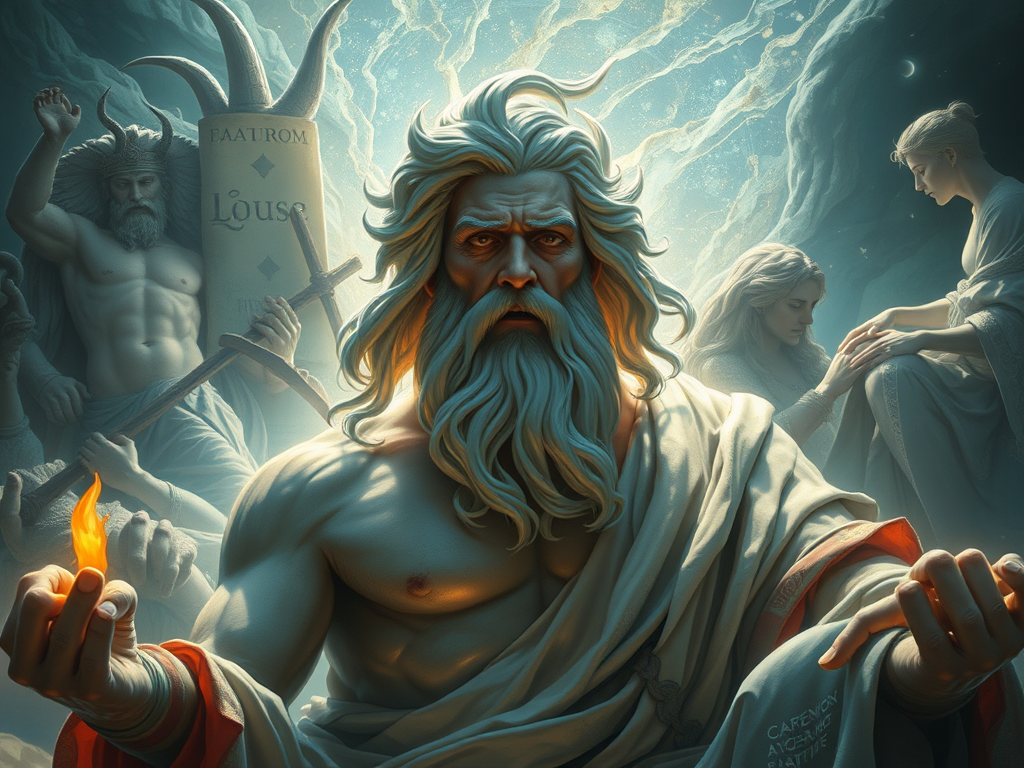
Why do stories from thousands of years ago still resonate with us today? When we read about Greek heroes, Norse gods, or Hindu epics, we’re not just encountering ancient entertainment—we’re looking into a mirror that reflects timeless truths about what it means to be human.
Across every continent and culture, mythology has served as humanity’s way of understanding itself. These narratives, passed down through generations, encode profound insights about our emotions, struggles, and aspirations. From the Epic of Gilgamesh in ancient Mesopotamia to the trickster tales of West Africa, from Greek tragedies to Buddhist parables, mythological patterns reveal universal aspects of human nature that transcend geography, time, and cultural boundaries.
Let’s explore what these ancient stories teach us about ourselves.
The Emotional Complexity Within Us All
Gods Who Feel Like Humans
One of mythology’s most striking revelations is beautifully simple: our emotions are complex, contradictory, and utterly natural. Greek mythology demonstrates this through its pantheon of immortal gods who, despite their divine power, experience jealousy, rage, love, and sorrow just as mortals do.
Consider Zeus, king of the gods, who repeatedly succumbs to temptation despite knowing the consequences. Or Hera, whose jealousy drives her to vengeful acts against Zeus’s lovers and their children. Then there’s Prometheus, whose compassion for humanity leads him to defy Zeus and suffer eternal punishment. These aren’t morality tales about perfect beings—they’re validations of our own emotional turbulence.
When mythology portrays gods struggling with the same feelings we experience daily, it sends a powerful message: the tension between desire and restraint, between passion and wisdom, is fundamental to existence itself. Emotions aren’t inherently good or evil—what matters is how we understand and channel them.
The Distance Between Mortal and Divine
Yet Greek and other mythologies maintain a crucial distinction: mortals suffer, die, and face powerlessness, while gods enjoy eternal, omnipotent existence. This contrast isn’t meant to diminish humanity but to illuminate what makes us unique—our mortality, our limitations, and our remarkable capacity to find meaning despite them.
This gap between human and divine becomes a lens through which we understand our own condition: temporary, vulnerable, yet capable of extraordinary acts within our brief existence.
Universal Struggles: Death, Fear, and Meaning
The Quest for Immortality
Perhaps no theme appears more consistently across world mythologies than humanity’s confrontation with mortality. The Epic of Gilgamesh, one of our oldest surviving narratives, centers on a powerful king’s desperate quest for immortality after witnessing his friend Enkidu’s death.
Gilgamesh’s journey takes him to the ends of the earth, through trials and dangers, seeking the secret of eternal life. Yet his ultimate lesson isn’t about achieving physical immortality—it’s about accepting mortality and recognizing that legacy, not endless existence, is what truly endures. This pattern resonates through heroic traditions worldwide, from Norse sagas to Polynesian legends.
Why Are We Here?
Creation myths from diverse cultures reveal humanity’s universal need to understand our origins and purpose. Whether it’s the Hindu concept of the cosmic egg (Brahmanda), the Mesopotamian story of creation from the blood of slain gods, or Native American emergence myths, these narratives provide frameworks for answering existential questions: Where do we come from? Why do we exist? What happens after death?
These aren’t just ancient curiosities—they represent humanity’s eternal grappling with fundamental mysteries. The specific details differ across cultures, but the questions remain constant, suggesting something deep about human consciousness itself.
Managing Fear Through Story
The fear of death emerges as a universal human experience that mythology addresses through various means. Ancient Greeks developed philosophical approaches to cope with death anxiety. Other cultures created elaborate beliefs about the afterlife and the relationship between the living and the dead.
Some anthropologists argue that religion itself originated partly from humanity’s attempts to manage the fear of death. Mythology provides comfort by offering narratives of continuity, transformation, and transcendence beyond physical mortality. Death becomes not an ending but a transition—a story with another chapter.
The Dual Nature of Pride and Humility
The Danger of Hubris
Greek mythology introduces hubris—excessive pride and the dangerous delusion of being equal to the gods. This wasn’t merely arrogance; it represented the belief that one could escape or alter destiny, transcend human limitations, and manipulate fate itself.
The story of Icarus powerfully illustrates this concept. Given wings of feathers and wax by his father Daedalus, Icarus was warned not to fly too close to the sun. But in his exhilaration and pride, he ignored the warning. The sun melted his wings, and he plummeted to his death. This wasn’t punishment for joy or ambition—it was the natural consequence of overestimating his abilities and ignoring his limitations.
Sisyphus offers another perspective. Condemned to eternally roll a boulder up a hill only to watch it roll back down, Sisyphus represents the ultimate futility. Yet his story teaches about the fine line between justified pride and destructive arrogance. The tragic heroes of Greek drama—Oedipus, Prometheus, Agamemnon—demonstrate that even the mighty can be brought low by excessive pride.
The Power of Perseverance
But mythology doesn’t only warn against pride; it also celebrates humility, perseverance, and resilience. Sisyphus’s eternal labor, while futile from one perspective, speaks to the human capacity to endure and persist in the face of insurmountable challenges. His determination, despite the repetitive and meaningless nature of his task, reminds us that finding fulfillment often lies in the journey itself rather than the destination.
This duality—warning against excessive pride while celebrating persistent effort—reflects mythology’s nuanced understanding of human psychology. We need confidence to attempt great things, but we also need humility to recognize our limits.
The Trickster: Mirror of Our Contradictions
Boundary Crossers and Rule Breakers
The near-universal presence of trickster figures—Loki in Norse mythology, Anansi in West African tales, Coyote in Native American stories, Kokopelli in Pueblo traditions—reveals something fundamental about human nature: we’re creatures of contradiction, capable of both creation and destruction, wisdom and folly, selfishness and generosity.
Tricksters exist in the fascinating space between hero and villain. They use wit rather than strength, cunning rather than courage. They break rules, challenge authority, and expose hypocrisies. Yet they’re also creators and problem-solvers, using their intelligence to overcome obstacles that brute force cannot.
Symbols of Resistance and Change
Consider Anansi, the spider trickster of West African folklore. When enslaved Africans were brought to the Americas, Anansi stories traveled with them, becoming symbols of resistance and survival. The message was profound: intelligence can triumph over brute force—a lesson of critical importance for oppressed communities.
Coyote stories from various Native American traditions often begin with the trickster helping humans but conclude with lessons about the consequences of greed, lust, or pride. The Lakota Heyoka deliberately acted contrary to expectations, forcing observers to question assumptions about proper behavior. This sacred role acknowledged that established orders aren’t permanent and that wisdom often comes from unexpected sources.
Psychological Significance
Carl Jung viewed tricksters as manifestations of the unconscious, representing the tension between rationality and instinct within every human psyche. Culturally, they function as agents of change and renewal, their disruptive nature preventing spiritual and social stagnation. They remind us that chaos and order, foolishness and wisdom, exist within each of us.
Transformation and the Hero’s Journey
The Universal Pattern
Joseph Campbell identified what he called the “monomyth”—a pattern appearing in heroic narratives worldwide. This hero’s journey involves separation from the ordinary world, initiation through trials and challenges, and return with wisdom or power to benefit the community.
This pattern isn’t just a storytelling device—it mirrors the psychological and spiritual transformations we all undergo. Whether it’s leaving home for the first time, facing a personal crisis, or pursuing a difficult goal, we all experience versions of the hero’s journey.
Growth Through Trials
Heroes like Odysseus, Hercules, and Rama demonstrate that growth comes through trials that test us physically, mentally, and spiritually. Hercules’s twelve labors reveal that physical strength alone is insufficient—he must learn cunning, diplomacy, endurance, and spiritual courage. His transformation from a guilt-ridden mortal into an immortal god demonstrates the possibility of redemption and transcendence.
Hindu mythology offers powerful examples of resilience through characters like Sita, Hanuman, and Karna. Sita’s unwavering loyalty during exile and captivity teaches the importance of remaining true to one’s values despite hardship. Karna, raised by a charioteer and facing discrimination throughout his life, maintained his principles and honor until the end, demonstrating the power of perseverance and integrity against overwhelming odds.
The Metaphor of Shapeshifting
Transformation myths often employ shapeshifting as a metaphor for identity’s fluidity and the relationship between change and power. Whether it’s Zeus taking different forms to achieve his aims, Proteus’s endless transformations to escape capture, or Norse bear-shifters moving between human and animal forms, these narratives teach that change can be both empowering and perilous.
The deeper lesson: true strength lies not in rigidity but in adaptability—the ability to bend without breaking, to transform in response to challenges while maintaining core identity.
Consequences, Karma, and Moral Responsibility
Actions Have Consequences
Mythology consistently teaches that actions have consequences—a principle crystallized in Hindu and Buddhist concepts of karma. The Mahabharata, one of the world’s longest epic poems, repeatedly emphasizes this key postulate: intent and action have consequences, karma lingers and doesn’t disappear, and all experiences in life require effort and intent.
This isn’t fatalism or predestination. Rather, it’s an acknowledgment of moral agency and responsibility. The law of karma emphasizes that we are the architects of our own destiny through thought, feeling, and action. If we cause others to suffer, suffering will come to us; if we love and give, we will be loved and given to.
Divine Justice and Human Ethics
Greek mythology conveys similar lessons through the concept of nemesis—divine retribution for hubris and wrongdoing. The struggles between good and evil, order and chaos that permeate mythologies worldwide reflect humanity’s attempts to understand moral causality and justice.
Plato’s myths personify powers of good and evil within human beings, illustrating the internal struggle that all must navigate. This internal battleground—between our higher and lower impulses—is where moral character is forged.
Wisdom and Inner Power
Wisdom traditions across cultures—from Vedic rishis to Egyptian scribes to Celtic bards—emphasize that knowledge must be transmitted for human welfare and that spiritual wisdom ultimately transcends temporal authority. The sages of Hindu mythology demonstrate that true power emerges not from external authority but from inner mastery and alignment with higher principles.
This pattern repeats globally: true authority comes from wisdom, not merely position; true strength emerges from self-mastery, not domination of others.
Social Bonds: Identity and Collective Consciousness
Mythology as Cultural Blueprint
Mythology serves crucial social functions by establishing cultural identity, reinforcing social norms, and legitimizing authority structures. Myths act as mirrors reflecting a society’s values, fears, and aspirations while providing explanations for why things are as they are.
The Hindu epics Ramayana and Mahabharata, for example, don’t merely offer religious teachings—they guide social behaviors and relationships, establishing roles and hierarchies that have shaped Indian society for millennia. These central figures embody values like righteousness (dharma), duty, and honor that transcend regional and cultural boundaries.
Creating Unity Through Story
Joseph Campbell identified mythology’s social function: to establish in every group member a system of sentiments that links them spontaneously to the group’s ends. Shared myths create solidarity, especially during times of crisis or conflict, by giving people a common heritage and understanding of their origins.
National myths about “founding fathers” or cultural heroes serve as rallying points for unity, binding diverse populations together. From Romulus and Remus founding Rome to the Dreamtime stories of Aboriginal Australians, these narratives create shared identity and purpose.
Finding Our Place
Mythology also helps individuals understand their place within the cosmic and social order. Creation myths define an orientation of humanity in the world, distinguishing primary reality from relative reality. They guide how people relate to the natural world, to spiritual dimensions, and to each other.
Stories of heroes, sages, and deities provide archetypal role models that reflect cultural ideals—and sometimes cultural flaws. By studying these figures, individuals learn what their society values and what it warns against.
Archetypal Patterns: The Collective Unconscious
Universal Symbols
Carl Jung’s concept of the collective unconscious provides a psychological framework for understanding mythology’s universality. Jung argued that all humans, regardless of culture, share an unconscious layer containing archetypes—universal symbols and patterns of behavior that manifest in myths, dreams, and cultural narratives.
These archetypes—the Hero, the Shadow, the Wise Old Man, the Trickster, the Mother—appear across vastly different cultures because they represent fundamental human experiences and psychological processes. The repetition of similar themes in myths from isolated cultures suggests these patterns spring from a shared psychic structure rather than cultural diffusion.
Mythology as Projection
Mythology becomes, in this view, a projection of the collective unconscious, encoding archetypal imagery that illuminates both individual and collective psychological dynamics. The hero’s journey isn’t just an adventure story—it’s a map of psychological development. The trickster isn’t just a mischievous character—it’s a representation of the chaotic, creative aspects of the psyche that resist order and convention.
Personal and Universal
By engaging with mythological narratives, individuals can recognize their personal struggles within larger, universal patterns, connecting them to the shared human experience. This recognition provides comfort, meaning, and a sense that we are not alone in our battles.
When you face a difficult choice, you’re experiencing the same dilemma as Arjuna on the battlefield of Kurukshetra. When you struggle with ambition and limits, you’re echoing Icarus. When you persist despite apparent futility, you’re channeling Sisyphus. Mythology tells us: others have been here before; you are part of an ancient human story.
Empathy, Compassion, and Connection
Ancient Teachings on Compassion
While mythology often focuses on heroic exploits and divine dramas, it also teaches profound lessons about empathy and compassion. Ancient Hindu texts emphasize karuna (compassion) and the concept of ātmaupamyatā—putting oneself in another’s place.
The Bhagavad Gita teaches seeing all beings as oneself, encouraging the development of compassion for all living beings, even enemies. This isn’t naive idealism—it’s a recognition that genuine understanding requires the ability to see the world through another’s eyes.
Compassion in Action
Stories from the Ramayana and Mahabharata feature characters who demonstrate empathy despite facing personal hardship. The Buddha’s enlightenment came from realizing the suffering of all beings, leading him to dedicate his life to helping others overcome suffering through compassion rather than violence.
Greek religion also centered on compassion, with Zeus and other gods having empathy for suffering. The Mysteries of Dionysus were seen as manifestations of Zeus’s compassionate providence, demonstrating divine care for human suffering. This emphasis on divine compassion reinforced the importance of empathy in human relationships.
Empathy Beyond Boundaries
Mythology teaches that empathy transcends borders and relationships. In the story of Rama’s rescue of Sita, monkeys and bears risked their lives despite having no obligation to the kingdom. Such narratives demonstrate that genuine compassion arises from understanding and shared feeling rather than proximity or duty.
This lesson remains vitally relevant: our circles of concern need not be limited by kinship, nationality, or similarity. Compassion is a choice to recognize the humanity in all beings.
The Enduring Relevance of Ancient Wisdom
Timeless Models for Modern Life
These lessons from mythology remain vital in contemporary life. Rama’s compassion, Arjuna’s moral clarity, Savitri’s faith, and the Buddha’s empathy provide models for ethical living in complex times. Modern education and cultural programs use these stories to teach emotional intelligence and ethical leadership.
The message is clear: courage is about standing firm in truth, and kindness is an active strength that heals and unites. These aren’t abstract virtues—they’re practical approaches to navigating modern challenges.
Frameworks for Resilience
Mythology offers frameworks for understanding risk and resilience in the face of uncertainty. Ancient narratives encode collective wisdom about danger, adversity, and the virtues necessary to overcome challenges. Whether facing personal struggles or societal upheavals, mythological patterns of transformation, perseverance, and renewal provide guidance.
In times of crisis, we can ask: What would the hero do? How would the sage respond? What does the trickster teach us about finding creative solutions? These aren’t childish questions—they’re ways of accessing deep, time-tested wisdom.
Our Shared Humanity
The universality of mythological themes—creation and destruction, life and death, good and evil, pride and humility, love and betrayal—reveals that despite cultural differences, humans share fundamental experiences, emotions, and questions.
Mythology teaches that we are all part of a larger narrative extending beyond individual circumstances, connecting us to countless generations who have sought meaning in the face of life’s mysteries. A person in ancient Sumeria wondering about death’s meaning had the same essential consciousness as someone wondering the same thing today.
Conclusion: The Mirror and the Map
Ultimately, mythology’s greatest teaching about human nature is this: we are complex beings capable of both greatness and folly, bound by mortality yet striving for transcendence, driven by emotions yet capable of wisdom, flawed yet capable of transformation.
These stories hold up a mirror to ourselves, reflecting not just who we are but who we might become. They map the territory of human experience—the challenges we’ll face, the choices we’ll make, the transformations we’ll undergo.
When we read about Odysseus’s long journey home, we’re not just enjoying an adventure story—we’re learning about perseverance, identity, and the meaning of home. When we encounter the trickster’s mischief, we’re exploring the value of questioning authority and thinking creatively. When we follow the hero’s journey from departure through trials to return, we’re tracing the path of our own psychological and spiritual development.
Mythology endures because it speaks to something unchanging in human nature. Technologies evolve, societies transform, but the fundamental experiences of being human—loving, fearing, hoping, striving, failing, succeeding, connecting, and ultimately confronting our mortality—remain constant.
In understanding these ancient stories, we understand ourselves better. And perhaps that’s the ultimate lesson mythology teaches: self-knowledge is the beginning of wisdom, and wisdom is the path to a life well-lived.
Leave a Reply