
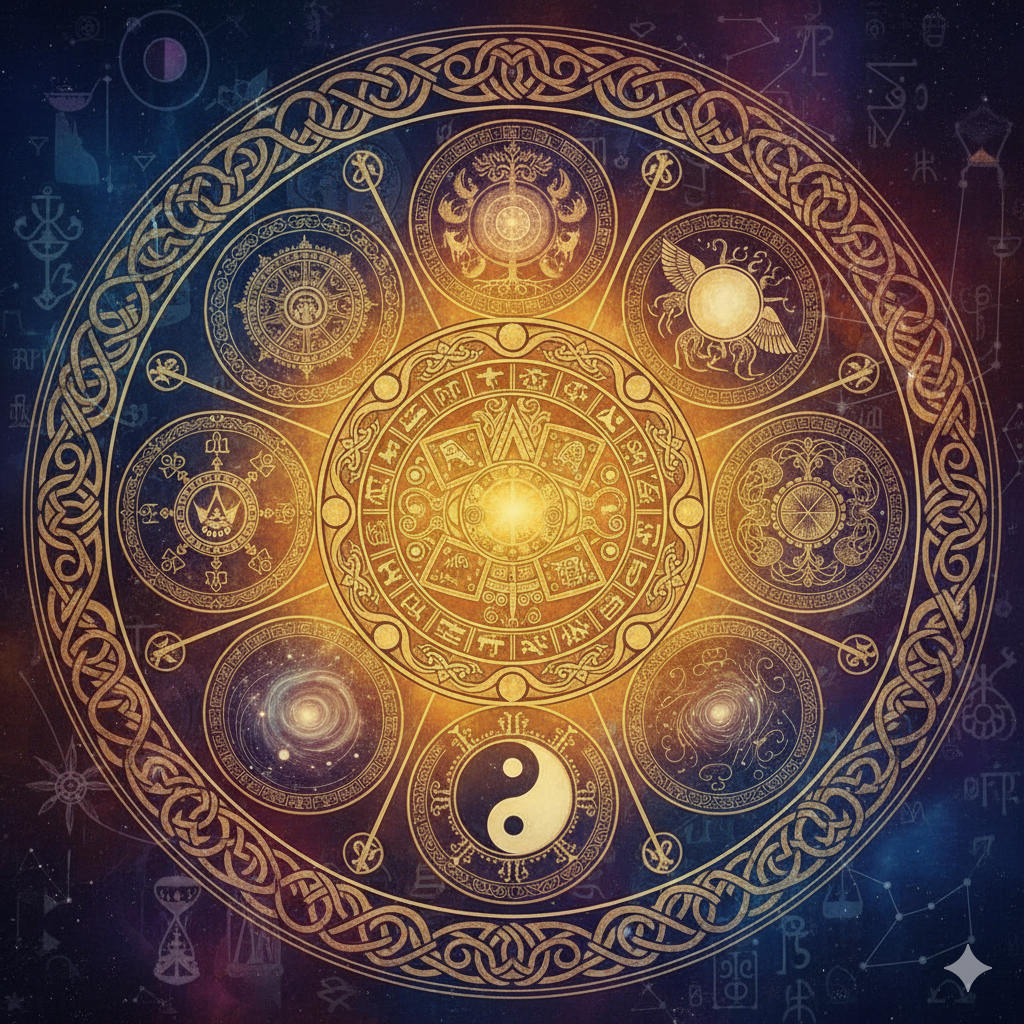
Time—invisible yet omnipresent, flowing yet eternal—has captivated human consciousness since our earliest days. How do we measure something we cannot see? How do we understand an experience that simultaneously binds and liberates us? Across continents and millennia, diverse cultures have grappled with these profound questions, weaving intricate mythologies that reveal fundamentally different understandings of time’s nature.
From the vast cosmic cycles of Hindu Yugas spanning millions of years to the Aboriginal Dreamtime existing outside temporal boundaries altogether, humanity has created rich tapestries of temporal philosophy. Some civilizations conceived time as a great wheel, eternally turning through phases of creation and destruction. Others saw it as an arrow flying forward from a definitive beginning toward an ultimate end. Still others perceived time as something fluid, interconnected, and multidimensional—resistant to simple categorization.
These mythological frameworks were far more than mere stories told around ancient fires. They shaped entire worldviews, informed religious practices, guided agricultural cycles, and provided answers to existence’s most fundamental questions: Where did we come from? Where are we going? What is our purpose in the cosmos?
The Eternal Wheel: Cyclical Conceptions of Time
Hindu Mythology: The Grandest Cosmic Cycles
Hindu mythology presents perhaps the most elaborate and mathematically sophisticated cyclical conception of time ever conceived. At its heart lies the Kalachakra—the “wheel of time”—where vast cosmic ages rotate through endless cycles of creation, preservation, and dissolution.
Time in Hindu cosmology operates through a system of Yugas, four distinct world-ages that comprise one complete cosmic cycle. Each Yuga represents a progressive decline from perfection, like the descending metals in a metallurgical sequence.
Satya Yuga, the Golden Age, endures for 1,728,000 years. This era embodies perfect truth, righteousness, and virtue. Humans live exceptionally long lives in harmony with cosmic law (Dharma), and spiritual knowledge flourishes without obstruction.
Treta Yuga, the Silver Age, continues for 1,296,000 years. Virtue begins its decline—reduced by one quarter from the perfection of Satya Yuga. Humans still live long lives, but conflict and moral ambiguity begin to emerge.
Dvapara Yuga, the Bronze Age, spans 864,000 years. Virtue diminishes further, now only half of what it was during Satya Yuga. Disease, discord, and confusion increase as spiritual awareness weakens.
Kali Yuga, the Iron Age—our current era—lasts 432,000 years. This is the age of darkness, characterized by moral decay, materialism, conflict, and spiritual ignorance. According to traditional calculations, Kali Yuga began around 3102 BCE with the death of Lord Krishna, meaning approximately 5,126 years have elapsed, leaving roughly 426,874 years remaining.
But the cosmic mathematics extends far beyond these four ages. One complete cycle through all four Yugas—called a Chaturyuga—totals 4,320,000 years. Yet even this staggering span represents merely one day-cycle in an incomprehensibly vaster timescale. One thousand Chaturyugas equal one Kalpa, which constitutes a single day of Brahma, lasting approximately 4.32 billion years. Brahma’s night equals another Kalpa, and Brahma himself lives for 100 cosmic years—each containing 360 cosmic days and nights.
At the end of each Kali Yuga, the world undergoes partial dissolution. The avatar Kalki—the tenth incarnation of Vishnu—will appear riding a white horse, wielding a blazing sword to cleanse the world of corruption and evil. Following this purgation, a new Satya Yuga dawns, and the eternal cycle begins anew.
This vision of time reflects a profound understanding of cosmic rhythms—the universe breathing in and out through cycles of manifestation and dissolution, with no absolute beginning or end, only eternal transformation.
Buddhist Kalachakra: Time as Interconnected Wheels
Buddhism, particularly the Vajrayana tradition of Tibet, adopted and transformed the concept of Kalachakra into a sophisticated system of interconnected temporal cycles. In Buddhist understanding, time operates simultaneously on multiple levels, each reflecting and influencing the others.
The Outer Wheel refers to macrocosmic time—the movements of planets, the progression of seasons, celestial patterns, and cosmic cycles. This is the time of astronomy and natural phenomena, the objective temporal framework within which existence unfolds.
The Inner Wheel represents microcosmic time—the human body’s cycles. This includes the rhythm of breath, the flow of subtle energies through channels (nadis), the circulation of consciousness, and biological rhythms. Human physiology mirrors cosmic patterns, making each individual a microcosm of the universe.
The Alternative Wheel refers to the practices and rituals through which practitioners can transcend ordinary time—meditation techniques, visualizations, and yogic practices that allow consciousness to move beyond linear temporal constraints.
Central to this philosophy is the deity Kalachakra himself, depicted in union with his consort Vishvamata (or Kalachakri). Kalachakra represents time and temporality—all that changes, flows, and transforms. His consort embodies timelessness—the eternal, unchanging essence beyond temporal flux. Their sacred union symbolizes the non-duality at existence’s heart: time and timelessness are not opposites but complementary aspects of reality.
This teaching emphasizes the fundamental principle: “as it is outside, so it is within.” The cosmos and the individual body are not separate domains but expressions of the same underlying patterns. By understanding and harmonizing with these temporal cycles, practitioners can achieve liberation from suffering and realize enlightenment.
Greek Mythology: Multiple Faces of Time
Ancient Greek civilization developed a remarkably nuanced understanding of time, recognizing that temporal experience encompasses multiple distinct qualities that cannot be reduced to simple measurement.
Chronos represented quantitative, chronological time—the relentless, linear progression that carries all beings inexorably toward death. Often depicted as an ancient man wielding a scythe, Chronos embodied time’s destructive power. The myth portrays him devouring his own children, consumed by jealousy and fear of being overthrown—a potent symbol of how time consumes everything it creates.
In response to this tyranny, Zeus—having escaped being devoured—overthrew his father and created the Horae (Hours). These maiden goddesses danced in eternal circles, representing time’s cyclical nature as expressed in seasons, agriculture, and natural rhythms. The Horae included Thallo (Spring), Auxo (Summer), and Carpo (Autumn), each presiding over growth, ripeness, and harvest. Their circular dance stood in stark contrast to Chronos’s linear march toward destruction.
Beyond these conceptions, the Greeks recognized Kairos—qualitative time, the opportune moment. While Chronos answers “what time is it?” Kairos asks “what kind of time is it?” This represents those fleeting windows when conditions align perfectly for decisive action. In rhetoric, art, and warfare, recognizing and seizing the kairotic moment determined success or failure. Kairos appears in classical art as a young man with winged feet and a forelock of hair—easy to grasp if approached from the front but impossible to catch once passed.
Finally, Aion embodied eternal, cosmic time—the everlasting eternity of the Greek cosmos. Associated with the highest celestial sphere and its 26,000-year precession cycle, Aion represented time beyond human comprehension, the eternal duration within which all cycles and ages unfold.
This multifaceted understanding reveals Greek sophistication: time is not monolithic but encompasses quantitative measurement, cyclical patterns, qualitative opportunity, and cosmic eternity—each aspect valid and important for understanding temporal experience.
Mayan Calendar: Interlocking Temporal Gears
The Maya developed one of history’s most sophisticated and intricate calendar systems, conceiving time not as a single flow but as multiple interlocking cycles of different lengths, each serving distinct purposes and combining to create an elaborate temporal matrix.
The Tzolkin (Sacred Round) formed the foundation of Mayan time-reckoning. This 260-day divinatory cycle combined 13 numbers with 20 day-names, creating 260 unique combinations. Each day carried specific spiritual qualities and energies that influenced events, births, and activities. The 260-day cycle corresponds remarkably to human gestation (approximately nine lunar months), suggesting deep connections between cosmic time, human biology, and agricultural cycles.
The Haab comprised 365 days, divided into 18 months of 20 days each, plus five additional “unlucky” days called Wayeb. This solar calendar regulated civil affairs, agricultural activities, and seasonal festivals. While functional for everyday use, the Haab lacked leap years and gradually drifted relative to the solar year.
When combined, the Tzolkin and Haab created the Calendar Round—a 52-year cycle (18,980 days) before any particular date combination repeated. This cycle held tremendous importance in Mesoamerican culture, with each 52-year completion marking a critical juncture when the world’s continuation wasn’t guaranteed. Renewal ceremonies ensured the cosmos would persist for another cycle.
Beyond these, the Maya employed the Long Count—a linear calendar tracking days from a mythological starting point corresponding to August 11, 3114 BCE in our Gregorian calendar. This date marked when the gods created the current world at Teotihuacan. The Long Count measured vast periods called baktuns (144,000 days each), with 13 baktuns forming a great cycle of approximately 5,125 years.
The infamous “end” of the Mayan calendar on December 21, 2012, represented the completion of the 13th baktun—not an apocalypse but a transition point, like the turning of an odometer, after which a new great cycle began.
This sophisticated interlocking system reflects a profound understanding: time operates simultaneously at multiple scales, with different cycles serving different purposes, all interconnected in a grand temporal clockwork.
Chinese Mythology: Yin-Yang Transformation
Chinese cosmology embeds time within the fundamental principle of Yin-Yang—the complementary, interdependent forces that generate all existence through their eternal dance of transformation.
Yin represents the passive, feminine, dark, cool, receptive principle. Yang embodies the active, masculine, bright, warm, creative principle. Crucially, these are not opposing forces locked in conflict but complementary aspects of a unified whole, each containing the seed of the other, continuously transforming into one another through cyclical patterns.
Time in Chinese philosophy manifests through this eternal alternation. When Yang reaches its extreme intensity, it begins transforming into Yin. When Yin achieves maximum expression, it starts converting into Yang. This process never stops, creating observable natural rhythms that govern all temporal experience.
The daily cycle exemplifies this transformation: dawn represents Yang emerging from Yin’s darkness; noon marks Yang’s zenith; dusk shows Yang diminishing as Yin strengthens; midnight represents Yin’s peak before Yang begins its return. The annual cycle mirrors this pattern: the winter solstice marks maximum Yin (shortest day, longest night), after which Yang gradually strengthens through spring until the summer solstice marks maximum Yang (longest day, shortest night), then Yin begins its ascent through autumn.
These transformations govern countless temporal phenomena—lunar phases (waxing yang, waning yin), tidal movements, seasonal changes, agricultural cycles, and even circadian rhythms within the human body. Ancient Chinese developed sophisticated systems to track these Yin-Yang fluctuations, including the 24 solar terms that divide the year into precise periods marking subtle shifts in cosmic energy.
This worldview understands time not as empty duration but as qualitative energy flowing through predictable patterns. Each moment possesses specific characteristics based on the current Yin-Yang balance, informing decisions about medicine, agriculture, construction, and governance. Time becomes inseparable from the fundamental forces animating the cosmos.
Norse Mythology: Ragnarök and Renewal
Norse mythology presents a fascinating fusion of linear and cyclical temporal understanding, centered on the apocalyptic event called Ragnarök—the “Twilight of the Gods.”
The prophesied Ragnarök describes a cataclysmic series of events: a terrible winter lasting three years without summer, social bonds collapsing, brother turning against brother. The great wolf Fenrir breaks free from his bonds and devours the sun. His brother Hati swallows the moon, plunging the world into darkness. The world-serpent Jörmungandr rises from the ocean, causing massive floods. The fire giant Surtr leads armies from Muspelheim to assault Asgard.
The gods know this destiny but march toward it anyway. Odin confronts Fenrir and is devoured. Thor slays Jörmungandr but dies from the serpent’s venom nine steps later. Heimdall and Loki kill each other. Surtr’s flames consume the world-tree Yggdrasil and all the realms. Everything ends in fire and flood.
This appears to be linear time reaching its ultimate conclusion—an eschatological endpoint. Yet Norse mythology doesn’t end here. After the devastation, the world rises again from the sea, green and fertile. Surviving gods like Baldur (released from Hel) and Höðr return. The human couple Líf and Lífþrasir, who sheltered within Yggdrasil during the destruction, emerge to repopulate the renewed earth. A new sun—daughter of the old—illuminates the reborn sky.
This suggests cyclical time: destruction followed by creation, death preceding rebirth. Some scholars debate whether Ragnarök truly cycles or represents a single, final end with subsequent new beginning. The texts remain ambiguous, perhaps intentionally so. What’s clear is that destruction isn’t absolute—continuity persists through the catastrophe, and life renews itself.
This reflects broader Indo-European religious patterns where time cycles between ages of glory and decline, with periodic renewal returning the world to a Golden Age. The Norse vision acknowledges endings while affirming regeneration—time as both arrow and wheel.
Aztec Five Suns: Successive World-Ages
Aztec cosmology conceives history as a series of five successive world-ages called “Suns,” each created by the gods and then catastrophically destroyed before the next begins. This represents neither pure linearity nor pure cyclicality but something between—sequential cycles moving through distinct phases.
The First Sun (Nahui-Ocelotl, “Jaguar Sun”) was ruled by Tezcatlipoca. This world ended when jaguars descended from the heavens and devoured all humanity. The era lasted 676 years.
The Second Sun (Nahui-Ehécatl, “Wind Sun”) was governed by Quetzalcoatl. Powerful hurricanes and winds destroyed this world, transforming the surviving humans into monkeys who fled into the forests. This age endured 364 years.
The Third Sun (Nahui-Quiahuitl, “Rain Sun”) fell under Tlaloc’s dominion. Volcanic fire rained from the sky, incinerating the world. The few human survivors became birds. This sun lasted 312 years.
The Fourth Sun (Nahui-Atl, “Water Sun”) was ruled by Chalchiuhtlicue. Catastrophic floods submerged the world for 52 years. Surviving humans transformed into fish.
We currently inhabit the Fifth Sun (Nahui-Ollin, “Earthquake Sun”), created when gods gathered at Teotihuacan and sacrificed themselves. The humble god Nanahuatzin threw himself into a great bonfire, transforming into the sun. Tecciztecatl followed, becoming the moon. But this new sun remained motionless until the other gods sacrificed themselves to set it in motion with their blood.
This sacrificial origin establishes humanity’s role: the Fifth Sun requires continuous nourishment through human sacrifice to maintain its strength and prevent cosmic collapse. When these offerings cease, this sun will also fall—destroyed by earthquakes—and humanity will end.
This cosmology profoundly shaped Aztec religious practice and social structure. Warfare secured captives for sacrifice. Ritual bloodletting connected humans to divine cycles. The Aztecs understood themselves as cosmic custodians, responsible for maintaining universal order through their devotional acts. Time in Aztec thought wasn’t neutral but laden with sacred responsibility.
Egyptian Mythology: Daily Cycles Within Cosmic Order
Ancient Egyptian civilization developed a sophisticated temporal worldview combining cyclical daily patterns with an underlying sense of cosmic order extending from primordial creation.
The daily journey of Ra, the sun god, formed the fundamental temporal cycle. Each morning, Ra sailed across the sky in his solar boat (Mandjet), bringing light and life to the world. At sunset, he descended into Duat—the underworld—and transferred to his night boat (Mesektet). Throughout the perilous night journey, Ra battled the chaos serpent Apophis, who sought to swallow the sun and end creation. With the aid of other gods, Ra defeated Apophis each night and emerged triumphantly at dawn, reborn and renewed.
This daily cycle symbolized perpetual regeneration—death followed inevitably by rebirth, darkness conquered by light, order overcoming chaos. Every sunrise wasn’t simply Ra’s continuation but his actual rebirth, making each day a reenactment of creation itself.
Annual cycles reinforced this temporal pattern. The predictable flooding of the Nile divided the Egyptian year into three seasons: Akhet (inundation), Peret (growth), and Shemu (harvest). These agricultural rhythms synchronized with religious festivals celebrating various deities and mythological events.
Beyond these observable cycles, Egyptians conceived creation itself as recurring rather than singular. Ra emerged from Nun—the primordial waters of chaos—standing on the benben (primordial mound) to create the world. Eventually, they believed, Ra would complete his cosmic journey, withdraw back into Nun, and the world would return to undifferentiated chaos. But this ending represented not absolute termination but precursor to new creation—another cycle beginning.
Crucially, Egyptians distinguished between mythic time and present time. The First Time (Zep Tepi) represented the mythological age when gods created the world and established Ma’at—cosmic order, truth, and balance. This foundational period was linear, setting patterns and laws. Present time, however, was cyclical—continuously reenacting and maintaining the patterns established in the First Time.
Ma’at herself embodied the principle preventing cosmic dissolution. Through proper rituals, ethical conduct, and social order, humans participated in maintaining Ma’at and ensuring time’s cycles continued harmoniously. This gave Egyptian civilization a profound sense of cosmic responsibility and continuity.
The Eternal Now: Aboriginal Dreamtime
Australian Aboriginal peoples developed perhaps the most radically different temporal conception—one that challenges fundamental Western assumptions about time’s nature.
The Dreamtime (or Dreaming, called Altjeringa in Arrernte and various names across different Aboriginal language groups) isn’t a past historical period but an eternal, ongoing state where creation continuously unfolds. It has no beginning or end; it simply is.
During the Dreamtime, ancestral spirit beings—often taking forms like the Rainbow Serpent, Wandjina, or ancestral kangaroos—traveled across the formless land, their movements creating geographical features. Where a spirit being camped, a waterhole formed. Where they dug, valleys appeared. Where they walked, paths traced across the landscape. These creative acts weren’t historical events that happened “once upon a time” but are perpetually present.
The profound insight: the Dreamtime exists simultaneously in past, present, and future. It isn’t that creation happened long ago; rather, creation is happening continuously. The ancestral beings didn’t simply shape the land and depart—they remain spiritually alive and present within the landscape, accessible through sacred sites, ceremonies, and songs.
Time in Aboriginal understanding doesn’t flow horizontally from past through present toward future. Instead, it exists vertically in relationship to the present. As Aboriginal scholar Miriam-Rose Ungunmerr explains: “The past underlies and is within the present.” Events don’t happen sequentially as effects of prior causes but exist and occur because the Dreamtime “is also here and now.”
This concept has been described as “Everywhen”—a state where all original creation stories remain perpetually present rather than receding into history. An Aboriginal person connecting with a sacred site through song or ceremony doesn’t merely remember or commemorate past events; they actively participate in the Dreamtime, collapsing temporal distance.
This temporal worldview profoundly shapes Aboriginal spirituality, connection to land, and social structures. Sacred sites aren’t historical monuments but living portals to eternal creative processes. Songlines—paths of knowledge linking sites across vast distances—map both geography and mythology simultaneously. Ceremonies don’t merely celebrate past events but actualize the Dreamtime in present moments.
Western philosophy struggles with this concept because it resists categorization into linear or cyclical frameworks. The Dreamtime transcends both, suggesting time itself may be more mysterious and multidimensional than conventional understanding allows.
Linear Progressions and Beginning Points
Mesopotamian Creation: Marduk Establishes Order
The Babylonian Enuma Elish (c. 1400 BCE) describes creation as progressive establishment of cosmic order from primordial chaos, marking a definitive beginning of structured time.
In the beginning, only Apsu (fresh water) and Tiamat (salt water) existed, their waters co-mingled in undifferentiated chaos. From their union, younger gods emerged—Lahmu and Lahamu, then Anshar and Kishar, eventually giving birth to Anu and Ea.
These younger deities grew noisy and restless, disturbing Apsu’s peace. He conspired with his vizier Mummu to destroy them. But Ea discovered the plot and used magic to kill Apsu, claiming his waters as his dwelling. Ea’s son Marduk was born in this sacred space.
Enraged by Apsu’s death, Tiamat created monstrous offspring and prepared for war against the younger gods. The deities, terrified, elevated Marduk to kingship, granting him supreme authority in exchange for defeating Tiamat.
The epic battle ensued. Marduk captured Tiamat in his net, sent winds to distend her body, and shot an arrow into her gaping mouth, splitting her in two. From her corpse, he created the cosmos: her upper half became heaven, her lower half the earth. He established the stars and constellations, assigned the sun and moon their paths, and created humans from the blood of Tiamat’s consort Kingu to serve the gods.
Critically, Marduk “marked out the days and created the annual calendar so that he could rule over time itself.” This act represents time’s inauguration—the moment when measured, structured time begins. Before Marduk’s victory, only chaotic, undifferentiated existence prevailed. His creative acts separated and ordered reality, making time possible.
The Enuma Elish was recited annually during Akitu—the Babylonian New Year festival celebrating spring floods and agricultural renewal. This ritual reenactment renewed cosmic order, reaffirming Marduk’s victory over chaos and ensuring time’s continued proper function for another year.
Japanese Kojiki: The Age of Gods
The Kojiki (712 CE), Japan’s oldest surviving text, describes creation beginning from formless chaos where heaven and earth were not yet separated. From this primordial void, spontaneous generation produced eternal beings, eventually including the divine pair Izanagi-no-Mikoto and Izanami-no-Mikoto.
These creator deities stood upon the Floating Bridge of Heaven and thrust a jeweled spear into the chaotic ocean below, stirring it. When they lifted the spear, brine dripping from its tip congealed and formed the first island, Onogoro-shima. Descending to this island, Izanagi and Izanami performed a marriage ritual and began giving birth to the islands of Japan and numerous kami (deities) representing natural forces—mountains, rivers, sea, wind, trees, and rice.
Tragedy struck when Izanami died birthing Kagutsuchi, the fire god. Grief-stricken, Izanagi descended to Yomi (the underworld) to retrieve her. Finding his beloved transformed into a rotting corpse inhabited by thunder deities, Izanagi fled in horror. This established the permanent boundary between life and death, between the living world and Yomi.
Performing purification rituals after his contamination in Yomi, Izanagi inadvertently created more major deities: Amaterasu (sun goddess) emerged from his left eye; Tsukuyomi (moon god) from his right eye; Susanoo (storm god) from his nose. These deities would play central roles in subsequent mythology.
This narrative represents the Age of the Gods (Kamiyo)—a foundational period when divine beings shaped creation, established natural laws, and formed the Japanese archipelago. Following this mythic age, time progresses linearly through legendary emperors claiming divine descent from Amaterasu, connecting mythological origins to historical governance.
The Kojiki thus establishes both a creation point and linear progression from divine age through legendary periods into historical time, providing Japan’s imperial line with cosmic legitimacy.
Polynesian Creation: Emergence from Primordial Darkness
Across the vast Polynesian triangle—from Hawaii to New Zealand to Easter Island—cultures share remarkably similar creation narratives centered on emergence from primordial darkness called Po.
In Maori cosmology, creation begins with Te Kore (The Void)—absolute nothingness containing only potential. From Te Kore emerged Te Po (The Night)—a realm of darkness lasting through multiple phases or epochs, each progressively developing toward manifestation.
From Te Po came Ranginui (Sky Father) and Papatūānuku (Earth Mother), locked in eternal embrace with their numerous divine children trapped in darkness between them. For eons, the children dwelled in this compressed darkness until they finally decided separation was necessary to allow light and life to flourish.
After debate, Tāne Mahuta (god of forests and birds) positioned himself against his mother earth and pushed upward with his legs, forcefully separating his parents. This separation created space between earth and sky, allowing light to enter the world for the first time. This moment marks time’s true beginning—when darkness gave way to light, chaos to order, potential to actuality.
Hawaiian creation chants (Kumulipo) describe similar emergence from darkness. The chant recounts creation unfolding in paired periods called “po” (nights), with each period bringing forth progressively complex life forms—beginning with simple organisms in the ocean, advancing through plants and animals, culminating in humans.
This evolutionary progression—from simplest forms toward complexity—is remarkably sophisticated for an oral tradition predating modern biology. Creation wasn’t instantaneous but developmental, with each stage building upon previous foundations.
Throughout Polynesian cultures, the demigod Maui appears as a cultural hero whose exploits shape the world. He fishes up islands from the ocean floor using magical hooks. He snares the sun with ropes and beats it until it agrees to move more slowly across the sky, lengthening days for human productivity. He steals fire from the underworld, bringing this transformative technology to humanity.
Maui’s stories represent human agency within cosmic order—the capacity to influence and improve natural conditions through cleverness and courage. His adventures mark significant transitions from primordial conditions toward the world as humans experience it.
Persian Zurvanism: Time as Primordial Deity
In Persian mythology, particularly Zurvanite tradition, Zurvan represents the primordial deity of infinite time and space—the ultimate source from which all existence emerges.
Zurvan Akarana means “Limitless Time” or “Infinite Time”—the eternal, boundless duration beyond measure or comprehension. This stands as one of two fundamental cosmic forces mentioned in ancient Avestan texts.
Zurvan manifests under two aspects: Zurvan Akarana (Infinite Time)—eternal, unlimited, without beginning or end; and Zurvan Daregho-Chvadhata (Time of Long Dominion)—finite, limited time extending for 12,000 years before returning to infinity.
According to Zurvanite mythology, Zurvan performed sacrifices for a thousand years, desiring offspring to create the cosmos. During this prolonged ritual, doubt arose: “What if this sacrifice proves fruitless?” From the sacrificial acts came Ahura Mazda (Ohrmazd)—the principle of light, truth, and goodness. From the doubt came Angra Mainyu (Ahriman)—the principle of darkness, lies, and evil.
Zurvan had promised kingship to whichever son appeared first. Ahriman, learning this, tore through the womb to emerge first. Reluctantly honoring his vow, Zurvan granted Ahriman 9,000 years of dominion, after which Ahura Mazda would rule for 3,000 years and ultimately triumph, ending finite time and returning existence to infinite eternity.
This cosmology presents time itself as the fundamental reality—not merely a dimension within which events occur but the creative foundation from which both good and evil emerge. The 12,000-year finite period represents time’s self-limitation, creating the cosmic drama of opposing forces before resolution into timeless eternity.
Zurvan embodies both creation’s foundation and its inevitable conclusion—time that encompasses beginning, duration, and forecasted end, ultimately transcending itself.
Celtic Threshold Times
Celtic tradition conceived time through the Wheel of the Year—eight festivals marking critical transitions in the agricultural and spiritual calendar. Four fire festivals celebrated threshold moments when boundaries between worlds grew thin.
Samhain (October 31-November 1) marked the Celtic New Year and the year’s most liminal time. As summer’s light half transitioned into winter’s dark half, the veil between the physical and spiritual worlds, between living and dead, grew gossamer-thin. This wasn’t feared but honored as a time when ancestors could be contacted, divination proved most effective, and supernatural beings moved freely.
The festival acknowledged life’s dependence on death, light’s emergence from darkness, the eternal cycle where endings enable beginnings. Bonfires were lit to guide souls and provide protection. Offerings were left for ancestors and spirits. This threshold time existed between years, neither in the old nor fully in the new—a temporal crack where normal rules suspended.
Imbolc (February 1) celebrated the first stirrings of spring, when ewes began lactating and daylight noticeably increased. Associated with the goddess Brigid, this festival honored creative inspiration, healing, and smithcraft—all transformative activities.
Beltane (May 1) marked summer’s beginning, celebrating fertility, vitality, and abundance. Cattle were driven between two bonfires for purification and protection. This festival balanced Samhain—while Samhain acknowledged descent into darkness, Beltane celebrated emergence into light.
Lughnasadh (August 1) honored the first harvest and the god Lugh, marking summer’s peak before autumn’s approach.
Together, these festivals embodied Celtic understanding of time as cyclical movement through complementary phases—light and dark, growth and decay, life and death—each necessary for the whole. The threshold moments between phases held particular power, creating opportunities for communication between worlds and deep spiritual work.
Deities of Time and Fate
Across mythologies, cultures personified time and fate through specific deities embodying temporal power and destiny’s inevitability.
The Norns in Norse mythology—Urd (past/fate), Verdandi (present/becoming), and Skuld (future/debt)—dwell at Yggdrasil’s base beside the Well of Urd. These three weavers determine every being’s destiny by spinning, measuring, and cutting the threads of fate. Even the gods cannot escape their decisions. They represent time as immutable destiny executed through temporal flow—past actions creating present conditions generating future outcomes.
Kali in Hindu mythology embodies time’s destructive power. Her name derives from “kala” (time), and she represents time’s capacity to consume all things. Often depicted wearing a garland of skulls and a skirt of severed arms, dancing upon Shiva’s body, Kali appears terrifying but ultimately liberating—destroying illusion and ego to enable spiritual transformation. She is time personified—the inevitable force before which all structures crumble.
Ma’at in Egyptian mythology represents cosmic order, truth, justice, and balance. More principle than personality, Ma’at embodies the fundamental order established at creation. Maintaining Ma’at through proper ritual and ethical conduct prevented the universe from descending into chaos. Upon death, hearts were weighed against Ma’at’s feather—if balanced, the deceased achieved eternal life; if heavier with sin, they were devoured. Ma’at thus governed both cosmic time and individual destiny.
Huh (or Heh) in Egyptian mythology personified infinity and formlessness, representing the boundless eternity of time and space. Often depicted kneeling while holding palm ribs (symbols of years), Huh embodied the endless duration within which finite events occur.
These personifications reveal how cultures grappled with time’s power—inescapable, impartial, simultaneously creative and destructive, governing all existence.
The Philosophical Divide: Cycles and Arrows
Examining these diverse mythologies reveals a fundamental philosophical division in temporal understanding: cyclical versus linear conceptions.
Cyclical time, predominant in Indian, Chinese, Greek, Mayan, Norse, Egyptian, and many indigenous traditions, emphasizes:
- Eternal return: patterns repeat endlessly without ultimate beginning or absolute end
- Cosmic breathing: creation and dissolution occur rhythmically, like inhalation and exhalation
- Natural integration: time mirrors observable cycles—seasons, lunar phases, celestial movements, biological rhythms
- Interconnectedness: past, present, and future exist in relationship rather than strict sequence
This worldview sees history not as progressing toward a goal but as oscillating through recurring patterns. Moral and social decay inevitably leads to renewal. Golden ages give way to darker periods, which eventually birth new golden ages. Nothing is truly new; everything has happened before and will happen again.
Linear time, more characteristic of Abrahamic traditions and certain other cosmologies, emphasizes:
- Directional flow: time moves like an arrow from definite beginning toward ultimate end
- Historical consciousness: events are unique, unrepeatable, shaping progressive development
- Teleology: existence moves toward ultimate purpose, culmination, or final judgment
- Eschatology: anticipation of definitive end-times when current cosmic order concludes
This perspective views history as meaningful progression where each moment matters uniquely. Moral choices have eternal consequences. Creation had a definitive beginning, and time will reach a conclusive end.
However, scholars increasingly recognize these divisions aren’t absolute. Many cultures held both conceptions simultaneously—recognizing observable cycles while perceiving historical progression. The Egyptian worldview exemplifies this duality: mythic time during the First Time was linear, establishing foundational patterns, while present time was cyclical, continuously reenacting those patterns.
Similarly, Norse Ragnarök combines linear apocalypse with cyclical renewal. Aztec Five Suns represent sequential progression through distinct ages, yet each age forms part of a larger cyclical pattern. Even Hindu cosmology, despite its overwhelming cyclical nature, contains linear elements within each Yuga’s progressive decline.
This suggests human temporal experience may inherently contain both dimensions. We observe cycles—day and night, seasons, life stages—while simultaneously experiencing unique, unrepeatable moments that shape personal and collective history. Perhaps the wisdom lies not in choosing one framework over another but in recognizing how both operate simultaneously at different scales.
Time Travel and Temporal Dilation in Myth
Beyond cosmological frameworks, many mythologies feature narratives specifically about time’s malleability—stories where time flows at different rates depending on location or supernatural influence.
The Irish legend of Oisín and Tír na nÓg tells of the warrior poet who accompanies the beautiful Niamh to the otherworldly “Land of the Young.” In this magical realm, time operates differently than in the mortal world. Oisín experiences what seems a brief, pleasant stay—perhaps three years. When homesickness draws him back to Ireland, he discovers three hundred years have elapsed. His companions are long dead, Christianity has replaced the old ways, and he’s become a legend himself. When his foot accidentally touches Irish soil, he instantly ages three centuries, crumbling into dust.
Japanese mythology features a remarkably similar tale in Urashima Tarō. The fisherman rescues a turtle, which reveals itself as the daughter of the sea god. She takes him to the magnificent undersea Dragon Palace (Ryūgū-jō), where he enjoys wonderful hospitality. After what feels like several days, he asks to return home to see his mother. Given a mysterious box (tamatebako) with instructions never to open it, he returns to his village—only to find everything changed. Hundreds of years have passed, his family is long gone, and no one remembers him. In his confusion and grief, he opens the forbidden box. White smoke emerges, and he instantly ages into an ancient man.
These tales reflect profound insights about temporal relativity long before Einstein formalized it mathematically. They suggest:
- Time isn’t uniform but can flow at different rates
- Supernatural realms operate under different temporal rules
- Crossing boundaries between worlds risks temporal dislocation
- Time’s passage can’t be recovered—what’s lost remains lost
Similar motifs appear in Celtic tales of people entering fairy mounds for what seems a single night of dancing, only to emerge and find centuries passed. Chinese literature contains stories of scholars entering mountain caves where immortals dwell, experiencing brief encounters while decades elapse outside.
These myths grapple with time’s subjective nature—how experience can make hours feel like minutes or minutes like hours, extended to supernatural extremes. They also warn about the dangers of attempting to escape time’s normal flow, suggesting such escapes inevitably exact heavy prices.
Common Threads Across Cultures
Despite vast geographical and cultural distances, examining these mythologies reveals remarkable convergences:
Creation from Chaos: Nearly all traditions describe ordered time emerging from primordial chaos or void. Whether Mesopotamian Tiamat’s watery chaos, Egyptian Nun, Polynesian Po, or the undifferentiated state before Hindu creation, formless potential precedes structured existence.
Cosmic Sacrifice: Many creation myths involve sacrifice establishing or sustaining time. Hindu gods sacrifice themselves to create the cosmos. Aztec deities throw themselves into fire to become sun and moon. Norse Ymir’s body is dismembered to create the world. This suggests ordered existence requires sacrifice—something must be given up or transformed for creation to occur.
Cyclical Renewal: Even traditions emphasizing linear time incorporate cyclical elements through seasonal festivals, daily rituals, or periodic renewals. Humans seem inherently attuned to recognizing recurring patterns.
Time and Morality: Across traditions, time connects intimately with moral order. Hindu Yugas decline morally through each age. Egyptian Ma’at must be maintained to prevent chaos. This suggests time isn’t morally neutral but reflects or influences ethical conditions.
The Role of Light: Time’s beginning often associates with light emerging from darkness—Egyptian Ra’s birth from Nun, Polynesian creation from Po, Genesis’s “Let there be light.” This connects consciousness, awareness, and temporal experience with illumination.
Sacred Responsibility: Many traditions assign humans crucial roles in maintaining cosmic order through time—Aztec sacrifice feeding the sun, Egyptian rituals upholding Ma’at, Celtic festivals marking transitions. Time isn’t merely a passive container but requires active human participation.
Liminal Moments: Threshold times—dawn and dusk, seasonal transitions, new year celebrations—hold special power across cultures. These in-between moments allow communication between worlds, heightened spiritual awareness, and transformative possibilities.
These commonalities suggest certain fundamental human experiences transcend cultural specifics—perhaps reflecting universal psychological responses to temporal existence or common observations of natural cycles.
What These Myths Teach Us Today
These ancient mythological frameworks weren’t primitive misunderstandings eventually corrected by science. Rather, they represent sophisticated philosophical responses to existence’s deepest questions, offering wisdom that remains relevant.
Multiple Valid Perspectives: The diversity of temporal conceptions suggests reality may be more multifaceted than any single framework captures. Scientific time describes measurable, objective duration. Psychological time acknowledges subjective experience where five minutes can feel eternal or five hours vanish instantly. Sacred time creates special moments outside ordinary flow. Perhaps time genuinely encompasses all these dimensions simultaneously.
Integration with Natural Rhythms: Modern industrial society increasingly disconnects humans from natural cycles—artificial lighting obscures day/night rhythms, climate control diminishes seasonal awareness, global supply chains divorce food from growing seasons. Ancient mythologies emphasize integration with natural temporal patterns, suggesting wellbeing requires honoring these rhythms rather than overriding them.
Meaning Through Narrative: These myths provided existential orientation—explaining origins, defining purpose, offering hope for renewal after destruction. In a secular age sometimes characterized by meaninglessness, perhaps humans still need compelling temporal narratives answering where we came from, where we’re going, and why we’re here.
Sacred Time: The distinction between ordinary and sacred time appears across traditions. Ritual temporarily suspends normal temporal flow, creating space for transformation, healing, and connection with deeper realities. This suggests the importance of regularly stepping out of chronological, productivity-focused time into qualitative, contemplative time.
Acceptance and Action: Cyclical time emphasizes accepting what cannot be changed while working within recurring patterns. Linear time emphasizes individual agency to shape progressive outcomes. Both perspectives offer value—accepting unchangeable realities while actively influencing what can be changed.
The Long View: Hindu cosmic cycles spanning billions of years or Aboriginal Dreamtime existing outside temporal bounds offer perspective on human timescales. Contemporary challenges often provoke anxiety because they’re viewed through narrow temporal windows. These mythologies encourage thinking across vastly longer spans, relativizing immediate concerns while maintaining long-term vision.
Conclusion: Time’s Many Faces
The concept of time reveals itself through world mythologies as humanity’s profound attempt to understand existence, mortality, change, and our place in the cosmos. Each tradition—whether Hindu Kalachakra’s eternal wheel, Mesopotamian creation establishing order from chaos, Aboriginal Dreamtime’s eternal now, Norse Ragnarök’s cycle of destruction and renewal, or Mayan interlocking calendrical gears—offers unique wisdom about time’s multifaceted nature.
These weren’t mere stories entertaining ancient peoples around fires but sophisticated philosophical frameworks that shaped entire civilizations. They informed when to plant crops and when to harvest, when to wage war and when to make peace, how to understand suffering and how to find hope. They structured religious rituals, moral codes, artistic expressions, and social organizations. They answered fundamental questions about human purpose and cosmic meaning.
The great variety of temporal conceptions across cultures reminds us that time itself may be more mysterious and multidimensional than any single perspective can fully capture. Perhaps time genuinely contains elements of both cycle and arrow, eternal recurrence and unique moment, vast cosmic scales and intimate personal presence, objective measurement and subjective experience.
In our contemporary world, dominated by clock-time, schedules, productivity metrics, and digital timekeeping, these ancient mythologies invite us to expand our temporal consciousness. They suggest we might benefit from occasionally stepping outside chronological time to experience kairos—the opportune moment. They remind us that endings enable new beginnings, that destruction precedes creation, that what seems linear at one scale reveals itself as cyclical at another.
The wisdom embedded in these diverse traditions speaks across millennia, offering not definitive answers but rich questions: What if time isn’t what we think it is? What if past, present, and future interconnect in ways we don’t fully understand? What if our moment in time holds sacred significance within larger patterns we can barely glimpse?
In exploring how different mythologies treat time across the world, we glimpse the rich tapestry of human wisdom woven through countless generations across every continent—a testament to our species’ endless fascination with the profound mystery of temporal existence and our eternal quest to understand it.
Leave a Reply