
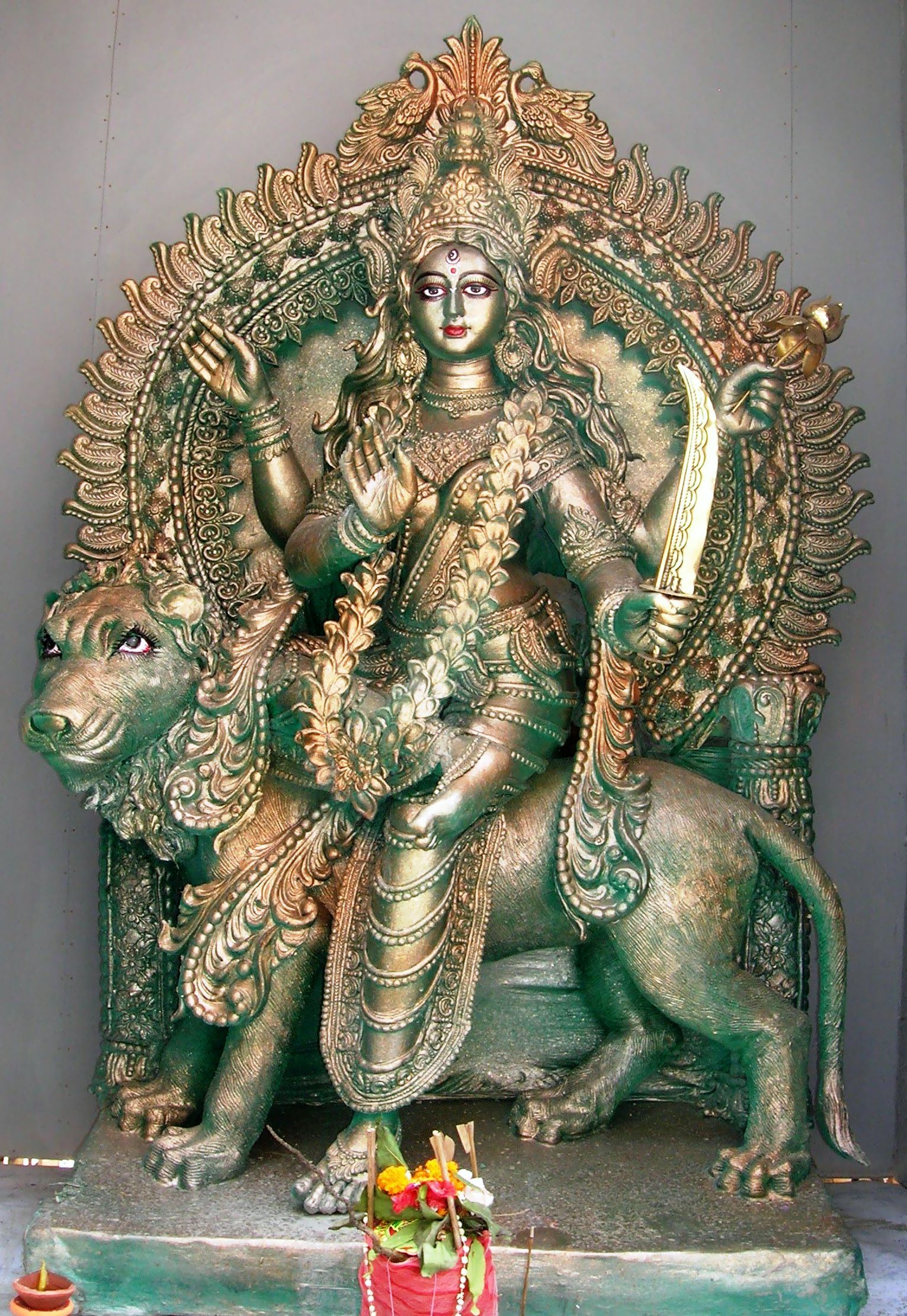
In the sacred journey through the nine nights of Navadurga, the sixth day brings us face to face with one of the most compelling manifestations of the Divine Feminine – Katyayani. She stands as a bridge between contemplative devotion and decisive action, embodying the moment when spiritual preparation transforms into dynamic courage. Her story reveals how divine grace manifests through human dedication, and how the goddess responds to sincere seeking with unprecedented power.
The Sacred Origin: When Devotion Calls Forth Divinity
The emergence of Katyayani represents one of mythology’s most beautiful examples of how intense spiritual practice can summon divine intervention. Her very existence stems from the profound austerities of the sage Katyayana, whose name she bears as both honor and origin story.
Ancient texts tell us that Katyayana, through years of unwavering penance and meditation, reached such depths of devotion that the cosmos itself responded. The Mother Goddess, moved by his sincere tapas (spiritual discipline), manifested before him in a form that would become known as Katyayani. This wasn’t merely an appearance – it was a divine promise that spiritual discipline, when combined with pure intention, has the power to invoke extraordinary transformation.
This origin story reveals a fundamental truth about the goddess tradition: divine power doesn’t remain distant or abstract, but responds intimately to genuine seeking. Katyayani’s manifestation demonstrates that the gap between human aspiration and divine grace can be bridged through sustained practice and devotion.
The Warrior’s Form: Understanding Divine Iconography
When we encounter Katyayani in temple art and sacred imagery, every detail speaks to her unique role in the cosmic order. Her six-armed form isn’t merely symbolic decoration – it represents the multidimensional nature of divine intervention in human affairs.
Her golden or light red complexion radiates the vitality of action combined with the warmth of compassion. Unlike purely transcendent deities, Katyayani’s coloring suggests someone actively engaged in worldly concerns while maintaining divine luminosity. She appears youthful, embodying the fresh energy needed for transformation and change.
Each of her six hands carries specific meaning: the trident (trishula) represents mastery over the three gunas (fundamental qualities of nature), the sword (khadga) symbolizes the cutting through of ignorance, the bow and arrow suggest focused intention and precise action, the disc (chakra) represents the cyclical nature of time and karma, while the lotus (padma) reminds us that even in battle, purity and beauty must be preserved.
Her fierce yet compassionate expression captures the paradox of divine love – sometimes love must wear the face of sternness to protect and guide. She rides the lion, that king of beasts, demonstrating that fearlessness isn’t the absence of challenge, but the sovereignty over it.
The Legendary Deeds: Cosmic Battles and Their Meaning
Katyayani’s legends weave through some of the most dramatic narratives in Hindu mythology, particularly the epic battles described in the Devi Mahatmya. While the defeat of the buffalo demon Mahishasura is primarily attributed to Durga, regional traditions recognize Katyayani’s crucial role in igniting the divine energy that made this victory possible.
In the cosmic battle against the asura brothers Shumbha and Nishumbha, Katyayani’s fierce incantations serve as a rallying cry for all divine forces. Her presence transforms isolated struggles into unified cosmic action. This reflects a profound spiritual truth: individual challenges are often part of larger universal patterns, and invoking Katyayani’s energy connects personal battles to cosmic forces of justice and transformation.
These battle narratives shouldn’t be read merely as ancient war stories, but as sophisticated psychological and spiritual allegories. The demons represent internal negativities – doubt, fear, ego, and ignorance – that must be confronted with both fierce determination and divine grace.
The Sacred Practice: Rituals That Transform Devotion
The worship of Katyayani reveals how ancient wisdom translates into practical spirituality. Her primary mantra, “Om Katyayanayai Namah,” serves as more than mere repetition – it becomes a sonic bridge between human consciousness and divine energy. Regular chanting of this mantra is said to cultivate the inner courage needed for life’s inevitable challenges.
The practice of Kumari Puja – honoring young girls as living representatives of the goddess – demonstrates Katyayani’s connection to pure, untainted spiritual energy. On her special day during Navadurga, families invite nine unmarried girls into their homes, wash their feet, and offer them food and gifts. This ritual recognizes that divine energy often manifests through innocence and purity, reminding adults to honor the sacred potential within youth.
The offering of marigolds and yellow chrysanthemums reflects her sunny, dynamic nature. These flowers, bright and resilient, mirror the qualities devotees seek to cultivate – the ability to maintain inner light even in difficult circumstances.
The Deeper Symbolism: From Fear to Fearlessness
Katyayani’s spiritual significance extends far beyond her role as a warrior goddess. She represents the crucial transformation from passive spirituality to active engagement with life’s challenges. Her emergence from Katyayana’s meditation suggests that true spiritual practice must eventually move from contemplation to courageous action.
The balance she maintains between compassion and fierce determination offers a model for navigating modern life’s complexities. She demonstrates that spiritual advancement doesn’t require becoming passive or withdrawn, but rather developing the wisdom to know when gentleness serves and when firmness becomes necessary.
Her six-armed form symbolizes the ability to handle multiple challenges simultaneously while maintaining spiritual centeredness. In our multitasking world, Katyayani’s iconography offers a divine template for managing complexity without losing inner peace.
Festival Celebrations: Community and Cosmic Connection
During Navadurga, the sixth day dedicated to Katyayani marks a pivotal moment in the festival’s spiritual arc. Communities across India gather for special pujas, devotional songs, and recitations of the Devi Mahatmya. These gatherings demonstrate how individual transformation connects to collective spiritual elevation.
The Katyayani Vrat, observed particularly in North India, shows her protective aspect extending to family welfare. Married women fast and pray for their husbands’ well-being, drawing on her energy to safeguard their loved ones. This practice recognizes that personal spiritual development serves not just individual growth but the welfare of entire family systems.
Regional temple fairs and processions, especially in Uttar Pradesh and Bihar, blend classical iconography with local musical and artistic traditions. These celebrations demonstrate how universal spiritual principles adapt to local cultural expressions while maintaining their essential transformative power.
The Navadurga Journey: Katyayani’s Unique Position
Within the sequence of nine goddess forms, Katyayani occupies a crucial transitional position. She follows the contemplative energy of earlier forms like Brahmacharini and Chandraghanta, while preparing devotees for the more intense transformational energies of Kali and Mahagauri that follow.
This positioning isn’t accidental – it reflects the natural progression of spiritual development. Initial stages focus on building foundation through discipline and devotion. Katyayani represents the moment when this accumulated spiritual energy must be channeled into active engagement with both internal and external challenges.
She serves as the divine catalyst that transforms spiritual preparation into spiritual action, showing that authentic religious practice ultimately leads to enhanced capacity for courageous living.
The Contemporary Relevance: Ancient Wisdom for Modern Challenges
In our contemporary world, Katyayani’s message becomes particularly relevant. We live in times requiring both inner stability and outer courage – the ability to maintain spiritual centeredness while actively engaging with complex social, environmental, and personal challenges.
Her teaching suggests that true fearlessness isn’t the absence of fear, but the cultivation of courage that can act despite fear. This distinction proves crucial for anyone seeking to live authentically while navigating modern pressures and uncertainties.
The goddess tradition, as embodied by Katyayani, offers a model of empowerment that includes both inner development and outer effectiveness. She demonstrates that spiritual advancement and worldly competence aren’t opposites, but complementary aspects of integrated living.
Conclusion: The Continuing Transformation
Katyayani’s worship ultimately offers a profound integration of devotional discipline and dynamic courage. Through her story, iconography, and practices, she guides sincere seekers toward the transformation of inner negativity into enlightened action.
Her message resonates across centuries: spiritual development requires not just contemplation, but the courage to act from that contemplation. In honoring Katyayani, devotees connect with an ancient current of wisdom that transforms fear into fearlessness, hesitation into determination, and spiritual seeking into authentic spiritual living.
The goddess who emerged from Katyayana’s devoted practice continues to emerge wherever sincere hearts call for the courage to transform themselves and their world. In her fierce compassion and dynamic grace, we find both the challenge and the support needed for our own ongoing transformation.
Leave a Reply