
In the shadowed depths of the ancient Greek imagination lies a profound understanding of justice—not the swift, merciful justice of mortals, but the eternal, perfectly calibrated retribution of the gods. The Underworld, particularly the tormented realm of Tartarus, serves as a cosmic courtroom where divine justice unfolds through punishments that mirror the very essence of each transgression.
These mythological punishments reveal more than mere divine cruelty; they represent a sophisticated moral philosophy where consequences perfectly reflect crimes, creating what scholars call poetic justice. Each condemned soul endures a fate that eternally embodies their fundamental character flaw, transforming their punishment into a perpetual reminder of their transgression.
The Architecture of Eternal Consequence
Greek mythology presents punishment not as arbitrary divine wrath, but as cosmic balance restored. The gods, in their infinite wisdom and terrible justice, crafted consequences that would forever mirror the nature of each offense. This principle of proportional retribution creates a moral universe where hubris, betrayal, and sacrilege receive their perfect counterparts in eternal suffering.
The realm of Tartarus becomes a theater of divine justice, where each punishment serves as both personal torment and universal warning. These stories functioned as powerful moral instruction for ancient Greek society, illustrating the inevitable consequences of defying divine order, natural law, and sacred bonds.
Sisyphus: The Eternal Futility of Deception
King Sisyphus of Corinth embodied the ultimate trickster—a mortal so cunning he believed himself capable of outwitting death itself. His first great deception involved trapping Thanatos, the personification of death, in chains, disrupting the natural order by preventing all mortals from dying. When Ares eventually freed Thanatos, Sisyphus faced his inevitable end, but the clever king had prepared one final trick.
Before his death, Sisyphus instructed his wife not to perform the proper burial rites. Upon arriving in Hades, he convinced Persephone that his improper burial was an oversight requiring his temporary return to the living world to correct this sacred obligation. Once back among the living, Sisyphus simply refused to return, living for many more years until age finally claimed him.
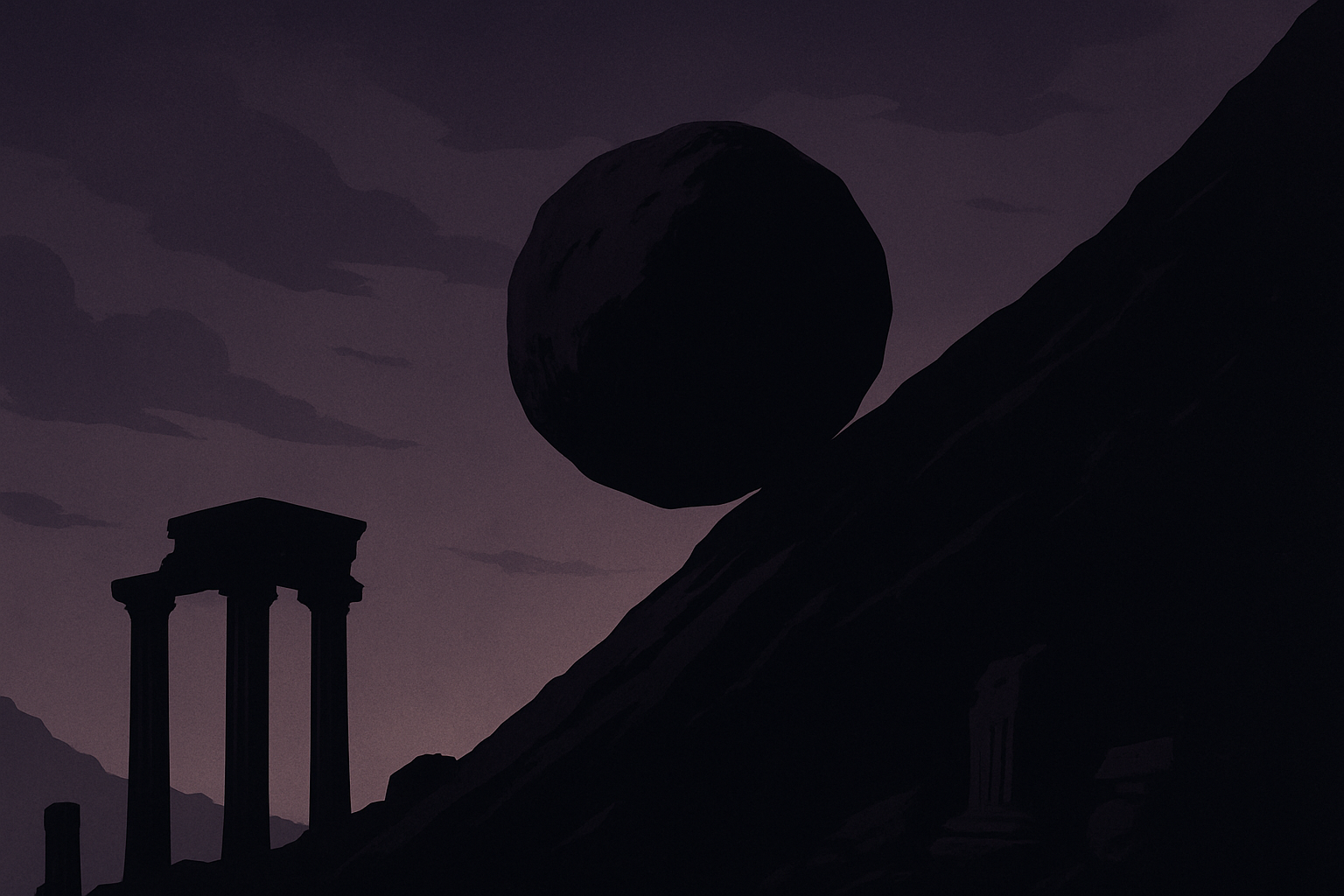
His punishment perfectly reflects his crime: condemned to roll a massive boulder up a steep hill in Tartarus, Sisyphus must watch it tumble back down each time he nears the summit. This endless cycle of effort without achievement mirrors his futile attempts to escape the natural order of mortality. The punishment transforms his cleverness into perpetual frustration, his triumph into eternal defeat.
The image of Sisyphus has resonated through millennia, becoming a symbol of humanity’s struggle against meaningless existence. His boulder represents the weight of hubris—the belief that mortal cunning can overcome divine will and natural law.
Tantalus: The Agony of Perpetual Desire
The punishment of Tantalus explores a different dimension of divine justice: the transformation of abundance into eternal want. As the son of Zeus, Tantalus enjoyed unprecedented access to divine favor and celestial knowledge. Yet this privilege corrupted him, leading to unthinkable acts of sacrilege.
Tantalus committed two grave offenses: first, he murdered his son Pelops and served the child’s flesh to the gods at a divine banquet, testing whether their omniscience was genuine. Second, he stole ambrosia and nectar—the food and drink of immortality—to share with mortals, violating the sacred boundary between divine and human realms.
In Tartarus, Tantalus stands forever in a pool of crystal-clear water beneath a tree heavy with luscious fruit. When thirst torments him and he bends to drink, the water recedes beyond his reach. When hunger drives him to grasp for nourishment, the branches lift the fruit away from his desperate fingers. His punishment eternally embodies the gap between desire and fulfillment, transforming his former abundance into infinite want.
The English word “tantalize” preserves his legacy, capturing the essence of his torment: the agony of forbidden longing, the pain of seeing what cannot be possessed. His punishment reflects not just his specific crimes, but the fundamental human condition of desire itself.
Prometheus: The Price of Defiant Compassion
Among all the punishments in Greek mythology, Prometheus’ suffering carries perhaps the most complex moral weight. Unlike the others, his crimes stemmed not from selfishness or hubris, but from compassion for humanity and defiance of divine tyranny.
The Titan Prometheus first angered Zeus during the establishment of sacrificial rites, tricking the king of gods into accepting bones and fat while humans kept the meat. This deception challenged Zeus’s authority and disrupted the proper relationship between gods and mortals. But Prometheus’ greatest transgression was stealing fire from Olympus itself—the sacred flame representing knowledge, technology, and civilization—and delivering it to humanity.
Chained to a rock on Mount Caucasus, Prometheus endures daily torment as an eagle tears at his liver, which regenerates each night only to be devoured again. This punishment transforms his gift of regeneration—his immortality—into the very source of his suffering. The liver, believed by Greeks to be the seat of passion and emotion, becomes the focus of his endless agony.
Prometheus represents the archetypal rebel hero, suffering for humanity’s benefit. His punishment illuminates the cost of defying divine authority, even for noble purposes. Unlike other mythological sufferers, Prometheus maintains his dignity and righteousness throughout his torment, becoming a symbol of heroic endurance and sacrifice for the greater good.
Ixion: The Wheel of Betrayed Trust
King Ixion’s punishment addresses the violation of two fundamental pillars of Greek society: hospitality and marital fidelity. His first crime was murdering his father-in-law to avoid paying the agreed bride-price, a betrayal of family bonds and contractual obligations. When Zeus, moved by pity, purified Ixion and welcomed him to Olympus, the ungrateful king repaid this divine hospitality by attempting to seduce Hera herself.
Bound to a fiery, winged wheel that spins eternally—first through the heavens as a warning to all, later in the depths of Tartarus—Ixion’s punishment embodies the unceasing nature of his crimes. The wheel never stops, just as his treachery knew no bounds. The fire that burns him reflects the consuming nature of his lust and murderous impulses.
His circular torment mirrors the cyclical nature of betrayal: each revolution represents another violation of trust, another moment of treachery. The wheel becomes both his prison and the perfect symbol of his character—forever spinning, never progressing, trapped in endless repetition of his fundamental nature.
Tityus: The Consequence of Attacking the Divine
The giant Tityus represents the dangers of assuming that physical might can overcome divine protection. His crime was straightforward but grave: he assaulted Leto, mother of the twin gods Artemis and Apollo, committing sacrilege against a figure sacred to Zeus himself.
Stretched across nine acres in Tartarus, Tityus suffers as two vultures perpetually feast on his regenerating liver. His punishment echoes that of Prometheus but with crucial differences: where Prometheus suffered for humanity’s benefit, Tityus endures torment as consequence of his own lustful violence. The vultures, unlike Prometheus’ single eagle, emphasize the degrading nature of his suffering.
His enormous size, once a source of confidence and power, becomes the foundation of his eternal vulnerability. Spread across vast space, he cannot escape or defend himself, transforming his former strength into perpetual helplessness. The punishment perfectly reflects the nature of his crime: just as he attempted to violate divine boundaries, the vultures eternally violate the boundaries of his flesh.
The Danaids: The Futility of Cleansing Murder
The fifty daughters of Danaus present perhaps the most psychologically complex punishment in Greek mythology. Commanded by their father to murder their husbands on their wedding night—ostensibly to prevent a prophecy that one of these men would kill Danaus—they obeyed with only one exception. Hypermnestra spared her husband Lynceus, but the other forty-nine carried out the horrific deed.
In Hades, the Danaids face eternal condemnation to fill a basin with water using perforated jugs, or in some versions, to carry water in vessels that leak endlessly. Their punishment transforms the act of cleansing—traditionally associated with purification from blood guilt—into an eternal impossibility. They can never complete their task, just as they can never truly cleanse themselves of their crime.
The leaking vessels symbolize their broken marriage vows, their shattered relationships, and their inability to contain or control the consequences of their actions. Water, the universal symbol of purification and life, becomes the instrument of their eternal frustration. They are forever attempting what they can never achieve: washing away the blood of their victims and the stain of their betrayal.
The Eternal Mirror of Human Nature
These six punishments reveal the sophisticated moral philosophy underlying Greek mythology. Each consequence reflects not merely the specific crime committed, but the fundamental character flaw that enabled such transgression. Sisyphus’ cleverness becomes futile repetition; Tantalus’ abundance transforms into perpetual want; Prometheus’ immortal strength becomes the source of eternal suffering; Ixion’s restless treachery manifests as endless spinning; Tityus’ overwhelming size enables overwhelming vulnerability; and the Danaids’ attempt at cleansing becomes eternal futility.
The Greek understanding of divine justice transcends simple punishment and reward. These mythological consequences serve as mirrors, reflecting the essence of human nature back upon itself. They suggest that our greatest strengths, when corrupted by hubris or selfishness, become the very instruments of our downfall.
In the architecture of Greek moral thought, these punishments function as both warning and wisdom. They remind us that every action carries within it the seed of its own consequence, and that the gods—representing natural law, cosmic order, and moral truth—ensure that justice ultimately prevails. The Underworld becomes not merely a place of punishment, but a realm where truth is finally revealed and consequences perfectly aligned with causes.
These eternal punishments continue to resonate because they illuminate timeless aspects of human nature: our tendency toward hubris, our capacity for betrayal, our struggle between desire and limitation. In their endless suffering, these mythological figures become cautionary tales, moral instruction, and ultimately, profound reflections on the human condition itself.
Leave a Reply