
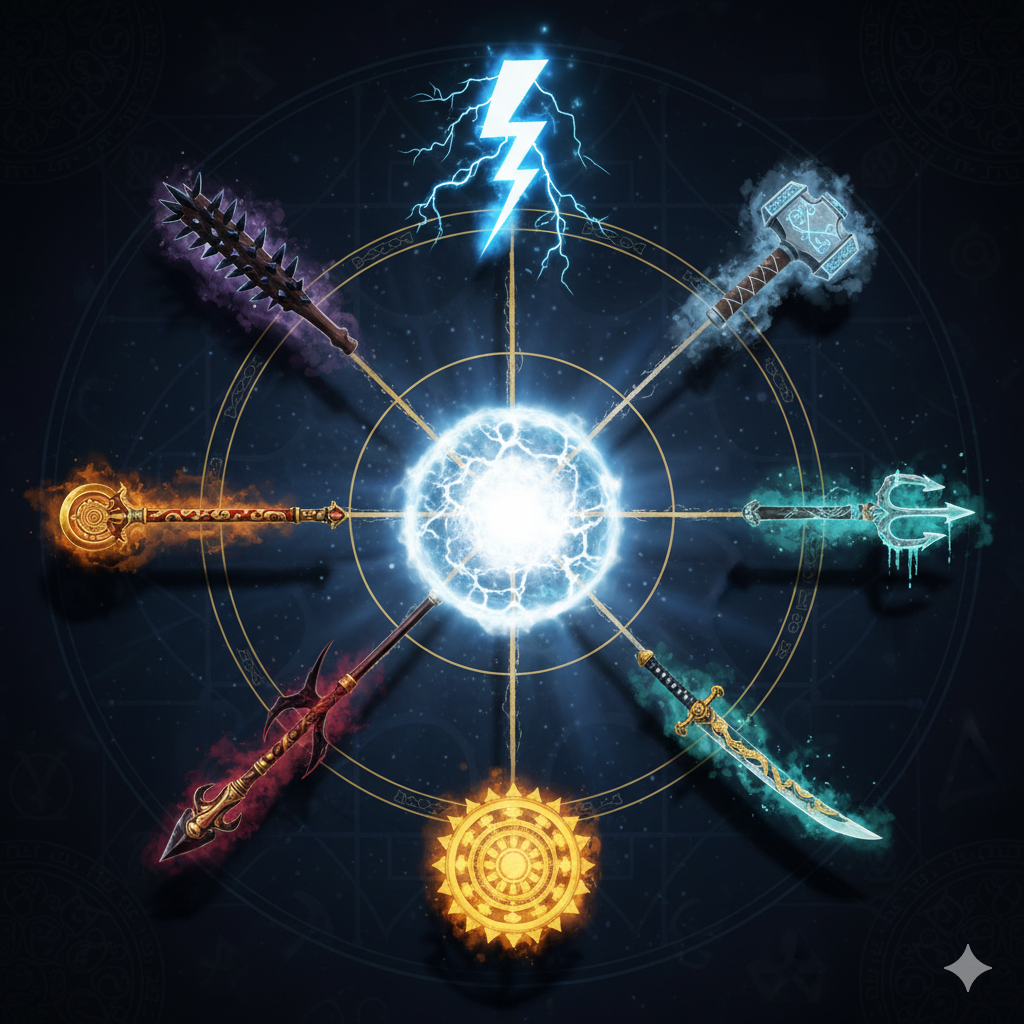
Throughout human civilization, mythological weapons have transcended their role as mere instruments of warfare. These legendary armaments represent something far more profound—they embody divine authority, cosmic forces, and the fundamental relationship between mortals and the supernatural realm. From thunderbolts that split mountains to staffs that bridge heaven and earth, these weapons reveal how cultures understood power, justice, and the forces that govern existence.
The Nature of Mythological Weaponry
Mythological weapons occupy a unique space between the physical and metaphysical worlds. Unlike ordinary armaments, these legendary implements often possess consciousness, require moral worthiness from their wielders, and operate according to cosmic principles rather than simple mechanical force. They serve as bridges between divine and mortal realms, transforming their bearers into conduits of supernatural power.
Across cultures, certain universal patterns emerge. Lightning weapons appear repeatedly—from Zeus’s thunderbolt to Indra’s Vajra—suggesting humanity’s primal recognition of electricity as a manifestation of divine fury. Many legendary weapons bear names and histories that transform them into characters within their own narratives, possessing agency and personality beyond the heroes who wield them.
The most significant weapons typically require more than physical strength; they demand spiritual advancement, adherence to moral codes, or mastery of sacred knowledge. This recurring theme reflects a fundamental human understanding: ultimate power carries ultimate responsibility.
Hindu Mythology: The Celestial Arsenal of Astras
Hindu mythology presents perhaps the most sophisticated and comprehensive system of divine weaponry found in any tradition. The concept of astras represents weapons that function not through physical mechanics but through cosmic principles and divine consciousness. These celestial armaments blur the boundaries between technology and theology, requiring sacred mantras for activation and embodying conscious entities imbued with divine essence.
At the apex of this divine arsenal stands the Brahmastra, Lord Brahma’s supreme creation. This weapon transcends conventional understanding of destruction—it manifests as an instrument of cosmic justice capable of annihilating entire armies or civilizations. The Brahmastra’s activation requires immense concentration, unwavering adherence to dharma (cosmic law), and knowledge of specific sacred mantras. More significantly, the weapon itself possesses consciousness and can refuse to function if the wielder lacks moral fitness, embodying the principle that ultimate power must serve ultimate good.
Vishnu’s Sudarshan Chakra represents another dimension of Hindu divine weaponry. This celestial disc, spinning with the force of creation itself, never misses its target and returns to its wielder’s hand. Its circular form symbolizes the cyclical nature of time and dharma, while its unerring accuracy represents the inevitability of divine justice.
Shiva’s Pinaka, the divine bow, demonstrates the destructive aspect of cosmic transformation. According to tradition, merely the vibration of its string possessed enough power to destroy worlds, reflecting Shiva’s role as both destroyer and regenerator within the cosmic cycle.
Indra’s Vajra, a thunderbolt weapon forged from the sage Dadhichi’s bones, connects Hindu mythology to the broader tradition of lightning weapons across cultures. It represents both the power of sacrifice—as Dadhichi willingly gave his body to create it—and the divine authority to maintain cosmic order against the forces of chaos.
The legendary bows of heroes like Arjuna’s Gandeeva and Karna’s Vijaya carried their own divine heritage and supernatural capabilities. These weapons required not merely physical prowess but spiritual advancement, creating a hierarchy of worthiness that extended beyond mortal skill into the realm of divine favor and karmic destiny.
Greek Mythology: Raw Divine Force Made Manifest
Greek mythology presents weapons that embody the primal forces of nature and the absolute authority of the Olympian gods. These armaments represent power in its most direct and overwhelming form, reflecting the Greek understanding of divinity as a force both magnificent and terrifying.
Zeus’s Thunderbolt stands as perhaps the most iconic weapon in Western mythology. Forged by the Cyclopes during the Titanomachy, these lightning bolts served as Zeus’s primary instrument of authority and vengeance. When wielded against the Titans, they possessed enough power to pin these primordial beings beneath mountains, creating volcanic fires like those of Mount Etna. The myth describes how even when the monster Typhon hurled mountains at Zeus, they recoiled through the sheer force of the thunderbolt’s power, demonstrating that divine authority supersedes even the most massive physical forces.
The Harpe represents a different aspect of divine weaponry—the cyclical nature of power and the inevitability of succession. This curved, sickle-like blade, forged from adamantine (a mythical indestructible metal), passed through generations of divine conflict. Kronos first wielded it to castrate and overthrow his father Ouranos, establishing a pattern of succession through violence. The weapon later passed to Zeus during his own rebellion against Kronos, and eventually to the hero Perseus, who used it to decapitate Medusa. The Harpe’s journey through divine history symbolizes how power itself transforms and transfers, carrying the weight of past revolutions into each new era.
Poseidon’s Trident controlled not just the seas but the very foundations of the earth, causing earthquakes and storms with equal facility. Its three prongs represented Poseidon’s dominion over all waters—oceans, rivers, and underground springs—making it a symbol of the interconnectedness of all aquatic realms.
Athena’s Aegis, whether described as a shield or breastplate, provided more than physical protection. Adorned with the face of Medusa, it struck terror into enemies while protecting its bearer. This dual nature—defense and psychological warfare—reflected Athena’s wisdom in understanding that victory often comes through the mind rather than mere force.
The silver bows of Artemis and Apollo never missed their targets, representing the precision and inevitability of divine will. When Apollo’s arrows struck, they brought plague; when Artemis’s found their mark, they ensured swift death for women in childbirth. These weapons embodied the Greek understanding that the gods’ actions, however harsh, served cosmic purposes beyond mortal comprehension.
Norse Mythology: Weapons Woven with Fate
Norse mythology presents weapons deeply entwined with the concepts of fate, destiny, and the inevitable end of all things. These armaments reflect a worldview where even the gods march toward their destined doom, making their weapons symbols of both power and the cosmic order’s fragility.
Mjölnir, Thor’s legendary hammer, embodies this duality more than any other Norse weapon. Forged by the dwarven brothers Brokk and Sindri under a wager with Loki, the hammer emerged as both destroyer and protector. Its short handle—a flaw introduced by Loki’s interference—paradoxically made it more effective as a throwing weapon while symbolizing how even divine instruments carry imperfections.
Mjölnir could level mountains, summon lightning, and strike with such force that it created thunder itself. Yet it also served sacred purposes: blessing marriages, consecrating births, and even resurrecting the dead in some traditions. This dual nature made it central to both warfare and the most intimate moments of Norse life. Warriors wore miniature replicas as protective amulets, while the hammer’s sign blessed newlyweds and newborns alike.
Gungnir, Odin’s spear, represents a different dimension of Norse divine power—the authority of wisdom and the inexorability of fate. Crafted by the Sons of Ivaldi and inscribed with runes, this weapon never missed its target regardless of the skill of the person throwing it. Its accuracy derived not from physical perfection but from the cosmic principle that Odin’s will, like fate itself, could not be thwarted.
When Odin cast Gungnir to signal the beginning of the Aesir-Vanir War, the act transcended mere military action. It represented fate’s declaration, the moment when future became present and possibility solidified into inevitability. The spear’s connection to Odin’s role as the god of wisdom and prophecy made it as much an instrument of knowledge as of war.
The legendary sword Gramr from the Volsunga Saga embodies the Norse concept of inherited destiny and heroic legacy. Passed from Sigmund to his son Sigurd, this blade could cleave through solid rock and possessed enough power to slay the dragon Fafnir. Yet the sword’s journey through generations illustrated how fate and family intertwine in Norse thought—heroic destiny flows through bloodlines, carrying both glory and doom to successive generations.
Celtic Mythology: Weapons of Beautiful Tragedy
Celtic mythology presents weaponry that emphasizes both extraordinary skill and the tragic dimensions of heroic destiny. These weapons often carry a sense of beautiful fatalism, where power and sorrow interweave inseparably.
The Gáe Bulg, wielded by the legendary hero Cú Chulainn, translates to “spear of mortal pain” and represents one of the most uniquely designed weapons in world mythology. Crafted from the bone of the sea monster Curruid, this barbed spear entered the body as a single wound but then opened into thirty barbs inside the victim’s flesh. Removal became impossible without cutting away surrounding tissue, ensuring that any wound proved fatal.
The technique for using the Gáe Bulg revealed its singular nature—it had to be cast “from the fork of the toes” rather than thrown by hand, a highly specialized skill that only Cú Chulainn mastered through rigorous training under the warrior woman Scáthach. This unusual method transformed the weapon from a simple projectile into an extension of its wielder’s entire being, requiring physical mastery that bordered on the superhuman.
The Gáe Bulg’s most tragic aspect emerged in the tale of Cú Chulainn’s combat with his foster brother Ferdia. Despite their deep bond, fate forced them into mortal combat, and Cú Chulainn ultimately used the Gáe Bulg to strike down his dearest friend. This moment epitomizes Celtic heroic tragedy—the weapon that brings glory inevitably brings sorrow, and the greatest warriors must sometimes destroy what they love most.
Fragarach, “The Answerer,” belonged to the sea god Manannán and later to the god Lugh. This sword could pierce any armor and always inflicted mortal wounds, but its true power lay in its ability to force anyone held at its point to answer any question truthfully. This dual nature—combining physical lethality with the revelation of truth—reflected the Celtic understanding that ultimate power extends beyond mere violence into the realm of knowledge and cosmic justice.
Japanese Mythology: Imperial Authority Made Material
Japanese mythology presents the Kusanagi-no-Tsurugi (Grass-Cutting Sword) as more than a weapon—it serves as one of the Three Imperial Regalia, physical manifestations of the divine right to rule Japan. This elevation of a weapon into a symbol of legitimate sovereignty reflects the Japanese understanding of how material objects can embody abstract principles.
The sword’s origin story connects imperial authority directly to divine power. The storm god Susanoo discovered it inside the body of the eight-headed serpent Yamata-no-Orochi after slaying the monster to save a maiden from sacrifice. This violent extraction from chaos—literally cutting order from the body of destruction—established the blade’s essential nature as an instrument that transforms disorder into civilization.
The weapon gained its name when Prince Yamato Takeru found himself trapped in a field of burning grass during an enemy ambush. Using the sword to cut away the grass, he discovered it could control wind according to the direction of its swing. By redirecting the wind, he turned the fire back upon his enemies, transforming certain death into victory. This moment revealed the sword’s true power: not merely cutting, but manipulating natural forces in service of righteous authority.
As a symbol of imperial legitimacy, Kusanagi-no-Tsurugi continues to play a role in Japanese enthronement ceremonies, though it remains hidden from public view. This perpetual concealment adds to its mystique—the sword’s power derives partly from its status as an unseen presence, a divine validation that need not be witnessed to be known.
Chinese Mythology: The Principle of Infinite Adaptation
Chinese mythology presents the Ruyi Jingu Bang, Sun Wukong’s magical staff, as the ultimate expression of adaptability and transformation. Originally a pillar used by the legendary Emperor Yu the Great to measure ocean depths and control floods, this implement embodies Taoist principles of flowing with circumstances while maintaining essential nature.
The staff’s abilities reflect Chinese philosophical concepts more than simple combat utility. It can grow to touch the heavens or shrink to the size of a needle fitting behind Sun Wukong’s ear. Weighing 17,550 pounds, it would be immovable for ordinary beings, yet the Monkey King wields it with effortless grace. This paradox—simultaneously immense and minute, infinitely heavy yet perfectly wielded—illustrates the Taoist understanding that apparent contradictions reveal deeper truths.
Beyond size manipulation, the Ruyi Jingu Bang can create perfect copies of itself, allowing Sun Wukong to transform one staff into thousands during battle. This multiplication capability reflects Buddhist concepts about the illusory nature of form and the relationship between singular and infinite. The staff demonstrates that true power lies not in rigid strength but in endless adaptability.
The weapon’s acquisition from the Dragon King of the East Sea marked Sun Wukong’s transformation from mere trickster into legendary hero. By claiming this ancient implement—one that no one else could even move—he declared himself worthy of cosmic significance, beginning his journey toward enlightenment through rebellion, punishment, and eventual redemption.
Egyptian Mythology: Scepters of Cosmic Order
Egyptian mythology emphasizes scepters and symbolic implements rather than weapons of war, reflecting their understanding that true power manifests through maintaining cosmic order (ma’at) rather than through violence. These implements represented the pharaoh’s divine mandate to preserve harmony between the human and divine realms.
The Was Scepter, topped with the head of Set and ending in a forked base designed for capturing snakes, symbolized the pharaoh’s authority over chaotic forces. In the hands of Set himself, it served as a weapon against Apep, the serpent of chaos who threatened the sun god Ra during his nightly journey through the underworld. This defensive role—protecting cosmic order against primordial chaos—defined the essential purpose of divine authority in Egyptian thought.
The Ankh cross, while not a weapon, represented perhaps the most powerful implement in Egyptian mythology—the key to eternal life itself. Carried by gods and offered to pharaohs, it symbolized the divine gift of immortality and the gods’ power over the transition between life and death.
Ptah’s Scepter combined multiple symbols: the ankh for life, the djed pillar for stability, and the was scepter for power. This combination represented complete divine authority over creation, maintenance, and the eternal order of existence. The scepter demonstrated that in Egyptian understanding, the greatest power lay not in destruction but in the ability to create and preserve.
Mesopotamian Mythology: Weapons of Divine Kingship
Mesopotamian mythology presents weapons intimately connected to divine kingship and the maintenance of civilization against chaos. These implements served both military and symbolic purposes, representing the ruler’s dual role as warrior and cosmic guardian.
Shamash’s Radiant Axe, gifted to the hero-king Gilgamesh, radiated divine light and could cleave through any obstacle. Beyond its cutting power, this weapon granted its wielder wisdom to discern truth from falsehood, embodying the Mesopotamian ideal that legitimate kingship requires both martial prowess and judicial wisdom. The axe’s radiance symbolized how divine authority illuminates darkness, bringing clarity to confusion and order to chaos.
The Abubu, associated with the god Ninurta, translates to “stirrer of the flood” and was interpreted as a mace that causes storms. This weapon reflected Mesopotamian understanding of divine power over natural forces, particularly the life-giving yet potentially destructive floods of the Tigris and Euphrates rivers. Control over such forces defined divine authority in a civilization wholly dependent on managing water.
Aztec Mythology: Sacred Violence and Obsidian Blades
Aztec mythology featured weapons that embodied their complex understanding of warfare as both practical necessity and cosmic ritual. The unique properties of obsidian—volcanic glass sharper than modern steel yet brittle enough to shatter—perfectly symbolized Aztec philosophy regarding the nature of power and sacrifice.
The Macuahuitl, a flat wooden club edged with obsidian blades, could deliver devastating slashing wounds capable of decapitating horses and men alike. Spanish conquistadors reported with horror the weapon’s effectiveness, describing how a single blow could nearly sever a horse’s head. Yet the Macuahuitl’s design revealed purposes beyond simple killing—its structure allowed warriors to wound and capture enemies for ritual sacrifice rather than simply slaying them in battle.
This weapon’s close association with Tezcatlipoca, the god who invented human sacrifice, connected martial prowess directly to cosmic maintenance. Aztec cosmology held that the sun required constant nourishment through human blood to continue its daily journey. The Macuahuitl thus served not merely as a weapon of war but as an instrument of cosmic necessity, making warriors into priests and battles into sacred rituals.
African Traditions: Innovation Through Necessity
African mythology, particularly Zulu traditions, presents the Iklwa—a weapon born from revolutionary military thinking. Named for the sucking sound it made when withdrawn from a body, this short stabbing spear transformed African warfare from long-distance projectile combat into devastating close-quarters formations.
Shaka Zulu’s innovation extended beyond the weapon itself to encompass an entire military system. The Iklwa’s design—a long, broad blade on a short shaft—created a sword-spear hybrid optimized for formation fighting. Combined with the large shield and the famous “bull horns” tactical formation, it made the Zulu kingdom a dominant force in southern Africa.
This transformation represented more than military evolution; it reflected a philosophical shift in understanding warfare. Where previous African traditions emphasized individual combat and distance weapons, the Iklwa system required discipline, coordination, and the subordination of individual glory to collective power. The weapon thus embodied social and political transformation as much as military innovation.
Native American Traditions: Weapons of the Land
Native American cultures developed diverse weapons perfectly adapted to their environments and philosophical understandings of humanity’s relationship with nature. These implements reflected intimate knowledge of local ecosystems and respect for the animals and materials from which they were crafted.
The Atlatl, a spear-thrower, represented sophisticated understanding of mechanical advantage. By extending the arm’s leverage, it could launch darts with tremendous force and accuracy, effectively doubling a hunter’s range. This tool, used across the Americas for thousands of years, demonstrated how human ingenuity could enhance natural ability without requiring complex metallurgy.
Tomahawks served dual purposes as weapons and ceremonial pipes, particularly among Plains tribes. This combination of practical and spiritual functions reflected the Native American understanding that all tools carry significance beyond their immediate utility. A weapon used in war could become an instrument of peace negotiation, transformed by context and intention.
The bow and arrow, used for at least 8,000 years across the Americas, represented perhaps the most successful projectile weapon system ever developed. The infinite variations of arrowheads—from broad hunting points to narrow armor-piercing designs—demonstrated both practical adaptation and artistic expression, as craftspeople imbued functional objects with beauty and cultural meaning.
Universal Patterns and Cultural Revelations
Examining weapons across world mythologies reveals profound patterns in how humanity understands power, responsibility, and the cosmic forces that shape existence. Certain themes emerge repeatedly, suggesting fundamental truths about human nature and our relationship with authority.
Lightning weapons appear in numerous traditions—Zeus’s thunderbolt, Indra’s Vajra, Mjölnir’s lightning—suggesting universal recognition of electricity as divine power made visible. Before scientific understanding of atmospheric electricity, ancient peoples witnessed lightning’s destructive force and concluded that such power could only be divine. These weapons embody the moment when heaven reaches earth, when abstract authority manifests as undeniable physical force.
Many legendary weapons require moral worthiness or spiritual advancement from their wielders. The Brahmastra refuses to activate for the unrighteous; Mjölnir cannot be lifted by the unworthy; Kusanagi-no-Tsurugi legitimizes only rightful emperors. This recurring theme reflects a fundamental human hope: that ultimate power serves ultimate good, that the cosmos itself contains mechanisms preventing evil from wielding divine force.
The most significant weapons possess names, histories, and personalities that transform them into characters within their narratives. They accumulate stories across generations, passing from divine hands to heroic ones, carrying the weight of past deeds into each new era. This anthropomorphization suggests human understanding that tools shape their users as much as users shape tools—that wielding power changes the wielder fundamentally.
Enduring Legacy and Modern Resonance
These mythological weapons continue to influence modern culture, appearing in literature, films, games, and popular imagination as symbols of ultimate power and heroic identity. Their endurance reveals more than mere entertainment value—they tap into fundamental human fascinations with the intersection of mortal ambition and divine might.
Contemporary retellings often focus on the weapons’ physical properties while overlooking their deeper significance. Yet the original myths understood these implements as bridges between worlds, as manifestations of cosmic principles, as tests of character rather than simple tools of violence. A hero’s worthiness to wield a legendary weapon demonstrated not physical strength but moral fitness, spiritual advancement, and alignment with cosmic purpose.
The study of mythological weapons reveals how different cultures conceptualized power, justice, and responsibility. Hindu astras demonstrate systematic theology; Greek weapons embody raw divine force; Norse arms acknowledge fate’s inevitability; Celtic blades carry beautiful tragedy; Japanese swords manifest political legitimacy; Chinese staffs express philosophical principles; Egyptian scepters maintain cosmic order. Each tradition’s unique approach reflects their deepest values and their vision of what it means to wield ultimate power in service of civilization.
These weapons endure not because they represent superior combat utility but because they answer fundamental human questions: What is power? Who deserves to wield it? What responsibilities accompany authority? How do mortal and divine realms intersect? By embodying these questions in physical form, mythological weapons transform abstract philosophy into tangible narrative, making cosmic principles accessible through story.
In the end, weapons across world mythologies serve as more than instruments of destruction or symbols of authority. They represent humanity’s eternal fascination with power’s nature and its proper use—a fascination that remains as relevant today as when these stories first emerged from the depths of human imagination and spiritual understanding.
Leave a Reply