
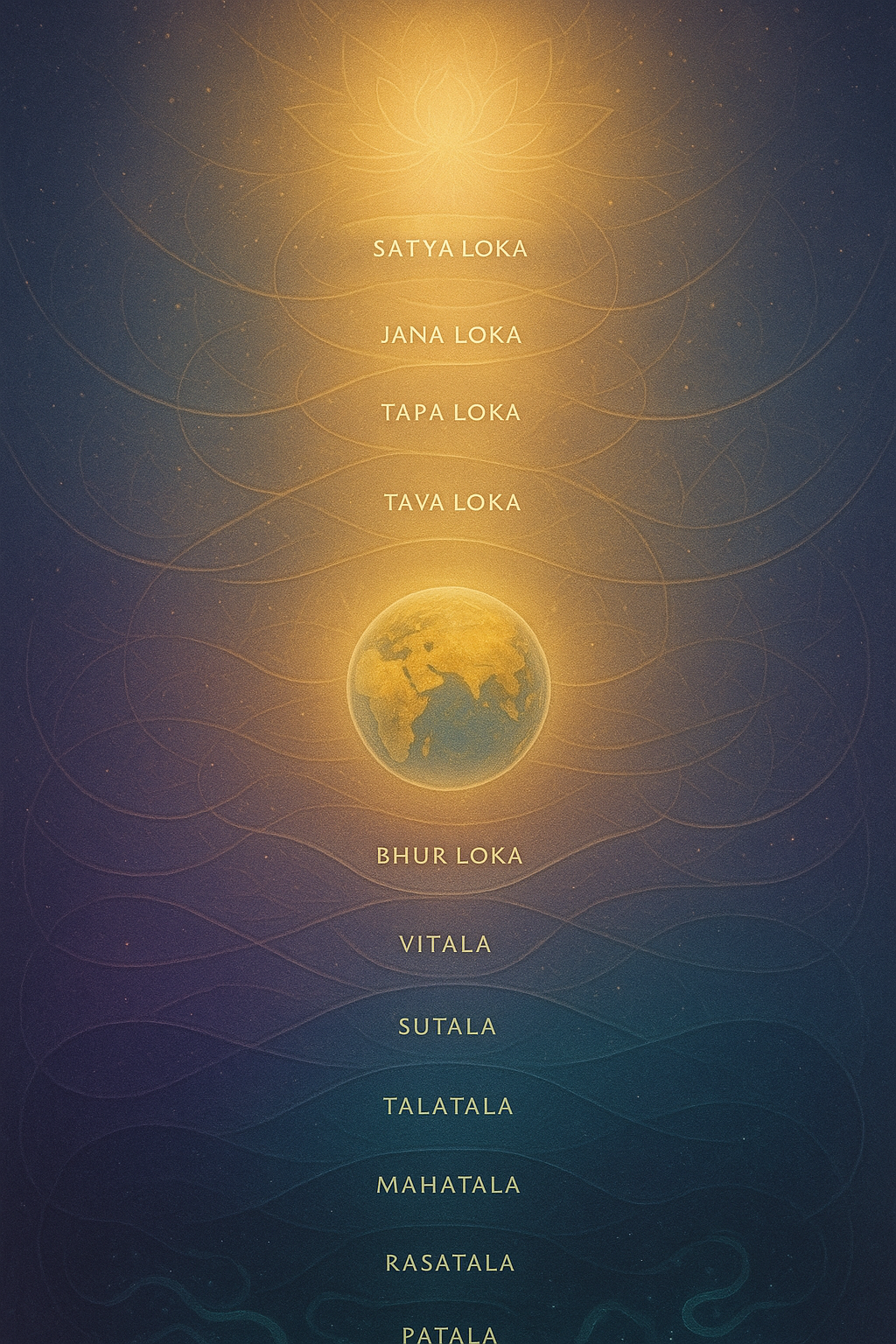
Hindu mythology presents one of the most intricate cosmological frameworks in ancient spiritual literature—a universe structured into fourteen distinct realms known as lokas. These are not merely physical locations scattered across the cosmos, but represent profound states of consciousness, spiritual development, and karmic manifestation. Together, they form a complete map of existence, from the highest divine abodes to the deepest subterranean worlds.
Understanding the Cosmic Architecture
At the heart of Vedic cosmology lies a sophisticated understanding: the universe operates on multiple dimensions simultaneously. The fourteen lokas are divided into two complementary groups—seven upper worlds (Vyahrtis or Urdhva Lokas) ascending toward spiritual enlightenment, and seven lower worlds (Patalas or Adho Lokas) descending into material density and spiritual obscuration.
Earth—our Bhur Loka—serves as the pivotal connection point, the cosmic fulcrum where these realms converge. This placement is significant: it positions human existence at the crossroads of ascension and descent, where beings possess the unique capacity to actively generate karma and consciously choose their spiritual trajectory.
What makes this cosmology particularly profound is its dual nature. These lokas represent both actual planes of existence that souls traverse after death based on their karmic accumulation, and simultaneous states of consciousness accessible through spiritual practice and awareness. A soul’s location within this cosmic hierarchy reflects not just a physical dwelling, but a state of spiritual evolution.
The Ascent: Seven Upper Worlds
Bhur Loka: The Realm of Action
The journey begins on Earth, the physical realm where humans, animals, and countless other beings reside. According to the Vishnu Purana, Earth is merely one among thousands of billions of inhabited worlds throughout the universe. Yet despite its seeming ordinariness, Bhur Loka holds extraordinary importance—it is the only realm where karma can be actively created and modified through conscious action.
This makes human birth precious beyond measure in Hindu philosophy. While higher realms offer greater pleasure and lower realms present harsher conditions, only in the earthly realm do souls possess the crucial combination of awareness, free will, and consequence that allows for genuine spiritual progress.
Bhuvar Loka: The Atmospheric Bridge
Rising above Earth lies Bhuvar Loka, also known as Pitri Loka—the realm of ancestors and semi-divine beings. This atmospheric dimension extends from Earth’s surface to the sun, encompassing the space where celestial entities, departed ancestors, and life-force energies interact.
Bhuvar Loka serves as a transitional zone, a cosmic vestibule where souls pause between earthly incarnations. Here dwell the Pitris—ancestral spirits who maintain connections with their earthly descendants, receiving offerings and prayers while guiding family lineages from beyond the physical veil.
Svar Loka: The Celestial Paradise
Beyond the atmospheric realm lies Svarga—the heaven of popular imagination. Ruled by Indra, king of the gods, this resplendent realm exists between the sun and the polar star, housing all 330 million Hindu deities alongside Gandharvas (celestial musicians), Apsaras (divine dancers), and other celestial beings.
Svar Loka represents the reward realm, where accumulated good karma manifests as divine pleasures, celestial beauty, and freedom from physical suffering. Yet this heaven, magnificent as it is, remains temporary. Once the merit earned through good deeds is exhausted, souls must descend again into lower realms, continuing their karmic cycle.
Mahar Loka: The Sages’ Domain
Here resides an extraordinary class of beings—great rishis and enlightened sages like Markandeya, whose spiritual attainments grant them lifespans of one kalpa (one day of Brahma, equivalent to 4.32 billion human years). These beings have transcended ordinary consciousness but remain within the material universe as guides and preservers of sacred knowledge.
The inhabitants of Mahar Loka possess remarkable abilities, including the power to travel between different lokas at will, perceiving the cosmic structure in its entirety. They serve as cosmic architects, maintaining the universe’s spiritual infrastructure across epochs.
Jana Loka: The Realm of Divine Consciousness
Ascending further, we reach Jana Loka—the dimension of “God consciousness” where divine sages and the Four Kumaras (Sanat, Sanak, Sanatana, and Sanandan) eternally dwell. These four brothers, eternal child avatars of Vishnu, represent pure intellect unburdened by material conditioning.
Beings in Jana Loka possess comprehensive knowledge about all realms above and below, experiencing a state of consciousness where transcendental wisdom and mystic abilities are innate. This realm represents a threshold—beyond which the material gradually dissolves into the purely spiritual.
Tapa Loka: The Dimension of Austerity
In Tapa Loka, consciousness itself becomes the practice. This realm houses the Ayohnija devadas—beings born directly from divine will rather than physical procreation—and great ascetics whose spiritual disciplines have refined their existence to pure awareness.
Here, the Four Kumaras maintain their eternal presence, embodying the paradox of infinite wisdom within childlike forms. Tapa Loka represents consciousness engaged in perpetual self-refinement, where spiritual discipline (tapas) is not a practice but a state of being.
Satya Loka: The Highest Material Realm
At the pinnacle of material creation stands Satya Loka, also called Brahma Loka—the abode of Lord Brahma, the creator deity. This realm embodies ultimate truth (satya) within the bounds of material existence, where souls released from rebirth’s necessity experience the highest possible material consciousness.
Beings here exist for incomprehensible durations—lifespans extending to 311 trillion human years—in a state of nearly perfect spiritual awareness. Yet even Satya Loka, exalted as it is, remains part of the material cosmos subject to creation and dissolution cycles. When Brahma’s day ends, even this highest realm dissolves, only to be recreated when the cosmic creator awakens again.
The Descent: Seven Lower Worlds
The lower realms, collectively known as Patalas, present a mirror image of the upper worlds—not simply as places of punishment, but as dimensions where consciousness becomes increasingly obscured by material illusion, desire, and spiritual ignorance.
Atala Loka: The Realm of Illusory Power
Ruled by Bala, son of the demon architect Maya, Atala represents the first step into spiritual obscuration. Bala possesses remarkable mystical powers, including the ability to manifest different types of beings through supernatural abilities. Yet these powers serve illusion rather than truth, creating temporary pleasures that bind consciousness rather than liberate it.
Atala Loka demonstrates a crucial principle: spiritual power without wisdom becomes a trap, leading souls deeper into material entanglement rather than toward liberation.
Vitala Loka: The Golden Realm
Governed by Hara-Bhava, an incarnation of Lord Shiva known as Hatakesvara (Lord of Gold), Vitala Loka overflows with precious metals. Its inhabitants adorn themselves with gold and jewels extracted from this realm’s abundant mines.
Despite its material wealth and the presence of a form of Shiva, Vitala represents consciousness captivated by material splendor, where even divine presence cannot penetrate the veil of material attachment.
Sutala Loka: The Demon King’s Righteousness
Perhaps the most fascinating of the lower realms, Sutala represents a paradox—a dimension of demons elevated by devotion. Its king, Mahabali, though born an Asura (demon), earned such divine favor through his righteousness and devotion that Lord Vishnu himself guards his kingdom.
Sutala Loka reveals an essential teaching: birth in lower realms doesn’t determine spiritual destiny. Even in the underworlds, righteousness and devotion can create divine grace, demonstrating that consciousness—not location—determines spiritual worth.
Talatala Loka: The Architect’s Illusion
Ruled by Maya, the master demon architect and creator of illusions, Talatala represents consciousness lost in material constructions and intellectual pride. Inhabitants become opinionated and quarrelsome, their awareness fragmented by endless mental constructions that obscure direct spiritual perception.
This realm embodies the danger of intellect divorced from wisdom—the capacity to create elaborate mental worlds that trap consciousness in self-created labyrinths.
Mahatala Loka: The Serpents’ Agitation
In Mahatala dwell great serpents with hundreds and thousands of hoods, powerful Nagas continuously agitated by uncontrolled desires. This realm represents consciousness dominated by raw impulses, where powerful energies exist without the wisdom to channel them constructively.
The serpents’ multiple heads symbolize proliferating desires—each hood a different craving that divides attention and prevents spiritual focus. Consciousness here becomes its own tormentor, powerful yet perpetually unsatisfied.
Rasatala Loka: The Realm of Opposition
Darkness deepens in Rasatala, inhabited by cruel demons and devils opposed to divine order. This realm represents consciousness actively resistant to truth, where beings have surrendered moral discrimination and indulge in desires regardless of right or wrong.
Yet even Rasatala serves a cosmic purpose—by embodying consciousness utterly lost in material illusion, it completes the spectrum of possible states of being, demonstrating what exists when spiritual light is wholly obscured.
Patala Loka: The Beautiful Abyss
At the universe’s foundation lies Patala—the deepest underworld, yet paradoxically described in ancient texts as extraordinarily beautiful. Ruled by Vasuki, the serpent king, and inhabited by the great serpent Shesha (Ananta) who supports the universe on his infinite hoods, Patala brims with jewels, magnificent palaces, and divine light emanating from gem-adorned serpent hoods.
This paradox reveals a profound truth: even in the lowest realm, divine beauty persists. The serpents of Patala are not demons but cosmic beings, their realm not hell but an alternative dimension where consciousness operates according to different principles than those governing higher worlds.
The Cosmic Connection: Chakras and Consciousness
The fourteen lokas find their microcosmic reflection in human physiology through the chakra system. The seven upper worlds correspond to the seven primary chakras—from Muladhara (root) to Sahasrara (crown)—representing ascending levels of spiritual awareness accessible through yogic practice and meditation.
The seven lower worlds connect to energy centers below the base chakras, representing subconscious states, repressed energies, and karmic patterns that require integration for complete spiritual development.
This correspondence suggests that the cosmic journey through lokas mirrors the internal journey of consciousness through different states of awareness. Spiritual practice becomes a form of cosmic travel, allowing practitioners to experientially access different lokas while still inhabiting the physical body.
Beyond Material Creation: The Eternal Realms
The fourteen lokas, vast as they are, represent only material creation—a cosmos subject to creation and dissolution cycles measured in billions of years. Yet Hindu scriptures describe realms beyond this temporal universe, eternal spiritual abodes that transcend material existence entirely.
Vaikuntha: Vishnu’s Eternal Domain
Vaikuntha represents the supreme spiritual realm of Lord Vishnu, existing beyond all material creation in a dimension untouched by time’s passage or cosmic dissolution. Unlike Svarga or even Satya Loka, Vaikuntha never experiences creation or destruction—it simply eternally is.
Souls who reach Vaikuntha never return to material existence, having transcended the cycle of birth and death entirely. Here, consciousness exists in eternal bliss, serving Vishnu and Goddess Lakshmi in a state of spiritual perfection beyond material comprehension.
Goloka Vrindavan: Krishna’s Supreme Abode
Considered the highest spiritual destination, Goloka Vrindavan serves as Lord Krishna’s personal realm, where he appears in his original two-armed form rather than as Vishnu’s avatar. This dimension, described as expanding 240 million miles and located 4 billion miles above even Vaikuntha, resembles a vast lotus with thousands of petals, each representing different divine pastimes.
Goloka transcends not just material existence but even the concept of transcendence itself—it is the original spiritual reality from which all other realms, material and spiritual, emanate.
Shiva Loka: The Abode Beyond Duality
Shiva Loka or Kailasa represents a different quality of transcendence—characterized by yogic energy, absolute stillness, and complete detachment from worldly illusion. This realm exists beyond time’s flow, unaffected by cosmic creation or destruction cycles, embodying pure consciousness in its most pristine state.
The Spiritual Journey: Purpose and Liberation
The loka system ultimately serves as a map for the soul’s evolutionary journey. Each realm offers unique lessons and experiences, challenges and opportunities for growth. Yet the goal is not to reach the highest material realm—even Satya Loka remains within the cycle of creation and dissolution.
The true aspiration is liberation (moksha)—transcending the fourteen lokas entirely to reach the eternal spiritual abodes where consciousness, freed from material conditioning, realizes its essential nature as pure awareness, eternal and blissful.
This journey occurs not just across lifetimes through reincarnation, but within individual consciousness through spiritual practice. The external cosmology reflects internal reality—the heavens and underworlds exist not just as distant realms but as states of mind, patterns of consciousness accessible in every moment.
A Universe of Consciousness
The fourteen lokas reveal Hinduism’s sophisticated understanding of existence as fundamentally multi-dimensional. This is not a simple heaven-and-hell cosmology but an intricate framework acknowledging countless gradations of consciousness, experience, and spiritual development.
Each loka represents a possible state of being, a vibrational frequency of consciousness that souls inhabit based on their karmic actions, spiritual practices, and evolutionary development. The cosmos becomes a vast school, each realm offering specific lessons necessary for the soul’s complete maturation.
From the beautiful abyss of Patala to the truth-realm of Satya Loka, from Earth’s precious opportunity for karmic action to the eternal transcendence of Vaikuntha and Goloka, the lokas chart consciousness itself—its possibilities, its pitfalls, and ultimately, its potential for infinite evolution beyond all material limitations.
This cosmological framework serves not as mere mythology but as a practical map for spiritual seekers, illustrating that the journey toward enlightenment encompasses all possible states of existence, requiring us to integrate and transcend each level of consciousness until we finally arrive at our eternal spiritual nature—beyond creation, beyond dissolution, beyond even the concept of beyond itself.
Leave a Reply