
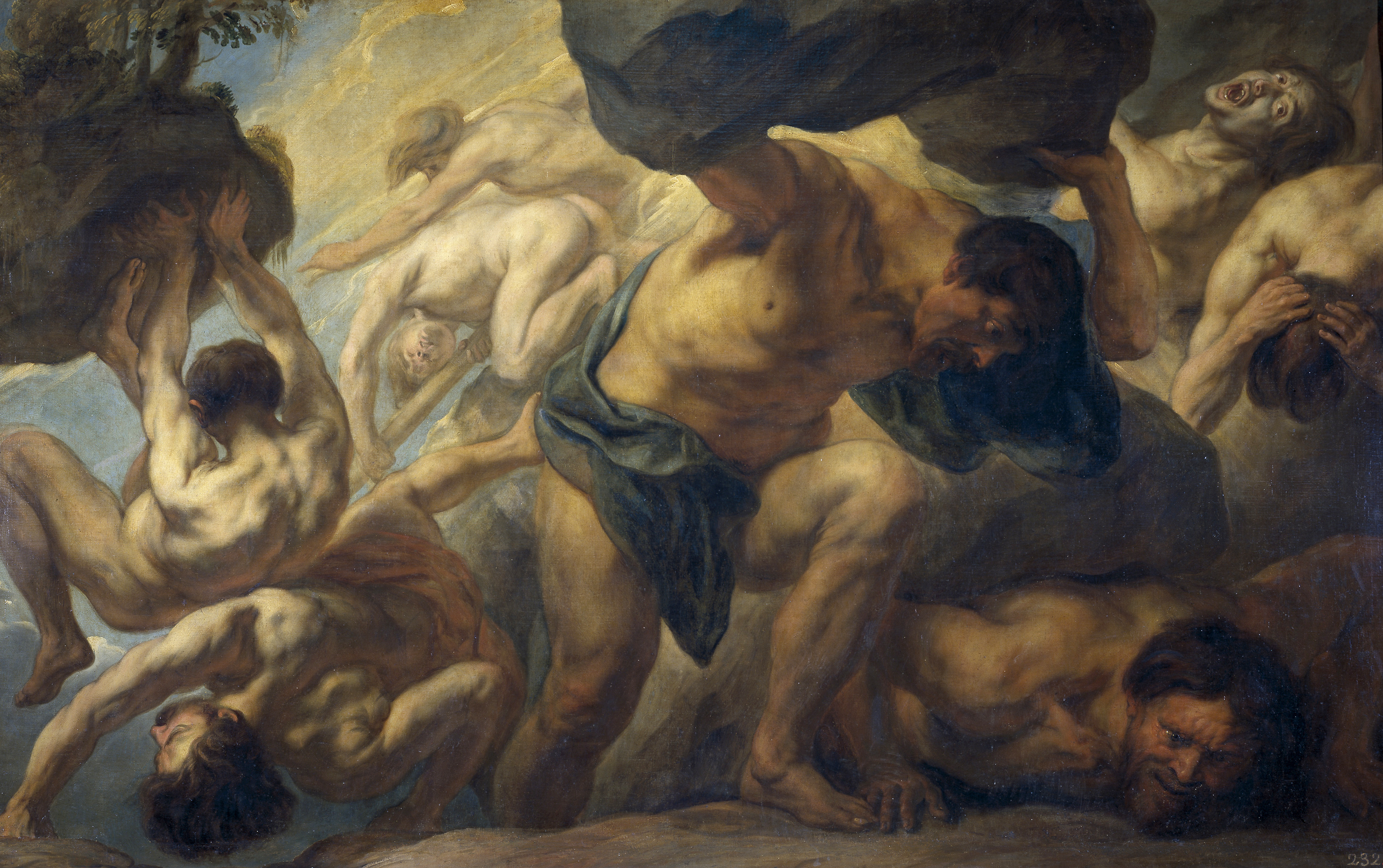
In the vast cosmological tapestry of Greek mythology, before Zeus wielded his thunderbolts and the Olympians ruled from their celestial throne, an earlier generation of divine beings shaped the cosmos. These were the Titans—primordial deities whose reign represented both the pinnacle of ancient harmony and the inevitable tragedy of generational conflict.
The Birth of Divine Order: Children of Sky and Earth
The Titan narrative begins with the fundamental forces of creation itself. Born from the union of Uranus (Sky) and Gaia (Earth), the Titans emerged as the first generation of divine consciousness in the Greek cosmos. This wasn’t merely biological procreation—it was the universe becoming aware of itself through divine beings who embodied the very elements of existence.
According to Hesiod’s Theogony, twelve original Titans came into being, each representing essential cosmic principles that would govern the natural world. The six male Titans controlled the fundamental forces: Oceanus commanded the earth-encircling waters, Hyperion governed light and celestial cycles, Coeus embodied intelligence and the axis of heaven, Crius presided over heavenly constellations, Iapetus ruled mortality and life-span, and Cronus wielded dominion over destructive time itself.
Their female counterparts, the Titanides, complemented these cosmic forces with equally vital powers: Theia brought sight and divine light, Rhea governed fertility and motherhood, Themis maintained justice and divine order, Mnemosyne preserved memory across generations, Phoebe wielded intellect and prophecy, and Tethys controlled rivers and fresh water sources.
Together, these twelve beings represented a complete cosmological system—a divine bureaucracy where every essential aspect of existence had its guardian and governor.
The Violent Transition: Cronus’s Bloody Ascension
The Titans’ rise to power emerged from family violence that would echo through subsequent generations. Uranus, fearful of being overthrown by his children, imprisoned the Cyclopes and Hecatonchires (hundred-handed giants) in Tartarus, the deepest pit of the underworld. This act of paranoid cruelty enraged Gaia, who devised a brutal solution.
Creating an adamantine sickle—a weapon of divine metal harder than diamond—Gaia convinced her youngest son Cronus to castrate his father and seize power. The act was both liberation and curse, freeing the oppressed while establishing a pattern of violent succession that would define divine kingship.
Yet even in his moment of triumph, Cronus received a prophetic warning that would haunt his reign: one of his own children would overthrow him just as he had overthrown Uranus. This curse transformed victory into perpetual anxiety, setting the stage for the Titans’ eventual downfall.
The Golden Age: When Peace Ruled the Earth
Despite its violent origins, the Titans’ reign ushered in what the Greeks remembered as the Golden Age—a period of unprecedented peace and prosperity. Under Titan rule, humanity experienced a world without war, where harvests were abundant, innocence flourished, and festivals marked the rhythm of joyful existence.
This wasn’t merely political stability; it represented a fundamental harmony between divine will and natural order. The Titans, being closer to the primordial forces of creation, maintained a delicate balance where cosmic energies worked in perfect synchronization. Oceanus’s waters flowed without violence, Hyperion’s light nurtured without burning, and Rhea’s fertility blessed the earth without excess.
The Romans later identified this period with Saturn’s rule (their version of Cronus), suggesting that even civilizations beyond Greece recognized something profound about this mythological era—a time when divine governance aligned with natural abundance rather than human ambition.
The Devouring Father: Cronus’s Desperate Solution
Cronus’s response to the prophetic curse revealed the tragic flaw that would doom the Titans: the inability to transcend the cycle of violence that brought them to power. Terrorized by the possibility of overthrow, Cronus devised a horrifying solution—he would swallow each of his children immediately upon birth.
One by one, five of the future Olympian gods—Poseidon, Hades, Hera, Demeter, and Hestia—disappeared into their father’s gullet. This wasn’t merely infanticide; it was an attempt to arrest the natural progression of cosmic evolution, to freeze divine development at a single moment of Titan supremacy.
Yet Cronus’s solution contained the seeds of its own failure. By consuming his children rather than killing them, he preserved their potential for eventual liberation. The gods remained alive within him, growing stronger and more resentful with each passing year.
The Hidden Prince: Zeus’s Secret Upbringing
Rhea’s maternal instincts ultimately shattered Cronus’s plan. When Zeus was born, she collaborated with Gaia to deceive her husband, wrapping a stone in swaddling clothes for Cronus to swallow while secretly spiriting the infant away to Crete. This act of divine subterfuge represented more than maternal protection—it was the cosmos itself ensuring its own evolution.
Zeus’s hidden upbringing on Crete, nurtured by nymphs and protected by the dancing Curetes who drowned out his cries, became a period of preparation for cosmic revolution. Unlike his father, who seized power through violence alone, Zeus would combine strength with strategy, force with wisdom.
The Titanomachy: Ten Years of Cosmic War
When Zeus reached maturity, he initiated the conflict that would reshape the divine order forever. The Titanomachy—literally “the war of the Titans”—began when Zeus forced Cronus to regurgitate his siblings through a potion prepared by the wise Metis. The liberation of the Olympians marked the beginning of a ten-year cosmic conflict that would determine the future governance of existence itself.
The war was fought between two divine strongholds: the Titans commanded Mount Othrys while the Olympians held Mount Olympus. Initially, the sides were evenly matched—both groups possessed divine strength and cosmic authority. However, Zeus demonstrated superior strategic thinking by forming crucial alliances that would tip the balance of power.
First, Zeus liberated the Cyclopes from their Tartarus prison, earning their gratitude and their divine craftsmanship. They forged Zeus’s thunderbolts, Poseidon’s trident, and Hades’ helm of darkness—weapons that would prove decisive in the coming battles. Next, Zeus freed the Hecatonchires, whose ability to hurl 300 boulders simultaneously provided overwhelming firepower against Titan forces.
Perhaps most importantly, Zeus gained the support of several Titans themselves. Themis, goddess of justice, and Prometheus, master of forethought, recognized that Zeus represented a more enlightened form of divine governance. This wasn’t merely political opportunism—it reflected a genuine philosophical division about how cosmic power should be exercised.
The Final Battle: Earth-Shaking Victory
The climactic battle of the Titanomachy was described in terms that suggested cosmic reorganization rather than mere military victory. Zeus unleashed lightning so devastating that forests ignited and the halls of Tartarus trembled. The Hecatonchires’ bombardment of massive boulders created earthquakes that reshaped the landscape.
When the Titans finally surrendered, it marked more than political defeat—it represented the triumph of a new cosmic order that valued strategic wisdom over brute force, collaborative governance over autocratic rule.
Divine Justice: The Titans’ Varied Fates
The aftermath of the Titanomachy revealed Zeus’s more sophisticated approach to power. Rather than simply destroying his enemies, Zeus tailored punishments and rewards based on individual actions during the conflict.
Most Titans were imprisoned in Tartarus under Hecatonchires guard, but significant exceptions revealed Zeus’s nuanced understanding of justice. Oceanus, who remained neutral, retained his oceanic realm. Themis and Prometheus, who supported Zeus, maintained their divine positions and even gained enhanced status.
Atlas received special punishment for his leadership role among the Titans—eternal condemnation to hold up the heavens. This wasn’t merely cruel vengeance but cosmic necessity; someone had to maintain the separation between earth and sky that Uranus’s defeat had disrupted.
The Second Generation: Legacy and Transformation
The Titans’ influence extended far beyond their own reign through their children, who played crucial roles in the new Olympian order. Iapetus’s sons exemplified this complex legacy: Prometheus became humanity’s benefactor by stealing fire from the gods, while Atlas bore the weight of cosmic responsibility. Epimetheus’s acceptance of Pandora demonstrated both Titan naivety and the continuing consequences of divine conflict.
Hyperion and Theia’s children—Helios (sun), Selene (moon), and Eos (dawn)—maintained essential cosmic functions under the new regime, suggesting that some Titan responsibilities were too fundamental to eliminate entirely.
Mythological Significance: Understanding Cosmic Evolution
The Titan narrative serves multiple profound functions in Greek mythological consciousness. On one level, it explains natural phenomena through divine personality and conflict. On another, it represents the inevitable progression from chaotic primordial forces toward organized civilization.
Most significantly, the Titan story explores themes of generational conflict, the tragedy of power, and the necessity of cosmic evolution. The Titans weren’t evil—they were cosmic forces that had outlived their purpose, unable to adapt to the universe’s continuing development.
Eternal Influence: From Ancient Greece to Modern Consciousness
The Titans remain fundamental to understanding Greek mythology’s cosmological structure, representing the bridge between primordial chaos and organized divine governance. Their stories continue influencing literature, art, and popular culture because they address universal themes: the relationship between power and responsibility, the inevitability of change, and the complex legacy that each generation leaves for the next.
In the Titan narrative, we find not just ancient stories but timeless explorations of cosmic order, divine justice, and the eternal struggle between preservation and progress that continues to shape human consciousness across millennia.
Leave a Reply