
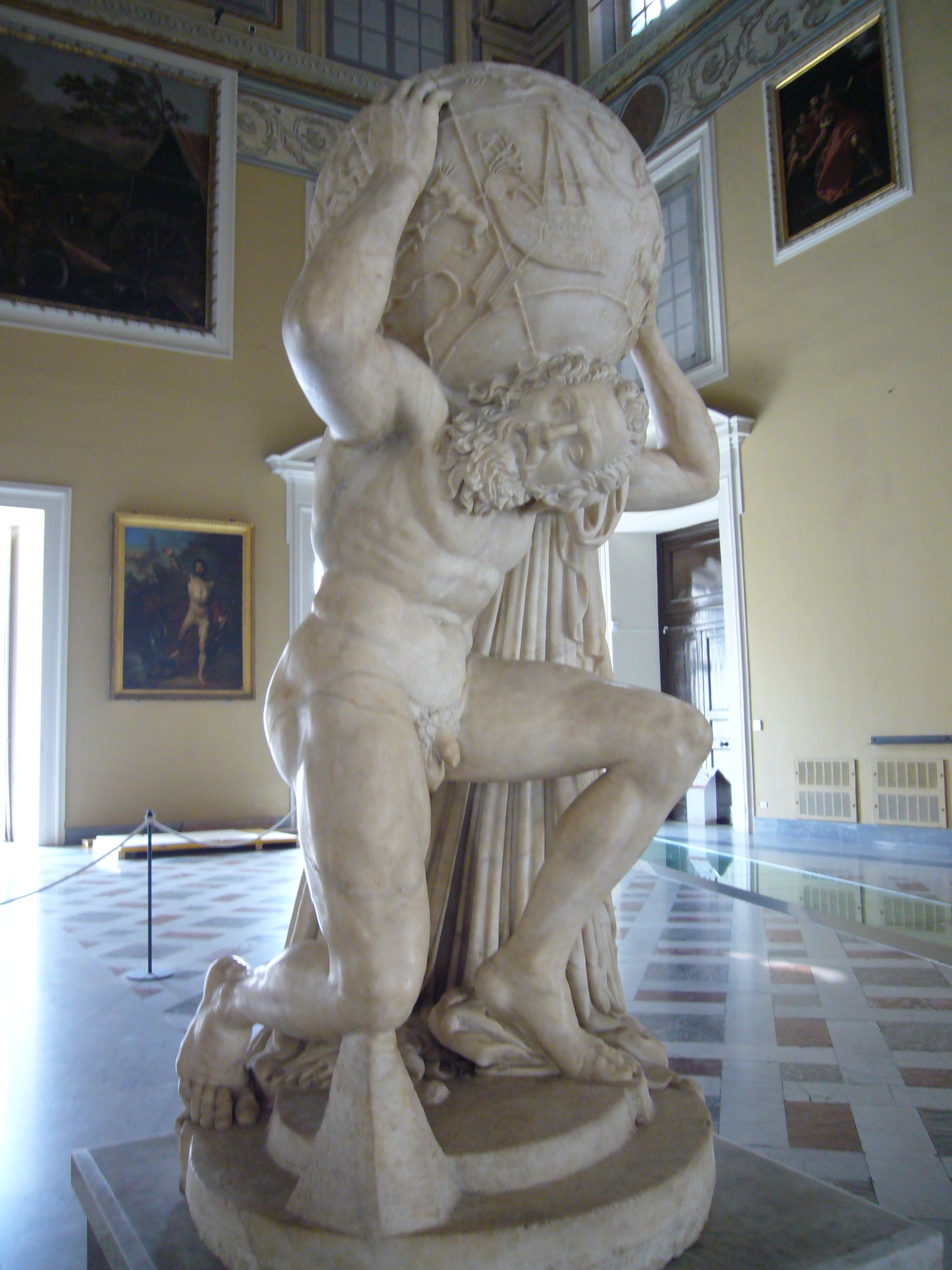
In the pantheon of Greek mythology, few figures embody the weight of cosmic responsibility quite like Atlas. Standing at the western edge of the world, this mighty Titan bears not the Earth as commonly believed, but the very heavens themselves—a punishment that has echoed through millennia as the ultimate symbol of enduring burden.
The Primordial Foundation: Atlas’s Origins
Atlas emerged from the ancient lineage of Titans, born to Iapetus and the Oceanid Clymene (or Asia in some accounts). His very name carries prophetic weight: in Greek, it means “very enduring” or “one who dares”—qualities that would define his eternal fate. Among his brothers were the famous Prometheus, who would steal fire for humanity, Epimetheus, and Menoetius, marking Atlas as part of a family destined to challenge divine order.
The Titans represented the older generation of divine beings, embodying raw cosmic forces before the more refined Olympian gods emerged. Atlas possessed not only immense physical strength but also profound knowledge of mathematics and astronomy—skills that would prove both blessing and curse in his mythological journey.
The Great Cosmic War: Titanomachy and Its Consequences
The story of Atlas’s punishment begins with the Titanomachy, the epic ten-year war between the Titans and the younger Olympian gods led by Zeus. This was not merely a battle for supremacy, but a fundamental transformation of cosmic order—old divine structures giving way to new celestial arrangements.
Atlas served as the commanding general of the Titan armies under Kronos, leading the rebellion against Zeus and his siblings. His role was crucial; he was the strategic mind behind the Titan resistance. When the war finally ended with the Olympians’ victory, most Titans were cast into Tartarus, the deepest prison of the underworld.
However, Zeus reserved a punishment for Atlas that was arguably worse than imprisonment—a cosmic responsibility that would last for eternity.
The True Nature of Atlas’s Burden: Sky, Not Earth
Here lies one of mythology’s most persistent misconceptions. Atlas was condemned not to hold the Earth on his shoulders, but rather the celestial sphere—the heavens themselves. This crucial distinction reveals the sophisticated cosmological understanding of ancient Greeks.
Zeus positioned Atlas at the western edge of the known world, where his eternal task was to prevent the sky (Uranus) and earth (Gaia) from reuniting in their primordial embrace. Homer’s Odyssey describes Atlas as “holding the pillars far out in the Atlantic Ocean which hold the heavens and earth apart,” emphasizing his role as a cosmic separator rather than a world-bearer.
The misconception about Atlas carrying the Earth likely arose from later artistic representations, particularly Renaissance interpretations of classical sculptures like the famous Farnese Atlas. Over time, the celestial globe depicted in these works was misinterpreted as representing the terrestrial world rather than the starry heavens.
Heroic Encounters: When Mortals Meet the Titan
Atlas’s story gains dramatic depth through his encounters with two of Greece’s greatest heroes, each interaction revealing different aspects of his character and condition.
The Cunning of Heracles: A Temporary Respite
The most famous encounter involves Heracles during his Twelve Labors. Tasked with retrieving the golden apples from the Garden of the Hesperides—guarded by nymphs who were Atlas’s own daughters—Heracles journeyed to the world’s edge to seek the Titan’s aid.
Atlas, weary from his eternal burden, eagerly accepted Heracles’ proposal: the hero would temporarily hold up the sky while Atlas retrieved the golden apples. For the first time in eons, Atlas felt relief from his cosmic responsibility. Upon returning with the fruit, however, the Titan attempted deception, offering to deliver the apples to King Eurystheus himself—hoping to leave Heracles permanently holding the heavens.
But Heracles possessed cunning equal to his strength. Pretending to agree, he asked Atlas to resume the burden momentarily so he could adjust his cloak for better padding. The naive Titan fell for this ruse, and Heracles escaped, leaving Atlas condemned to his eternal task once more. This encounter reveals Atlas not just as a suffering figure, but as someone capable of both hope and desperate cunning.
Perseus and the Stone Transformation: A Prophetic End
The second heroic encounter proved fatal for Atlas. When Perseus returned from slaying Medusa, he sought hospitality from the Titan. However, Atlas had received a prophecy warning that a son of Zeus would one day steal his golden apples. Recognizing Perseus as Zeus’s offspring, Atlas refused shelter to the hero.
Perseus, carrying Medusa’s severed head as his trophy, revealed the Gorgon’s face to Atlas in revenge. The mighty Titan was instantly transformed to stone, but according to Ovid’s account, this was no ordinary petrification. Atlas became an entire mountain range—his head the peak, his shoulders the ridges, his hair the forests. These became the Atlas Mountains of North Africa, forever bearing his name.
This transformation represents a profound mythological concept: the Titan’s punishment evolved from active eternal suffering to passive eternal presence in the landscape itself.
Cultural Metamorphosis: From Ancient Symbol to Modern Metaphor
The figure of Atlas underwent remarkable transformation as it traveled through cultural history. The ancient Greeks saw him as a cosmic necessity, a figure whose punishment maintained universal order. His association with the far western reaches of the world led to the Atlantic Ocean bearing his name, as it was believed to lie beyond the pillars he eternally maintained.
During the Renaissance, cartographers began calling their map collections “atlases,” honoring the Titan’s association with supporting the world. This naming convention ironically reinforced the misconception about Atlas carrying the Earth rather than the heavens.
The phrase “carrying the weight of the world on one’s shoulders” emerged as a powerful metaphor for bearing heavy responsibility, though it perpetuates the geographical misunderstanding of Atlas’s actual burden. In modern literature, figures like Ayn Rand’s Atlas Shrugged use the Titan as a symbol for those who bear society’s essential burdens, asking profound questions about what would happen if such individuals simply walked away from their responsibilities.
Astronomical and Philosophical Dimensions
Beyond his punishment, Atlas was credited with founding astronomy and teaching navigation to sailors and seasonal measurement to farmers. His positioning as the supporter of the celestial sphere made him the cosmic axis around which the stars revolved—a crucial figure in ancient understanding of celestial mechanics.
The philosophical implications of Atlas’s story explore fundamental themes of endurance, responsibility, and the weight of leadership. His eternal punishment serves as both a warning about challenging divine authority and a meditation on the burden of those who must hold up civilization itself.
Key Mythological Transformations:
- Cosmic rebel becomes cosmic necessity
- Punishment transforms into essential function
- Individual suffering enables universal order
- Physical burden becomes metaphysical symbol
The Enduring Titan: Atlas in Contemporary Understanding
Atlas remains one of mythology’s most resonant figures precisely because his story addresses universal human experiences: the weight of responsibility, the consequences of rebellion, and the nature of endurance. His myth evolved from ancient Greek cosmology to modern metaphors for leadership and burden-bearing.
The Titan’s story reminds us that some responsibilities, once accepted or imposed, become integral to the very structure of existence. Atlas cannot abandon his post without cosmic consequences—a reflection perhaps of how certain human roles and responsibilities become so fundamental that they define not just individuals but entire systems.
In our contemporary world, where global challenges require sustained commitment and endurance, Atlas serves as both inspiration and warning. His eternal vigilance maintains cosmic order, but at the cost of personal freedom—a tension that resonates deeply with modern discussions about duty, sacrifice, and the price of maintaining civilization itself.
The story of Atlas ultimately transcends its ancient origins to become a profound meditation on what it means to bear responsibility for something larger than oneself, making him not just a figure from Greek mythology, but an eternal symbol of the burdens that come with power, knowledge, and the dare to challenge the established order.
Leave a Reply