
In the pantheon of Romanian folklore, few narratives resonate as profoundly as the Legend of Meșterul Manole. This haunting tale, preserved in the folk ballad Monastirea Argeșului (The Monastery on the Argeș River), stands as one of Romania’s four fundamental myths—alongside Miorița, Zburătorul, and Dochia and Trajan. Unlike mere folklore entertainment, the Manole legend functions as what literary critic George Călinescu termed an “aesthetic myth,” encapsulating a distinctly Romanian philosophy of artistic creation: that true beauty demands the ultimate sacrifice.
The Historical Foundation: Where Legend Meets Stone
The legend centers on the Curtea de Argeș Monastery, a genuine architectural masterpiece constructed between 1512 and 1517 during the reign of Prince Neagoe Basarab V of Wallachia. This extraordinary structure, celebrated for its intricate stone carvings and elaborate Byzantine-influenced design, remains one of Romania’s most distinctive religious buildings.
Historical records confirm the monastery’s construction timeline, with building commencing in 1512 and consecration occurring by 1517. The chief builder was likely an Armenian craftsman named Manoli from Niasia—a historical figure whose name became absorbed and transformed into the mythological Master Manole. This fusion of historical fact and folkloric imagination creates a unique cultural artifact where stone and story become inseparable.
The Impossible Task: Walls That Would Not Stand
The narrative begins with Prince Neagoe Basarab’s ambitious commission: a monastery of unprecedented beauty, a structure so magnificent it would testify to both divine favor and princely piety. He summons Master Manole, renowned as the finest mason of his era, along with nine master craftsmen to undertake this sacred construction on the banks of the Argeș River.
Yet from the first day, the builders encounter a supernatural obstacle that defies their considerable skill. Whatever they construct during daylight hours mysteriously collapses each night. Stone by stone, the walls tumble. Mortar hardens into ruin. Arches sag and crumble. Their progress is perpetually undone, as if some invisible force refuses to allow the monastery’s existence.
Days stretch into weeks, weeks into months. The prince’s patience wears thin, and his initial promises of reward transform into threats of execution. The builders find themselves trapped between an impossible task and certain death—a predicament that will demand an unthinkable solution.
The Dream That Changed Everything
Desperate and tormented by endless failure, Master Manole experiences a prophetic dream that reveals a terrible truth: only a human sacrifice can consecrate the monastery’s foundation and allow the walls to stand. The structure requires not just skill and material, but a life willingly given—or unwillingly taken.
Upon waking, Manole shares this dark revelation with his fellow workers. Together, they reach a collective decision that attempts to distribute the burden of choice beyond individual will: the first person to arrive at the construction site the following morning, bringing food for the workers, shall become the sacrifice. This arrangement represents both resignation to fate and a desperate attempt to absolve themselves of direct responsibility.
Yet fate, as it so often does in myth, proves crueler than any rationalization can soften.
The Heart-Breaking Arrival
As dawn breaks, Master Manole looks across the hills and sees a figure approaching—his beloved wife, Ana. She is pregnant, carrying their unborn child, and has risen early to prepare a nourishing meal for her husband. Love and devotion propel her forward through the morning mist.
In some versions of the legend, Manole desperately prays for divine intervention. He begs heaven to send a storm, to raise obstacles, to turn her back—anything to spare her from the fate awaiting at the construction site. But Ana’s love proves stronger than any natural barrier. She continues forward, determined to reach him, unaware that each step brings her closer to becoming the sacrifice.
When she arrives, the terrible recognition dawns. Manole must confront the horror of the agreement he made. The durability of the monastery and obedience to the ruler have become more important than personal happiness—a realization that brings no solace, only deepening tragedy.
The Immolation: Brick by Brick
With tears streaming down his face, Manole begins the work. Brick by brick, he and the other builders wall Ana into the monastery’s foundation. Her anguished cries pierce the morning air as she begs for mercy—for herself, for their unborn child, for the life they might have shared. But the work continues, inexorable and terrible.
Manole has become what he most despises: the instrument of his wife’s death, the executioner of his own happiness. Yet in most versions of the legend, Ana transcends simple victimhood through her response. She accepts her role with courageous dignity, choosing to enable her husband’s great work and their shared legacy. This acceptance complicates the moral landscape, refusing easy categorizations of hero and villain, perpetrator and victim.
As the final brick is laid, the supernatural obstruction vanishes. The walls stabilize. The mortar holds. What had seemed impossible becomes possible through the ultimate price. The monastery’s construction proceeds without further collapse, rising steadily toward completion—built upon the foundation of irreplaceable loss.
The Builder’s Final Flight
The legend grants Manole no redemption, no peace in his achievement. After the monastery’s completion, Prince Neagoe Basarab poses a calculated question: Could Manole construct another monastery equally beautiful? When Manole honestly affirms that he could, the prince makes a chilling decision. Such a rival creation must never exist. The Curtea de Argeș Monastery must remain unique, unmatched—and Manole’s genius must die with him.
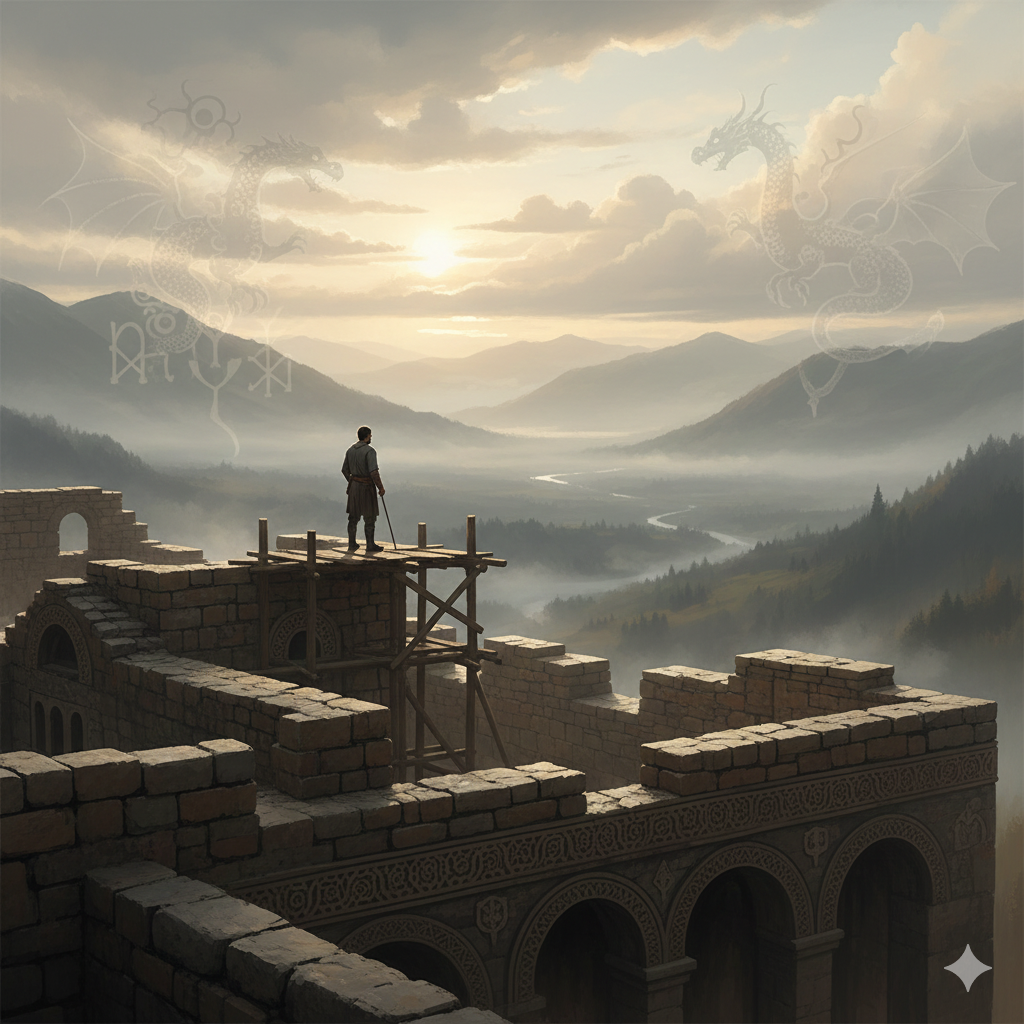
Basarab orders the scaffolding destroyed while Manole and his remaining workers stand trapped on the monastery’s roof, separated from the ground by impossible height. Faced with certain death, the craftsmen attempt one final act of defiance and desperation: they craft wings from wooden shingles, hoping to fly from the roof like birds.
This moment embodies the tragedy of the artisan—masters of stone and mortar who cannot master the air. The wings fail. Manole and his companions plunge to their deaths. The spot where Manole fell is marked by the Fountain of Manole, which still flows in the monastery’s courtyard today, a perpetual memorial to the builder’s final, failed attempt at freedom.
The Aesthetic Philosophy: Creation Through Suffering
George Călinescu recognized the Manole legend as expressing “Romania’s constitutive aesthetic myth,” a fundamental belief that creation demands sacrifice—not metaphorically, but existentially. This philosophy stands in stark contrast to artistic traditions in other cultures that celebrate creation as exaltation, divine inspiration, or joyful self-expression.
In Romanian cosmological thought, true creation requires the surrender of what is most precious. Beauty is not freely given but purchased at terrible cost. The artist must sacrifice not comfort or time, but the irreplaceable—love, life, future itself. This understanding transforms creation from act to ritual, from craft to consecration.
The ballad synthesizes eleven folkloric motifs across five dramatic movements: the site selection through divine guidance, the architect’s design coupled with princely promises and threats, the supernatural collapse of walls, the prophetic dream revealing sacrifice’s necessity, and finally the immolation and the builder’s tragic end. Each element explores the tension between individual will and collective obligation, personal loss and communal beauty.
Beyond Folklore: Myth as Cosmogony
Scholars recognize the Manole legend as functioning beyond simple narrative—it operates as both folk ballad and cosmogonic myth. Rather than merely recounting an event, it attempts to explain the origin and permanence of the monastery through a governing principle of creation itself.
The work completed after Ana’s sacrifice “holds differently,” becoming steady and inevitable, as if her life has woven something inviolable into the structure’s essence. This transformation suggests that great works require not just skill but consecration through sacrifice—a philosophical position that explains why certain creations endure while others crumble.
Pilgrims visiting the monastery developed their own folkloric traditions. Some believed the stones themselves offered healing and blessing. Others claimed that dreamers might occasionally glimpse a figure of a man eternally at work within the walls—Manole himself, forever building, forever mourning, forever trapped in the monument to his genius and his grief.
The Architecture of Memory
The Curtea de Argeș Monastery endures as both religious site and cultural repository. Some sources claim a red mark visible on the cathedral’s outer wall indicates where Ana’s remains were walled in, though historical verification remains impossible. What persists with certainty is the monastery itself—a testament not only to medieval craftsmanship but to the narrative that has shaped how generations of Romanians understand the relationship between creation and cost.
The structure’s unique design, featuring elaborate stone carvings and intricate decoration influenced by Byzantine and local architectural traditions, demonstrates the extraordinary skill of its builders. Whether or not a historical Manole existed as the legend describes, the monastery stands as proof that exceptional beauty was indeed achieved—and that its creation required dedication bordering on the sacrificial.
Contemporary Resonance and Reinterpretation
The Manole legend has been continually reinterpreted across Romanian literature, film, theater, and scholarship. After 1989, feminist discourse examined how the myth’s symbolic structures—centering female sacrifice for masculine artistic achievement—had been instrumentalized during the communist era. Critics questioned whether such narratives reinforced problematic gender dynamics, valorizing male ambition at the expense of women’s lives and agency.
Yet rather than disappearing beneath such critiques, the legend has demonstrated remarkable resilience. Contemporary interpretations explore its psychological dimensions: the transformation of an artist into an unwilling executioner, the impossible choices demanded by authority and circumstance, the way duty and love can become tragically incompatible. The legend continues to speak to universal questions about the price of greatness, the relationship between personal cost and collective beauty, between individual will and historical necessity.
The Enduring Question
What makes the Legend of Meșterul Manole perpetually relevant is its refusal of easy answers. It does not celebrate sacrifice as noble or condemn it as barbaric. It does not glorify Manole as hero or vilify him as murderer. Instead, it presents creation as a profoundly ambiguous act—one that mingles genius with grief, achievement with annihilation, permanence with irreparable loss.
The monastery stands. The fountain flows. And somewhere in the mortar and stone, the ballad suggests, both the artisan’s genius and his terrible choice remain eternally present—a memorial not only to what was built, but to what was surrendered in the building. This dual presence transforms the structure into something more than architecture: it becomes a meditation in stone on the nature of creation itself.
In this way, the Legend of Meșterul Manole transcends its origins as regional folklore to address fundamental questions that haunt every creator: What price is worth paying for lasting beauty? When does duty become complicity? Can great works be separated from the suffering that birthed them? And perhaps most troubling: Does true creation always demand the sacrifice of what we most love?
The walls of Curtea de Argeș offer no answers—only the silent testimony of their endurance, built upon a foundation of loss that time cannot erase and beauty cannot redeem.
Leave a Reply