
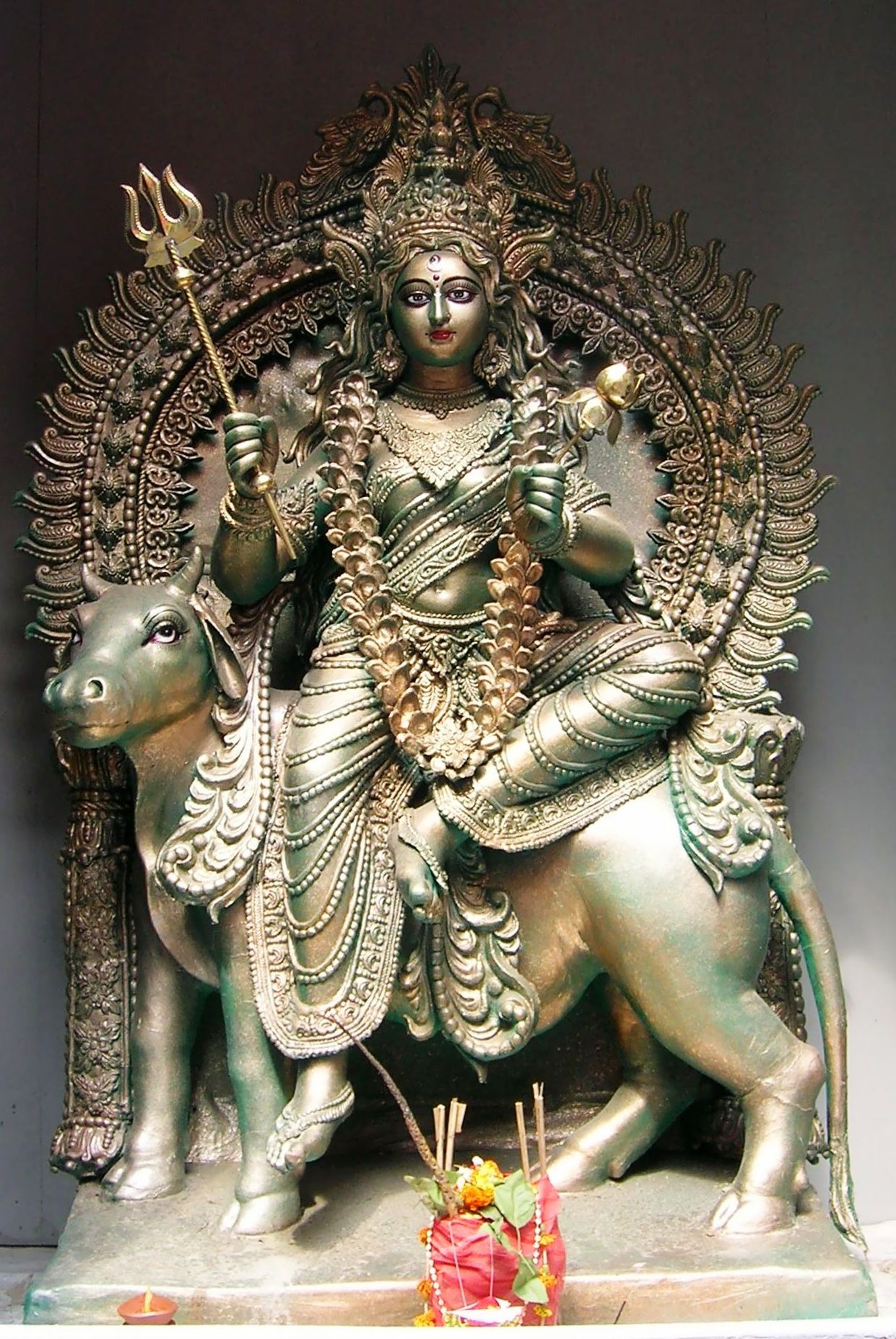
In the sacred landscape of Hindu mythology, where divine narratives weave together cosmic truth and human experience, few stories resonate with such profound transformation as that of Shailaputri. As the first manifestation of Goddess Durga among the nine forms worshipped during Navratri, she embodies the fundamental principle that authentic spiritual growth often requires complete surrender of what we once were.
Her name itself tells a story of rebirth: Shaila (mountain) and Putri (daughter) – the daughter born from the eternal strength of the Himalayas. Yet this simple designation masks one of mythology’s most powerful narratives of love, sacrifice, and divine transformation.
The Tragedy That Sparked Transformation
The story begins not with Shailaputri, but with Sati – a goddess whose devotion would reshape the cosmic order itself. Born as the daughter of King Daksha Prajapati, Sati possessed an unwavering love for Lord Shiva that transcended social conventions and parental approval. Against her father’s fierce objections, she chose Shiva as her divine consort, setting into motion events that would echo through eternity.
The pivotal moment arrived when Daksha organized a grand yagna – a sacred fire sacrifice that would bring together all divine beings. In a calculated act of humiliation, he invited every deity except Shiva, his own son-in-law. This wasn’t merely a social slight; it was a cosmic insult that struck at the very heart of dharma and divine respect.
Despite Shiva’s gentle warnings against attending, Sati felt compelled to confront her father’s disrespect. What she found at the sacrifice was worse than anticipated – not just exclusion, but active mockery of her beloved husband. Unable to bear the public humiliation of Shiva, she made a choice that would transform her from a loving daughter into a cosmic force: she immolated herself in the sacrificial fire.
The Cosmic Dance of Grief
Sati’s self-sacrifice triggered one of mythology’s most profound expressions of divine grief. When Shiva discovered her death, his sorrow manifested as the Tandava – the cosmic dance of destruction. Carrying Sati’s body, he danced across the universe, his grief threatening to unmake creation itself.
It was Lord Vishnu who intervened, using his Sudarshana Chakra to dismember Sati’s corpse. As the pieces fell across the earth, they created the 52 Shakti Peethas – sacred sites where divine feminine energy would forever reside. This act wasn’t destruction but transformation, ensuring that Sati’s sacrifice would become a source of perpetual blessing for devotees across the world.
Rebirth as the Mountain’s Daughter
The narrative takes a profound turn with Sati’s rebirth as Parvati, daughter of Himavat, the king of the Himalayas. This transformation from Sati to Shailaputri represents far more than simple reincarnation – it embodies the spiritual principle that sometimes we must completely release our previous identity to emerge into our true divine nature.
As Shailaputri, she inherited not just new parentage but new qualities: the unshakeable strength of mountains, the patience of eternal peaks, and the grounding force that would make her the foundation of all spiritual practice. Where Sati had been defined by passionate devotion and tragic sacrifice, Shailaputri emerged as embodied stability and quiet strength.
The Sacred Iconography: Symbols of Transformation
Shailaputri’s divine form speaks in the language of symbols that bridge earthly experience and cosmic truth:
The Crescent Moon: Adorning her forehead, this symbol represents divine consciousness and the cyclical nature of time itself. Unlike the full moon’s completion, the crescent suggests potential – the constant possibility of growth and renewal.
The Trident (Trishul): In her right hand, she holds the three-pronged weapon representing creation, preservation, and destruction – the eternal cosmic dance that governs all existence. For devotees, it symbolizes the balance between willpower, action, and wisdom.
The Lotus: Her left hand carries this perfect symbol of spiritual awakening – the flower that blooms in muddy waters yet remains pristine. It teaches that we can maintain purity and beauty regardless of our circumstances.
Nandi, the Sacred Bull: Her mount represents more than divine transportation. Nandi embodies steadfastness, patience, and unwavering dharma – qualities essential for any spiritual journey.
The Chakra Connection: Foundation of Spiritual Architecture
Perhaps most significantly for spiritual practitioners, Shailaputri governs the Muladhara or Root Chakra, located at the base of the spine. This connection reveals her fundamental role in human spiritual development. Just as mountains provide unshakeable foundations for ecosystems, Shailaputri provides the energetic foundation for all higher spiritual practices.
The Root Chakra governs our sense of safety, belonging, and basic survival – our connection to the physical world and our ability to remain grounded during transformation. Without this foundation, higher spiritual experiences become unstable, like buildings constructed on shifting sand.
Key Spiritual Qualities of the Root Chakra:
- Emotional stability and security
- Connection to Mother Earth
- Survival instincts and basic needs
- Foundation for spiritual growth
- Sense of belonging and community
When devotees worship Shailaputri during the first day of Navratri, they’re not just honoring a deity – they’re establishing the energetic groundwork that will support their journey through the subsequent eight forms of Durga.
Astrological Wisdom: The Moon’s Divine Influence
In Vedic astrology, Shailaputri’s connection to the Moon reveals another layer of her significance. The Moon governs emotional well-being, mental peace, intuition, and the subconscious mind – all essential elements for spiritual stability.
Those suffering from Moon-related afflictions in their birth charts – such as anxiety, emotional instability, or mental confusion – find particular solace in Shailaputri’s worship. Her mountain-born strength provides the emotional grounding needed to weather psychological storms and achieve mental clarity.
Worship and Ritual: Creating Sacred Space
The worship of Shailaputri begins with Ghatasthapana – the sacred installation of a kalash (holy pot) that serves as a physical anchor for divine presence. This ritual involves:
- Sacred Pot Installation: Filling a vessel with holy water, coins, turmeric-mixed rice, and durva grass, topped with mango leaves and a coconut
- Grain Sowing: Planting barley seeds in earthen pots to symbolize growth and prosperity
- Lighting the Akhand Jyoti: Maintaining a continuous flame throughout the nine days
The essential mantra for her worship carries profound vibrational power:
ॐ देवी शैलपुत्र्यै नमः॥
Om Devi Shailaputryai Namah
This simple yet powerful invocation acknowledges her as both divine force and accessible guide for human transformation.
Contemporary Relevance: Ancient Wisdom for Modern Times
In our contemporary world of constant change and digital overwhelm, Shailaputri’s message becomes remarkably relevant. She teaches us to:
- Remain grounded during periods of external chaos
- Develop patience for long-term spiritual and personal growth
- Embrace resilience when facing life’s inevitable challenges
- Find strength in authentic foundations rather than superficial achievements
- Cultivate steady devotion over fleeting emotional highs
Her story reminds us that transformation often requires a complete death of old patterns. Like Sati’s sacrifice and rebirth as Shailaputri, our own spiritual evolution may require us to release familiar identities to discover our deeper nature.
The Foundation for All Spiritual Practice
As the first of the Navadurga forms, Shailaputri establishes the template for the entire spiritual journey. Her worship provides the stability necessary to experience progressively higher states of consciousness through the subsequent eight goddesses. Without her grounding influence, the transformative power of the other forms lacks proper foundation.
Her narrative arc – from Sati’s passionate devotion through tragic sacrifice to Shailaputri’s mountain-born stability – offers a complete map for spiritual transformation. It suggests that authentic growth often requires not just addition of new qualities, but fundamental reconstruction of our entire being.
Conclusion: The Eternal Return to Foundation
The story of Shailaputri ultimately teaches that no matter how high we aspire spiritually, we must continually return to foundational truths. Like a mountain that reaches toward heaven while maintaining deep earthly roots, genuine spiritual development requires both ascending aspiration and grounding presence.
Her worship during Navratri’s opening day isn’t merely traditional observance – it’s a conscious choice to establish the stability, patience, and strength necessary for authentic transformation. In honoring Shailaputri, we acknowledge that every spiritual journey must begin with proper foundation, and that sometimes the most profound growth emerges from the ashes of what we thought we were.
Through her eternal presence, the Mountain’s Daughter continues to offer her most precious gift: the unshakeable foundation upon which all spiritual realization rests.
Leave a Reply