
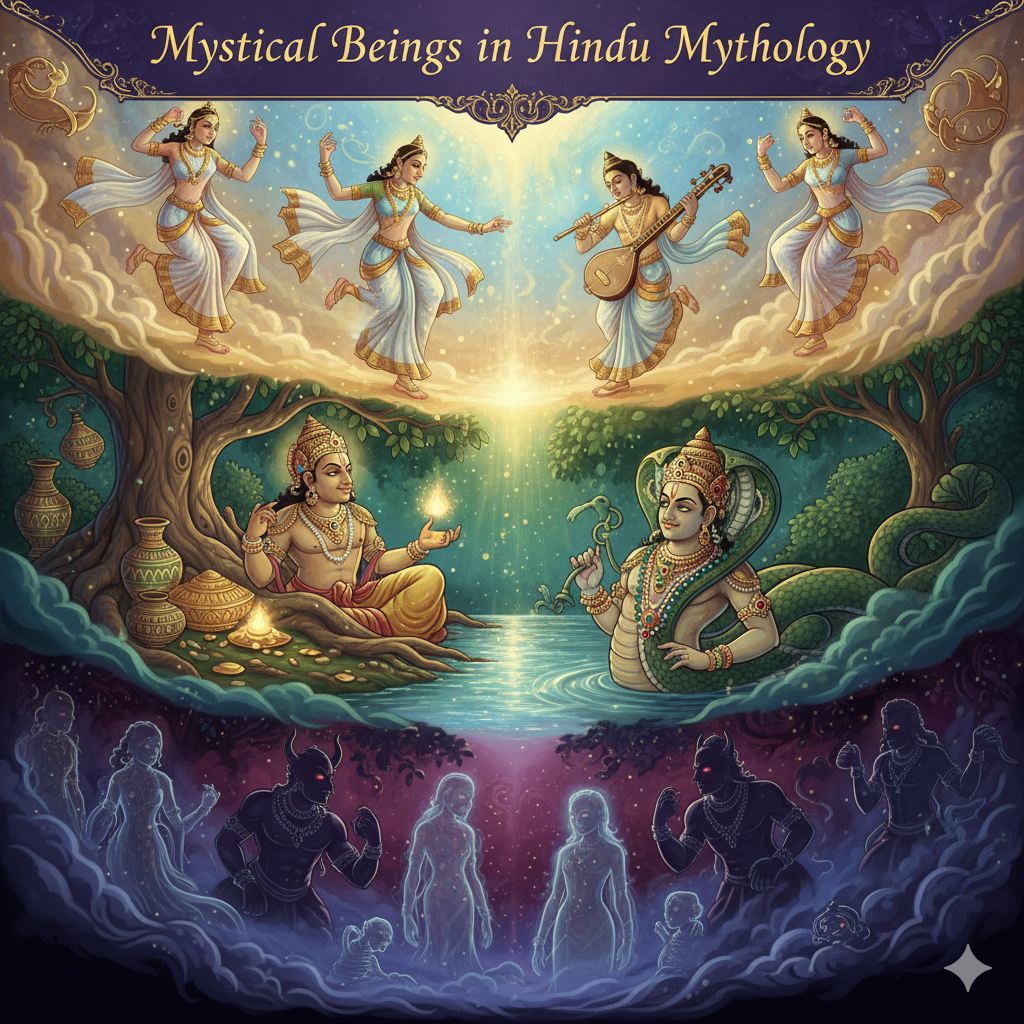
Between the mortal realm and the divine pantheon exists a fascinating dimension populated by supernatural beings whose stories have captivated imaginations for millennia. Hindu mythology presents an intricate cosmic hierarchy where celestial entertainers dance in heavenly courts, nature spirits guard ancient treasures, and shadow beings haunt the boundaries between life and death. These mystical entities are not mere decorative elements in religious texts—they represent fundamental aspects of existence, embodying everything from artistic beauty to moral consequences, from natural abundance to karmic justice.
Understanding these beings reveals a sophisticated worldview where the universe operates through multiple dimensions of consciousness, each inhabited by entities serving specific cosmic functions. Their stories, preserved in ancient texts like the Vedas, Puranas, Ramayana, and Mahabharata, continue to influence Indian art, literature, and spiritual practices today.
The Celestial Court: Divine Entertainers and Musicians
Apsaras: Embodiments of Celestial Beauty
The apsaras emerged during one of mythology’s most significant events—the churning of the cosmic ocean, or Samudra Manthan. When gods and demons cooperated to extract the nectar of immortality from the primordial waters, these divine nymphs arose from the churning depths, their beauty so extraordinary that they immediately captured the attention of all present.
These celestial beings are categorized into two types: laukika (worldly) and daivika (divine). The distinction speaks to their dual nature—some apsaras interact more closely with the mortal realm, while others remain primarily in heavenly spheres. Their most remarkable characteristic is their ability to alter physical form at will, shape-shifting to serve whatever purpose the gods require.
In Indra’s celestial court, apsaras serve as divine entertainers, their performances of dance and music creating an atmosphere of transcendent beauty. Yet their role extends far beyond mere entertainment. The gods frequently dispatch them to Earth on critical missions—testing the spiritual resolve of great sages and ascetics. When a mortal achieves such profound meditative states that they threaten to accumulate power rivaling the gods themselves, an apsara descends to disrupt their concentration.
The most renowned among them include Urvashi, whose love story with King Pururavas became legendary; Menaka, who seduced the fierce ascetic Vishwamitra; Rambha, celebrated for her unmatched dancing skills; Tilottama, created specifically to sow discord among demons; and Ghritachi, known for her musical talents. Their stories often explore themes of desire, duty, and the tension between earthly attachments and spiritual pursuits.
Gandharvas: Masters of Celestial Harmony
If apsaras represent visual beauty and graceful movement, gandharvas embody the perfection of sound itself. The term derives from Sanskrit roots meaning “musician,” and these semi-divine beings serve as the primary musical performers in the heavenly realms. With their handsome appearance, colorful attire, and exquisite jewelry, gandharvas cut striking figures in the celestial court.
These beings possess mastery over various musical instruments—the veena’s resonant strings, the flute’s haunting melodies, the drums’ rhythmic foundations. They are intrinsically connected to natural phenomena, associated with clouds, wind, and the changing seasons. This connection suggests an ancient understanding of music as a fundamental force of nature, with gandharvas serving as conduits between cosmic rhythms and aesthetic experience.
The Atharvaveda speaks of more than 6,000 gandharvas organized into tribes, though their origins vary across texts. Some traditions trace their lineage to Prajapati or Brahma, while others name the sage Kashyapa as their progenitor. The most prominent gandharva was Tumburu, depicted with a horse’s head atop a human body—a striking image from which the tambura musical instrument derives its name.
Gandharvas frequently marry apsaras, creating celestial couples whose combined talents in music and dance produce performances of unparalleled beauty. Beyond their artistic functions, they serve as messengers between divine and mortal realms, their semi-divine status making them ideal intermediaries. This bridging role reflects a deeper philosophical principle: that art and beauty serve as pathways connecting earthly existence to transcendent reality.
Guardians of Earth’s Treasures: Nature Spirits
Yakshas: Protectors of Hidden Wealth
While celestial beings inhabit the upper realms, yakshas anchor themselves firmly to Earth, serving as guardians of natural sites and custodians of treasures concealed within the ground and tree roots. These powerful magicians possess shape-shifting abilities, altering their appearance at will to serve their protective functions.
Yakshas embody a fascinating duality—generally benevolent but occasionally mischievous and capricious. They are not uniformly good or evil but reflect nature’s own unpredictable character. Communities throughout ancient India gave them homage as tutelary deities of cities, districts, lakes, and wells, recognizing their power over local prosperity and resources.
Kubera, the principal yaksha, rules from Alaka, a mythical Himalayan kingdom of unimaginable wealth. His position as lord of treasures extends beyond material gold and gems to encompass all forms of abundance—fertile soil, mineral deposits, hidden springs. This connection between yakshas and prosperity may have originated among early indigenous Indian peoples, whose worship of nature spirits predated the Vedic traditions.
Artistically, yaksha sculptures were among the earliest divine images created in the Indian subcontinent, apparently preceding even representations of bodhisattvas and Brahmanical deities. This archaeological evidence suggests their worship represented one of humanity’s earliest attempts to personify and honor the forces governing natural abundance. Later traditions incorporated yakshas as protective attendants in Hindu, Buddhist, and Jain iconography.
The feminine forms—yakshinis or yakshis—carry particular associations with fertility symbolism and the ashoka tree. Their depictions often emphasize their connection to growth, reproduction, and the life-giving aspects of nature, complementing the masculine yakshas’ role as treasure guardians.
Nagas: Serpentine Balance-Keepers
Few mystical beings evoke such complex reactions as nagas—the semi-divine serpent entities who embody both creation and destruction, fertility and danger. Their ability to assume wholly human, wholly serpentine, or intermediate forms reflects their liminal nature, existing between categories and defying simple classification.
Nagas dwell in Naga-loka or Patala-loka, an underground kingdom of resplendent palaces adorned with precious gems. Yet despite their subterranean home, they maintain profound connections with water bodies—rivers, lakes, seas, and wells. This association makes them critical to agricultural societies, where their appearance during monsoon season signals the arrival of life-giving rains.
Three nagas hold particular prominence in mythological narratives:
Shesha (or Ananta), the cosmic serpent of infinite coils, serves as the resting place for Narayana (Vishnu) on the primordial ocean. His thousand heads form a canopy over the sleeping god, symbolizing the foundation upon which existence rests during cosmic dissolution and recreation.
Vasuki, perhaps the most famous naga, served as the churning rope during the Samudra Manthan. Gods held his tail while demons grasped his heads, pulling back and forth to churn the cosmic ocean. From his exertion came the deadly halahala poison, which Shiva consumed to save creation—a testament to the nagas’ role in both threatening and preserving cosmic order.
Takshaka, described as the tribal chief of serpents, represents the dangerous aspect of naga nature. His bite killed King Parikshit in the Mahabharata, demonstrating that these beings could serve as agents of karmic justice or vengeful destruction.
The worship of nagas continues through festivals like Nag Panchami, where devotees honor these serpent deities, seeking their blessings for protection and prosperity. This ongoing reverence reveals how deeply these beings are woven into cultural consciousness, representing humanity’s complex relationship with serpents—creatures both feared and revered across civilizations.
Keepers of Sacred Knowledge
Vidyadharas: The Wisdom Bearers
In the ethereal spheres above Earth yet below the highest heavens, vidyadharas guard ancient secrets and sacred knowledge. Their name—translating to “knowledge-bearers” or “those who possess knowledge”—reveals their essential function in the cosmic order. Unlike the aesthetic focus of apsaras and gandharvas or the material guardianship of yakshas, vidyadharas preserve the intellectual and esoteric dimensions of existence.
These supernatural beings possess remarkable magical powers, including flight and shape-shifting abilities that allow them to traverse different realms while maintaining their primary mission of knowledge preservation. Hindu epics describe them as “spirits of the air,” observing human activities with a mixture of fascination and detachment. They watch combat with astonishment, strewing flowers upon displays of exceptional prowess, suggesting their role as witnesses to and chroniclers of mortal achievements.
Vidyadharas demonstrate mastery over various arts and sciences—astronomy for understanding celestial movements, astrology for interpreting cosmic influences, alchemy for transforming matter, and healing for preserving life. This comprehensive knowledge base positions them as repositories of wisdom that might otherwise be lost to mortal forgetfulness or divine indifference.
Among their ranks, Chitrasena stands out as a celebrated celestial musician and dancer, his expertise in divine arts earning recognition throughout heavenly realms. His presence suggests that knowledge encompasses not just intellectual understanding but also embodied wisdom expressed through artistic practice.
The concept of vidyadharas raises profound questions about knowledge transmission: How is sacred wisdom preserved across generations? Who decides which secrets remain hidden and which are revealed? Their existence in mythology reflects ancient concerns about maintaining and protecting crucial understanding in an ever-changing world.
Kinnaras: The Mysterious Horse-Headed Musicians
Among the more enigmatic beings in Hindu mythology are kinnaras, whose physical form varies dramatically across different textual traditions. Some describe them as having horse heads atop human bodies, while others reverse this arrangement. The Mahabharata portrays them as half-human, half-horse creatures similar to Greek centaurs, suggesting possible cross-cultural mythological exchanges or parallel evolution of similar archetypes.
The confusion extends to their relationship with a similar class called kimpurushas. Some texts describe kimpurushas as having horse hips with human faces, while kinnaras possess horse faces with human bodies. Other sources blur these distinctions entirely, using the terms almost interchangeably. This textual ambiguity might reflect regional variations in how these beings were understood or represent different traditions that merged over time.
Despite uncertainties about their appearance, kinnaras are consistently celebrated as accomplished musicians, often grouped with gandharvas as celestial entertainers. Their musical talents complement their mysterious nature, suggesting that the boundaries between different performer categories remained fluid in the cosmic court.
Interestingly, the Kinnara tribe is identified with the Kinnaur district of Himachal Pradesh, where inhabitants still call themselves Kinnaurs. This geographical connection hints at possible historical populations whose distinctive cultural practices or physical characteristics inspired mythological elaboration. Whether the myth created the identity or the identity inspired the myth remains an open question, illustrating how mythology and history interweave in complex ways.
The Shadow Realm: Demonic and Malevolent Forces
Rakshasas: The Shape-Shifting Adversaries
Not all mystical beings serve benevolent purposes. Rakshasas represent the chaotic, destructive forces that threaten cosmic order and human welfare. Though possessing supernatural powers comparable to divine beings, they typically employ these abilities for evil acts—disrupting Vedic sacrifices, consuming human flesh, and spreading terror across the mortal realm.
Physical descriptions of rakshasas emphasize their fearsome nature: enormous creatures with two fangs protruding from their upper jaws, sharp claw-like fingernails, and fierce countenances designed to inspire dread. Their ability to smell human flesh from great distances makes them formidable predators, while their shape-shifting powers allow them to assume any form—animals, monsters, or, in the case of female rakshasas (rakshasis), beautiful women who lure victims to their doom.
The power of maya (magical illusion) enables rakshasas to change size at will and disguise their true nature. They are most powerful during evening hours, particularly during the dark period of the new moon, when their strength peaks. However, the rising sun dispels their powers, establishing a cosmic rhythm of danger and safety that ancient peoples would have understood through lived experience.
Despite their generally malevolent characterization, Hindu epics acknowledge complexity within rakshasa society. Not all serve evil purposes—some function as warriors and even allies to righteous causes. This moral nuance prevents the mythology from lapsing into simple good-versus-evil dichotomies, recognizing that even beings associated with darkness can act according to dharma.
The most famous rakshasa is Ravana, the ten-headed king of Lanka whose abduction of Sita catalyzed the events of the Ramayana. Yet even Ravana is portrayed as a complex figure—a learned scholar, devoted follower of Shiva, and capable ruler whose fatal flaw was uncontrolled desire. His story becomes a meditation on how even great beings can fall through attachment and pride.
Rakshasas especially detest sacrifices and prayer, actively working to disrupt ritual activities. This antagonism toward sacred practices positions them as opponents not just of individual humans but of the entire religious order that maintains cosmic stability.
Pisachas: Grotesque Flesh-Eaters
If rakshasas represent organized demonic power, pisachas embody pure horror—flesh-eating demons characterized by grotesque appearances and insatiable appetites. Their bodies are covered in coarse, bristly hair, their eyes protrude in crimson bulges, their complexions resemble black smoke, and their long pointed fangs serve as instruments for their ghastly feedings.
According to creation accounts, pisachas originated either from the creator god Brahma’s wrath or from the union of Sage Kashyapa and Krodhavasa, the daughter of Daksha who embodied anger and wrath. This genealogy connects them intrinsically to negative emotions, suggesting they represent the materialization of humanity’s darkest impulses.
These creatures haunt battlefields and cremation sites, drawn to locations where death has recently occurred. Their ability to possess humans is particularly terrifying—they can drive victims insane, compelling disturbing behaviors while spreading illness. This possession capacity made pisachas explanations for mental illness and erratic behavior in traditional societies, embodying fears about losing control over one’s own mind and actions.
Pisachas prefer darkness and traditionally congregate in cremation grounds alongside other monstrous beings like bhutas and vetalas, creating a supernatural ecosystem centered on death and decay. Their shape-shifting abilities and capacity to become invisible make them difficult to detect or escape, while their ability to feed on human energy adds a vampiric dimension to their horror.
The concept of pisachas reveals cultural anxieties about bodily corruption, spiritual contamination, and the thin boundaries separating civilized behavior from savage consumption. They represent not just external threats but internal fears about what humans might become if stripped of moral restraints.
Vetalas: The Undead Knowledge-Keepers
Vetalas occupy a unique position among malevolent beings—they are ghost-like entities that inhabit corpses, using cadavers as vehicles for movement while retaining the ability to leave these bodies at will. This partial embodiment creates an unsettling liminality, as vetalas are neither fully corporeal nor entirely spectral.
Defined as knowledgeable paranormal entities dwelling in charnel grounds, vetalas are hostile spirits of the dead trapped between life and afterlife. What makes them particularly valuable to sorcerers seeking to capture and enslave them is their freedom from the laws of space and time, granting them uncanny knowledge about past, present, and future events. Their deep insight into human nature makes them formidable judges of character and intention.
Despite their terrifying nature, vetalas possess capabilities beyond mere harm. They can drive people mad, kill children, and cause miscarriages, but they can also guard villages, suggesting their power might be directed toward protective purposes under proper circumstances. This duality reflects a common pattern in Hindu mythology where even dangerous beings might serve beneficial functions when properly approached or controlled.
The most famous vetala story appears in Vetala Panchavimshati (Baital Pachisi), where King Vikramaditya repeatedly attempts to capture a vetala who inhabits a corpse hanging from a tree. Each time the king succeeds, the vetala tells a story ending with a riddle. If Vikramaditya knows the answer but remains silent, his head will explode; if he speaks, the vetala escapes back to the tree. Through this narrative framework, the text explores profound philosophical and moral questions, using the vetala’s supernatural knowledge to examine human nature and ethical dilemmas.
Vetalas thus represent the idea that death does not destroy knowledge—in fact, liberation from physical constraints might expand awareness beyond mortal limitations. Their existence suggests that wisdom can persist beyond bodily death, accessible to those brave or skilled enough to engage with these dangerous entities.
Spirits of the Twilight: Between Life and Death
Charanas: The Wandering Ascetics
Charanas represent an elevated class of beings whose most remarkable characteristic is their ability to fly—a capability that symbolizes their spiritual freedom from earthly constraints. The term derives from “char,” meaning “to wander” or “to move,” reflecting their nature as itinerant ascetics unbound by conventional limitations of space and gravity.
These divine beings are associated with sacred practices and worship, particularly linked to trees and holy regions. In the Ramayana, charanas serve as celestial witnesses and narrators of epic events, their aerial perspective allowing them to observe from privileged vantage points and report on activities across vast distances. They are frequently mentioned alongside siddhas, another group of enlightened beings with extraordinary capabilities, suggesting a community of perfected souls who have transcended ordinary existence.
The flying ability of charanas should be understood not merely as physical levitation but as representing spiritual attainment—the capacity to rise above worldly concerns and move freely through different planes of existence. Their presence in narratives often signals moments of great significance, as their attention indicates events worthy of divine notice.
Pretas: Tormented by Insatiable Hunger
Among the most pitiable beings in Hindu cosmology are pretas, or hungry ghosts—souls suffering extreme hunger and thirst as karmic punishment for greed, corruption, and selfishness in previous lives. Their physical form reflects their spiritual condition: thin necks that prevent swallowing, distended stomachs that can never be filled, and emaciated bodies that testify to endless deprivation.
The karmic logic of pretas is precise and severe. Those who were false, corrupted, compulsive, deceitful, jealous, or greedy face retribution perfectly calibrated to their transgressions. They are afflicted with insatiable hunger for particular substances or objects, traditionally something repugnant like cadavers or feces—a grotesque inversion of their previous greed that now condemns them to desire what is worthless or revolting.
What makes the preta’s suffering especially cruel is the distortion of their perception. Where humans see clear water, pretas see rivers of pus and filth. This perceptual corruption means they cannot even accidentally find relief—their own consciousness has become a trap from which there is no escape through external circumstances alone.
The concept of pretas serves multiple functions in Hindu thought. It provides a moral warning about the consequences of greed and selfishness, illustrating how these qualities create suffering not just for others but ultimately for oneself. It also offers an explanation for the feeling that desires, once satisfied, simply regenerate in new forms—the preta represents the logical extreme of this endless craving.
Unlike some malevolent beings who threaten others, pretas are primarily dangers to themselves. Their existence explores the idea that the worst punishment might not be external torment but internal compulsion—being trapped in cycles of wanting that can never be satisfied.
Bhutas: Restless Spirits of the Untimely Dead
Bhutas haunt the boundaries of proper death, representing souls denied peaceful transition to the afterlife. These restless ghosts are believed to be spirits of people who died untimely deaths—execution, accident, suicide—or who led unholy or immoral lives. Their inability to progress to the next stage of existence leaves them trapped in liminal spaces, neither fully gone nor properly alive.
Particularly malignant if they died violent deaths or were denied proper funeral rites, bhutas are especially feared by women, children, and the newly married—those considered most vulnerable to spiritual threats. Their appearance takes various forms: flickering lights that dance in the darkness, misty apparitions that seem almost substantial but cast no shadows and hover above the ground, never actually touching the earth.
Bhutas haunt specific locations: forests where travelers might lose their way, empty dwellings that echo with abandonment, certain trees whose gnarled forms seem to harbor presences, deserts where isolation magnifies fear, abandoned houses filled with memories of former inhabitants, hearths and roofs of homes where the boundary between inside and outside grows thin, crossroads where decisions must be made, and boundaries between properties or territories. This list reveals how bhutas cluster around liminal spaces—thresholds, edges, and in-between places where the normal order becomes uncertain.
These spirits are held responsible for a catalog of misfortunes: accidents that seem to have no natural cause, bad crops that devastate farming communities, calamities that strike without warning, diseased livestock that threaten livelihoods, illness that doctors cannot cure, insanity that destroys minds, and plagues that ravage entire populations. By attributing these disasters to bhutas, traditional communities created explanatory frameworks for random suffering while also suggesting potential remedies through proper ritual observance.
The concept of bhutas emphasizes the importance of proper death rituals in Hindu culture. If funeral rites are performed correctly, the soul can transition peacefully; if not, it remains trapped, suffering and potentially causing suffering to others. This belief system incentivizes communities to ensure proper treatment of the dead, regardless of how they died or what they did in life.
The Cosmic Tapestry: Understanding the Mystical Hierarchy
These diverse beings collectively form a complex supernatural ecosystem that serves multiple functions in Hindu cosmology. From the aesthetic and artistic dimensions embodied by apsaras, gandharvas, and kinnaras, to the protective and material aspects represented by yakshas and nagas, to the knowledge-bearing functions of vidyadharas and charanas, each category occupies a specific niche in maintaining universal balance.
The darker entities—rakshasas, pisachas, vetalas, bhutas, and pretas—represent the shadow aspects of existence. Rather than being mere antagonists, they embody necessary elements of the cosmic order: the forces of dissolution that balance creation, the consequences of moral transgressions, the dangers that test heroic virtue, and the fears that define boundaries of acceptable behavior.
Even these malevolent beings serve crucial functions. Rakshasas often act as tests for heroes and sages, their opposition creating opportunities for demonstrating righteousness. Pisachas and vetalas make tangible the consequences of various moral failures, while bhutas emphasize the importance of proper ritual observance. Pretas illustrate the self-destructive nature of greed and attachment.
This rich mythological landscape reflects sophisticated philosophical thinking about the nature of existence. The universe is not divided into simple good and evil but contains multiple gradations and categories of being, each with its own purpose and place. The mystical beings bridge gaps between different levels of reality—connecting mortals to gods, linking the seen and unseen worlds, embodying abstract concepts in concrete form.
Legacy and Contemporary Resonance
The influence of these mystical beings extends far beyond ancient texts. They appear throughout Indian artistic traditions—sculpted into temple walls, painted in miniatures and murals, depicted in classical dance forms where performers embody celestial characters through stylized movements and expressions. Regional folklore continues to tell stories of encounters with yakshas guarding hidden treasures, nagas living in sacred ponds, and rakshasas haunting deserted forests.
In contemporary India, festivals like Nag Panchami maintain active worship of serpent deities, while artistic performances regularly feature apsaras and gandharvas as representations of divine beauty and harmony. The concepts underlying these beings—the idea that multiple dimensions of existence interpenetrate the visible world, that nature contains conscious guardians, that moral consequences manifest through karmic mechanisms—continue to shape cultural worldviews.
These mystical entities offer modern readers insights into how ancient societies understood consciousness, morality, nature, and the supernatural. They reveal sophisticated thinking about categories of existence, the relationship between form and essence, and the complex interplay of creative and destructive forces in maintaining cosmic order.
From the dancing apsaras who emerged from primordial waters to the hungry pretas tormented by unending desire, from the treasure-guarding yakshas to the corpse-inhabiting vetalas, these beings populate a mythological universe of remarkable depth and complexity. They remind us that the world was once—and for many, still is—populated not just by humans and animals but by diverse orders of consciousness, each playing its role in the grand cosmic drama that unfolds across time and space.
In understanding these mystical beings, we gain access not just to fascinating stories but to entire ways of seeing the world—perspectives that recognized multiple dimensions of reality and populated them with entities whose functions, powers, and purposes created a living, breathing cosmos where every element had meaning and purpose in the eternal dance of existence.
Leave a Reply