
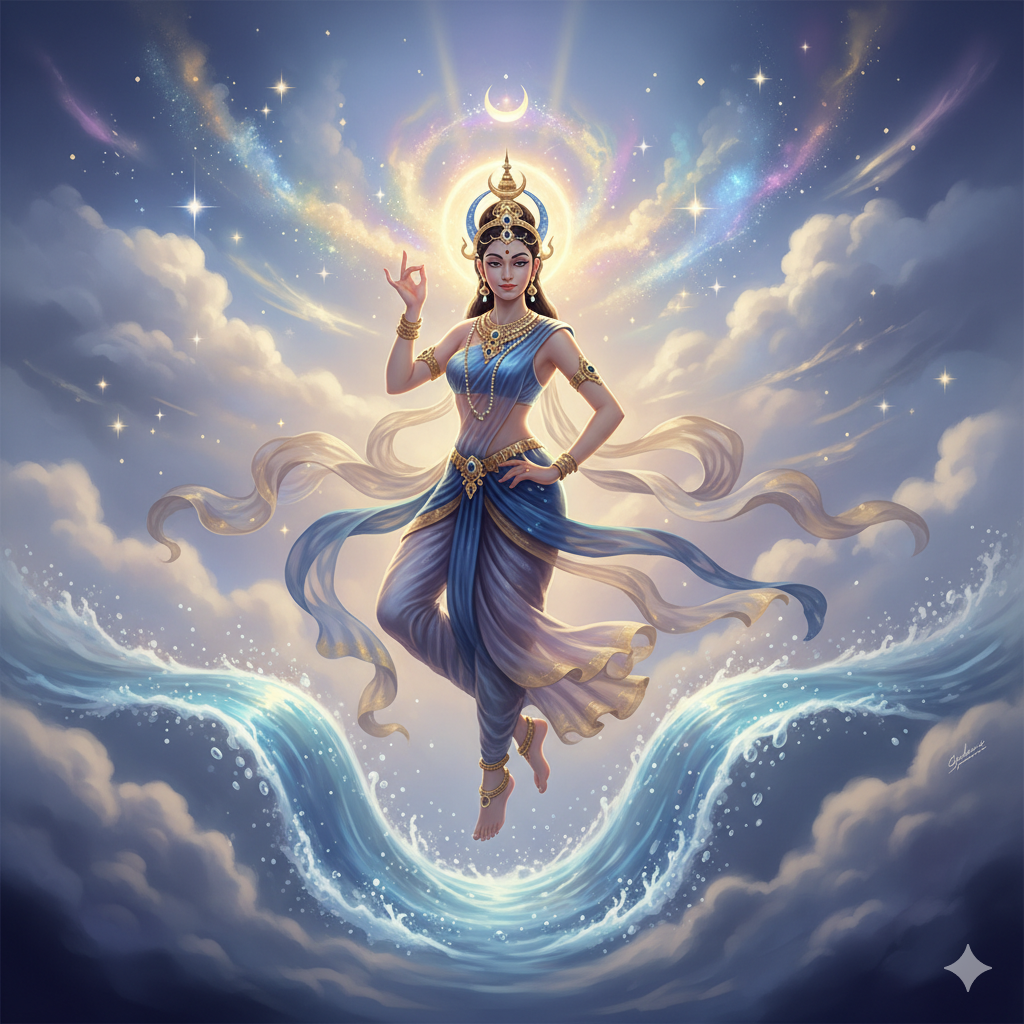
In the celestial courts of Hindu mythology, where divine beings gather in resplendent halls adorned with jewels beyond earthly imagination, there exists a class of entities whose beauty, grace, and artistic mastery transcend mortal comprehension. These are the Apsaras—celestial nymphs who dance through the cosmic narratives of ancient India, shaping the destinies of gods, sages, and mortals alike.
More than mere entertainers or symbols of divine beauty, Apsaras represent complex theological concepts woven into the fabric of Hindu cosmology. They embody the fluid nature of existence itself, born from primordial waters and serving as bridges between the celestial and earthly realms. Their stories explore profound themes: the tension between spiritual discipline and worldly desire, the power of beauty as both blessing and test, and the intricate balance that maintains cosmic order.
The Cosmic Birth: Origins from the Primordial Ocean
The most celebrated origin story of the Apsaras emerges from one of Hinduism’s most significant cosmological events—the Samudra Manthan, or the churning of the cosmic ocean. This monumental episode, detailed in sacred texts including the Vishnu Purana, Bhagavata Purana, and Mahabharata, describes a rare cooperation between opposing cosmic forces.
In this primordial event, the devas (celestial gods) and asuras (powerful demons) joined forces to churn the vast ocean of milk, seeking amrita—the divine nectar of immortality. Using Mount Mandara as a churning rod and the serpent Vasuki as a rope, they set in motion a cosmic process that would yield treasures both wondrous and terrible. From these churning waters emerged not only the elixir of immortality but also the goddess Lakshmi, the divine physician Dhanvantari, the wish-fulfilling cow Kamadhenu, and the Apsaras themselves.
The Apsaras materialized from the cosmic ocean in a moment of pure creation, their forms crystallizing from primordial waters and celestial nectar. This aquatic birth defines their essential nature, connecting them eternally to the element from which they emerged.
The Water Connection: Etymology and Elemental Symbolism
The Sanskrit term “Apsara” carries within it the essence of these celestial beings. Derived from “apas,” meaning water, the name emphasizes their intrinsic connection to the aquatic realm. This linguistic root reveals a deeper truth: like water itself, Apsaras are described as ever-flowing, fluid, and uncontained—embodying the dynamic, transformative nature of celestial divinity.
Early Vedic texts, particularly the Rigveda and Atharvaveda, describe Apsaras as aquatic nymphs dwelling in waters, closely associated with stars, clouds, and rain. This connection extends beyond mere symbolism; water represents fundamental cosmic principles—fluidity, the life-giving essence, purification, and the primordial source from which all creation flows. The Apsaras thus serve as living embodiments of these eternal truths, their very existence a reminder of the cosmic waters from which all life emerged.
The Celestial Hierarchy: Classifications and Dwelling Places
Hindu scriptures, with their characteristic attention to cosmic order and classification, divide the Apsaras into distinct categories, each occupying a specific place within the divine hierarchy.
Laukika Apsaras: The Worldly Nymphs
The Laukika Apsaras, numbering thirty-four according to classical texts, belong to a category more directly engaged with earthly affairs. These worldly nymphs frequently descend from the celestial realms to interact with mortals, particularly ascetic sages whose spiritual practices threaten to accumulate power that might disturb cosmic equilibrium. Their involvement in stories of seduction and temptation positions them as active participants in maintaining the balance between earthly and celestial domains.
Daivika Apsaras: The Divine Elite
Standing at the apex of the celestial hierarchy are the Daivika Apsaras—ten divine maidens of the highest order. These exalted beings reside permanently in the heavenly court of Indra, king of the gods, possessing spiritual powers and divine attributes that set them apart even among celestial entities. They represent the pinnacle of divine feminine grace, their powers extending beyond mere physical beauty to encompass profound spiritual and cosmic influence.
The Court of Heaven: Entertainers of the Divine
In Svarga, the celestial paradise ruled by Indra, the Apsaras serve a function that transcends mere performance. According to Puranic texts, twenty-six Apsaras grace Indra’s court, each representing a different aspect of the performing arts. This assembly draws natural parallels to the Muses of Greek mythology, yet the Apsaras embody a uniquely Hindu conception of art as both divine expression and cosmic function.
Masters of the Celestial Arts
The Apsaras are celebrated throughout Hindu literature for their unparalleled mastery of dance and music. They perform to the accompaniment of the Gandharvas—celestial musicians who serve as their companions, counterparts, and often their consorts. Together, Apsaras and Gandharvas create performances that transcend mortal comprehension, their art representing the highest expression of beauty and harmony in the universe.
Their performances are not entertainment in the mundane sense but rather expressions of cosmic order itself. Each movement, each note, each gesture reflects and reinforces the fundamental rhythms of existence. Through their art, the Apsaras participate in the ongoing creation and maintenance of the universe.
Powers Beyond Beauty
The abilities of Apsaras extend far beyond their celebrated physical appearance and artistic talents:
Shape-shifting: Apsaras possess the ability to transform their physical forms at will, appearing in whatever guise best serves their purpose or mission. This transformative power reflects their fluid, water-like nature—ever-changing yet essentially unchanging.
Irresistible Charm: Their beauty captivates both mortals and immortals, a power that serves cosmic purposes beyond mere vanity. This attraction operates on multiple levels—physical, emotional, and spiritual—making resistance extraordinarily difficult even for those of great spiritual advancement.
Artistic Supremacy: Their mastery of dance, music, and performance represents the absolute pinnacle of these arts, setting standards that mortal practitioners can only aspire to approach.
Fortune and Chance: Interestingly, Apsaras are associated with gambling and fortune in dice games, suggesting their influence extends into the realm of chance and probability—another reflection of their connection to the unpredictable, flowing nature of existence.
Fertility Connections: Links to fertility rites and procreation connect them to fundamental life forces, positioning them as channels through which divine creative energy flows into manifestation.
The Luminaries: Prominent Apsaras and Their Stories
Among the multitudes of Apsaras, certain figures stand out, their stories woven deeply into the narrative fabric of Hindu mythology. These prominent celestial nymphs serve as more than characters in ancient tales—they embody profound philosophical concepts and drive narratives that explore the complexities of desire, duty, and divine will.
Urvashi: The Supremely Beautiful
Universally acknowledged as the most prominent and beautiful of all Apsaras, Urvashi occupies a special position in both celestial hierarchy and mythological significance. Her very name reveals her unique origin: derived from “uru” (thigh) and “aś,” it relates to her miraculous birth from the thigh of sage Narayana during a moment of cosmic creativity.
The Epic Romance with Pururavas
Urvashi’s most celebrated narrative involves her passionate relationship with King Pururavas, the first ruler of the legendary Chandravansha (Lunar) dynasty. This love story, which would later inspire Kalidasa’s masterpiece “Vikramorvashiyam,” explores themes that resonate across millennia: the impossible love between mortal and immortal, the intoxicating power of desire, and the inevitable heartbreak when celestial beings must return to their divine realm.
Their union was marked by extraordinary passion but bound by celestial rules that Pururavas, in his mortal limitations, could not fully understand or maintain. When circumstances forced their separation, the king’s grief became legendary, his yearning representing the universal human experience of loss and the unbridgeable gulf between earthly existence and divine perfection.
This narrative transcends simple romance, becoming a meditation on the nature of attachment, the temporary nature of pleasure, and the spiritual journey that often begins only when worldly desires are frustrated or fulfilled and found wanting.
Menaka: The Reluctant Seductress
Menaka’s story represents one of the most strategically significant interventions by celestial forces in earthly affairs. Born during the Samudra Manthan, she possessed not only extraordinary beauty but also intelligence and a nuanced understanding of both celestial and earthly realms—qualities that made her uniquely suited for a mission of cosmic importance.
The Disruption of Vishwamitra’s Penance
The sage Vishwamitra had undertaken a thousand-year penance, accumulating spiritual power through extreme austerities. His growing abilities alarmed Indra, king of the gods, who perceived in the sage’s ascent a potential threat to the established cosmic order. Indra understood that if Vishwamitra’s power continued to grow unchecked, it might challenge the very foundations of divine authority.
In response, Indra dispatched Menaka with a clear mission: seduce Vishwamitra and break his concentration, disrupting the accumulation of spiritual energy that threatened celestial stability. Yet Menaka approached this mission with trepidation. She recognized the formidable power Vishwamitra had accumulated and feared the consequences of failure—the sage’s curse could be devastating. Only with assurances of assistance from Marut (the wind god) and Kamadeva (the god of desire) did she agree to attempt the task.
The mission succeeded beyond Indra’s expectations. Vishwamitra, despite his advanced spiritual development, fell under Menaka’s enchantment. Their union disrupted his penance, dissipating the accumulated power that had threatened the celestial order.
The Birth of Shakuntala: An Unintended Legacy
The relationship between Menaka and Vishwamitra produced an unexpected consequence: the birth of Shakuntala, destined to become one of the most celebrated heroines in Sanskrit literature. After giving birth, Menaka abandoned the infant on the banks of the river Malini in the Himalayas, where she was discovered and raised by the sage Kanva.
This abandonment, while seemingly cruel by mortal standards, follows a pattern common in mythological narratives—the celestial parent unable or unwilling to raise a child in the mortal realm. Yet Shakuntala’s destiny unfolded magnificently without maternal guidance. She became the wife of King Dushyanta and mother of Emperor Bharata, the legendary ruler after whom India (Bharat) derives its Sanskrit name. Through Shakuntala, Menaka’s temporary liaison with Vishwamitra produced consequences that literally shaped the history and identity of a civilization.
Rambha: The Queen of Apsaras
Rambha holds the distinguished title of foremost among Apsaras, often referred to as the “Queen of Apsaras.” According to the Mahabharata’s Adi Parva, she is the daughter of the sage Kashyapa and his wife Pradha, though alternative accounts describe her emergence from the churning of the cosmic ocean alongside her celestial sisters.
The Tragic Encounter with Ravana
One of the most significant and tragic stories involving Rambha concerns her fateful encounter with Ravana, the powerful demon king of Lanka. While traveling, Ravana encountered Rambha on a mountain and, captivated by her celestial beauty, approached her with desire. Rambha protested, explaining that she was married to Nalakuvara, the son of Kubera, the god of wealth. By relation, this made her Ravana’s daughter-in-law, since Kubera was Ravana’s half-brother.
Despite her pleas and the sacred relationships that should have protected her, Ravana violated Rambha. When Nalakuvara learned of this crime against his wife, he pronounced a curse that would echo through the great epic of the Ramayana: “If you ever touch a woman without her consent, your head shall shatter into pieces.”
This curse became crucial in the Ramayana narrative. When Ravana later abducted Sita, the wife of Lord Rama, his overwhelming desire to possess her was constrained by this ancient curse. Though he held her captive, he could not violate her, for doing so would bring instant death. Thus, an act of violence against Rambha created a divine protection that preserved Sita’s virtue throughout her captivity—a cosmic consequence spanning across epic narratives.
The Second Test of Vishwamitra
After Menaka’s successful disruption of Vishwamitra’s first great penance, Indra later sent Rambha on a similar mission. However, Vishwamitra—now wiser to the gods’ tactics and more resolved in his spiritual discipline—recognized the attempt immediately. Enraged at this second celestial interference, he cursed Rambha to transform into stone for ten thousand years, a punishment that would only end when a Brahmin of pure heart would release her from the curse.
This story demonstrates the evolution of the sage’s spiritual journey: where once he succumbed to temptation, he now possessed the awareness and strength to resist. It also reveals the risks Apsaras faced in these missions—they were not mere pawns but beings who could suffer serious consequences when their assignments failed.
Tilottama: Perfection Incarnate
Tilottama stands unique among Apsaras, for she was not born from the cosmic ocean but deliberately created for a specific divine purpose. Her name itself—meaning “one who is desired by all” or “composed of the finest qualities”—reveals the intention behind her existence. She was crafted by Vishwakarma, the divine architect of the gods, at Lord Brahma’s request, using the finest qualities of everything in creation as her constituent elements.
The Destruction of Sunda and Upasunda
Tilottama’s creation addressed a cosmic crisis. Two asura brothers, Sunda and Upasunda, had performed such severe austerities that Brahma granted them a powerful boon: they would be invulnerable to all beings except each other. With this protection, the inseparable brothers conquered the three worlds, driving out the gods and establishing their own dominion. Their bond seemed unbreakable—they shared everything, agreed on all matters, and their unity formed the foundation of their power.
The gods, displaced from their celestial abodes, appealed to Brahma for a solution. Understanding that direct confrontation was impossible, Brahma conceived a more subtle strategy: he would create a being of such perfect beauty that even the unbreakable bond between the brothers would shatter in the face of desire.
When Tilottama appeared before Sunda and Upasunda, the effect was instantaneous and devastating. Both brothers fell immediately and completely in love with her, each demanding her for himself alone. For the first time in their existence, the brothers found themselves in fundamental disagreement. Desire transformed unity into rivalry, and rivalry into rage. They engaged in fierce combat, each wielding weapons against the one being who could harm them. The battle ended with both brothers dead, victims of the one vulnerability Brahma’s boon could not protect them from: their own conflict.
This story was later narrated by the sage Narada to the Pandavas as a cautionary tale during the Mahabharata. The lesson resonates beyond its immediate context: even the strongest bonds can be destroyed by desire, and unchecked passion leads to self-destruction. Tilottama’s role in this narrative positions her as an instrument of cosmic justice, her perfect beauty serving a specific divine purpose in restoring balance to the universe.
Ghritachi: The Eternal Beauty
Ghritachi represents a unique aspect of the Apsara tradition—she is described as possessing eternal youth, her celestial beauty never fading with the passage of time. While many Apsaras feature prominently in stories of seduction and temptation, Ghritachi’s legacy extends into a different realm: divine motherhood.
Sacred Unions and Illustrious Offspring
Ghritachi’s relationships with prominent sages resulted in the birth of several figures who would shape the course of Hindu mythology and philosophy:
The legendary compiler of the Vedas, Vyasa, sought a son of spiritual merit. Through divine intervention involving Ghritachi, he became father to Shuka, a sage of such spiritual advancement that he is remembered as one of the greatest teachers in Hindu tradition.
Her union with the sage Bharadwaja produced Drona, who would become one of the most formidable warriors and martial instructors in the Mahabharata, teaching both the Pandavas and Kauravas the arts of warfare and serving as a central figure in that great epic.
She also married King Kushanabha, bearing him one hundred daughters—an extraordinary lineage that would spread her divine heritage across multiple generations.
The Curse of Vayu
In one notable episode, Ghritachi’s hundred daughters spurned the advances of Vayu, the wind god. Enraged at this rejection, Vayu cursed them to become hunchbacks, their physical forms twisted by divine anger. Yet this curse was not permanent; they were later cured and married to King Brahmadatta, their story illustrating themes of divine retribution, redemption, and the eventual restoration of harmony.
Anjana: From Curse to Divine Motherhood
Among all the Apsaras, Anjana’s (originally named Punjikasthala) story follows perhaps the most dramatic arc of transformation. Originally an Apsara in Indra’s court, she was cursed by a sage to be born on earth as a vanara (a semi-divine monkey being) princess. This curse, like many in Hindu mythology, contained within it the seeds of its own resolution and a pathway to something greater.
Born as Anjana in the mortal realm, she married Kesari, a vanara chief. Her transformation reached its ultimate purpose when she gave birth to Hanuman, one of the most revered deities in Hinduism. Hanuman’s birth fulfilled multiple prophecies and divine purposes—he would become the greatest devotee of Lord Rama, play a crucial role in the Ramayana, and emerge as a deity worshipped by millions for his strength, devotion, and selfless service.
Anjana’s curse lifted upon Hanuman’s birth, yet by that point, the distinction between curse and blessing had become meaningless. Her descent from celestial courts to earthly existence, her transformation into a vanara, and her subsequent motherhood of a being who transcended all categories—these were not punishments but rather a divine plan unfolding toward its predestined conclusion.
The Extended Pantheon
The vast celestial courts house numerous other Apsaras, each with their own attributes and stories: Alambusha, known for her role in various seduction missions; Misrakeshi, whose name appears in multiple narrative contexts; Vidhyutparna, Aruna, Rakshita, Manorama, Subahu, Keshini, Surata, and Suraja. Each contributes to the rich tapestry of celestial narratives, their individual stories forming threads in the larger pattern of Hindu cosmological understanding.
Cosmic Functions: The Role of Apsaras in Divine Order
Understanding the Apsaras requires moving beyond surface impressions of beauty and seduction to grasp their deeper cosmic functions. These celestial beings serve specific purposes within the intricate machinery of Hindu cosmology.
Instruments of Divine Will
Apsaras frequently operate as instruments through which the gods, particularly Indra, influence events across different realms of existence. When sages perform extreme austerities, accumulating spiritual power through years or centuries of focused practice, they can potentially upset the cosmic balance. A sage whose power rivals or exceeds that of the gods poses not merely a political threat but a metaphysical one—their accumulated energy might destabilize the very foundations of cosmic order.
In these situations, Apsaras serve as divine intervention agents. Their missions to seduce sages serve a purpose beyond mere disruption: they prevent the accumulation of power that might threaten universal stability. This positions Apsaras not as simple temptresses but as maintainers of cosmic equilibrium, their actions preserving the balance necessary for the universe to function.
Tests of Spiritual Fortitude
Many narratives portray Apsaras as tests designed to evaluate spiritual strength and self-control. When an Apsara appears before a sage deep in meditation, the encounter represents more than a simple distraction. It becomes a crucible in which genuine spiritual advancement is proven or found wanting.
These stories explore profound philosophical questions: Can spiritual discipline withstand the full force of worldly desire? At what point does asceticism become true renunciation rather than mere suppression? When a sage succumbs to an Apsara’s charms, has he failed, or has he simply discovered that his spiritual journey requires a different path than pure asceticism?
The complexity of these narratives reflects sophisticated theological thinking. Desire itself is not condemned; rather, these stories examine the relationship between spiritual aspiration and worldly engagement, questioning whether true enlightenment requires complete renunciation or integrated understanding.
Bridges Between Realms
The fluid nature of Apsaras—born from water, capable of moving between celestial and earthly domains, possessing both divine attributes and engagement with mortal affairs—positions them as bridges between different levels of existence. They embody the principle that the divine and mundane are not absolutely separate but rather exist on a continuum of being.
Their children, born from unions with sages and kings, often become pivotal figures who shape human civilization while carrying divine heritage. Through these offspring, celestial influence flows into the mortal realm, guiding the development of culture, philosophy, and spiritual understanding.
Cultural and Artistic Legacy
The influence of Apsaras extends far beyond religious texts and mythological narratives. They have profoundly shaped artistic expression throughout South and Southeast Asian cultures for millennia.
Embodiments of Aesthetic Ideals
Apsaras represent the highest ideals of feminine beauty, grace, and artistic excellence in Hindu culture. Classical Indian dance forms—Bharatanatyam, Kathak, Odissi, Kuchipudi—draw inspiration from celestial performers whose movements embody cosmic rhythms. Dancers training in these traditions study not merely technique but the spiritual and cosmic significance of each gesture, aspiring to channel the same divine grace that characterizes Apsara performances in celestial courts.
Architectural and Sculptural Representations
Temples across India and Southeast Asia feature elaborate sculptures and reliefs depicting Apsaras. These are not mere decorations but theological statements in stone. The famous Apsara carvings of Angkor Wat in Cambodia, the celestial dancers adorning Khajuraho temples in India, and countless other representations serve multiple functions: they beautify sacred spaces, illustrate mythological narratives, and create visual bridges between earthly temples and celestial realms they symbolically represent.
Literary Inspiration
Sanskrit literature, from the Vedas through classical poetry and drama, returns repeatedly to Apsara narratives. Kalidasa’s works, particularly “Vikramorvashiyam,” demonstrate how these celestial figures provide frameworks for exploring timeless themes of love, loss, duty, and the relationship between mortal and divine existence.
Modern literature, film, and other media continue to reinterpret Apsara stories, finding in these ancient narratives resonances with contemporary questions about desire, power, autonomy, and the nature of beauty itself.
Theological and Symbolic Dimensions
Beyond their narrative functions, Apsaras embody complex theological concepts central to Hindu philosophy.
Manifestations of Divine Feminine
Apsaras represent multiple aspects of Shakti—the divine feminine principle that animates and energizes existence. They embody beauty as a sacred attribute, creativity as divine expression, and the transformative power that can either elevate or distract depending on the spiritual readiness of the observer.
Their role in testing sages connects to the concept of maya—the cosmic illusion that veils ultimate reality. An Apsara’s beauty can be understood as a form of maya: captivating, seemingly real and desirable, yet ultimately temporary and potentially distracting from higher truths. Yet maya itself, in sophisticated Hindu theology, is not simply negative but rather a necessary aspect of divine play (lila) through which consciousness experiences and knows itself.
Water Symbolism and Cosmic Principles
The deep connection between Apsaras and water operates on multiple symbolic levels. Water represents:
Primordial Source: The cosmic ocean from which they emerged symbolizes the undifferentiated potential from which all manifest existence arises.
Fluidity and Transformation: Like water, Apsaras are shape-shifters, adapting their forms to circumstances, embodying the principle that reality is fundamentally fluid and dynamic rather than fixed and static.
Purification and Life: Water cleanses and sustains life. Apsaras, through their various roles, participate in cosmic purification—removing impediments to divine order, testing and purifying spiritual seekers, and bringing forth new life through their divine offspring.
Depth and Mystery: Water’s depths conceal unknown realms. Similarly, Apsaras embody mysteries that cannot be fully grasped through intellectual understanding alone—their stories invite contemplation of paradoxes central to existence itself.
Enduring Significance
The Apsaras of Hindu mythology represent far more than celestial entertainers or divine temptresses. They are complex theological concepts given narrative form, serving crucial functions within the cosmic drama that Hindu tradition describes. Their stories weave together themes of beauty and duty, desire and spirituality, creation and destruction, forming a rich mythological tapestry that reflects the sophisticated philosophical and artistic traditions of Hindu civilization.
From the primordial waters of creation to the celestial courts of Indra, from missions that shape the destinies of sages to motherhood that produces civilization-defining figures, Apsaras move through Hindu mythology as active participants in cosmic unfolding. They challenge simplistic categorizations, embodying paradoxes central to Hindu thought: they are both divine and engaged with worldly affairs; they distract from spiritual goals yet serve cosmic purposes; they embody desire yet participate in divine order.
Their enduring presence in art, literature, dance, and cultural consciousness across millennia testifies to the depth and resonance of these celestial figures. In contemporary times, as in ancient eras, the Apsaras continue to inspire reflection on beauty’s nature, the complexity of desire, the relationship between worldly engagement and spiritual aspiration, and the fluid boundaries between divine and human existence.
The stories of Urvashi, Menaka, Rambha, Tilottama, Ghritachi, Anjana, and their celestial sisters remain vital not as historical curiosities but as living narratives that continue to offer insights into the perennial questions of human existence—questions of love and loss, duty and desire, the search for meaning, and the eternal dance between the temporal and the transcendent that defines conscious existence itself.
Leave a Reply