
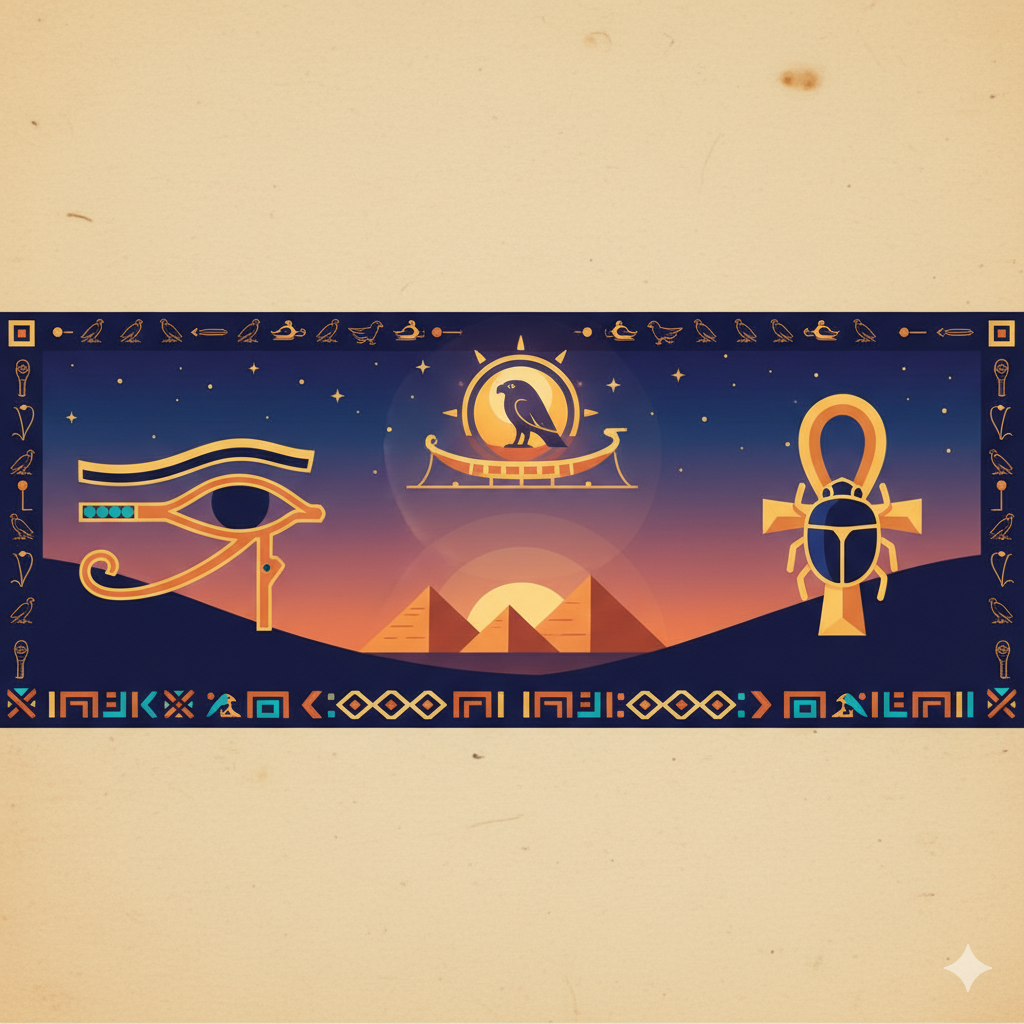
For over three millennia, along the life-giving banks of the Nile River, ancient Egyptians developed one of humanity’s most intricate and enduring belief systems. Egyptian mythology wasn’t merely a collection of stories about gods and monsters—it was a comprehensive framework for understanding existence itself, from the first moment of creation to the eternal journey beyond death.
Imagine a world where the sun’s daily journey across the sky was a divine voyage, where death was not an ending but a perilous adventure, and where over 2,000 deities governed every aspect of reality. This was the spiritual landscape of ancient Egypt, a civilization that thrived for thousands of years, leaving behind monuments, texts, and a mythological legacy that continues to captivate us today.
In this exploration, we’ll journey through the cosmic waters of creation, meet the powerful gods who shaped Egyptian life, uncover the dramatic myths that explained their world, and walk the dangerous path through the underworld that every Egyptian hoped to navigate successfully.
From Chaos to Cosmos: The Egyptian Creation
The Primordial Waters of Nun
Before time began, before light pierced darkness, before anything existed at all, there was Nun—the infinite, dark waters of primordial chaos. This wasn’t mere emptiness, but rather unlimited potential, a cosmic ocean containing everything that would ever be, waiting to manifest.
The ancient Egyptians didn’t imagine a single moment of creation spoken into being. Instead, they envisioned creation as emergence, transformation, and self-generation rising from these chaotic waters. Multiple cities across Egypt developed their own creation narratives, each reflecting local theological traditions, yet all shared this fundamental starting point: the dark, formless waters of Nun.
The First Land: The Benben Mound
From Nun’s infinite depths emerged the benben, a pyramidal mound of solid earth—the first land in the universe. This imagery was deeply rooted in Egyptian experience: each year, the Nile’s floods would recede, leaving behind fertile mounds of earth that brought life and abundance. The benben represented this same principle on a cosmic scale—order and life emerging from chaos.
In Heliopolis, the religious center where the most influential creation myth originated, the creator god Atum (sometimes merged with Ra as Ra-Atum) arose from these waters, self-created and alone. Through acts of divine will—described variously as spitting, speaking words of power, or other creative acts—Atum produced the first divine pair: Shu, god of air and dryness, and Tefnut, goddess of moisture.
The First Generations: Building the Divine Family
Creation continued through divine procreation. Shu and Tefnut gave birth to Geb, the earth god, and Nut, the sky goddess. This second generation of deities embodied the fundamental structures of the cosmos itself—the ground beneath and the heavens above.
Geb and Nut, in their turn, produced four children who would become central to Egyptian mythology’s most important narratives: Osiris, Isis, Set, and Nephthys. These deities would shape the destinies of both gods and mortals, their stories explaining everything from kingship to death itself.
According to one particularly poignant detail in these creation accounts, humanity was born from the tears of the creator god’s eyes—a beautiful metaphor suggesting that human existence itself emerged from divine emotion, connecting mortals intimately to the gods from the very beginning.
The Architecture of Reality: Egyptian Cosmology
Three Realms of Existence
The ancient Egyptians conceived the universe as a vast, carefully structured space divided into three fundamental realms: Ta (the earth), Nut (the sky), and Duat (the underworld). Each realm was a complete world unto itself, yet all three were interconnected through divine cycles and the movement of souls.
The earth itself was imagined as a flat, circular disk surrounded by the great ocean that extended beyond the known world. This disk was the body of Geb, often depicted as a reclining man covered in vegetation—every plant, every harvest, every fertile field was literally part of the earth god’s living body.
Above stretched Nut, the sky goddess, whose star-covered body arched across the heavens like a vast canopy. Between earth and sky stood Shu, the air god, whose role was cosmic and essential: he held Nut aloft, maintaining the separation necessary for life to exist. Without Shu’s constant support, sky and earth would collapse together, returning the universe to primordial chaos.
The Eternal Solar Journey
This cosmic architecture wasn’t static—it was animated by Ra, the supreme sun god, whose daily journey gave rhythm and meaning to existence. Each morning, Ra emerged from the eastern horizon in his magnificent solar boat, sailing across Nut’s body and bringing light, warmth, and life to the world below.
But Ra’s journey didn’t end at sunset. Each evening, Nut would swallow the sun god, and he would begin a perilous voyage through her body and through the underworld itself. This nightly journey took Ra through twelve gates, each representing an hour of night, and at each gate lurked dangers, demons, and the great serpent Apophis who sought to devour the sun and plunge the world into eternal darkness.
Yet each dawn, Ra would emerge victorious, reborn from Nut’s body at the eastern horizon. This eternal cycle—life, death, journey through darkness, and rebirth—became the fundamental pattern that Egyptians understood as governing all existence, including their own lives and hoped-for afterlife.
The Divine Pantheon: Gods Who Shaped Egypt
Ra: The Supreme Sun God
Ra stood at the apex of the Egyptian pantheon, the creator and king of all gods. More than just a solar deity, Ra represented divine kingship, creative power, and the triumph of order over chaos. His daily journey across the sky wasn’t mere astronomical movement—it was a cosmic battle, a divine duty that sustained all life.
Ra appeared in many forms and merged with other deities throughout Egyptian history. His combination with Amun to become Amun-Ra represented the ultimate divine power, earning the title “King of the Gods.” Typically depicted with the head of a falcon crowned by a solar disk, Ra’s image appeared in temples throughout Egypt, a constant reminder of the divine force that gave life to the world.
Osiris: Lord of Death and Resurrection
Osiris governed one of humanity’s most profound mysteries: what lies beyond death. As god of the underworld, resurrection, and eternal life, Osiris embodied the promise that death was not an ending but a transformation. His distinctive appearance—green skin symbolizing rebirth and vegetation, holding a crook and flail representing kingship and authority, wearing his characteristic atef crown—made him immediately recognizable in Egyptian art.
But Osiris was more than an underworld deity. He represented the possibility of triumph over death itself, the hope that through proper preparation and righteous living, one could achieve eternal life in paradise. Every mummy created, every funeral rite performed, every spell recited from the Book of the Dead invoked Osiris’s story and sought his favor in the journey to come.
Isis: The Most Powerful Goddess
If Osiris represented death and resurrection, Isis embodied the magical power that made resurrection possible. She was the most prominent and powerful goddess in Egyptian mythology, revered as the embodiment of magic, motherhood, healing, and wisdom. Her name literally means “throne,” and she was considered the symbolic mother of every pharaoh who sat upon Egypt’s throne.
Isis’s mythology portrayed her as clever, determined, and possessing magical abilities that sometimes surpassed even those of Ra himself. Her devotion to Osiris and her role as mother to Horus made her a figure of both divine power and human emotion—a goddess who mourned, struggled, and persevered. Her cult eventually spread beyond Egypt’s borders, making her one of the most widely worshipped deities of the ancient Mediterranean world.
Horus: The Divine King
Horus, the falcon-headed sky god, bridged the divine and earthly realms of kingship. Every pharaoh was believed to be the living incarnation of Horus, making this deity essential to Egyptian concepts of legitimate rule and divine authority. His famous eyes—the sun and moon—watched over Egypt constantly, and the Eye of Horus became one of ancient Egypt’s most powerful protective symbols, used in amulets, inscriptions, and funerary equipment.
The mythology of Horus was complex and multifaceted, with different aspects and forms appearing throughout Egyptian religious texts. As the son of Osiris and Isis, he represented legitimate succession and the restoration of cosmic order after his father’s murder—a narrative that provided theological justification for the inheritance of the Egyptian throne.
Anubis: Guardian of the Dead
With his distinctive jackal head, Anubis presided over one of Egypt’s most sacred processes: mummification. But his role extended far beyond the embalming table. Anubis guided souls through the treacherous underworld, protected tombs from desecration, and played a crucial role in the weighing of the heart ceremony that determined each soul’s ultimate fate.
The choice of a jackal for Anubis’s iconography was deliberate and practical—jackals were commonly seen in cemeteries, scavenging among the graves. By making a jackal-headed god the protector of the dead, Egyptians transformed a potential threat into a divine guardian, ensuring that Anubis would watch over the deceased rather than disturb their rest.
Thoth: Divine Wisdom and Writing
Thoth, depicted with the head of an ibis, governed knowledge, writing, magic, and the moon. As the divine scribe, Thoth recorded the results of the judgment of the dead, documenting which souls passed into paradise and which were condemned. His association with writing made him the patron deity of scribes, who invoked his name before beginning their work.
But Thoth was more than a celestial record-keeper. He represented wisdom itself, often depicted as an advisor to other gods, using his knowledge and magical abilities to resolve disputes and maintain cosmic order. In some myths, Thoth possessed healing powers and was credited with creating many of the magical spells that protected both living and dead.
Ma’at: The Principle of Cosmic Order
Ma’at occupied a unique position in Egyptian theology—she was both a goddess and a fundamental concept. As a deity, she appeared as a woman with an ostrich feather on her head. As a principle, Ma’at represented truth, justice, harmony, balance, and cosmic order—the fundamental structure that held the universe together and prevented it from sliding back into primordial chaos.
Every pharaoh’s primary duty was to maintain Ma’at throughout the land. Every priest performed rituals to uphold Ma’at. Every individual Egyptian was expected to live according to Ma’at’s principles. In the afterlife judgment, it was Ma’at’s feather that would be weighed against the heart, determining whether a soul had lived righteously or not. Without Ma’at, the universe itself would unravel.
Other Essential Deities
The Egyptian pantheon extended far beyond these major figures. Hathor, often depicted as a cow or a woman with cow’s horns, governed love, music, joy, and motherhood. Sekhmet, the lioness-headed goddess, embodied both the destructive power of war and the healing that follows. Bastet, the cat goddess, protected homes and families. Set, brother and murderer of Osiris, represented chaos, storms, and the dangerous desert—yet even he had a necessary role in cosmic balance, sometimes helping Ra fight off the serpent Apophis during the nightly journey through the underworld.
Each nome (province) of Egypt had its own patron deity, and individual cities often elevated local gods to positions of great importance. This resulted in a flexible, evolving pantheon where gods could merge, split, or change attributes over the centuries, reflecting the changing religious and political landscape of ancient Egypt.
The Osiris Myth: Death, Love, and Resurrection
The Perfect King and the Jealous Brother
The most elaborate and important story in Egyptian mythology centered on Osiris, and it contained all the elements of great drama: a beloved king, a jealous brother, a devoted wife, murder, resurrection, and ultimate justice. This wasn’t merely entertainment—it was theology, explaining fundamental beliefs about death, the afterlife, and rightful kingship.
Osiris ruled Egypt during a golden age, bringing civilization, agriculture, and prosperity to the land. He taught humanity how to cultivate crops, build communities, and live according to divine law. Beloved by gods and mortals alike, Osiris seemed destined to rule forever—but his brother Set grew increasingly jealous of the king’s success and the people’s adoration.
The Murder and the Quest
Set’s jealousy festered into murderous intent. He murdered Osiris, sealed his body in an ornate chest, and cast it into the Nile River. In some versions of the myth, Set’s brutality extended further—he later dismembered Osiris’s body into fourteen pieces and scattered them across Egypt, ensuring that his brother could never be whole again.
But Set had not accounted for the determination and magical power of Isis. The devoted wife refused to accept her husband’s death as final. She embarked on a desperate search throughout Egypt, traveling to every corner of the kingdom to recover Osiris’s scattered remains. Her sister Nephthys, Anubis, and Thoth aided in this quest, moved by Isis’s grief and determination.
The First Mummy and the Underworld King
When Isis finally recovered all the pieces, she used her considerable magical abilities to reassemble Osiris’s body, creating the first mummy in the process. Through powerful spells and sacred rituals, she succeeded in resurrecting her husband—but the resurrection was incomplete. Osiris could not remain in the world of the living. Instead, he descended to the underworld, where he would reign as eternal king, judging the souls of the dead and offering them the possibility of eternal life.
Before departing, through magical means, Isis conceived a son: Horus. She raised him in secret in the Nile Delta’s marshes, protecting him from Set’s murderous intentions. When Horus came of age, he challenged Set for the throne of Egypt, ultimately defeating his uncle and restoring rightful rule to the land.
Theological Significance
This myth operated on multiple levels. It explained the origin of mummification and funerary practices. It established the theological basis for the pharaoh’s divine right to rule (as the living Horus succeeding the deceased Osiris). It provided a model for the journey every Egyptian hoped to make after death—from death through resurrection to eternal life. And it illustrated the eternal struggle between order (represented by Osiris and Horus) and chaos (represented by Set), showing that while chaos might temporarily triumph, divine order would ultimately be restored.
Monsters and Mythical Beings: Guardians and Threats
Apophis: The Great Serpent of Chaos
If the gods represented order, structure, and life, then Apophis (also called Apep) embodied their opposite. This colossal serpent was chaos incarnate, an enormous creature dwelling in the underworld who sought nothing less than the destruction of all existence. Each night, as Ra’s solar boat journeyed through the underworld, Apophis attacked, attempting to swallow the sun god and prevent dawn from ever arriving.
The battle between Ra and Apophis represented the most fundamental struggle in Egyptian cosmology: the eternal conflict between Ma’at (order) and Isfet (chaos). Ra never faced this battle alone—he was defended by other deities, including sometimes even Set, whose chaotic nature made him particularly effective against the chaos serpent. The sun’s successful emergence each morning proved that order had triumphed once again, but the battle would be fought anew the following night. This eternal struggle would continue until the end of time itself.
Ammit: The Devourer of the Dead
In the Hall of Ma’at, where souls faced judgment after death, lurked a creature that terrified every ancient Egyptian: Ammit, the Devourer of the Dead. Part crocodile, part lion, part hippopotamus—three of Egypt’s most dangerous animals combined into one horrifying form—Ammit waited beside the scales where hearts were weighed against Ma’at’s feather of truth.
If a heart proved heavy with sin and wrongdoing, Ammit would devour it immediately, condemning that soul to complete annihilation. This was the ultimate terror—not merely death, but the absolute destruction of one’s very existence, preventing any possibility of eternal life. The threat of Ammit encouraged righteous living and ensured that Egyptians took the moral requirements of Ma’at seriously throughout their lives.
The Sphinx: Guardian of Sacred Spaces
The Sphinx, with its human head and lion’s body, represented intelligence combined with strength, wisdom united with power. These monumental creatures guarded temple entrances, tombs, and sacred spaces, their presence warning that only those with proper authority and pure intentions should proceed. The Great Sphinx of Giza, one of the world’s most recognizable monuments, embodies this protective function on a massive scale, watching over the royal necropolis for over four thousand years.
Sphinxes appeared in various forms throughout Egyptian art and architecture—some with falcon heads representing Horus, others with ram heads representing Amun. Each variation combined human intellect with the strength of Egypt’s most powerful animals, creating guardians suited to protecting different types of sacred spaces.
Bennu: The Phoenix Bird of Rebirth
The Bennu bird, depicted as a heron or similar long-legged bird, was associated with Ra and represented creation, renewal, and rebirth. According to myth, the Bennu lived for five hundred years before building a pyre and being consumed in flames, only to rise again from its own ashes. The Greeks later adopted this creature as their Phoenix, spreading the symbolism of death and resurrection throughout Western mythology.
The Bennu’s connection to the sun god Ra linked it to the daily cycle of death and rebirth that the sun itself experienced. Some texts suggest the Bennu was present at creation itself, emerging from the primordial waters alongside the benben mound, its cry marking the beginning of time.
Other Supernatural Creatures
Egyptian mythology featured numerous other fantastic beings: Serpopards (leopards with serpentine necks), Griffins (lion bodies with eagle heads and wings), protective demons who guarded gates in the underworld, and various composite creatures that embodied Egypt’s most powerful and dangerous animals. These beings served as guardians, threats, or supernatural forces that populated the mythological landscape, making it rich with danger and wonder.
The Journey After Death: Trial, Judgment, and Paradise
Entering the Duat: The Beginning of the Journey
Death was not an ending but a beginning—the start of a perilous journey through the Duat, the underworld. This mysterious realm existed as a mirror world beneath the earth, a place of darkness, danger, and divine judgment. The journey through the Duat paralleled Ra’s nightly voyage, and like the sun god, the deceased had to navigate treacherous paths and overcome numerous obstacles to reach their destination.
Anubis, the jackal-headed god, guided souls through this dangerous realm. The deceased needed more than divine guidance, however—they required knowledge. The Book of the Dead, properly called the “Book of Coming Forth by Day,” contained spells, prayers, and instructions for navigating the underworld. Wealthy Egyptians commissioned personalized copies of these texts, inscribed on papyrus or tomb walls, ensuring they would have the magical knowledge needed to survive their journey.
The Twelve Gates and Their Guardians
The path through the Duat led through twelve gates, each representing an hour of night and each guarded by powerful deities and fearsome demons. At each gate, the soul needed to know the guardian’s name, recite specific spells, and answer questions to prove their worthiness to proceed. Without the proper knowledge—the spells from the Book of the Dead—a soul could become lost in the underworld forever, wandering through darkness without hope of reaching judgment or paradise.
These gates weren’t merely obstacles but transformative thresholds. Passing through each one represented progress toward rebirth, movement from death toward the possibility of eternal life. The journey tested not only the deceased’s knowledge but their moral character, their relationship with the gods, and their adherence to Ma’at during their earthly life.
The Hall of Ma’at: The Ultimate Judgment
The culmination of the underworld journey came at the Hall of Ma’at (also called the Hall of Two Truths), where Osiris sat enthroned, presiding over the judgment of the dead. This was the moment every Egyptian both anticipated and feared—the final determination of their eternal fate.
The deceased first stood before forty-two divine judges, reciting the “Negative Confession”—a declaration of sins they had not committed during their lifetime: “I have not killed. I have not stolen. I have not told lies. I have not caused suffering. I have not polluted water. I have not mistreated animals…” This litany continued, covering the ethical requirements of Ma’at and demonstrating that the deceased had lived righteously.
The Weighing of the Heart
Then came the ceremony that would determine everything: the weighing of the heart. Anubis carefully removed the deceased’s heart and placed it on one side of a great scale. On the other side rested Ma’at’s ostrich feather, the lightest symbol of truth and justice.
The heart contained all the deeds, thoughts, and intentions of the deceased’s lifetime. A heart heavy with sin, lies, cruelty, and violations of Ma’at would outweigh the feather. Ammit waited beside the scales, ready to devour any heart that failed the test, condemning that soul to complete annihilation—not merely death, but the total destruction of existence itself.
But a heart light with virtue, truth, and righteousness would balance perfectly with the feather. Thoth, serving as divine scribe, recorded the result. If the heart balanced or weighed lighter than the feather, Osiris would welcome the soul, declaring them “true of voice” and worthy of eternal life.
The Field of Reeds: Egyptian Paradise
Those who passed judgment entered the Field of Reeds (Sekhet-Aaru), the Egyptian version of paradise. This was no abstract, ethereal heaven—it was a perfected version of Egypt itself. Lush fields stretched endlessly under eternal blue skies. The Nile flowed with crystal-clear water. Grain grew taller than anywhere on earth, yielding unlimited harvests.
The blessed dead lived in this paradise much as they had in life, but without suffering, hunger, illness, or toil. They farmed fertile lands that produced abundant crops without effort. They feasted and celebrated. They reunited with loved ones who had passed before them. They could even travel in Ra’s solar boat, accompanying the sun god on his daily journey across the sky.
Yet even paradise required preparation. Wealthy Egyptians were buried with shabti figures—small statuettes inscribed with spells that would animate them in the afterlife. These magical servants would perform any labor required of the deceased in the Field of Reeds, ensuring that even in paradise, the blessed would never need to perform difficult work. It was the ultimate expression of Egyptian pragmatism: even in eternal life, one should be prepared.
Sacred Symbols: The Visual Language of Egyptian Belief
Ma’at: The Foundational Principle
While Ma’at was a goddess, she was also the most fundamental concept in Egyptian thought—the principle of truth, justice, balance, harmony, and cosmic order that held the universe together. Without Ma’at, existence itself would collapse back into the chaos of Nun. Every pharaoh’s coronation included vows to uphold Ma’at. Every temple ritual reinforced Ma’at. Every individual who lived honestly and justly contributed to maintaining Ma’at in the world.
This wasn’t merely abstract philosophy. Ma’at had practical implications for how Egyptians lived, governed, and related to one another. The pharaoh who ruled unjustly violated Ma’at. The merchant who cheated customers violated Ma’at. The individual who lied or stole violated Ma’at. These violations had cosmic significance—they weakened the structure of reality itself and invited chaos back into the world.
The Ankh: Symbol of Life Eternal
The ankh, shaped like a cross with a loop at the top, appeared everywhere in Egyptian art and hieroglyphics. It represented eternal life—not merely physical existence but the immortal life that awaited the righteous in the Field of Reeds. Gods frequently held ankhs in artwork, sometimes pressing them to the nostrils of the deceased in images representing the gift of eternal life.
The ankh’s shape may have originated from several sources—perhaps a sandal strap, perhaps a combination of male and female symbols, perhaps something else entirely. Regardless of its origin, its meaning became universal: life continuing beyond death, the promise that proper preparation and righteous living would lead to eternal existence.
The Eye of Horus: Protection and Power
The Eye of Horus (also called the Wedjat eye) was one of ancient Egypt’s most powerful protective symbols. According to myth, during Horus’s battles with Set, the chaos god tore out Horus’s eye. Thoth magically restored it, making it whole and even more powerful than before. The restored eye became a symbol of healing, protection, royal power, and good health.
The Eye of Horus appeared on amulets worn by living Egyptians for protection, on tomb walls to guard the deceased, and in funerary equipment to ensure safe passage through the underworld. Its distinctive shape—a human eye with markings resembling a falcon’s facial markings—made it instantly recognizable and remains one of the most famous symbols of ancient Egypt.
The Scarab: Transformation and Rebirth
Scarab beetles might seem like unlikely divine symbols, but their behavior perfectly embodied Egyptian concepts of transformation and rebirth. These beetles roll balls of dung across the ground, lay their eggs inside, and bury them. Later, young beetles emerge from the buried ball, appearing to generate spontaneously from the earth itself.
To ancient Egyptians, this process mirrored the sun’s movement across the sky and journey through the underworld. The god Khepri, depicted as a scarab or as a man with a scarab for a head, represented the morning sun—the moment of rebirth after the night’s dangerous journey. Scarab amulets were placed over mummies’ hearts, inscribed with spells to ensure the heart wouldn’t testify against the deceased during judgment.
The Djed Pillar: Stability and Osiris
The djed pillar, resembling a column with horizontal bars near the top, represented stability, permanence, and endurance. It was associated with Osiris, sometimes interpreted as representing the god’s backbone or spine. During certain festivals, the ritual “raising of the djed” symbolized Osiris’s resurrection and the triumph of order over chaos, stability over destruction.
The djed appeared frequently in funerary contexts, offering the deceased the stability and endurance needed for the afterlife journey. Its presence in tomb decorations reinforced the hope that death was not permanent collapse but a transformation leading to eternal stability in paradise.
The Lotus: Daily Renewal
The lotus flower, which closes at night and reopens at dawn, became a powerful symbol of rebirth and creation. This daily cycle of closing and opening mirrored Ra’s journey through death each night and rebirth each morning. In creation myths, some versions described the first sunrise as the sun god emerging from a lotus blossom floating on the primordial waters of Nun.
Blue lotuses and white lotuses both appeared in Egyptian art and religious contexts, adorning temples, appearing in offering scenes, and symbolizing the moment of creation and recreation that occurred with each sunrise. The lotus represented the possibility of renewal—that what appears dead can bloom again, that darkness inevitably gives way to light.
The Living Legacy of Egyptian Mythology
Egyptian mythology wasn’t merely ancient stories told and forgotten. It was a living, breathing system of belief that shaped every aspect of Egyptian civilization for over three thousand years. The monuments they built—the pyramids, temples, and tombs that still stand—were all designed according to mythological principles, embodying cosmic truths in stone and paint.
The myths explained natural phenomena: why the sun rose and set, why the Nile flooded annually, why death occurred but life continued. They provided moral guidance through the concept of Ma’at, establishing principles of justice, truth, and balance that governed both divine and human behavior. They offered comfort in the face of mortality, promising that death was not an ending but a journey toward eternal paradise for those who lived righteously.
Even after Egypt’s conversion to Christianity and later Islam, echoes of these ancient myths persisted in folklore, symbols, and cultural memory. The Greek and Roman civilizations, which conquered Egypt, absorbed many Egyptian deities into their own pantheons—Isis became one of the Roman Empire’s most popular goddesses, her cult spreading from Britain to the Black Sea. The concept of judgment after death, the symbolism of the sun’s daily journey, the image of the phoenix rising from ashes—all these carry forward Egyptian mythological themes into modern Western culture.
Today, Egyptian mythology continues to fascinate scholars, artists, writers, and spiritual seekers. Museums display artifacts inscribed with spells from the Book of the Dead. Egyptologists decipher hieroglyphic texts revealing new details about ancient beliefs. Popular culture reimagines these myths in books, films, and games, introducing new generations to Ra, Isis, Osiris, and the eternal journey through the underworld.
The appeal is timeless because the questions Egyptian mythology addressed remain universal: Where do we come from? What happens after death? How should we live? What does justice mean? How can we find meaning in a chaotic world? The ancient Egyptians built an elaborate, beautiful, profound system of mythology to answer these questions—and their answers, carved in stone and written on papyrus, continue speaking across the millennia, reminding us that humanity’s deepest questions transcend time and culture.
From the chaos of Nun to the paradise of the Field of Reeds, from the creation of the first gods to the judgment of every soul, Egyptian mythology offers a complete vision of existence—one that acknowledges both the terror of death and the promise of eternal life, both the constant threat of chaos and the possibility of enduring order. It is a mythology that doesn’t shy away from darkness but ultimately affirms light, that faces death directly but promises transformation and rebirth.
In understanding Egyptian mythology, we glimpse not just ancient beliefs but timeless human hopes, fears, and aspirations—the eternal human quest to understand our place in the cosmos and to ensure that death is not the final word, but merely a threshold to something greater.
Disclaimer: This post represents my current understanding based on research and may contain errors or interpretations that differ from other sources. I’m continually learning, and I welcome corrections or additional insights from readers.
Leave a Reply