
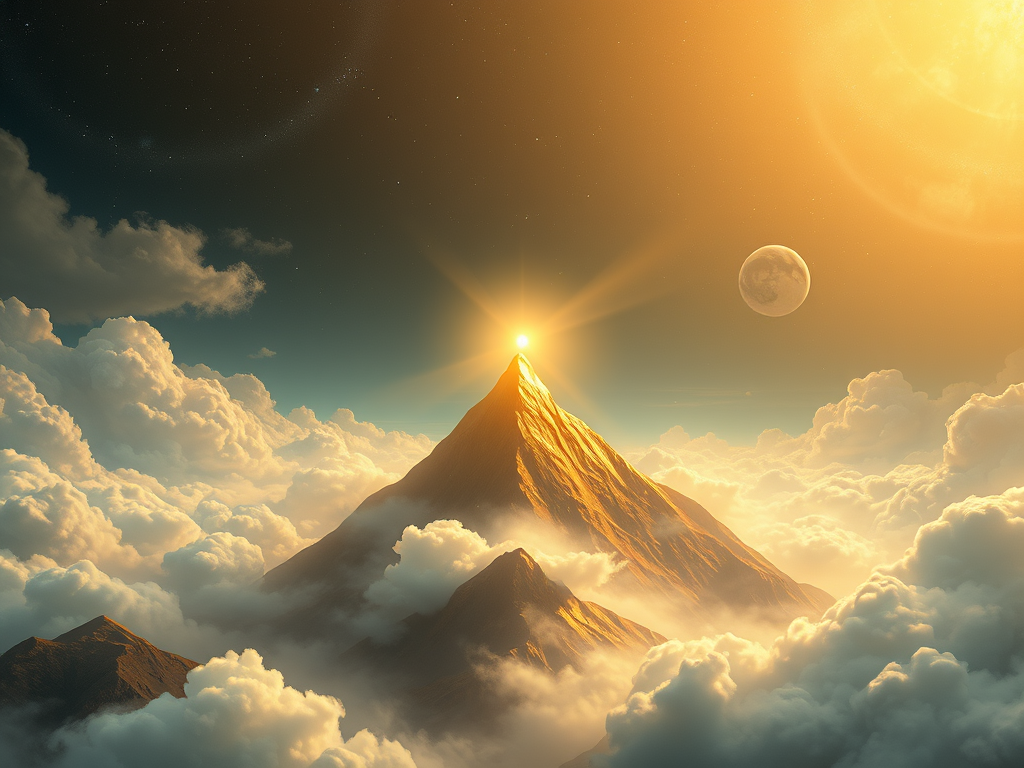
Picture this: you’re standing in your backyard on a clear night, gazing up at the stars, when suddenly you wonder – what lies beyond what we can see? How did all of this begin? These are the same questions that have captivated humanity since time immemorial, and nowhere are they explored more beautifully than in Hindu cosmology.
Hindu cosmology isn’t just an ancient attempt to explain the universe – it’s a breathtaking tapestry of mythology, philosophy, and spiritual insight that continues to inspire wonder thousands of years later. Think of it as humanity’s first attempt at writing cosmic poetry, complete with gods, demons, and a universe so vast it makes our modern understanding look almost quaint.
The Universe as a Cosmic Apartment Building
Let’s start with something that might sound familiar if you’ve ever lived in a high-rise: the Hindu cosmos is essentially structured like a massive, mystical apartment building. But instead of floors, we have fourteen distinct worlds or realms, each with its own residents and cosmic purpose.
The ancient texts describe seven upper worlds (lokas) and seven lower realms (pātālas), with our Earth sitting right in the middle of this cosmic sandwich. It’s like living on the ground floor of the universe’s most exclusive building – convenient, but with some pretty interesting neighbors both upstairs and downstairs.
The upper worlds include places like Svargaloka (Indra’s heaven – think of it as the penthouse suite) and Satyaloka (Brahma’s realm, the ultimate cosmic corner office). These aren’t just fancy addresses; they’re entire dimensions of existence where different types of beings live according to their spiritual development and cosmic roles.
Below our earthly realm lie the seven pātālas – not exactly hellish torture chambers, but rather sophisticated underworlds inhabited by asuras (demons), nāgas (serpent beings), and other fascinating entities. These aren’t necessarily evil places; they’re just different neighborhoods in the cosmic community, each with its own culture and purpose.


Mount Meru: The Universe’s Ultimate Landmark
Now, every cosmic apartment building needs a central pillar, and in Hindu cosmology, that’s Mount Meru – imagine the universe’s most spectacular skyscraper, but made of gold and jewels instead of steel and glass.
This isn’t just any mountain; it’s the cosmic axis around which everything revolves. The texts describe Meru as towering 84,000 yojanas high (roughly 672,000 to 1,008,000 kilometers – that’s like stacking about 75,000 Mount Everests on top of each other). It rises from the center of Jambūdvīpa, the central continent, and serves as the cosmic anchor point for all existence.
Picture Meru as nature’s most magnificent lighthouse, gleaming with precious stones and serving as the meeting place for gods. Around this cosmic mountain, like ripples in a pond, spread seven great island-continents (dvīpas), each separated by vast oceans of milk, wine, ghee, and other delightful substances. It’s geography on a scale that makes our planet look like a small neighborhood in an infinitely vast city.
The beauty of this imagery isn’t just in its grandeur – it’s in how it makes you feel small and connected simultaneously. We’re not just random specks in an empty void; we’re part of an intricately designed cosmic community with a clear center and purpose.
The Divine Cosmic Management Team
Every well-run universe needs good management, and Hindu cosmology delivers with what’s essentially the ultimate divine corporation: the Trimūrti – Brahma, Vishnu, and Shiva.
Think of them as the cosmic CEO, COO, and head of restructuring. Brahma is the creator, the visionary who dreams up new universes and brings them into being. Vishnu is the sustainer, the steady hand who keeps everything running smoothly and intervenes when things go off track. Shiva might seem like the intimidating one – he’s the destroyer – but he’s really the cosmic renewal specialist, clearing away what’s no longer needed to make room for fresh creation.
This isn’t a one-time corporate restructuring; it’s an eternal cycle. Imagine the universe as a vast garden that’s constantly being planted, tended, and then composted to enrich the soil for the next growing season. Each cycle spans unimaginably long periods called kalpas, making our human lifespans feel like fleeting moments in cosmic time.
But the divine management team extends beyond the Trimūrti. Indra runs the weather department from his heavenly headquarters, wielding thunderbolts and managing storms with the enthusiasm of someone who genuinely loves their job. Surya, the Sun god, is essentially the universe’s power plant manager, providing the life-giving energy that keeps everything running. Agni handles communications between humans and gods through the medium of fire and sacrifice.
What’s beautiful about this system is how personal it feels. These aren’t distant, unknowable forces – they’re beings with personalities, stories, and relationships. They argue, they collaborate, they make mistakes, and they learn. It’s like having a cosmic family that’s both dysfunctional and deeply loving.
Creation Stories That Spark the Imagination
Hindu creation myths are like the universe’s origin stories, but written by poets instead of scientists. They’re not trying to give you a technical manual for cosmic assembly; they’re trying to capture the profound mystery and beauty of how something came from nothing.
One of the most intriguing is found in the Nāsadīya Sūkta from the Rig Veda, which begins with a stunning admission of uncertainty: “In the beginning there was neither naught nor aught… Only the Existent One breathed calmly, self-contained…” It’s like the universe’s first philosophers admitting, “You know what? This is so profound and mysterious that maybe the best response is wonder rather than certainty.”
Another creation story involves Vishnu sleeping on the cosmic ocean (imagine the ultimate waterbed), with a lotus growing from his navel that becomes the birthplace of Brahma. It’s surreal and beautiful – like a dream sequence that somehow captures something true about the nature of reality.
Then there’s the Purusha Sukta, which describes the universe emerging from the sacrifice of a cosmic being. It’s both grand and intimate, suggesting that creation requires giving of oneself – a theme that resonates deeply with anyone who’s ever created anything meaningful.
These stories aren’t meant to be taken literally in the way we might read a science textbook. They’re more like cosmic poetry, using powerful imagery to convey truths about existence that might be impossible to express in plain, literal language. They’re inviting us to feel the mystery rather than just understand it intellectually.
Ancient Wisdom Meets Modern Wonder
Here’s where things get really interesting: while Hindu cosmology and modern scientific cosmology use completely different approaches, they sometimes arrive at surprisingly similar insights about the nature of reality.
Both traditions grapple with the concept of vast time scales. Hindu texts speak of endless cycles of creation and destruction spanning billions of years, while modern cosmology deals with a universe that’s been expanding for about 13.8 billion years. Both make human existence feel like a brief but significant moment in an incomprehensibly long story.
The idea of multiple universes appears in both traditions too. Some Hindu texts describe countless brahmāṇḍas (cosmic eggs), each with its own Brahmā and cycle of creation. Modern physics toys with multiverse theories, though these remain highly speculative. It’s fascinating how both ancient wisdom and cutting-edge science arrive at the possibility that our universe might be just one of many.
Of course, the differences are profound. Hindu cosmology is geocentric, with Mount Meru at the center of everything, while modern cosmology describes a universe with no special center. Hindu creation involves divine beings with personalities and intentions; modern cosmology explains origins through natural processes and physical laws.
But perhaps the most significant difference is in purpose. Hindu cosmology isn’t just trying to explain how the universe works – it’s trying to help us understand our place in it, our spiritual journey, and our relationship with the divine. It’s simultaneously a cosmological model and a spiritual guide, wrapped in stories that nourish the soul as much as they stimulate the mind.
The Eternal Dance of Existence
What makes Hindu cosmology so compelling isn’t just its grandeur – it’s how it makes existence feel like a cosmic dance where every being, from the smallest ant to the mightiest god, has a role to play. It’s cyclical rather than linear, which means that endings are always beginnings, and death is just another transformation in the ongoing dance of consciousness.
This perspective can be incredibly comforting in our modern world, where we often feel disconnected from any larger purpose or meaning. Hindu cosmology reminds us that we’re not accidents in a meaningless void – we’re participants in a cosmic drama so vast and intricate that even the gods are still figuring it out.
It teaches us that the universe is both unimaginably large and intimately personal. The same consciousness that spins galaxies also beats in our hearts. The same creative force that brings forth new worlds also inspires our daily acts of love, creativity, and compassion.
A Living Wisdom for Modern Times
Hindu cosmology isn’t just an ancient curiosity – it’s a living wisdom tradition that continues to offer insights for our contemporary lives. In an age where we’re increasingly aware of our interconnectedness with all life, these ancient texts remind us that this insight is as old as human civilization itself.
When we feel overwhelmed by the scale of modern problems – climate change, social inequality, technological disruption – Hindu cosmology offers a perspective that’s both humbling and empowering. It reminds us that we’re part of something much larger than ourselves, while also affirming that our individual actions matter in the cosmic scheme.
The cyclical nature of Hindu time can also be profoundly healing. In a culture obsessed with linear progress and permanent solutions, the idea that existence moves in cycles – that destruction and creation are both necessary parts of a larger pattern – can help us navigate life’s inevitable ups and downs with greater equanimity.
Perhaps most importantly, Hindu cosmology invites us to approach the mystery of existence with both intellectual curiosity and spiritual reverence. It suggests that the universe is not something to be conquered or fully understood, but something to be lived, experienced, and celebrated.
As we continue to explore the cosmos with our telescopes and equations, we might do well to remember that the ancient sages who gave us these beautiful cosmic myths were grappling with the same fundamental questions that drive modern science: Where do we come from? Why does anything exist? What is our place in the vast scheme of things?
Their answers, clothed in the language of myth and metaphor, continue to offer wisdom for anyone brave enough to contemplate the infinite mystery of existence. In a world that sometimes feels fragmented and meaningless, Hindu cosmology reminds us that we’re part of a cosmic story so beautiful and complex that it’s worth spending a lifetime – or many lifetimes – trying to understand.
Leave a Reply