
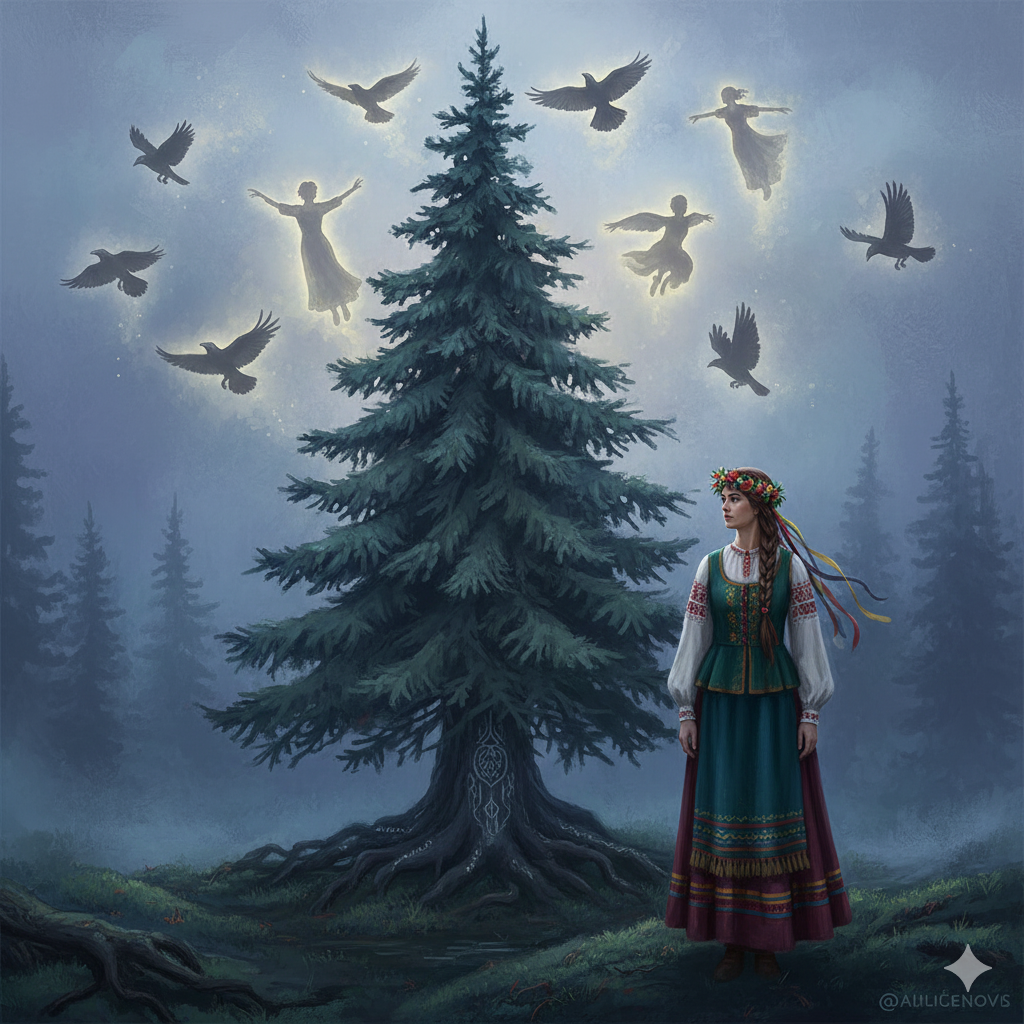
The Twelve Raven
Deep within the Baltic folklore tradition lies a haunting tale of familial devotion, dark magic, and ultimate redemption. “The Twelve Ravens” stands as one of Lithuania’s most compelling fairy tales—a narrative that explores the profound bonds between siblings and the transformative power of sacrifice.
Origins and Cultural Context
“The Twelve Ravens” belongs to the rich tapestry of Lithuanian folklore, though it shares thematic elements with broader Eastern European storytelling traditions. The tale exemplifies the Aarne-Thompson tale type 451, “The Maiden Who Seeks Her Brothers,” a widespread narrative pattern found throughout German, Slavic, and Nordic cultures. While the Brothers Grimm’s “The Seven Ravens” remains the most internationally recognized variant, the Lithuanian version carries distinct Baltic elements that reflect the unique spiritual and cultural landscape of Lithuania.
The story has been preserved through generations of oral tradition and has experienced renewed interest through contemporary retellings, most notably Diana Kizlauskas’s acclaimed illustrated version, which has introduced this powerful narrative to modern audiences while maintaining its folkloric essence.
The Curse: Darkness Enters the Household
The tale begins with a widowed nobleman who, in his loneliness, decides to remarry. His chosen bride is a woman named Ragana—a name that carries ominous weight, as “ragana” itself means “witch” in Lithuanian. Before agreeing to the marriage, the witch makes a chilling demand: the nobleman must kill his twelve sons, burn their bodies, wrap the ashes in paper, and send them to her.
Faced with this impossible choice between love and paternal duty, the lord devises a clever deception. Rather than sacrificing his sons, he sends the witch the ashes of twelve dogs instead. Satisfied with this grim offering, Ragana agrees to become his wife, unaware of the trick that has been played upon her.
Yet deception in fairy tales carries consequences. Once established in her new home, the witch’s supernatural senses detect something amiss. Hidden away in the cellar, the twelve brothers remain concealed from her sight, but not from her perception. Growing suspicious and enraged, she unleashes a bitter curse upon the household: “Where is this evil smell coming from? Let all who don’t belong in the house turn into black ravens and go flying out of here!”
In an instant, the transformation occurs. The twelve brothers become black ravens, their human forms stripped away by the witch’s malevolent magic. They fly from the manor into the vast world beyond, leaving behind only their young sister—a girl who will grow up unaware of their existence.
The Discovery: Truth Unveiled
For twelve years, the young girl lives in ignorance of her brothers’ fate. Her father, perhaps from guilt or protective instinct, forbids any mention of the cursed sons. The household maintains a conspiracy of silence, as if the twelve brothers had never existed at all.
But truth, like water, finds its way through the smallest cracks. At the age of twelve—a number that resonates throughout the tale—the girl accidentally overhears servants whispering about the family tragedy. She learns that she once had twelve brothers, that they were transformed into ravens by her stepmother’s curse, and that they have been lost to the family ever since.
This revelation becomes her awakening. Rather than succumbing to despair or accepting the curse as permanent, she feels the stirring of an unbreakable determination. These brothers she has never known become the focus of her existence, and she resolves to find them, whatever the cost.
The Quest: Preparation and Journey
The girl’s preparation reflects the practical wisdom embedded in Baltic folklore. She does not set out impulsively but instead crafts twelve complete sets of clothing: twelve shirts, twelve pairs of pants, twelve sheets, and twelve pillowcases. These garments represent more than mere necessities—they symbolize her faith that she will find her brothers and restore their humanity. Each stitch carries her hope, each completed set affirms her belief in their eventual transformation.
With her bundles prepared, she departs into the unknown world, asking everyone she encounters the same persistent question: “Have you seen my twelve black raven brothers?” Her quest takes her far from home, through unfamiliar territories, as she follows whispers and rumors in search of her cursed siblings.
The Hermit Brothers: Mystical Guides
The girl’s journey brings her to three hermit brothers, each possessing dominion over different aspects of the natural world. These figures represent the interconnectedness of human and natural realms that characterizes Baltic spirituality.
The first hermit rules the heavens and commands the clouds. At the girl’s request, he summons the clouds to search for the twelve ravens, but they return without success.
The second hermit commands the winds. He sends them across the land to investigate, but even the all-seeing winds cannot locate the brothers.
Finally, the third hermit—lord of all birds—calls upon his feathered subjects for information. An eagle, with its keen sight and far-ranging flight, brings crucial intelligence: the twelve brothers can be found on High Mountain. By day, they fly as black ravens, trapped in their avian forms. But toward evening, they undergo a partial transformation, becoming brave and handsome young men who spend the night in a cave before dawn returns them to their cursed state.
This revelation provides the girl with both hope and direction. Her brothers are not permanently lost to their raven forms—humanity still exists within them, waiting to be fully restored.
The Cave: Silent Devotion
Guided by the eagle’s information, the girl makes her way to High Mountain and discovers the cave where her brothers dwell. Rather than announcing her presence immediately, she employs patience and subtlety. She hides beneath the youngest brother’s bed, observing their nightly transformation from ravens to men.
Night after night, she witnesses their routine—the cawing as they arrive in raven form, the transformation into human shapes, their conversations and activities. While they sleep, she quietly prepares their beds, tidies their cave dwelling, and performs small acts of care. She eats portions of their bread and leaves her clothing as subtle evidence of another presence.
These careful revelations build toward recognition. When the brothers finally discover her and recognize the signs she has left, their joy is overwhelming. Yet the curse carries conditions that must be fulfilled. Following the supernatural laws that govern their situation, the brothers must take their sister to a dense forest and leave her atop a tall spruce tree—a trial that seems cruel but serves a necessary purpose in breaking the enchantment.
The Vow of Silence: The Ultimate Sacrifice
The path to breaking curses in fairy tales often requires sacrifice, and this tale demands one of the most difficult: silence. The girl receives counsel that to fully restore her brothers’ humanity, she must remain completely silent while completing her task. Not a single word can pass her lips, regardless of what trials she faces.
This vow transforms her redemptive journey into an act of profound self-denial. Language, after all, is fundamental to human connection, self-defense, and identity. To surrender speech is to surrender one’s primary means of establishing truth and protecting oneself from false accusations.
Abandoned on the spruce tree, the girl endures years of hardship. Her clothes deteriorate, tearing to shreds and falling away. She remains exposed to the elements, alone, unable to call for help or explain her situation. The passage of time becomes her companion, each season marking progress toward the curse’s completion.
Eventually, a prince discovers her in the forest. Despite her inability to speak, he is captivated by her beauty and gentle nature. He brings her to his palace and, moved by a love that transcends words, marries her. She becomes a princess, yet still cannot break her silence—the curse’s time has not yet elapsed.
The Final Trial: Truth Vindicated
The witch’s malevolence extends beyond the original curse. As the girl’s stepmother, she continues to plot against her stepdaughter. When the princess gives birth, the witch substitutes the newborn children with animals, framing the silent princess as a monster who has birthed unnatural offspring.
Unable to defend herself with words, the princess faces condemnation. She is sentenced to death by fire—a common punishment in European folklore for those accused of witchcraft or monstrous acts. The pyre is prepared, the flames are lit, and it seems that her years of sacrifice will end in tragedy.
But fairy tales operate on precise temporal logic. At the exact moment when the twelve-year curse period ends—as the flames begin to rise—the twelve brothers arrive in their fully restored human forms. They expose the witch’s deceptions, reveal the truth of their sister’s sacrifice, and restore order to the kingdom. The princess, her vow of silence finally completed, can speak again. The substituted children are revealed as the trick they were, and the true infants are restored to their mother.
Justice prevails. The witch faces consequences for her malevolence, while the family—separated by curse and circumstance—is finally reunited.
Symbolic Themes and Meaning
Transformation and Liminality
The ravens represent a liminal state—existing between human and animal, caught in an in-between world. This transformation symbolizes how curses and trauma can trap individuals in states of incompleteness, unable to fully return to their true selves without intervention and sacrifice from those who love them.
The Power of Familial Love
The girl’s quest exemplifies unconditional sibling devotion. She sacrifices her voice, her comfort, her safety, and years of her life for brothers she has never known. This represents love in its purest form—commitment without expectation of reciprocity, sacrifice without guarantee of success.
Silence as Strength
In folklore, silence often represents powerlessness, but this tale inverts that interpretation. The girl’s silence becomes her greatest weapon against the witch’s deceptions. By refusing to defend herself with words, she allows the truth to emerge organically, proving more powerful than any verbal argument could be.
Justice Through Patience
The tale emphasizes that justice operates on its own timeline. The curse must run its full twelve-year course. Attempts to rush or circumvent this temporal requirement would fail. This reflects a worldview where cosmic order, rather than human impatience, determines when wrongs can be righted.
The Natural World as Ally
The hermit brothers who command clouds, winds, and birds represent the Baltic understanding of nature as an active, responsive force. The natural world is not merely a backdrop but a participant in human affairs, capable of being called upon for aid by those who approach it with respect.
The Tale’s Enduring Resonance
“The Twelve Ravens” continues to captivate audiences because it addresses universal human experiences through the lens of magical realism. The story explores how families can be torn apart by malevolent forces, how individuals must sometimes endure seemingly impossible trials to protect those they love, and how patience and faith can ultimately triumph over darkness.
The tale’s Lithuanian origins provide it with distinctive elements—the specific nature of Baltic witchcraft, the relationship between humans and the natural world, the particular quality of the curse and its breaking—yet its core themes resonate across cultures. Whether encountered through oral tradition or modern retellings, the story of the girl who saved her twelve raven brothers remains a powerful testament to the transformative power of sacrifice, the strength found in silence, and the unbreakable bonds of family.
In the landscape of European folklore, “The Twelve Ravens” stands as a reminder that the most profound magic often requires the most profound sacrifice, and that redemption, though it may take years to achieve, is worth any price.
Leave a Reply