
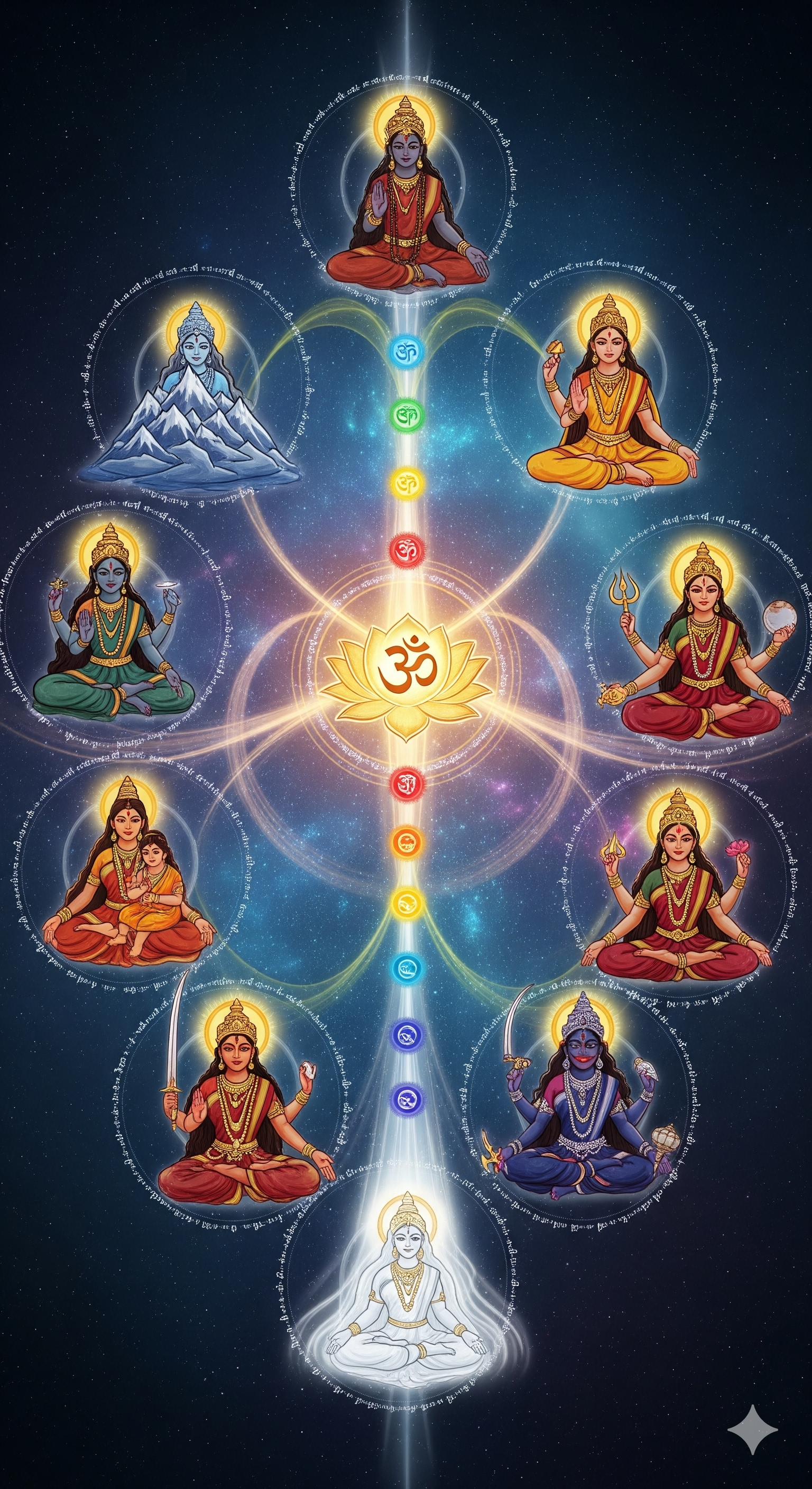
In the heart of Hindu mythology lies one of the most profound spiritual narratives ever conceived—the story of Navdurga, the nine divine manifestations of the Supreme Goddess. These are not merely tales of deities, but intricate mythological blueprints that map the human journey from material bondage to spiritual liberation. Each form carries within her a complete universe of meaning, transforming the nine nights of Navratri into a cosmic drama of awakening.
The Navdurga cycle represents something unique in world mythology: a systematic spiritual pedagogy disguised as divine narrative. Unlike linear heroic tales, these stories form an interconnected web of transformation, where each goddess embodies both a cosmic principle and a psychological state. Together, they create what scholars call a “holistic syllabus of spiritual psychology”—a mythological roadmap for inner evolution.
The Primordial Foundation: Shailaputri’s Story of Resilience
“From the ashes of sacrifice rises the daughter of mountains”
The first story begins with one of mythology’s most powerful themes: death and rebirth. Shailaputri’s narrative starts in tragedy and transforms into triumph, establishing the fundamental pattern for all that follows.
In the primordial age, when the cosmic order was still being established, there lived Sati—the divine daughter of Daksha Prajapati. Her love for Shiva, the ascetic god of destruction and transformation, defied her father’s conventional expectations. When Daksha organized a great sacrifice but deliberately excluded Shiva, the insult to her beloved became unbearable. In a moment that would echo through cosmic time, Sati immolated herself in the sacrificial fire, unable to bear the dishonor to her husband.
But death, in this mythological universe, is never the end—it is transformation. The cosmic forces that govern existence could not allow such devotion to be extinguished. Sati was reborn as Parvati, daughter of the mountain king Himavan, earning the epithet Shailaputri—”daughter of the mountain.”
This rebirth narrative carries profound psychological symbolism. The mountains represent stability, endurance, and the foundational strength required for any spiritual journey. Shailaputri, mounted on Nandi the bull (representing grounded dharma), holding the trident of transformation and the lotus of purity, embodies the essential truth that all genuine spiritual progress must begin from a place of authentic strength and rootedness.
Mythological Insight: Shailaputri’s story teaches that spiritual transformation often requires a complete death of old patterns. Like the phoenix, the soul must sometimes burn away everything familiar to discover its true nature.
The Ascetic’s Path: Brahmacharini’s Thousand-Year Tapas
“In the crucible of disciplined desire, the goddess forges divine union”
Following rebirth comes the most challenging phase of any spiritual journey: disciplined practice. Brahmacharini’s story unfolds as an epic of determination that spans a thousand years of austere penance.
Having been reborn as Parvati, the goddess faced a cosmic challenge. Shiva, devastated by Sati’s death, had withdrawn into deep meditation, refusing all connection with the world. The universe itself was at stake—without the union of Shiva and Shakti, creation would remain incomplete and sterile.
But Shiva had become the ultimate ascetic, beyond the reach of ordinary attraction or persuasion. Even when Kamadeva, the god of love, shot his flower arrows at the meditating Shiva, the god of destruction opened his third eye and reduced Kama to ashes. The message was clear: only through matching Shiva’s own spiritual intensity could Parvati win his recognition.
Thus began one of mythology’s most extraordinary penances. Parvati retreated to the forests, discarding all royal comforts. She dressed in bark cloth, slept on bare ground, and sustained herself on increasingly minimal nourishment—first fruits, then leaves, then air alone. For a thousand years, she maintained unbroken meditation, her devotion burning with the intensity of inner fire.
The iconography of Brahmacharini captures this perfectly: she stands barefoot, carrying only a water pot and prayer beads, her face serene despite the severity of her practices. She embodies the paradox of spiritual discipline—that through voluntary limitation, unlimited power is achieved.
Mythological Insight: Brahmacharini’s millennium-long tapas reveals that authentic spiritual achievement requires sustained effort over vast periods. The goddess shows that disciplined practice (sadhana) transforms desire itself into a spiritual force.
The Warrior Bride: Chandraghanta’s Wedding Day Transformation
“When love meets fear, the goddess reveals her protective fury”
The third story marks a dramatic shift from solitary practice to engaged action. Chandraghanta’s narrative unfolds on what should have been the most joyous day—her wedding to Shiva—but becomes a tale of protective transformation.
After her thousand-year penance, Parvati had indeed won Shiva’s recognition and love. The cosmic wedding was arranged with great celebration throughout the three worlds. But when the wedding procession arrived, it brought unexpected terror to the bride’s family.
Shiva’s baraat (wedding procession) was unlike any earthly ceremony. The groom himself appeared in his most fearsome aspect—smeared with ashes, wearing serpents as ornaments, his matted hair wild, his third eye gleaming. His companions were even more alarming: ghosts, demons, goblins, and spirits of the cremation grounds danced around him in ecstatic celebration.
Parvati’s relatives, expecting a conventional royal wedding, were horrified. Her mother fainted, her father began to reconsider the alliance, and panic spread through the wedding party. The cosmic union that would restore balance to creation was threatened by ordinary human fear.
In this moment of crisis, Parvati underwent her first martial transformation. Taking the form of Chandraghanta, she manifested ten arms bearing various weapons, mounted a fierce tiger, and adorned her forehead with a crescent moon shaped like a bell. Her bell’s sound, with its peculiar resonance, had the power to dispel negative forces and calm chaotic situations.
Chandraghanta performed two simultaneous miracles: she pacified Shiva’s terrifying appearance, making him acceptable to conventional society, while simultaneously protecting her family from actual dangers. Legend says that the sound of her bell drove away a host of demon bats (Jatukasura) who had infiltrated the ceremony seeking to disrupt the cosmic wedding.
Mythological Insight: Chandraghanta’s story illustrates the goddess’s role as a bridge between the transcendent and the ordinary. Her transformation teaches that spiritual realization must include the ability to function skillfully in the everyday world, protecting those who are not yet ready for ultimate truth.
The Cosmic Creator: Kushmanda’s Universe-Birthing Smile
“From the darkness of non-existence, a single smile ignites infinite worlds”
The fourth narrative takes us beyond personal transformation to cosmic creation itself. Kushmanda’s story addresses one of mythology’s most profound questions: how does something emerge from nothing?
In the primordial void before creation, there existed neither time nor space, neither light nor darkness—only pure, undifferentiated potential. Into this absolute emptiness, Kushmanda manifested as the first stirring of cosmic consciousness. Her very name reveals the mystery: ku (little) + ushma (warmth) + anda (cosmic egg)—she who creates the universe from the smallest spark of divine warmth.
The creation myth describes her eight-armed form radiating light like countless suns, seated on a lion that represents her mastery over cosmic forces. But the most remarkable aspect of her creation is its effortless joy. Unlike creation myths that involve struggle, conflict, or cosmic battles, Kushmanda creates through sheer delight. Her smile becomes the Big Bang that initiates existence.
Legend describes how her laughter scattered the building blocks of reality throughout space, how her breath became the cosmic wind that moves between worlds, and how her radiance kindled the sun itself. She is said to reside within the sun’s core, continuously fueling its light and warmth, ensuring that life throughout the solar system receives the energy it needs to flourish.
The iconography shows her holding various implements of creation—the bow and arrow that direct cosmic forces, the discus that maintains cosmic order, the jar of nectar that sustains life, and the lotus that represents the unfolding of potential into actuality.
Mythological Insight: Kushmanda’s creation-through-joy challenges conventional notions about the universe’s origin. Her story suggests that existence itself springs from divine bliss, and that creativity is the natural expression of consciousness encountering its own infinite potential.
The Divine Mother-Warrior: Skandamata’s Strategic Nurturing
“In her arms, she holds both the future of victory and the lotus of peace”
The fifth story introduces a unique mythological concept: the divine mother who nurtures the very force that will save the cosmos. Skandamata’s narrative demonstrates how spiritual wisdom includes strategic thinking about future needs.
The cosmic order faced a terrible threat in the form of Tarakasura, a powerful demon who had obtained a boon that he could only be killed by a son of Shiva. Since Shiva had become a complete renunciate after Sati’s death, this seemed impossible—which was exactly what Tarakasura had calculated. The demon began terrorizing all three worlds, knowing himself to be invulnerable.
Even after Shiva’s marriage to Parvati, the cosmic solution required extraordinary divine intervention. Through mystical circumstances involving the god of fire (Agni) and the Kritika constellation (Pleiades), the divine child Kartikeya (also called Skanda) was born—the one destined to defeat Tarakasura.
But Skandamata’s story reveals a crucial insight: the goddess does not merely give birth to the savior and then step aside. She actively nurtures, protects, and prepares him for his cosmic role. Her iconography shows her in four-armed form, holding the infant Kartikeya in her arms while simultaneously carrying lotus flowers—symbols of spiritual wisdom and purity.
Seated on a lotus herself and riding a lion, she represents the perfect integration of nurturing motherhood and warrior strength. Her story shows that she maintains her own spiritual practices and martial readiness even while caring for the child who will grow up to be heaven’s greatest general.
Mythological Insight: Skandamata’s narrative explores the sophisticated balance between caring and preparation. Her story suggests that true nurturing includes preparing those we love for the battles they must fight, combining maternal tenderness with strategic wisdom.
The Ultimate Warrior: Katyayani’s Cosmic Battlefield
“Born from the collective fury of gods, she ends the reign of impossible evil”
The sixth story represents the climactic battle of the entire mythological cycle—the confrontation between divine justice and seemingly invincible evil. Katyayani’s narrative is the epic war story at the heart of Durga mythology.
Mahishasura, the buffalo demon, had become the most formidable threat the cosmos had ever faced. Through severe penances, he had obtained a boon that no man or god could kill him. Armed with this invincibility, he conquered heaven itself, driving out the gods and establishing a reign of terror that threatened the very foundations of cosmic order.
The crisis reached such proportions that all the gods—Brahma the creator, Vishnu the preserver, Shiva the destroyer—pooled their divine energies in a desperate measure. From their collective fury and power emerged a goddess so radiant that her light illuminated all three worlds. She appeared in the hermitage of the sage Katyayan, who became her first worshipper, giving her the name Katyayani.
The goddess immediately issued a challenge that reverberated throughout creation: Mahishasura should face her in single combat. The demon, initially dismissive of this beautiful woman-warrior, soon discovered he had encountered his cosmic match.
What followed was a ten-day battle that shook the foundations of existence. Mahishasura deployed every power at his disposal—shape-shifting between buffalo, lion, elephant, and human forms, commanding vast armies of demons, wielding weapons that could shatter mountains. But Katyayani matched him at every level, her four arms wielding sword and lotus, her lion mount tearing through enemy ranks, her tactical brilliance outmaneuvering every demonic strategy.
The final confrontation became a duel of cosmic principles: unlimited arrogance versus divine justice, brute power versus skillful strength, chaos versus dharmic order. In the climactic moment, as Mahishasura emerged from his buffalo form thinking he had escaped, Katyayani beheaded him with her sword, ending his reign of terror forever.
Mythological Insight: Katyayani’s war story serves as mythology’s definitive statement about the ultimate defeat of evil. Her victory demonstrates that no force, however powerful or seemingly invincible, can permanently overcome cosmic justice when it is wielded with divine authority and righteous purpose.
The Terrible Mother: Kalaratri’s Dance of Cosmic Destruction
“In absolute darkness, she drinks the blood of infinite multiplication”
The seventh story takes us into mythology’s deepest mysteries—the terrifying but necessary destruction that clears space for rebirth. Kalaratri’s narrative confronts the shadow side of divine action, showing how cosmic love sometimes manifests as absolute terror.
During the great battle with demonic forces, the gods faced an enemy even more dangerous than Mahishasura: Raktabeej, whose very name means “blood-seed.” This demon possessed the horrifying ability to reproduce himself from every drop of his spilled blood. When cut in battle, each blood drop that touched the earth instantly became another fully-grown Raktabeej. The more the gods fought him, the more numerous he became.
As thousands of identical demons filled the battlefield, threatening to overwhelm all resistance through sheer multiplication, the situation demanded a solution beyond conventional warfare. From the forehead of Chandika emerged Kalaratri—the goddess in her most terrifying aspect.
Kalaratri’s appearance defied all conventional notions of divine beauty. Her skin was pitch black like the darkness between stars, her hair hung wild and unkempt, her three red eyes blazed with the fire of cosmic dissolution. She rode not a noble lion but a humble donkey, carrying a scimitar that flashed like lightning and an iron hook that could snare souls themselves. Most terrifying of all, she breathed flames and made the sound of cosmic destruction.
But her frightening appearance served a cosmic necessity. As the gods battled Raktabeej’s multiplying army, Kalaratri spread her vast tongue across the battlefield and drank every drop of demon blood before it could touch the earth. She consumed not just the blood but the very principle of multiplication itself, swallowing the infinite regress that threatened to destroy creation through endless proliferation.
Her epithet “Shubhankari”—”bringer of auspiciousness”—reveals the deeper truth: her terrifying work was ultimately beneficial. By consuming the blood of multiplication, she restored the cosmic balance between creation and limitation, ensuring that existence itself would not be overwhelmed by infinite repetition.
Mythological Insight: Kalaratri’s blood-drinking represents the mysterious truth that sometimes cosmic love must manifest as terrible destruction. Her story reveals that the divine feminine includes the power to consume what threatens existence itself, even when that consumption appears frightening to ordinary perception.
The Purified Radiance: Mahagauri’s Restoration
“Through the river of grace, the darkened warrior reclaims her luminous truth”
The eighth story explores one of mythology’s most beautiful themes: the restoration of original purity after necessary contamination. Mahagauri’s narrative shows how divine consciousness renews itself after engaging with cosmic darkness.
Following her terrifying work as Kalaratri—drinking demon blood and wielding the forces of cosmic destruction—the goddess found her radiant form darkened and tarnished. The nature of her necessary task had left its mark: her skin had become black from contact with demonic forces, her beauty obscured by the residue of cosmic battle.
This darkening was not a punishment or failure, but the natural consequence of divine engagement with evil. Like a surgeon whose hands become stained in the operating room, or a firefighter blackened by smoke while saving lives, the goddess’s darkness testified to the reality of her work in the cosmic battlefield.
But Shiva, her eternal consort, could not bear to see her divine radiance so obscured. In an act of profound cosmic tenderness, he directed the sacred river Ganga to flow from his hair, bathing his beloved in streams of purifying water. As the holy river washed over her, the darkness that had accumulated from her battles dissolved away, revealing once again her original luminosity.
The transformation was complete and stunning. Her skin became white as snow, pure as moonlight, radiant as sunlight on mountain peaks. Dressed in white garments and adorned with white ornaments, seated on a white bull, she manifested as Mahagauri—the “Great White One,” embodying purification so complete that it transcended all previous limitations.
Her four arms carried the trident of transformation and the damaru drum of cosmic rhythm, while her other hands offered boons and dispelled fears. She represented the divine truth that no engagement with darkness, however necessary for cosmic welfare, could permanently stain the essential purity of divine consciousness.
Mythological Insight: Mahagauri’s purification story reveals the resilience of divine consciousness. Her transformation demonstrates that spiritual purity is not about avoiding contact with impurity, but about maintaining an essential luminosity that can be restored after any necessary engagement with darkness.
The Perfect Completion: Siddhidatri’s Universal Bestowal
“In her final form, she grants what even gods must seek from her”
The ninth and final story completes the cosmic cycle by revealing the goddess as the source of all spiritual attainments. Siddhidatri’s narrative addresses the ultimate question: what lies beyond even divine achievement?
When creation was finally stabilized through the preceding eight transformations, the cosmic order revealed its deepest structure. All beings—from the humblest human to the greatest gods—remained incomplete without access to the eight supernatural perfections (siddhis): anima (becoming infinitely small), mahima (becoming infinitely large), laghima (becoming weightless), garima (becoming infinitely heavy), prapti (reaching anywhere instantly), prakamya (fulfilling any desire), ishitva (lordship over nature), and vashitva (complete self-control).
But these siddhis were not scattered randomly throughout creation. They had a single source: Siddhidatri, the goddess in her role as “Bestower of Perfections.” Her story reveals that even Brahma the creator, Vishnu the preserver, and Shiva the destroyer had to approach her to receive the supernatural powers necessary for their cosmic functions.
The most remarkable aspect of her mythology involves Shiva himself. To obtain his complete cosmic role, Shiva had to merge with the goddess so completely that he became Ardhanarishvara—half male, half female. The left half of this composite deity was Siddhidatri herself, demonstrating that the highest spiritual realization requires the integration of both transcendent consciousness (Shiva) and dynamic power (Shakti).
Siddhidatri’s iconography shows her seated on a lotus or lion, her four arms holding the discus of cosmic order, the conch of cosmic sound, the mace of divine authority, and the lotus of spiritual perfection. But unlike the previous forms, she is worshipped not only by humans and gods but by demons, sages, celestial beings, and nature spirits—all recognizing her as the universal source of spiritual achievement.
Her story culminates the entire Navdurga cycle by revealing that the journey from Shailaputri’s rootedness through Kalaratri’s destruction ultimately leads to the recognition that all spiritual seeking finds its fulfillment in the Divine Feminine as the eternal bestower of whatever the soul truly needs.
Mythological Insight: Siddhidatri’s universal generosity reveals the ultimate nature of divine consciousness: it is not a goal to be reached but the source from which all spiritual seeking springs and to which it returns. Her story suggests that enlightenment is not achievement but recognition of what has always been freely given.
The Eternal Return: Living the Nine Sacred Stories
“Each year the cycle begins again, because transformation never ends”
The beauty of the Navdurga narratives lies not just in their individual power, but in their cyclical structure. Unlike linear myths that tell a story once and finish, these nine stories form an eternal spiral of transformation. Each Navratri, devotees re-enter the mythological cycle, discovering new layers of meaning in familiar narratives.
The stories work on multiple levels simultaneously: as cosmic dramas about the fundamental forces that govern existence, as psychological maps for inner development, and as practical guides for navigating life’s challenges. A devotee facing a major life transition might find special resonance in Shailaputri’s death-and-rebirth story. Someone undertaking disciplined spiritual practice might discover new inspiration in Brahmacharini’s thousand-year tapas.
But perhaps most importantly, the stories function as what scholars of mythology call “technologies of transformation”—narrative structures that actively facilitate personal and collective change. By engaging with these stories through ritual, meditation, dance, and community celebration, participants don’t just hear about transformation—they experience it.
The nine nights of Navratri become nine opportunities to embody different aspects of divine consciousness, to explore different approaches to life’s challenges, and to connect with the eternal feminine principle that encompasses all existence. In Gujarat’s garba circles, Bengal’s Durga pandals, and countless homes where families gather to honor each goddess, the ancient stories come alive in contemporary hearts.
As the great cycle completes with Siddhidatri and begins again with Shailaputri, the stories remind us that spiritual development is not a linear progression but a spiral dance—each year bringing us back to familiar themes but at deeper levels of understanding and integration.
The nine sacred stories of Navdurga thus offer more than mythological entertainment or religious instruction. They provide a complete cartography of consciousness, mapping the territory that every soul must traverse in its journey from fragmentation to wholeness, from limitation to liberation, from ordinary awareness to divine recognition.
In honoring these nine stories, we honor not just ancient wisdom but the ongoing possibility of transformation that lives within every human heart—the eternal promise that no matter how dark the night or difficult the battle, the goddess within us carries all the power needed for victory, purification, and ultimate perfection.
Leave a Reply