
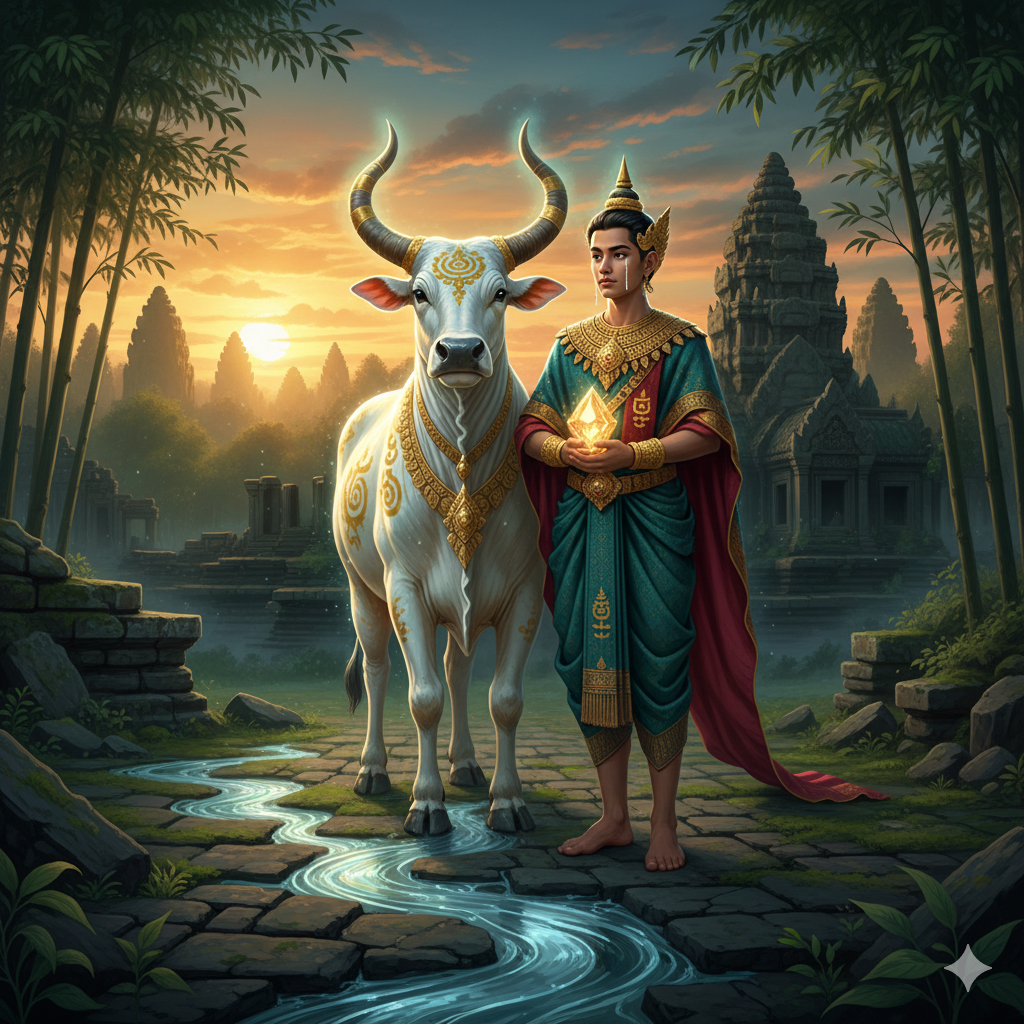
The legend of Preah Ko Preah Keo stands as one of Cambodia’s most cherished cultural treasures, weaving together threads of historical trauma, spiritual wisdom, and enduring hope. This profound narrative of two miraculous brothers transcends simple mythology to embody the Khmer people’s deepest experiences of suffering, resilience, and their unbreakable connection to their ancestral land.
The Sacred Names: Symbolism and Meaning
The very names of these legendary brothers carry layers of cultural and spiritual significance. Preah Ko (ព្រះគោ) translates to “Sacred Ox,” where Preah denotes what is sacred or royal, and Ko means ox. Preah Keo (ព្រះកែវ) means “Sacred Gem” or “Sacred Prince,” with Keo referring to a precious gem—a term that evokes the legendary Emerald Buddha and connects this tale to Cambodia’s deepest Buddhist heritage.
This pairing creates a resonant alliteration comparable to foundational mythological duos across world cultures: Romulus and Remus in Roman tradition, or Hengist and Horsa in Germanic lore. Yet the significance extends beyond linguistic beauty. These names represent the synthesis of Hindu and Buddhist traditions that defines Khmer civilization.
Preah Ko embodies associations with Nandi, the sacred bull from Hindu Shaivism who serves as the divine mount of Shiva. Meanwhile, Preah Keo represents Buddhist wisdom, purity, and spiritual protection. Together, they form a complete theological vision—strength united with wisdom, devotion paired with enlightenment.
Historical Roots: From Trauma to Myth
The legend emerged not from pure imagination but from genuine historical catastrophe. During the post-Angkorian period, Cambodia endured repeated invasions from neighboring Siam (modern-day Thailand). The most devastating losses occurred when Siamese forces sacked the Khmer capitals of Angkor in the 16th century and Longvek in 1594. These conquests resulted in the capture of vast treasures: precious objects, jewels, sacred statues, Buddhist manuscripts, and countless prisoners.
This catastrophic plundering precipitated Cambodia’s decline and left an irreplaceable wound in Khmer civilization. The material losses were staggering, but the spiritual and cultural devastation cut even deeper.
The legend of Preah Ko Preah Keo functions as an etiological myth—a story created to explain and process profound collective loss. According to scholarly accounts, the narrative may trace back to the actual theft of a sacred metal calf called Preah Ko, whose belly contained a precious collection of Pali Buddhist manuscripts. This statue, reportedly treated with mercury, possessed the miraculous ability to walk. When Siamese forces captured this sacred object and opened it to steal the manuscripts, the event became mythologized as the abduction of the divine brothers themselves.
Historical records from 1692 provide a concrete reference point: Cambodian King Chey Chettha IV commissioned his aunt to transcribe nearly forgotten legends from memory, possibly including this one. The legend thus bridges documented history and oral tradition, preserving cultural memory through narrative form.
The Miraculous Birth: Origins in Tragedy
The legend exists in multiple versions transmitted through oral tradition, written texts, shadow puppet performances, films, and pagoda murals. While variations differ in details, the core narrative remains remarkably consistent across tellings.
A Prophetic Dream
The story begins in the land of Takkasila, where a virtuous couple named Meanop and his wife lived righteously despite their poverty. The wife experienced a prophetic dream of three diamond rings, which a fortune-teller interpreted as a sign she would bear three neak boun (virtuous spirits). However, the prophecy came with a crucial warning: she must avoid eating green mangoes.
Overcome by temptation while her husband hunted, she climbed a mango tree to reach the forbidden fruit. She fell, dying in childbirth before her husband could return. From her body emerged two extraordinary children: Preah Ko, born as an ox, and Preah Keo, an infant still encased in the placenta.
Rejection and Survival
Their unusual birth and their mother’s mysterious death caused villagers to reject the brothers as cursed or unnatural. Forced into the forest, the brothers survived alone, developing their miraculous powers in isolation from human society.
Years later, when they attempted to play with village children, they faced mockery and violence. In this moment of crisis, Preah Ko revealed his first miracle: he produced silver knives, forks, dishes, and abundant food from his belly—a power that would become his defining characteristic throughout the legend.
When villagers attempted to capture and bind Preah Ko to a tree, he told his brother to grasp his tail. Together they flew into the air, causing the tree to collapse and kill their pursuers. Yet rather than leaving his attackers dead, Preah Keo demonstrated profound compassion, reviving the villagers using water infused with kandol wood. This act of mercy established his character as embodying Buddhist principles of forgiveness and loving-kindness.
The Three Contests: Battles for Kingdom and Honor
As the brothers traveled through Cambodia, their reputation reached the King of Siam, who saw an opportunity to conquer the Khmer kingdom through a series of challenges designed to capture these divine beings.
The Cockfight: Rise to Power
The Siamese king first challenged Cambodia’s ruler to a cockfight, pitting his prized rooster against Cambodia’s champion. When the Cambodian bird fell in defeat, Preah Ko transformed into a magnificent black rooster and won decisively.
This victory carried extraordinary consequences. So impressed was the Cambodian king that he granted his entire kingdom to Preah Keo and offered his daughter, Neang Prou, in marriage. The brothers, once rejected forest outcasts, suddenly found themselves elevated to the highest echelons of Khmer society—protectors of the realm itself.
The Elephant Fight: Strength Confirmed
Humiliated by defeat, the Siamese king escalated to an elephant duel. Once again, Preah Ko transformed—this time into a powerful elephant—and vanquished the Siamese champion. Each victory further cemented the brothers’ role as Cambodia’s supernatural guardians.
The Bullfight: Tragedy and Separation
In a final, desperate attempt, the Siamese king deployed a mechanically crafted bull of extraordinary power. Preah Keo received premonitory dreams warning of this menace, but even foreknowledge could not prevent the tragedy to come.
During the brutal confrontation, Preah Ko recognized approaching defeat. He told his brother and sister-in-law Neang Prou to hold hands and cling to his tail as he attempted to fly to safety. In a moment that echoes through Cambodian cultural memory, Neang Prou lost her grip and fell back to earth, dying from the impact.
The legend describes how Lord Indra, moved by her virtue and sacrifice, transformed her body to stone and granted her soul entry to paradise. Grief-stricken but determined, Preah Ko and Preah Keo fled toward Phnom Sruoch (literally, “the pointy mountain”), seeking refuge in the familiar Cambodian landscape.
The Capture: Cunning and Cultural Loss
The most poignant portion of the legend describes the brothers’ eventual capture and removal from Cambodia—a narrative that metaphorically represents the loss of Khmer sovereignty and cultural treasures.
The Siege of Lovek
When the Siamese king sent his army to seize the brothers at Phnom Sruoch, they flew to the fortified citadel of Lovek, surrounded by a protective bamboo forest. The natural barrier seemed impenetrable, but the Siamese king employed psychological warfare rather than military force.
He ordered his soldiers to throw silver coins and precious objects into the bamboo forest. The desperate Khmer people, seeing opportunity for sudden wealth, rushed to harvest the bamboo to retrieve the treasure. In their eagerness, they unwittingly removed their own defense, exposing the brothers to capture.
This detail carries particular moral weight in the legend’s teaching: momentary greed and short-term thinking can destroy long-term protection and sovereignty.
The Flight Through Cambodia
Exposed and vulnerable, the brothers attempted repeated escapes, transforming into buffaloes and fleeing to sacred mountains at Oudong, Pailin, and Battambang. Each time, the relentless Siamese forces pursued them across the Khmer landscape, a pursuit that became encoded in the very geography of Cambodia.
One of the most emotionally powerful elements describes Preah Ko weeping so profoundly during his forced journey from Cambodia to Thailand that his tears formed lakes and rivers along the route. When he turned back for a final glance at his homeland, his tears created Tonle Bati (or a series of sacred ponds), which Cambodians believe to this day hold sacred water.
This geographical encoding of grief transforms the landscape itself into a memorial of loss, ensuring that every generation encountering these waters remembers the brothers’ sacrifice.
Eternal Captivity
Finally captured and bound with ropes, the brothers were taken to Ayutthaya, the Siamese capital. There, the king built a special palace with seven walls to imprison them, deliberately preventing their reunion to contain their combined power.
According to the legend, they remain imprisoned there to this day—a poignant metaphor for Cambodia’s lost sovereignty, stolen cultural treasures, and the painful separation of strength from wisdom that follows national trauma.
Layers of Meaning: Religious and Cultural Interpretation
The legend operates on multiple interpretive levels, resonating differently depending on the perspective brought to it.
For the Devout: Moral and Spiritual Allegory
For believers, the story functions as profound moral teaching about faith, loyalty, compassion, and spiritual resilience. Preah Keo’s purity and wisdom reflect the Buddha’s teachings and the protection Buddhism offers to Cambodia. His acts of compassion—reviving those who attacked him, maintaining virtue even in defeat—demonstrate the Buddhist ideal of loving-kindness transcending personal harm.
Preah Ko’s immense strength represents devotion and the power of spiritual practice channeled through physical form. His ability to produce sustenance from within suggests that true abundance flows from spiritual cultivation rather than external acquisition.
Their separation symbolizes the disunity that brings misfortune to a nation. The legend teaches that harmony between mind and body, strength and wisdom, spiritual and temporal power, is essential for national flourishing. When these forces work in concert, the kingdom prospers; when separated, vulnerability follows.
For Historians: Collective Memory and National Identity
For scholars and nationalists, the legend serves as poetic remembrance of Cambodia’s historical suffering and resistance. The brothers’ abduction stands for the catastrophic loss of Khmer sovereignty and cultural treasures during the invasions following Angkor’s decline.
Significantly, some versions include an eschatological element—a prophecy that the brothers will return when the Khmer people regain harmony with Buddhist teachings. This hopeful ending embodies Cambodia’s enduring faith in spiritual and cultural renewal, suggesting that what was lost can be restored through collective virtue and reunification of the nation’s fragmented strengths.
The legend preserves historical memory without descending into mere resentment. It acknowledges profound loss while maintaining dignity, transforming trauma into teaching.
Philosophical Teachings: Enduring Wisdom
The legend encodes several interlocking ethical principles that remain relevant across generations:
Unity of Wisdom and Strength: Alone, neither brother’s qualities suffice to protect Cambodia. Wisdom without strength cannot enforce justice; strength without wisdom becomes tyranny. Together, they are invincible—a lesson about the necessity of balanced governance and integrated virtues.
Loyalty Transcends Personal Safety: The brothers’ willing sacrifice for Cambodia demonstrates that some values transcend self-preservation. Their devotion to their adopted homeland, despite their tragic origins and repeated suffering, models the highest form of patriotism.
Greed Enables Conquest: The Siamese king’s endless ambition and the Cambodian people’s momentary greed (rushing to collect silver) both bring catastrophe. The legend warns against attachment to material wealth that blinds communities to genuine threats and long-term security.
Spiritual Treasures Surpass Material Wealth: The brothers’ greatest power lies not in the jewels and food Preah Ko produces but in their divine essence and dedication to their people. True sovereignty rests on moral authority and cultural integrity, not accumulated possessions.
Compassion in the Face of Injustice: Preah Keo’s decision to revive those who attacked him demonstrates that responding to violence with mercy breaks cycles of revenge and elevates human dignity even in oppression.
Living Legacy: Contemporary Cultural Presence
The legend remains vibrantly alive in modern Cambodian culture, adapting to contemporary media while retaining its essential message.
Artistic and Educational Forms
The narrative appears in illustrated children’s books, dramatic plays, shadow puppet performances (particularly traditional Sbek Thom), and pagoda murals throughout the country. Interestingly, most pictorial representations are relatively recent. The murals at Svay Chroum Pagoda were created in 1987, and full-size statues at the Tonle Bati Pagoda on Oudong Hill date only to 1990, demonstrating the legend’s continuous renewal in each generation.
Religious Practice and Popular Devotion
Statues of Preah Ko and Preah Keo are enshrined in local shrines throughout Cambodia, where devotees light incense and pray for protection and good fortune. The brothers are particularly invoked during times of national tension, social unrest, or collective mourning.
In rural regions, parents encourage children to emulate Preah Keo’s honesty and Preah Ko’s loyalty, using the legend as an ethical teaching tool demonstrating that moral values endure even when material wealth is lost. The story functions as both spiritual heritage and practical moral education.
Political Resonance
The legend’s prominence in national consciousness fluctuates with Cambodia-Thailand relations. It gained significant attention in the late 1950s and early 1960s during diplomatic tensions between the countries, and resurged during disputes over the temples of Preah Vihear and surrounding territories. The legend thus serves as a cultural touchstone for processing contemporary political tensions through the framework of historical memory.
In Kampong Chhnang province, various sites exploit the legend to attract tourists, demonstrating how sacred narrative interweaves with modern economic development and cultural preservation efforts.
Regional Variations: Local Interpretations
Different regions of Cambodia maintain distinct versions reflecting local pride and interpretive traditions. In some narratives, the brothers are royal siblings magically transformed—Preah Keo as a human embodiment of virtue and Preah Ko as his guardian spirit. In others, they appear as reincarnations of ancient sages sent by the gods to bless Khmer lands.
Some versions end not with eternal captivity but with a prophecy of return, connecting the myth to Cambodia’s hopes for spiritual and cultural renewal. These eschatological versions suggest that when Cambodia achieves sufficient moral and spiritual unity, the brothers will break free from their Siamese prison and return to restore the kingdom’s former glory.
Interestingly, neighboring Thailand preserves its own folklore references to “Phra Kao” and “Phra Ko,” though with distinct meanings and symbolism. This overlap suggests the myth evolved through centuries of cross-cultural contact, transformed by each culture’s particular historical experience and spiritual needs.
The Enduring Power of Sacred Narrative
The legend of Preah Ko Preah Keo continues to shape the Khmer imagination and moral vision. Their names have been adopted by pagodas, schools, and cultural societies across Cambodia. During national celebrations, performances of the legend serve as moral allegories encouraging unity and compassion among citizens.
Most profoundly, in Cambodian popular belief, when social injustice or corruption grows severe, the spirits of the brothers are said to weep once more—a spiritual reminder to leaders and people alike that balance and virtue must be restored.
For Cambodians today, Preah Ko and Preah Keo remain not distant mythical figures but living symbols of what binds the nation together: compassion transcending violence, unity enabling survival, wisdom guiding strength, and enduring faith in the power of goodness even in the face of profound loss.
The legend demonstrates how mythological narrative preserves cultural memory, transmits ethical teaching, and provides frameworks for processing collective trauma. It shows that what is lost materially can be retained spiritually, that separation need not mean disappearance, and that tears shed for one’s homeland can become sacred waters that nourish future generations.
In this way, the story of two miraculous brothers—one ox, one gem—continues to reflect Cambodia’s soul back to itself, offering both remembrance of suffering and promise of renewal.
Leave a Reply