
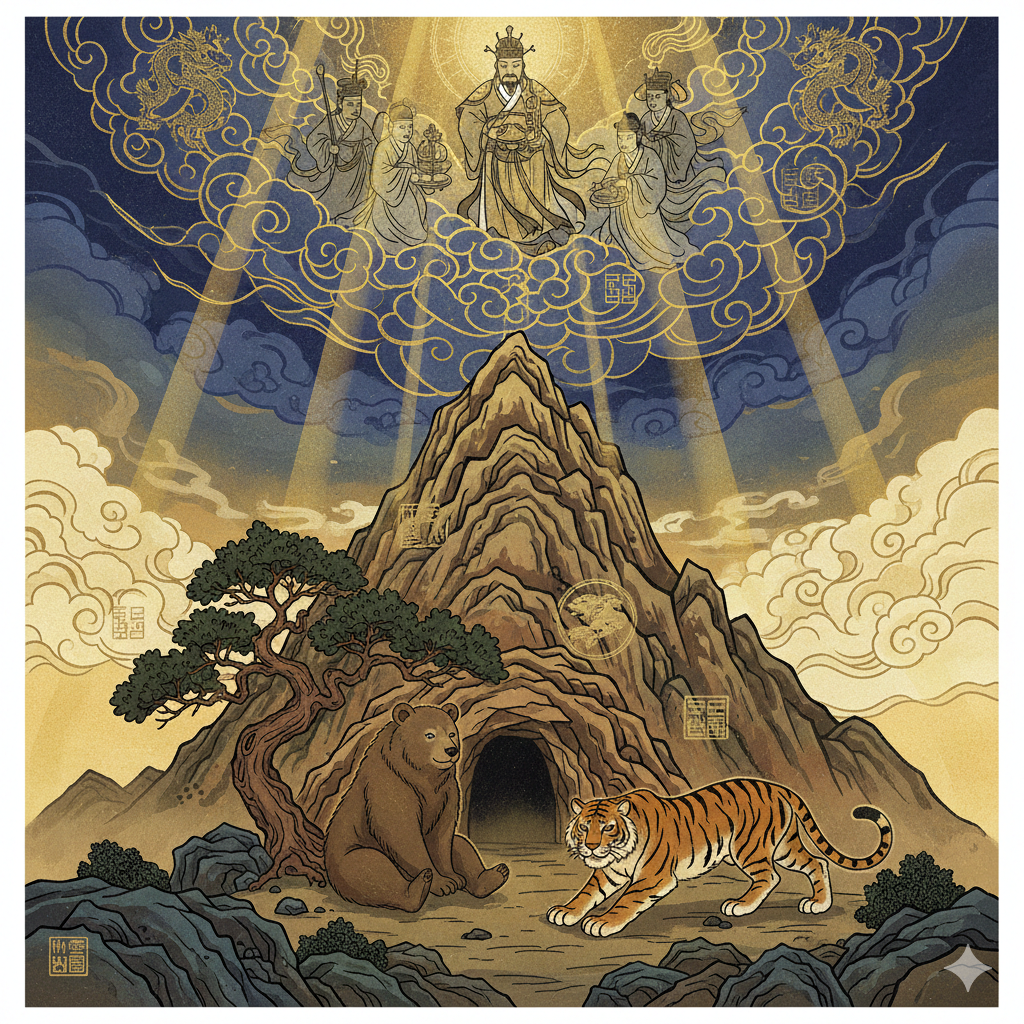
At the intersection of divine intervention and earthly perseverance lies one of East Asia’s most compelling creation myths. The Legend of Dangun Wanggeom stands as the foundational narrative of the Korean people, chronicling the birth of Gojoseon, the first Korean kingdom, traditionally dated to 2333 BCE. This is not merely a tale of gods and mortals—it is a sophisticated exploration of cultural integration, shamanic transformation, and the philosophical principles that would shape Korean civilization for millennia.
The Celestial Descent: When Heaven Touched Earth
The narrative begins in the realm beyond human comprehension—the Heavens themselves. Hwanin, the Lord of Heaven, ruled over the celestial domains, but his son Hwanung possessed an unusual quality for a divine being: compassion for the earthly realm. Looking down upon the world of humans, Hwanung saw not subjects to rule, but beings who could benefit from divine guidance and wisdom.
This desire to descend and serve marks a profound departure from many creation myths where gods demand worship and tribute. Hwanin, recognizing his son’s noble purpose, granted permission for the descent with an extraordinary retinue—3,000 followers and three celestial ministers governing the fundamental forces of nature: the Lord of Clouds, the Lord of Rain, and the Lord of Wind.
Hwanung descended upon Mt. Taebaek (often identified with the sacred Mt. Paektu that straddles the modern border between North Korea and China), establishing Sinsi, the “City of God.” Here, he became not a distant deity but an active teacher, introducing humanity to agriculture, medicine, law, and moral philosophy. This establishes the foundational concept that would define Korean governance: Hongik Ingan (홍익인간)—”To broadly benefit the human world.”
The Sacred Cave: A Trial of Transformation
Near a sacred sandalwood tree, in a cave shadowed from the world, dwelt two creatures who would become central to Korea’s national identity: a bear and a tiger. These animals, possessing some spark of awareness beyond their nature, observed Hwanung’s works and developed an extraordinary desire—they wished to transcend their animal existence and become human.
Their prayers reached the divine prince, who saw in their longing an opportunity to test the very qualities that distinguish humanity: patience, discipline, and the capacity to endure hardship for transformation.
Hwanung presented them with a deceptively simple trial. He gave them a bundle of mugwort and twenty cloves of garlic, along with strict instructions:
“Eat only these and remain in the darkness of your cave for one hundred days. If you endure this trial, you will receive the gift of human form.”
The conditions were deliberately austere—a diet of bitter herbs, complete darkness, total isolation from the outside world. This was not merely a physical test but a crucible for the spirit, a shamanic initiation that would strip away the instinctual nature and forge something new.
Two Paths Diverge: Patience and Power
The tiger and the bear represented fundamentally different approaches to existence. The tiger embodied raw power, ferocity, and dominance—qualities that served it well in the natural world. The bear represented quiet strength, patience, and endurance.
In the suffocating darkness of the cave, these differences became destiny.
The tiger, for all its physical prowess, could not master the invisible enemy of impatience. The gnawing hunger, the oppressive darkness, the monotony of confinement—these proved more formidable than any physical opponent. After approximately twenty days, the tiger’s will broke. It fled the cave, choosing the freedom of its animal nature over the promise of transformation.
The bear, however, discovered depths of resilience that transcended its physical form. Day after day, it endured. The mugwort and garlic sustained its body while something deeper sustained its spirit. This was no mindless endurance—it was conscious choice, maintained through each moment of suffering.
After twenty-one days (a number heavy with shamanic significance), the transformation occurred. The bear emerged from the cave not as an animal, but as Ungnyeo, a beautiful woman—the Bear Woman. She had passed through the crucible of darkness and emerged fundamentally changed, carrying within her the patience and endurance that would characterize the Korean spirit.
The Sacred Union: Heaven Meets Earth
Ungnyeo’s transformation solved one challenge but revealed another—she was alone, suspended between her animal past and an uncertain human future. Beneath the sacred sandalwood tree, she offered prayers once more, this time expressing her profound loneliness and desire for a companion with whom to share her hard-won humanity.
Hwanung, moved by her devotion and recognizing in her transformation a partner worthy of his divine purpose, took human form and married her. This union was profoundly symbolic—not merely a marriage of individuals, but a cosmic joining of Heaven (the celestial realm of Hwanung) and Earth (represented by Ungnyeo’s connection to the primal, natural world).
From this sacred marriage was born Dangun Wanggeom, the “Sandalwood King.” He would grow to establish Gojoseon in 2333 BCE, creating a kingdom built not on conquest alone, but on the principles his father had brought from heaven and the endurance his mother had demonstrated in darkness.
Beneath the Surface: Historical and Anthropological Layers
While the narrative holds spiritual and moral power, modern scholarship recognizes deeper historical currents flowing through this myth. The story likely preserves cultural memory of actual Bronze Age events—the meeting of different peoples and their integration into a unified culture.
The Tribal Interpretation
Hwanung and his celestial retinue may represent a migrating or invading group possessing superior Bronze Age technology and organized shamanic religious practices. These newcomers brought advanced knowledge of agriculture, metalworking, and social organization.
Ungnyeo, the Bear Woman, likely symbolizes a native tribe whose totemic animal was the bear. The “transformation” represents this tribe’s adoption of the newcomers’ culture and technology, facilitated through intermarriage and alliance. The bear cult was widespread across Northern Asia, from Siberia to the Korean peninsula, indicating deep roots in the region.
The tiger, conversely, represents a rival native group that refused assimilation. Their departure from the cave mirrors the historical reality of tribes that rejected integration and either migrated away or remained in conflict with the emerging unified culture.
The cave itself becomes a metaphor for the difficult transition period—the “dark” time of cultural change when old ways must be abandoned before new ways are fully established. The austere diet of garlic and mugwort likely references actual shamanic purification rituals used during initiation ceremonies.
Core Philosophical Themes
Hongik Ingan: Leadership as Service
The principle of Hongik Ingan—broadly benefiting humanity—stands as the philosophical cornerstone of the Dangun myth. Unlike mythologies where divine beings rule to receive worship and tribute, this narrative presents leadership as fundamentally oriented toward service and education. Hwanung descended not to conquer but to teach, not to be served but to serve.
This principle would echo through Korean history, establishing an ideal (if not always the reality) of governance as a moral responsibility to improve the welfare of all people.
The Virtue of Endurance
The contrast between the tiger and the bear offers a profound meditation on the nature of strength. The tiger possessed superior physical power—in any direct confrontation, it would dominate. Yet when faced with the invisible challenge of patience, discipline, and endurance through suffering, raw power proved insufficient.
The bear’s victory came through qualities often undervalued: steadfastness, patience, and the ability to maintain purpose through prolonged hardship. This theme resonates deeply with Korean cultural values, emphasizing that true strength lies not in overwhelming force but in the capacity to endure, adapt, and emerge transformed.
Sacred Transformation Through Trial
The myth presents transformation as neither instantaneous nor painless. The bear did not become human through divine gift alone but through willing participation in a trial that demanded everything. This reflects a sophisticated understanding that meaningful change requires sacrifice, suffering, and unwavering commitment.
The darkness of the cave serves as a womb for rebirth—a space where the old self must die so the new self can emerge. This shamanic understanding of transformation through ordeal appears across numerous cultures but finds particularly poignant expression in the Dangun narrative.
Cultural Continuity and Living Tradition
Gaecheonjeol: The Day the Sky Opened
The legend of Dangun is not merely historical curiosity—it remains vibrantly alive in Korean culture. Every October 3rd, Korea celebrates Gaecheonjeol, the National Foundation Day, commemorating the moment when Hwanung descended from heaven and set in motion the events that would create the Korean nation.
This holiday, literally meaning “The Day the Sky Opened,” connects modern Koreans to a mythological past that continues to shape national identity.
Shamanic Roots
The Dangun myth firmly grounds Korean culture in the shamanic traditions that spread across Northern Asia. The emphasis on animal spirits, transformation through ordeal, and the mediation between earthly and spiritual realms reflects a worldview where the boundaries between natural and supernatural remained permeable.
The bear, in particular, held special significance across the Northern Hemisphere’s shamanic cultures—from the Ainu of Japan to indigenous Siberian tribes to the Sami of Scandinavia. As the “Lord of Animals” and mediator between worlds, the bear represented a bridge between human and spirit realms, making it the perfect symbol for Ungnyeo’s transformation.
Comparative Mythology: Universal Themes, Unique Expression
While divine ancestry as legitimization of rule appears across numerous cultures—from the Japanese emperors claiming descent from the sun goddess Amaterasu to the pharaohs of Egypt embodying Horus—the Dangun myth contains distinctive elements.
Most significantly, the union of Heaven (Hwanung) and Earth (Ungnyeo) suggests a harmonious balance rather than simple domination. The divine does not simply impose order upon the earthly; instead, the celestial and primal unite, each bringing essential qualities to the resulting civilization.
This marriage of opposites—divine and earthly, masculine and feminine, celestial authority and natural endurance—creates a foundation built on complementary strengths rather than the triumph of one force over another.
Enduring Symbolism in Korean Identity
The symbols embedded in the Dangun legend continue to resonate in Korean cultural consciousness:
- The sacred mountain (Mt. Paektu) remains a powerful symbol of Korean identity, claimed as a spiritual homeland by both North and South Korea
- The bear appears frequently in Korean art and folklore, representing the enduring spirit of the people
- The tiger, despite failing the trial, remains significant in Korean iconography, representing raw power and fierce independence
- The sandalwood tree symbolizes the connection between earth and heaven, the place where transformation becomes possible
Traditional depictions often show Dangun as a sage-like figure with a long white beard, flanked by a bear and tiger, representing his mastery over and unity with the spirits of the land. These images remind viewers that the founder of the nation embodied both divine wisdom and earthly strength.
The Myth’s Living Meaning
The Legend of Dangun transcends simple origin story to become a complex meditation on cultural identity, the nature of transformation, and the qualities required to build lasting civilization. It teaches that:
- Leadership should serve rather than dominate, orienting power toward the benefit of all
- Transformation requires endurance through hardship, not instant gratification
- True strength lies in patience and discipline, not merely physical power
- Cultural unity emerges from the integration of different peoples, each bringing essential qualities
- The sacred appears at the intersection of heaven and earth, divine and natural, masculine and feminine
For the Korean people, this myth provides more than historical identity—it offers a template for understanding struggle, transformation, and the values that create enduring civilization. The bear’s patient endurance in darkness becomes a metaphor for the Korean historical experience, while Dangun’s founding principle of Hongik Ingan continues to inspire visions of leadership oriented toward the common good.
In an age where instant gratification often overshadows patient effort, where raw power frequently overshadows quiet strength, the ancient tale of a bear who endured darkness to become human offers timeless wisdom. It reminds us that the most profound transformations require not supernatural intervention alone, but our own willingness to endure, to remain steadfast through trials, and to emerge from our own caves of darkness fundamentally changed and ready to build something greater than ourselves.
The Legend of Dangun, born from the mists of prehistory, continues to speak across millennia—a testament to the enduring power of myths that capture fundamental truths about human nature, cultural identity, and the long, difficult path from darkness into light.
Leave a Reply