
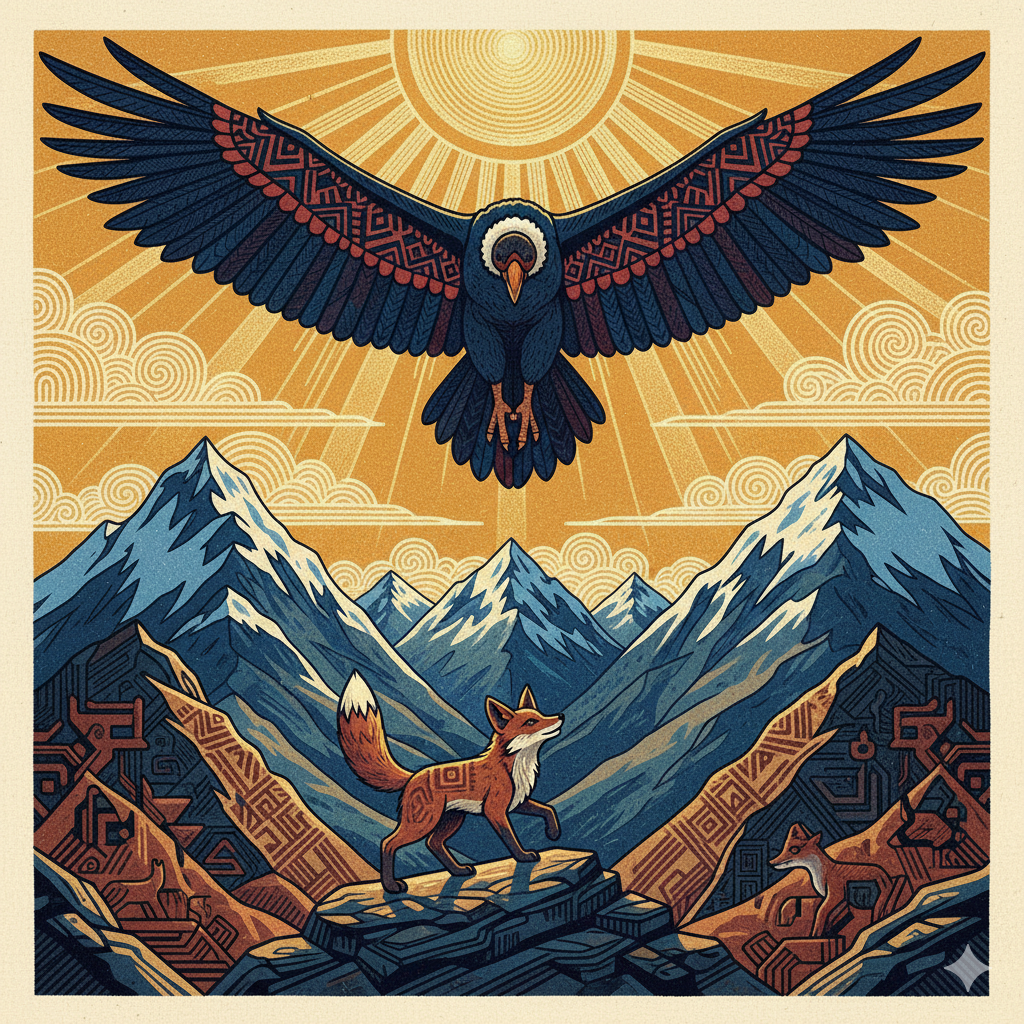
In the high peaks of the Andes, where mountain winds carry ancient wisdom and condors trace circles across infinite skies, the Quechua people have preserved a folktale that speaks to fundamental truths about pride, limitation, and the natural order of existence. “The Fox and the Condor” is more than a simple animal fable—it represents a sophisticated philosophical exploration of cosmic balance, encoded in narrative form and passed down through countless generations.
The Narrative: A Dance Between Earth and Sky
The story begins on a sun-drenched morning in the Andean highlands. A small fox, filled with exuberant confidence, climbs to the peak of a rocky outcrop and begins to dance. He spins, leaps, and celebrates his movements with unbridled pride, proclaiming himself the greatest dancer in all the mountains. His voice echoes across the valleys, a bold declaration of supremacy.
As the fox revels in his performance, a vast shadow sweeps across the mountainside. The condor—magnificent lord of the skies with a wingspan stretching up to three meters—descends and lands beside the smaller animal. The condor inquires about the fox’s solitary celebration, and the fox eagerly boasts of his dancing prowess.
The condor responds with measured good humor. While acknowledging the fox’s talent, he notes that just as the fox excels at dancing, the condor himself reigns supreme in flight. Then comes the pivotal offer: would the fox like to experience the world from the heights, to fly among the clouds and see creation from the perspective of the sky?
The fox, caught up in excitement and perhaps unable to resist the challenge implicit in the invitation, accepts immediately. He climbs onto the condor’s broad back, gripping the powerful feathers as the great bird launches skyward.
Initially, the experience fulfills every promise. They soar over forests and rivers, past snow-covered peaks that seem to touch the heavens themselves. The fox laughs with pure joy, exhilarated by this transcendent perspective. But as the condor climbs higher, the wind intensifies. The air grows thin and cold. The fox’s small paws begin to slip against the condor’s feathers, and what began as exhilaration transforms into terror.
The fox begs to return to solid ground, but the lesson has already been set in motion.
Multiple Endings: Traditional and Contemporary Interpretations
The tale’s conclusion varies across different tellings, each version emphasizing particular aspects of the underlying wisdom.
In traditional Quechua versions, the condor—recognizing the necessity of teaching humility—releases the fox from his back. The fox plummets through the sky, a terrifying descent that strips away all pride. Some versions tell of the fox landing safely but with his tail flattened from the impact, explaining why foxes are said to have flat tails to this day. This physical transformation serves as a permanent reminder of the consequences of hubris.
More contemporary retellings soften the lesson while preserving its core message. In these versions, the condor lands safely and speaks directly to the fox about acceptance and recognition of one’s gifts. Flight belongs to the condor; cleverness and agility belong to the fox. Each creature has its domain, its excellence, its proper place in the cosmic order.
Both endings convey the same fundamental truth, but through different pedagogical approaches—one through consequence, the other through dialogue.
Thematic Depths: Beyond Surface Narrative
The Danger of Hubris
At its most accessible level, the tale serves as a warning against boastfulness and overconfidence. The fox’s pride blinds him to his limitations. His inability to simply celebrate his own gifts without proclaiming superiority sets him on a path toward painful enlightenment. This theme resonates across cultures and time periods—the dangers of pride appear in Greek tragedy, Biblical proverbs, and countless folk traditions worldwide.
Acceptance of Natural Gifts
The story presents a more nuanced teaching about authenticity and self-knowledge. Every being possesses unique capabilities, evolved or granted for specific purposes. The fox’s dancing, his ground-based agility, his cleverness—these constitute his true excellence. The condor’s mastery of flight, his ability to navigate between earthly and celestial realms—this defines his nature.
Wisdom emerges not from envying others’ gifts but from fully inhabiting one’s own capabilities. The fox’s tragedy stems not from lacking the ability to fly—most creatures cannot fly—but from his refusal to accept this limitation as part of his fundamental nature.
Cosmic Order and Sacred Balance
The deepest layer of meaning connects to Andean cosmological understanding. In Quechua worldview, reality comprises three fundamental realms: Hanan Pacha (the upper world or celestial realm), Kay Pacha (the middle world where humans and animals dwell), and Ukhu Pacha (the lower world or interior realm). Each realm maintains its own character, inhabitants, and spiritual significance.
The condor, as a creature capable of soaring to tremendous heights, serves as a natural bridge between Kay Pacha and Hanan Pacha. The bird literally and symbolically connects earth to sky, physical to spiritual, mundane to divine. The fox, meanwhile, belongs firmly to Kay Pacha, moving skillfully across the earthly terrain but not meant to transcend it.
When the fox attempts to enter the condor’s realm, he violates this natural order. The universe—through the condor’s action or the consequence of the fall—reasserts proper boundaries. This is not punishment in a moral sense but rather a correction, a return to balance. The story teaches respect for cosmic structure, acceptance of one’s place within the larger order of existence.
Sacred Animals in Andean Tradition
The Condor: Messenger Between Worlds
In Inca and broader Andean mythology, the condor occupies one of the most exalted positions in the spiritual hierarchy. The Incas revered the condor as a divine messenger, carrying prayers and human supplications upward to the gods while bringing divine wisdom back to earth. This role stems from the bird’s remarkable ability to soar at extreme altitudes, often disappearing from human sight into the realm of clouds and celestial mystery.
The condor forms part of a sacred trilogy in Inca cosmology, alongside the puma and the serpent. These three animals represent the three cosmic realms: the condor symbolizes Hanan Pacha (heaven), the puma represents Kay Pacha (earth), and the serpent embodies Ukhu Pacha (the underworld). Together, they form a complete cosmological system, a symbolic map of existence itself.
With its massive wingspan and ability to ride thermal currents for hours without flapping, the condor embodies spiritual transcendence, freedom from earthly limitation, and access to divine wisdom. To witness a condor in flight was considered an auspicious sign, a moment when the barrier between realms grew thin.
The Fox: Trickster and Terrestrial Wisdom
The fox occupies a more ambivalent position in Andean tradition. As with trickster figures in many cultures, the fox embodies both admirable and problematic qualities. The animal represents intelligence, adaptability, and cunning—survival traits necessary in harsh mountain environments.
In some Andean communities, the fox was associated with water cultivation and seasonal agricultural cycles. Offerings of coca leaves and tobacco were made to honor the fox’s influence on harvest success. This connection suggests the fox served as an intermediary between human endeavors and natural forces, a creature whose cleverness could benefit those who showed proper respect.
Yet the fox also appears in tales as overly ambitious, impulsive, and prone to self-deception—qualities that lead to comic or tragic consequences. This duality reflects a sophisticated understanding of intelligence itself: cleverness divorced from wisdom, skill without self-knowledge, can lead one astray as surely as ignorance.
Ecological Alliance: Fact and Folklore
Interestingly, an actual ecological relationship exists between condors and foxes in the Andean wilderness. In Peru’s Colca Valley, locals describe an ancient alliance: when a condor locates carrion, it circles overhead until foxes arrive. The smaller, more agile fox approaches first, checking for traps or other dangers before the larger condor descends to feed. This real-world cooperation may have inspired or reinforced the folkloric relationship between these animals, demonstrating how Andean peoples observed and incorporated natural behaviors into their mythological narratives.
Regional Variations and Cultural Continuity
“The Fox and the Condor” appears across the Andean regions of Peru, Bolivia, Chile, Colombia, and Ecuador, with each area contributing unique elements while maintaining core themes. Some versions feature the fox requesting a single feather from the condor, believing it will grant him the power of flight. When the feather alone proves insufficient, the fox learns to appreciate the condor’s gift and value their friendship rather than seeking to appropriate the condor’s abilities.
Other variations describe the fox being invited to a celestial feast, where he dances for the inhabitants of Hanan Pacha and receives rewards for his entertainment. In these versions, the fox’s dancing becomes a legitimate gift that brings joy even to the divine realm, suggesting that when talents are offered humbly rather than boasted about, they can transcend ordinary limitations.
These variations demonstrate how oral traditions adapt to different communities while preserving essential wisdom. The story remains flexible enough to emphasize different aspects—friendship, humility, acceptance, respect for nature—depending on what lessons a particular community wishes to highlight.
Contemporary Relevance: Ancient Wisdom for Modern Lives
Despite originating in pre-Columbian indigenous cultures, “The Fox and the Condor” speaks directly to contemporary concerns. Modern society often encourages constant self-promotion, comparison with others, and the pursuit of capabilities beyond one’s natural strengths. Social media amplifies these tendencies, creating environments where boasting becomes normalized and where people measure their worth by standards that may not align with their authentic gifts.
The fox’s dilemma resonates in an age of relentless self-improvement rhetoric and the pressure to excel in every domain. The tale offers an alternative perspective: perhaps wisdom lies not in endless expansion of abilities but in deep cultivation of inherent strengths. Perhaps true success means dancing beautifully on the ground rather than falling awkwardly from the sky.
For children, the story provides accessible lessons about humility and self-acceptance. For adults, it offers more subtle teachings about authenticity, the dangers of comparison, and the peace that comes from accepting one’s nature rather than fighting against it.
Preserving Oral Traditions in Written Form
The continued telling of “The Fox and the Condor” represents a broader effort to preserve Quechua and Andean oral traditions in an increasingly globalized world. These stories encode not just entertainment but entire philosophical systems, ecological knowledge, spiritual beliefs, and communal values.
When indigenous folktales are recorded, translated, and shared beyond their original communities, they risk losing contextual depth. Yet they also gain the potential to offer their wisdom to wider audiences, to preserve endangered cultural knowledge, and to demonstrate the sophistication of indigenous intellectual traditions.
The fox and the condor continue their eternal dance—one on the earth, one in the sky—reminding us that every creature, every person, has their proper place in the grand design. The question is not whether we can transcend our nature, but whether we can fully embrace it, dancing with joy in the realm where we truly belong.
This folktale exemplifies how Andean cultures encoded profound life lessons into narratives about the natural world, ensuring that spiritual values and practical wisdom would be transmitted across generations through the captivating adventures of two remarkable creatures.
Leave a Reply