
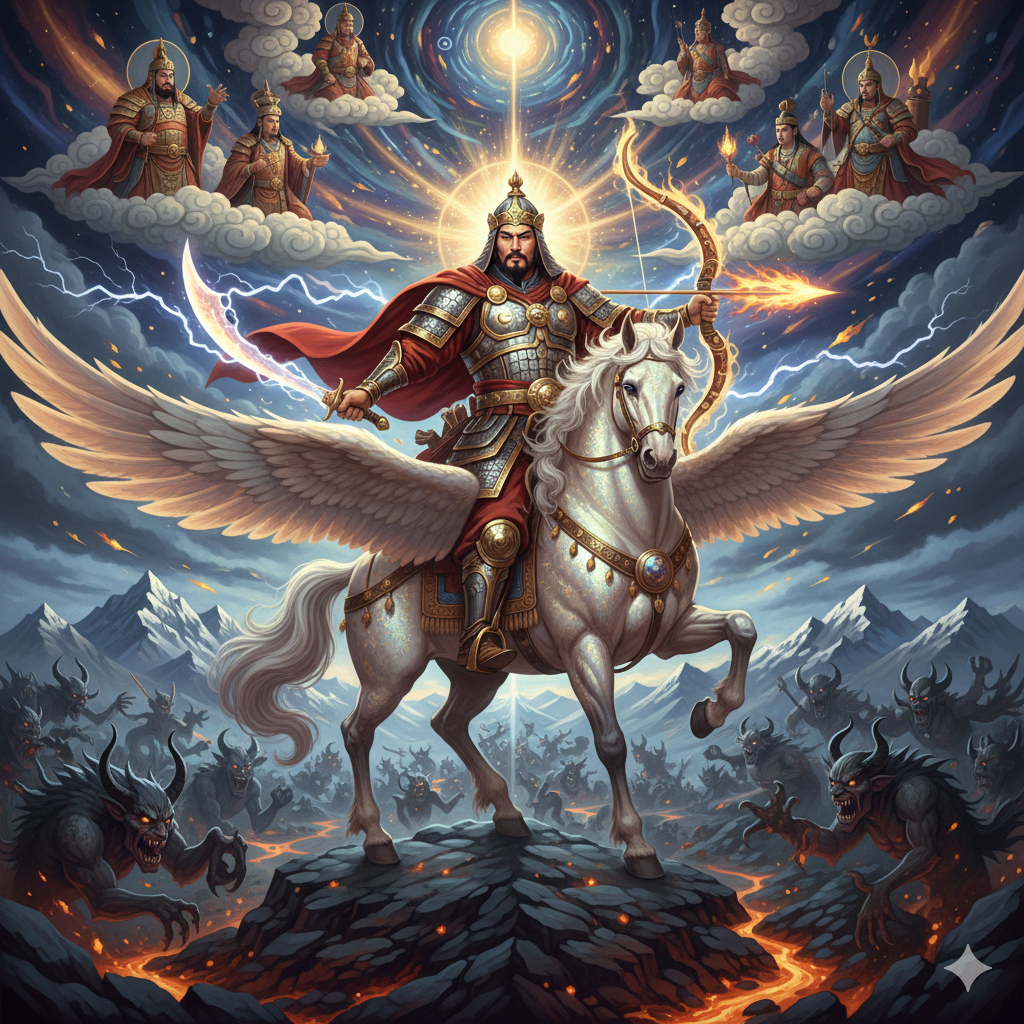
In the vast expanse of Central Asian literature, few narratives achieve the mythological grandeur and cultural significance of the Epic of Geser Khan. This legendary tale, comparable in scope to the Mahabharata, weaves together celestial conflicts, heroic adventures, and profound spiritual themes into a narrative that has captivated audiences for nearly a millennium.
A Living Tradition Across Cultures
The Epic of Geser Khan—also spelled Gesar or Kesar—stands as one of Central Asia’s most magnificent literary achievements. Emerging from Tibetan oral traditions around the 12th century CE, the epic evolved distinctively across different cultures, with Mongolian, Buryat, Tibetan, Balti, and Ladakhi communities each developing their own versions while preserving the narrative’s essential elements.
The Mongolian written version, first printed in Beijing in 1716 during the Kangxi reign, represents a unique literary development rather than a simple translation of Tibetan sources. This edition emerged during a turbulent period—the 17th and 18th centuries—marked by feudal fragmentation, civil discord, and Manchurian expansion into Mongolia. That the epic survived and flourished through such challenging times speaks to its profound resonance with the cultural identity of Central Asian peoples.
The Celestial Prologue: A Cosmic Conflict
Unlike many heroic epics that begin with earthly events, the Epic of Geser Khan opens in the celestial realms, establishing the protagonist’s extraordinary divine origins and cosmic purpose.
The narrative begins with a great conflict between divine powers: Han Hormasta, leader of the 55 Tenger (sky-gods) of the western skies, faced off against Atai Ulaan, leader of the 44 Tenger of the eastern skies. Atai Ulaan commanded an army of 6,666 soldiers and possessed immense magical power—reportedly making “thirteen magics dance on his palm and twenty-three magics dance on his fingers.” This formidable adversary posed an unprecedented threat to universal harmony.
Though Han Hormasta achieved victory, the triumph was incomplete. The heavens could not completely destroy Atai Ulaan’s essence. Instead, his severed body fragmented into multiple demonic entities that would plague the earthly realm, sowing chaos and destruction among humanity.
Recognizing this catastrophe, the gods collectively decided to send a divine incarnation to earth. One of Han Hormasta’s sons volunteered to incarnate as Geser, a mortal hero destined to defeat these demons and restore peace to all lands. This decision set in motion one of mythology’s most epic journeys—a divine being’s descent into the mortal realm to serve as humanity’s protector.
The Miraculous Birth and Supernatural Childhood
Geser’s entry into the world was marked by miraculous portents and mystical circumstances. His mother, Gog-bzang lha-mo (also called Mayas Hara Toodei in various versions), received instructions from the unborn hero himself. He directed her to build a special dwelling—a house with three stones and three beams on a mountain with three tops—so he could properly enter the mortal world.
From infancy, Geser displayed abilities far beyond ordinary mortals. As a young child, he confronted and defeated terrifying monsters that would kill seasoned warriors: giant man-eating rats, human-sized mosquitoes, and steel ravens. These early trials foreshadowed his destined role as humanity’s champion against supernatural threats.
Among his divine gifts was Kyang Go Karkar, a miraculous steed that would serve as his faithful companion throughout his adventures. This enchanted horse possessed extraordinary speed and endurance, capable of feats no ordinary mount could achieve.
The Rise of a King: From Youth to Ruler
As Geser matured, he underwent a dramatic transformation that would establish his earthly authority. Through a combination of trickery, magic, intellect, and supernatural forces, he won the heart of a beautiful and virtuous princess. In some versions she is named Rogmo, in others Sengjam Zholmo—a woman who would become not just his queen but his spiritual partner in the trials ahead.
The defining moment of his coming of age involved defeating a massive black piebald tiger, a feat that marked his transition into adulthood and demonstrated his worthiness to rule. Upon this victory, Geser proclaimed himself “the Great Lion, Wish-fulfilling Jewel, Subduer of Foes,” and became king of the realm of Ling. He assembled thirty loyal warriors who would accompany him on his legendary military campaigns, forming an unbreakable brotherhood dedicated to protecting humanity from demonic forces.
The Great Campaigns: Battling Demonic Forces
Geser’s reign was defined by systematic campaigns against the demonic entities threatening his kingdom and all surrounding lands. Each confrontation tested different aspects of his abilities—martial prowess, magical knowledge, strategic thinking, and moral virtue.
The Northern Campaign: Confronting Lubsan
Geser’s first major campaign targeted Lubsan, the man-eating demon king of the north. This fearsome adversary posed an existential threat to the kingdom, devouring humans and spreading terror throughout the land.
During their confrontation, Geser employed both martial skill and magical arts to overcome the demon. However, the encounter revealed unexpected complexity: Lubsan’s wife, Tümen Dzhirgalang (also called Bumskid or Dze-mo), possessed profound spiritual knowledge. Recognizing Geser’s divine mission, she secretly aided him in defeating her husband.
After vanquishing Lubsan, Geser inherited the demon’s kingdom and remained there temporarily. During this period, the demon’s widow provided him with a magical potion, which had an unintended consequence—it caused Geser to forget his homeland and duties. This enchanted forgetfulness would prove catastrophic, as back in Ling, his enemy Tsoton (an uncle with treacherous ambitions) seized the opportunity to attack, imprisoning Queen Rogmo and devastating the kingdom.
The Fragmented Demon: Atai Ulaan’s Progeny
The fragmentation of Atai Ulaan’s body had created multiple demon entities, each requiring individual defeat. These battles formed the epic’s most supernatural sequences:
Arhan Chotgor, the Sun-Eater, emerged from Atai Ulaan’s body with the power to devour celestial bodies. This monster threatened Geser’s very homeland and murdered his uncle Hara Zutan before Geser could return to confront it. The battle against the Sun-Eater tested Geser’s ability to combat threats to the cosmic order itself.
Gal Nurma Khan (also called Gal Dulme), a fire demon born from Atai Ulaan’s severed neck vertebra, personified volcanic destruction. This entity ravaged the lands with uncontrollable fury, representing the raw, destructive power of elemental chaos. Young Geser initially struggled against this powerful adversary, but ultimately prevailed, often with supernatural assistance from the divine realm.
Lobsogoi, born from Atai Ulaan’s backside, represented a different kind of threat. Unlike his more straightforward demonic siblings, Lobsogoi employed trickery, deception, and illusion. Defeating this adversary required Geser to match wits as much as strength, demonstrating that heroism encompasses mental as well as physical prowess.
The War Against the Three Kings of Sharaigol
One of the epic’s most significant narrative sequences involved the three evil rulers of Sharaigol, a kingdom of the Hor people. These kings represented political and martial threats to Ling’s stability, embodying the dangers of territorial ambition and tyrannical rule.
The three kings invaded Geser’s realm while he remained under the spell of forgetfulness in the northern lands. Superior in numbers and taking advantage of his absence, they seized territory and imprisoned his wife Rogmo. Initially, they defeated Geser’s forces, seemingly establishing permanent control.
However, upon breaking free from the magical forgetfulness—through various means depending on the version, including divine intervention or Rogmo’s spiritual appeals—Geser returned home with renewed purpose and clarity of mission. The ensuing confrontation showcased his development as both warrior and king. He decisively defeated the three Hor kings, rescued his wife, and restored peace and order to his realm, demonstrating that true kingship requires both strength and unwavering commitment to one’s responsibilities.
The Journey to China: Expanding the Cosmic Order
Geser’s campaigns extended beyond neighboring kingdoms to China itself, representing his role as a cosmic peacemaker with responsibilities across the entire known world. This expedition demonstrated that his mission transcended local conflicts—he was destined to establish harmony across all civilized lands.
During this journey, he married the Chinese emperor’s daughter, establishing diplomatic alliances that united different peoples under a common vision of peace. This marriage symbolized more than political union; it represented the extension of cosmic order to distant realms, bringing the benefits of his divine mission to populations far from his original kingdom.
The Spiritual Dimensions: Multiple Planes of Existence
The Epic of Geser Khan operates on multiple spiritual and philosophical levels simultaneously, reflecting its origins in cultures with sophisticated cosmological understanding.
Geser exists on three planes of reality: as a legendary human (or demi-god) hero whose adventures inspire martial virtue; as a protective spiritual force and deity venerated by believers seeking divine intervention; and as a potentially enlightened or bodhisattva-like being within Buddhist cosmology, representing the active compassion of enlightened consciousness.
This multivalent nature allowed the epic to speak to different audiences. Warriors valued his martial prowess and strategic brilliance. Spiritual practitioners recognized his divine nature and invoked him for protection. Buddhists incorporated him into their religious framework, seeing his battles against demons as metaphors for the spiritual struggle against ignorance and negative mental states.
Buddhist Interpretations and Tensions
Within Tibetan Buddhism, different schools interpreted Geser’s significance in varying ways. The Kagyu and Nyingma schools favored the epic, interpreting it as expressing the activity of Padmasambhava, Buddhism’s legendary founder in Tibet. They saw the narrative as a vehicle for Dzogchen teachings—the highest form of Buddhist philosophy concerning the nature of mind and reality.
Conversely, the Gelug school disapproved of the epic, viewing its shamanic elements as conflicting with Buddhist orthodoxy. This tension reflected broader debates about indigenous traditions and Buddhist purity.
Notably, the epic flourished particularly in the outlying regions of Kham and Amdo, areas with strong pre-Buddhist Bon traditions. This geographic distribution suggests the narrative has deep indigenous roots predating Buddhism’s arrival in Tibet, representing an authentic expression of Central Asian spirituality that later incorporated Buddhist elements without losing its original character.
Until recently, the epic was forbidden reading in many Tibetan monasteries, yet certain monasteries performed elaborate rituals invoking Geser as a major spiritual force. This contradiction between official religious prohibition and popular devotion highlights the epic’s enduring power as a cultural touchstone transcending institutional boundaries.
Shamanic Elements and Cosmology
The epic retained strong shamanic elements that reflect Central Asia’s indigenous spiritual traditions. Geser’s ability to navigate vertically between earthly, heavenly, and underworld realms mirrors the classical shamanic cosmology found throughout the region. His magical powers, communication with spirits, transformation abilities, and role as healer and protector all align with shamanic practitioner roles.
This shamanic dimension grounds the epic in practices and worldviews that predate organized religions, connecting it to humanity’s oldest spiritual technologies for navigating between visible and invisible worlds.
The Mongolian Adaptation: A Distinct Literary Achievement
The Mongolian version, established in print in 1716, developed distinctive characteristics reflecting Mongolian cultural values and historical circumstances. Scholars argue that the written Mongolian versions stem from independent sources influenced by Mongolian oral traditions rather than being direct translations of Tibetan texts.
The Mongolian adaptation emphasized heroic virtues valued by nomadic warrior culture: courage, loyalty, strategic thinking, physical prowess, and moral integrity. While maintaining the epic’s supernatural and spiritual dimensions, the Mongolian version grounded these elements in recognizable landscapes and social structures.
The narrative structure includes its own heavenly prologue and celestial mythology while adapting key episodes to reflect Mongolian geography and political circumstances. The epic served as a living cultural document, preserving “the modes of speech and manners of life of the nomad tribes” across generations, making it invaluable to understanding medieval Mongolian society, values, and spiritual worldview.
Literary Structure and Narrative Techniques
The epic employs sophisticated narrative techniques that have ensured its survival across centuries and cultures. The use of episodic structure allows individual adventures to stand alone while contributing to the larger arc of Geser’s mission. This modularity facilitated oral transmission, as bards could perform individual episodes or extended sequences depending on the occasion.
The integration of celestial framing with earthly adventures creates a cosmic perspective that elevates Geser’s struggles beyond mere human conflict. His battles become manifestations of universal principles—order versus chaos, compassion versus cruelty, wisdom versus ignorance.
The narrative also employs cyclical patterns, with Geser repeatedly facing challenges, temporarily succeeding, encountering setbacks (often through magical interference or his own human limitations), and ultimately triumphing through renewed divine assistance or recovered memory of his mission. This structure reflects both shamanic initiatory journeys and Buddhist teachings about the cyclical nature of existence.
Cultural Legacy and Continuing Relevance
The Epic of Geser Khan survives in multiple versions across Central Asia—Tibetan, Mongolian, Buryat, Balti, Ladakhi, and other regional variants—each preserving distinct cultural features while maintaining core narrative elements. The Buryat versions, particularly those from western Buryatia, preserved ancient material uninfluenced by Buddhism, suggesting the epic’s roots extend deep into pre-Buddhist shamanic traditions.
The epic’s themes of heroism, supernatural conflict, moral virtue, and the restoration of cosmic order resonate across cultures and centuries. Geser’s journey from divine origin through earthly trials to ultimate ascension mirrors universal hero narratives found in mythology worldwide—yet remains distinctly rooted in Central Asian cosmology, spiritual philosophy, and the values of nomadic warrior societies.
For contemporary audiences, the epic offers insights into how cultures construct meaning through narrative, how spiritual traditions adapt and evolve while maintaining core truths, and how heroic ideals can inspire individuals to confront the chaos and challenges of their own times.
Conclusion: A Hero for All Ages
The Epic of Geser Khan represents more than ancient entertainment or religious instruction. It embodies a sophisticated understanding of human existence, spiritual purpose, and cosmic order. Through Geser’s adventures—his supernatural battles, political struggles, moral trials, and ultimate fulfillment of his divine mission—the epic explores fundamental questions about duty, courage, leadership, and the relationship between human and divine realms.
As one of Central Asia’s greatest literary achievements, the epic continues to speak to audiences seeking models of heroism, wisdom about navigating moral complexity, and connection to spiritual traditions that honor both martial prowess and compassionate purpose. In Geser Khan, cultures across centuries have found a hero worthy of veneration—a divine warrior whose mission to restore cosmic order remains eternally relevant.
Leave a Reply