
The birth of Lord Krishna stands as one of Hinduism’s most profound and celebrated mythological narratives, weaving together themes of divine intervention, cosmic justice, and the eternal struggle between good and evil. This sacred story, commemorated annually during Krishna Janmashtami, reveals not merely the arrival of a divine avatar, but a complex exploration of how the Supreme Being manifests in the material world to restore cosmic balance.
The Cosmic Context: Understanding Krishna’s Divine Purpose
Before delving into the miraculous circumstances of Krishna’s birth, it’s essential to understand the cosmic framework that necessitated this divine incarnation. According to Hindu scripture, Krishna represents the eighth avatar (incarnation) of Lord Vishnu, the preserver god within the Hindu trinity. This manifestation occurred during a time when the world was overwhelmed by tyranny and spiritual darkness, requiring divine intervention to restore dharma (righteousness).
The Prophecy That Changed Everything: Kamsa’s Tyrannical Rule
Our story begins in the ancient kingdom of Mathura, where King Kamsa had usurped the throne from his father, Ugrasena, establishing a reign of terror that oppressed his subjects. Kamsa embodied the archetypal tyrant – cruel, paranoid, and consumed by his thirst for power.
The turning point came during the wedding celebration of Kamsa’s sister, Devaki, to the noble prince Vasudeva of the Yadava clan. As Kamsa personally drove the newlyweds’ chariot in ceremonial celebration, the heavens themselves intervened. A divine voice, known as an akashvani (celestial proclamation), thundered across the sky with a chilling prophecy: Devaki’s eighth child would be the instrument of Kamsa’s death.
The prophecy’s impact was instantaneous and devastating. Kamsa, consumed by terror and rage, immediately drew his sword to kill Devaki on the spot. However, Vasudeva’s desperate intervention saved his bride’s life through a terrible bargain: he promised to deliver each of their children to Kamsa immediately upon birth, allowing the tyrant king to prevent the prophecy’s fulfillment.
This agreement led to Devaki and Vasudeva being imprisoned in the deepest dungeons of Kamsa’s palace. The couple, who should have been celebrating their union, instead found themselves trapped in a nightmare that would unfold over several years.
The Years of Sorrow: Six Children Lost
The following years witnessed a heartbreaking cycle of birth, hope, and murder. True to his word, Vasudeva delivered each newborn child to Kamsa, who ruthlessly killed them immediately. The six sons – Kirttimat, Sushena, Udayin, Bhadrasena, Rijudasa, and Bhadradeha – were murdered within moments of their births, each death devastating their imprisoned parents further.
According to Hindu scripture, these six children were actually reincarnations of the sons of the demon Kalanemi, working out their karmic destinies through this tragic cycle. The extreme suffering of Devaki and Vasudeva demonstrated their unwavering faith and prepared them spiritually for their role as parents to the divine avatar.
The Seventh Child: Balarama’s Divine Transfer
When Devaki conceived her seventh child, the cosmic machinery of divine intervention began operating in earnest. Through the power of Yogamaya – Lord Vishnu’s divine illusory energy – an unprecedented miracle occurred. The seventh child, destined to be Balarama (Krishna’s elder brother and an incarnation of Ananta Shesha, the cosmic serpent), was supernaturally transferred from Devaki’s womb to that of Rohini, Vasudeva’s first wife, who lived safely in the village of Gokul.
This miraculous transfer protected Balarama, who would play a crucial role in Krishna’s earthly mission, while creating the deception that Kamsa believed was a miscarriage, reducing his vigilance slightly.
The Sacred Night: Krishna’s Miraculous Birth
On the eighth day of the dark fortnight (Krishna Paksha) of the month of Bhadrapada, at the stroke of midnight, the moment arrived that would transform both earthly and cosmic history. Lord Krishna’s birth was marked by extraordinary supernatural phenomena that immediately distinguished this event as divinely significant.
At the moment of birth, Krishna first appeared to his parents in his magnificent four-armed divine form (Chaturbhuja), radiating celestial light that transformed the prison into a sacred space. Devaki and Vasudeva immediately recognized their child as Lord Vishnu himself, experiencing direct divine darshan (sacred viewing) that elevated their consciousness.
However, demonstrating infinite compassion, Krishna then concealed his divine form and appeared as an ordinary newborn, allowing his parents to experience the natural joy of parenthood while still carrying the awareness of his true nature.
The Prison Transformation: Miracles Unfold
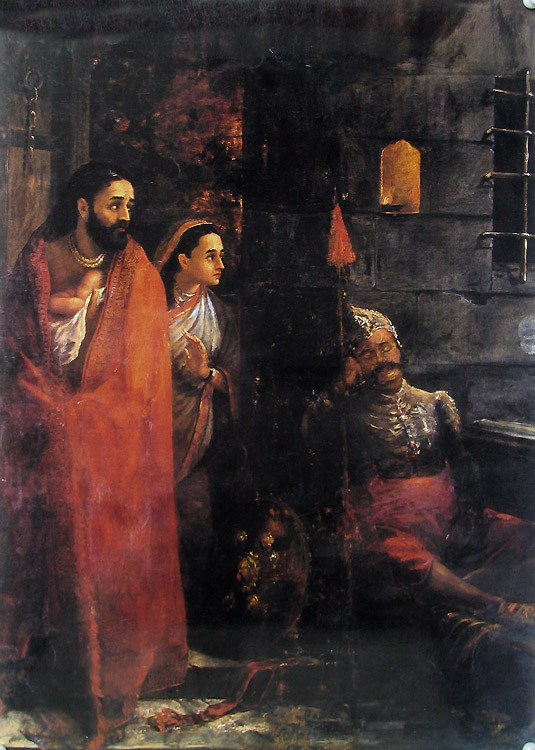
Simultaneously with Krishna’s birth, a series of miraculous events demonstrated that ordinary physical laws no longer applied. The heavy iron chains that had bound Vasudeva for years broke and fell away automatically. All prison doors swung open without human intervention. Every guard in the palace fell into a deep, supernatural slumber. The entire prison filled with divine radiance, transforming the space from a place of suffering into a temporary temple.
The Perilous Journey: Crossing Sacred Waters
Following divine instructions received through inner revelation, Vasudeva placed the newborn Krishna in a basket and embarked on what seemed like an impossible journey to Gokul. The night was treacherous – storm winds howled, torrential rain fell, and the path was fraught with danger.
As Vasudeva made his way through the tempest, carrying Krishna on his head, miraculous protection accompanied them at every step. Adishesha, the thousand-headed cosmic serpent upon whom Lord Vishnu eternally rests, manifested above them, spreading his multiple hoods to create a divine umbrella that shielded the baby from the rain. The landscape itself seemed to cooperate with the divine mission, with obstacles disappearing and paths becoming clear despite the darkness and storm.
The Yamuna Crossing: Waters of Devotion
The most dramatic moment came when Vasudeva reached the Yamuna River, which was flooding and appeared completely impassable. In normal circumstances, attempting to cross would have meant certain death for both father and child.
According to the sacred narrative, the River Yamuna, personified in Hindu tradition as a goddess, recognized the divine presence of baby Krishna and wished to offer worship by touching his sacred feet. As Krishna’s tiny foot touched the water, the raging flood immediately calmed and receded, creating a safe passage. Vasudeva’s unwavering trust in divine protection, even while facing seemingly impossible circumstances, allowed divine grace to operate freely.
The Sacred Exchange: Divine Strategy in Gokul
Vasudeva’s arrival in Gokul marked the culmination of a divinely orchestrated plan. The village was under the benevolent influence of Yogamaya, ensuring that this critical exchange could occur without detection. Gokul presented a scene of supernatural tranquility. Nanda, the village chief and Vasudeva’s friend, and his wife Yashoda had just given birth to a daughter. Through divine arrangement, everyone in the village was in deep, peaceful sleep.
Following the divine instructions he had received, Vasudeva gently placed baby Krishna beside the sleeping Yashoda and took their newborn daughter – who was actually Yogamaya herself in human form. The return journey to Mathura proceeded with the same miraculous protection. The Yamuna again provided safe passage, Adishesha continued his protective presence, and Vasudeva arrived back at the prison just as dawn approached. Immediately upon his return, the chains reappeared around his limbs and the prison doors closed, erasing all evidence of the night’s extraordinary events.
Yogamaya’s Final Intervention: The Goddess Revealed
The crying of the newborn alerted the guards, who rushed to inform Kamsa of the eighth child’s birth. When the tyrant king arrived at the prison, he was surprised to find a baby girl rather than the prophesied male child. However, his paranoia and cruelty remained unchanged.
Despite Devaki and Vasudeva’s desperate pleas that this was merely a daughter who posed no threat, Kamsa seized the infant and attempted to dash her against the stone wall of the prison. As Kamsa grasped the baby girl, she miraculously slipped from his hands and rose into the air, transforming into her true form – the eight-armed goddess Durga, blazing with divine power.
In this awesome manifestation, Yogamaya delivered a message that struck terror into Kamsa’s heart: “O fool! What is the use of killing me? Your nemesis has already been born elsewhere and is safe. Do not kill children unnecessarily.”
After delivering this message, the goddess vanished, leaving behind a bewildered and increasingly desperate Kamsa who now knew that his nemesis had indeed been born and was beyond his reach.
Krishna’s Sacred Childhood: Growing Up in Gokul
Safe in the loving village of Gokul, Krishna began the earthly phase of his divine mission. Nanda and Yashoda, his foster parents, embraced him with pure parental love, naming him Krishna (meaning “dark” or “all-attractive”) for his beautiful dark complexion. They celebrated his arrival with great joy, unaware of his divine nature but instinctively recognizing something extraordinary about this child.
Gokul represented the ideal environment for Krishna’s upbringing. The cowherd community lived in harmony with nature, embodying simple devotion and authentic relationships. The village was naturally shielded from Kamsa’s direct influence, allowing Krishna’s divine nature to unfold gradually through loving foster family bonds and the presence of Balarama as elder brother.
Krishna’s childhood in Gokul became legendary for its miraculous deeds and playful pastimes, known as Krishna Leela. These stories demonstrate how divine consciousness manifests through apparently ordinary activities, transforming everyday life into sacred play.
The Fulfillment of Prophecy
Years later, when Krishna had grown into a powerful young man, he eventually returned to Mathura and fulfilled the prophecy by killing Kamsa, just as the divine voice had predicted. This marked the triumph of good over evil and the restoration of righteous rule in Mathura.
Krishna Janmashtami: Celebrating the Sacred Birth
This profound birth narrative is commemorated annually through Krishna Janmashtami, celebrated on the eighth day of the dark fortnight in the month of Bhadrapada (August-September). The festival’s observances directly connect devotees to the story’s spiritual themes.
Devotees gather for midnight celebrations marking the exact time of Krishna’s birth, with special prayers, bhajans (devotional songs), and reenactments of the birth story. Many observe complete fasts until midnight, using physical discipline to deepen spiritual focus. Communities perform elaborate plays depicting Krishna’s birth and childhood, making the ancient stories come alive for new generations.
The famous Dahi Handi ceremony recreates Krishna’s childhood pranks of breaking decorated pots filled with yogurt, emphasizing the joy and playfulness inherent in divine consciousness. Elaborate temple decorations, special altars, and beautiful imagery transform sacred spaces into representations of the divine birth chamber and pastoral Gokul.
The Enduring Legacy and Contemporary Relevance
The story of Krishna’s birth has profoundly shaped Hindu religious consciousness for over two millennia. Its influence extends far beyond historical narrative to become a living spiritual reality that continues to inspire and guide millions of devotees worldwide.
The Krishna birth story has inspired countless works of art, literature, music, and dance throughout Indian cultural history. From classical Sanskrit poems to folk songs, from temple sculptures to contemporary films, the story continues to generate creative expression that keeps its themes alive in popular consciousness.
For millions of devotees, the story serves not merely as historical account but as a guide for spiritual practice, offering devotional meditation, moral guidance, and models for different types of relationships with the divine.
The Deeper Spiritual Significance
The birth story of Lord Krishna operates on multiple profound levels, offering insights into fundamental Hindu theological concepts that continue to resonate across cultures and centuries.
Divine Incarnation and Cosmic Responsibility Krishna’s birth exemplifies the doctrine of avatar – the voluntary descent of divine consciousness into material form for cosmic restoration. Unlike ordinary births driven by karma, this birth was entirely voluntary, motivated by divine compassion for suffering humanity. The Supreme Being makes itself accessible to devotees through incarnation while accepting responsibility for maintaining cosmic balance, remaining transcendent yet becoming fully immanent in creation.
The Transformation of Suffering into Blessing Throughout the narrative, divine presence transforms suffering into sacred experience. Krishna’s birth transformed the dungeon into sacred space, physical chains broke symbolizing spiritual freedom, and despair transformed into hope through divine intervention. This demonstrates how divine consciousness can sanctify even the most difficult circumstances.
Divine Grace Operating Through Human Cooperation The story reveals how divine grace operates through human cooperation and faith. Vasudeva’s unwavering trust enabled divine protection during the perilous journey, Devaki’s surrender prepared her to receive divine blessing, and the unconscious cooperation of Gokul’s residents facilitated Krishna’s safety. This illustrates the essential partnership between divine will and human receptivity.
The Eternal Birth of Divine Consciousness Perhaps most significantly, the midnight birth in a prison cell, transformed into a moment of cosmic celebration, speaks to the human condition itself. We all begin our spiritual journey in the darkness of ignorance, bound by the chains of limitation, yet carrying within us the seed of divine consciousness that, when awakened, can break all bonds and illuminate all darkness.
Conclusion: The Living Truth of Krishna’s Birth
The birth story of Lord Krishna represents far more than an ancient tale of miraculous events. It serves as a profound meditation on the nature of divine consciousness, the mechanics of cosmic intervention, and the eternal struggle between light and darkness that plays out both in the world and within the human heart.
In celebrating Krishna’s birth, devotees are not merely commemorating a historical event but participating in the eternal birth of divine consciousness within their own hearts. Krishna’s birth was not a one-time occurrence but an eternal reality, continuously manifesting wherever devotion calls and dharma needs restoration.
The story reminds us that divine grace operates through the most unlikely circumstances, that faith can literally move mountains and part rivers, and that love ultimately transcends all limitations. In this understanding, the story of Krishna’s birth becomes not just ancient history but present possibility, not just sacred legend but living truth available to all who approach it with open hearts and faithful minds.
Leave a Reply