
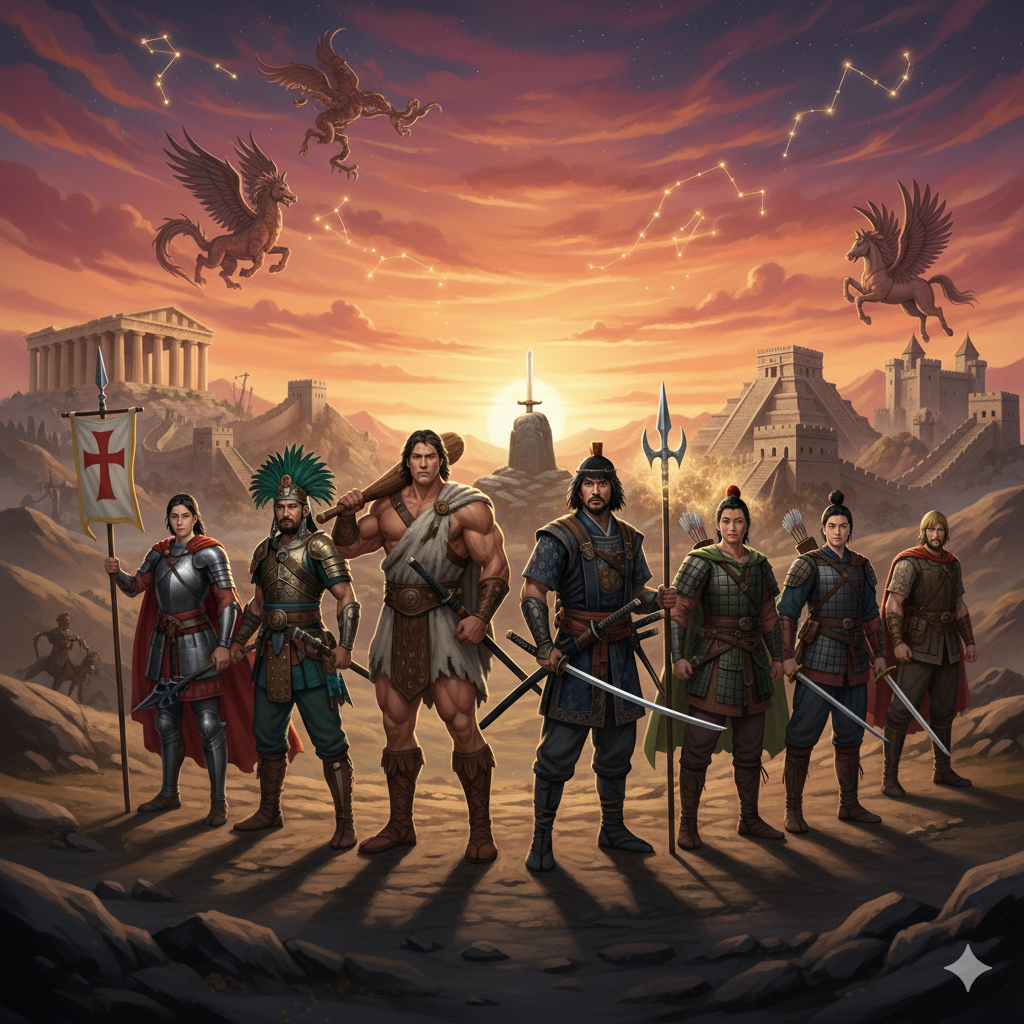
Introduction: The Universal Appeal of the Mortal Hero
Throughout human civilization, cultures across the globe have celebrated extraordinary individuals who transcend ordinary human limitations while remaining fundamentally mortal. These legendary heroes occupy a unique space in mythology—beings who possess divine ancestry or supernatural abilities, yet remain vulnerable to human flaws, suffering, and death. Unlike the immortal gods who shape destiny from distant realms, mortal heroes walk among humanity, facing challenges that test not only their strength but their character, wisdom, and resolve.
The concept of the mortal hero serves a profound cultural purpose. These figures embody the highest ideals of their civilizations while remaining relatable through their struggles and limitations. They demonstrate that greatness can emerge from human origins, that courage can overcome seemingly insurmountable obstacles, and that mortality itself need not diminish one’s legacy. From ancient Mesopotamia to medieval Russia, from the Pacific islands to the African savanna, these heroes have shaped cultural values, inspired generations, and revealed universal truths about the human condition.
What distinguishes mortal heroes from divine beings is their essential humanity—they experience fear, doubt, grief, and anger. They make mistakes, suffer consequences, and ultimately face death. Yet through their extraordinary deeds, whether slaying monsters, founding kingdoms, or bringing knowledge to humanity, they achieve a form of immortality that transcends their physical existence: they live on in story, symbol, and cultural memory.
Greek Heroes: The Foundation of Western Heroic Tradition
Ancient Greece gave the world some of its most enduring heroic archetypes, figures whose stories have resonated through millennia of Western literature and thought. These heroes typically possessed divine parentage that granted them superhuman abilities, yet their greatest trials often stemmed from very human conflicts—jealousy, pride, love, and the burden of destiny.
Heracles: Strength Through Suffering
Heracles, known to the Romans as Hercules, stands as perhaps the most celebrated hero in Greek tradition. Born to Zeus and the mortal woman Alcmene, he inherited godlike strength but also attracted the vengeful attention of Hera, Zeus’s wife. This divine jealousy would shape his entire existence, transforming him from a figure of pure strength into a complex symbol of redemption through suffering.
The turning point of Heracles’s story came when Hera drove him to madness, causing him to kill his own wife and children in a fit of divine fury. Upon regaining his senses and confronting the horror of his actions, Heracles sought purification and penance. The Oracle of Delphi directed him to serve King Eurystheus, who assigned him twelve seemingly impossible labors. These tasks would define his legend: slaying the invulnerable Nemean Lion and wearing its impenetrable hide as armor, defeating the nine-headed Hydra whose heads multiplied when severed, capturing the Golden Hind of Artemis, cleaning the Augean stables in a single day, and ultimately descending into the Underworld itself to capture Cerberus, the three-headed guardian of death’s domain.
Each labor tested different aspects of heroism—not merely physical strength, but cunning, perseverance, and the willingness to venture into realms forbidden to mortals. Heracles’s story resonated deeply in Greek culture because it illustrated that even the strongest among mortals must face consequences for their actions, and that true heroism lies in accepting one’s burden and transforming suffering into purposeful action.
Perseus: The Hero of Divine Favor
Perseus’s legend demonstrates how intelligence and divine favor can prove as valuable as raw strength. Born to Danaë, who was imprisoned by her father after a prophecy foretold that his grandson would kill him, Perseus entered the world under extraordinary circumstances—conceived when Zeus visited Danaë as a shower of golden light.
His greatest exploit, the slaying of Medusa, showcases the Greek ideal of the clever hero. Medusa, once a beautiful maiden transformed into a monster by Athena’s curse, possessed a gaze that turned any who looked upon her to stone. Perseus succeeded where others failed by employing both divine gifts and tactical thinking. Hermes provided him with winged sandals for flight, Athena granted him a polished shield to serve as a mirror, and Hades contributed a cap of invisibility. Rather than confronting Medusa directly, Perseus viewed her reflection in his shield, approached unseen, and beheaded her while she slept.
The hero’s journey continued with his rescue of Andromeda, a princess chained to a rock as a sacrifice to a sea monster. Perseus’s use of Medusa’s severed head to petrify the monster established him as a protector of the innocent and a destroyer of threats to civilization. His story concludes with the fulfillment of the original prophecy—accidentally killing his grandfather during athletic games—demonstrating the Greek belief in the inescapability of fate even for the most favored heroes.
Theseus and Achilles: Civilization and Warfare
Theseus, considered the legendary founder-hero of Athens, earned his greatest fame by slaying the Minotaur—a half-man, half-bull monster confined within an elaborate labyrinth beneath the Cretan palace. Each year, Athens was forced to send seven young men and seven young women as tribute to feed this beast, a humiliation that symbolized Athenian subjugation to Cretan power.
Volunteering as one of the tributes, Theseus caught the attention of Princess Ariadne, who provided him with a ball of thread to navigate the maze’s endless passages. After defeating the Minotaur in combat, Theseus followed the thread back to freedom, liberated the other captives, and ended Athens’s shameful tribute. This story represented more than monster-slaying—it symbolized Athens’s emergence from subordination to become a great power, with Theseus credited for unifying the region’s scattered communities into a cohesive city-state.
Achilles represents another dimension of Greek heroism—the warrior who chooses glorious death over long, unremarkable life. The hero of Homer’s Iliad, Achilles possessed near-invulnerability, having been dipped in the River Styx by his mother Thetis, who held him by his heel. This single vulnerable point would become legendary, but Achilles’s true tragedy lay not in his physical weakness but in his knowledge that he was fated to die young. His choice to fight at Troy, knowing it meant certain death, exemplified the Greek heroic ideal of kleos—eternal glory achieved through memorable deeds, even at the cost of life itself.
Norse and Germanic Heroes: Embracing Fate’s Inevitability
The heroes of Norse and Germanic tradition occupy a darker, more fatalistic landscape than their Greek counterparts. In the Norse worldview, even the gods face an inevitable doom at Ragnarök, making heroism not about achieving victory but about meeting one’s destiny with courage and dignity. These heroes understand that fate cannot be avoided, only faced with honor.
Sigurd: The Dragon-Slayer and Tragic Victim
Sigurd, known as Siegfried in Germanic tradition, embodies the Norse heroic ideal in its most complete and tragic form. Born into the Volsung lineage—a family marked by Odin’s favor and cursed with violent destiny—Sigurd’s story weaves together themes of dragon-slaying, cursed treasure, supernatural wisdom, and inevitable betrayal.
The central episode of Sigurd’s legend involves the dragon Fafnir, originally a dwarf who transformed himself into a wyrm to guard his cursed hoard of gold. Reforging his father’s shattered sword, Nothung, Sigurd dug a pit beneath the dragon’s path and struck upward, piercing Fafnir’s vulnerable belly. As the dragon died, he warned Sigurd that the treasure would bring doom to all who possessed it—a prophecy that would prove tragically accurate.
When Sigurd tasted the dragon’s blood while roasting its heart for his foster father Regin, he gained the ability to understand the speech of birds. They warned him that Regin plotted his death, leading Sigurd to kill his treacherous foster father and claim the treasure for himself. Among the hoard was a magical ring that would bind his fate to tragedy.
Sigurd’s encounter with the valkyrie Brynhild, his betrayal through magical deception, his marriage to Gudrun, and his eventual murder orchestrated by Brynhild in revenge for perceived betrayal—all these elements demonstrate the Norse understanding that heroes cannot escape their wyrd (fate). The story, preserved in the Volsunga Saga and carved on runestones throughout Scandinavia, represents the apex of Germanic heroic tragedy.
The Volsung Legacy: Generations of Heroes
The Saga of the Volsungs traces multiple generations connected to Odin, the Allfather, in his aspect as victory-god. This family line includes Sigmund, Sigurd’s father, who alone could pull Odin’s sword from the tree Branstock; Signy, who chose death over dishonor; and Sigurd himself. The prefix “Sig” (meaning victory) marks their divine connection and their fated role as Odin’s chosen warriors.
These heroes understood themselves as instruments of divine will moving toward inevitable doom. Their courage lay not in hope of survival but in determination to die well, to meet fate without flinching. This worldview reflected the harsh realities of Viking age Scandinavia, where survival demanded unflinching courage in the face of overwhelming odds.
Celtic Heroes: Warriors Between Worlds
Irish and Scottish mythology presents heroes who exist at the threshold between the mortal and supernatural realms. These figures routinely interact with gods, supernatural beings, and creatures from the Otherworld, blurring the boundaries between human and divine in ways that reflect the Celtic understanding of reality as inherently magical.
Cú Chulainn: The Hound of Ulster
Cú Chulainn represents the pinnacle of Celtic heroic tradition—a figure of such supernatural prowess and fearsome aspect that he transcends human limitations while remaining fundamentally mortal. Born as Sétanta to Deichtine and the god Lugh, he demonstrated extraordinary abilities from childhood. His adult name, meaning “Hound of Culann,” came from an incident when he killed a fierce guard dog belonging to the smith Culann and offered to serve as replacement guardian until a new hound could be trained.
The most distinctive aspect of Cú Chulainn’s heroism was his ríastrad or “warp spasm”—a battle-frenzy that transformed him into something terrifying and barely recognizable as human. Irish texts describe his body contorting, one eye bulging while the other contracted, his mouth stretched to his ears, and a light shining from his head like a warrior’s beacon. In this state, he became an unstoppable force of destruction, unable to distinguish friend from enemy until cooled down through elaborate rituals involving naked women and vats of cold water.
His greatest feat came during the Cattle Raid of Cooley, when Queen Medb of Connacht invaded Ulster while the kingdom’s warriors lay under a curse of weakness. Cú Chulainn, immune to the curse due to his divine heritage, single-handedly defended Ulster’s borders, fighting a series of individual combats against Medb’s champions while the enemy army waited. For months, he held them at bay, demonstrating the Celtic ideal of the hero as the protector who stands alone against overwhelming odds.
His death exemplifies Celtic heroic ideals: mortally wounded by magical spears (the only weapons that could harm him), he tied himself to a standing stone so he would die on his feet, facing his enemies. Even in death, his fierce appearance and the light still shining from his head kept his enemies at bay, until a raven—symbol of the Morrigan, the war goddess—landed on his shoulder to signal that the great hero had finally passed.
Fionn mac Cumhaill: Warrior-Poet and Giant
Fionn mac Cumhaill, known in English as Finn MacCool, represents a different facet of Celtic heroism—the warrior-poet who leads through wisdom as much as martial prowess. Leader of the Fianna, an elite band of warriors who served the High King of Ireland, Fionn gained supernatural wisdom by accidentally tasting the Salmon of Knowledge while cooking it for his master, the druid Finnegas.
This wisdom manifested through his ability to gain knowledge by biting his thumb, a power he used to lead the Fianna through countless adventures. The stories of Fionn and his warriors blend martial exploits with poetry, hunting, and interactions with the supernatural world. His son Oisín would become one of Ireland’s greatest poets, spending three hundred years in the land of eternal youth with the fairy woman Niamh.
In later folk tradition, Fionn transforms into a clever giant who created the Giant’s Causeway between Ireland and Scotland, outwitted the Scottish giant Benandonner, and still sleeps beneath Ireland, ready to awaken when his country needs him most. This evolution from warrior-hero to folk giant demonstrates how mythological figures adapt to serve different cultural needs across generations.
Japanese Heroes: Defenders Against the Supernatural
Japanese mythology features heroes who protect human civilization from yokai (supernatural creatures) and oni (demons). These figures often straddle the line between historical warriors and legendary champions, with their exploits growing more supernatural with each retelling.
Minamoto no Yorimitsu: The Demon Queller
Minamoto no Yorimitsu, also called Raikō, exemplifies the Japanese tradition of heroes who were actual historical figures transformed into legendary monster-slayers. A real samurai of the Heian period (794-1185), Yorimitsu’s historical military victories became intertwined with tales of supernatural conquest.
His most famous exploit involved defeating Shuten-dōji, the king of oni who terrorized Mount Ōeyama. The demon and his followers kidnapped young nobles from the capital, taking them to their mountain fortress. Yorimitsu and his four loyal retainers, known as the Shitennō (Four Guardian Kings), disguised themselves as mountain priests and infiltrated the demon’s lair. They offered Shuten-dōji enchanted sake that weakened his powers, then revealed their true nature and engaged in fierce combat. The battle required not just martial skill but cunning and the strategic use of sacred weapons blessed by the gods.
This story reflects Heian period anxieties about the wilderness beyond civilization’s borders and the supernatural threats lurking in mountains and forests. Yorimitsu’s victories represented the triumph of Buddhist and Shinto religious authority, combined with samurai martial prowess, over chaotic supernatural forces.
Momotarō: The Peach Boy Hero
Momotarō represents the archetypal folk hero found in Japanese fairy tales, embodying virtues that transcend social class and emphasize moral character over birth. An elderly childless couple discovered him as a baby inside a giant peach floating down a river—a miraculous birth that marked him as someone special without making him explicitly divine.
Growing to possess extraordinary strength and noble spirit, Momotarō learned of oni ravaging his homeland and set out to defeat them. Along his journey, he befriended a dog, monkey, and pheasant by sharing magic dumplings his adoptive mother had made. These animal companions, each offering unique abilities, accompanied him to Onigashima (Demon Island), where they fought and defeated the oni king and his forces.
The story emphasizes cooperation, sharing, courage, and filial piety—Momotarō fights not for glory but to protect his community and honor his adoptive parents. His eventual return with the demons’ treasure, which he shares with his village, completes the hero’s journey from miraculous birth through trials to triumphant return and communal benefit. Momotarō remains one of Japan’s most beloved folk heroes, with his story taught to children as a model of virtue.
Egyptian Heroes: Courtiers and Adventurers
Ancient Egyptian literature presents a unique heroic tradition focused on loyalty, adaptability, and divine favor rather than monster-slaying and battlefield glory. Egyptian heroes often triumph through wisdom, eloquence, and proper conduct rather than martial prowess alone.
Sinuhe: The Reluctant Exile
The Tale of Sinuhe, one of world literature’s oldest surviving fictional narratives, presents a hero whose adventures stem from political intrigue rather than quests or prophecy. Sinuhe, a courtier serving Princess Neferu, overheard discussions about the death of Pharaoh Amenemhat I and the succession of his son Senusret I. Whether fearing implication in conspiracy or simply panicking, Sinuhe fled Egypt, beginning an exile that would define his life.
His journey took him through the Levant, where his skills and character earned him respect and position. When challenged by a local champion, Sinuhe demonstrated combat prowess worthy of any hero, defeating his opponent and gaining wealth and status. Yet despite his success abroad, he never stopped longing for Egypt, fearing he would die in foreign soil without proper burial—a fate worse than death in Egyptian belief.
The story’s resolution comes through divine intervention and royal mercy. Pharaoh Senusret I, having heard of Sinuhe’s fame, invited him to return. The hero’s description of his homecoming—being cleaned, perfumed, dressed in fine linen, and restored to his rightful place—represents the Egyptian ideal of order restored and the proper relationship between subject and ruler reestablished.
Sinuhe’s tale resonated so deeply that it was copied and recopied throughout ancient Egypt, found on numerous papyri. Its themes of exile and return, loyalty rewarded, and the importance of dying in one’s homeland with proper burial reflect core Egyptian values. Sinuhe succeeds not through superhuman strength but through adaptability, cultural sophistication, and ultimate loyalty to the divine order embodied by Pharaoh.
African Heroes: Empire Builders and Visionaries
West African oral tradition celebrates heroes who shaped history through leadership, wisdom, and the ability to unite disparate peoples. These narratives blur the line between history and mythology, with supernatural elements enhancing rather than replacing the heroes’ historical impact.
Sundiata Keita: The Lion King of Mali
The Epic of Sundiata tells of the founder of the Mali Empire, one of Africa’s greatest medieval kingdoms. His story begins with prophecy and disability—predictions foretold that he would become a greater ruler than Alexander the Great, but his birth brought disappointment. Sundiata was born sickly, unable to walk until age seven, leading his father’s first wife to mock him and his stepmother to see opportunity for her own son.
The turning point came through supernatural intervention. Sundiata’s mother sought help from a blacksmith who created special iron staffs. When Sundiata grasped them with determination, his legs straightened and strengthened. He stood for the first time, bent the iron staffs with his newfound power, and uprooted a baobab tree to present to his mother. This miraculous transformation from disabled child to powerful warrior fulfilled the first part of the prophecy.
Political intrigue forced Sundiata into exile with his mother and siblings, wandering from kingdom to kingdom while the sorcerer-king Soumaoro Kanté conquered their homeland. These years of exile tempered Sundiata’s character and built the alliances he would need for his return. When finally called back to liberate his people, he gathered an army from the various kingdoms that had sheltered him.
The climactic Battle of Kirina pitted Sundiata’s forces against Soumaoro’s magical powers. The sorcerer-king seemed invincible, protected by powerful juju, but Sundiata learned from Soumaoro’s own nephew the secret of his uncle’s vulnerability—an arrow tipped with the spur of a white rooster. This combination of intelligence gathering, strategic thinking, and understanding of the supernatural world led to victory.
Sundiata’s subsequent establishment of the Mali Empire demonstrated the African heroic ideal of the leader who unifies diverse peoples under just rule. His empire lasted over two centuries, becoming one of the wealthiest and most powerful states in medieval Africa. The oral tradition surrounding Sundiata, passed down through generations of griots (traditional storytellers), continues to shape West African cultural identity.
Native American Heroes: Peacemakers and Confederacy Builders
Iroquois tradition honors heroes whose greatest achievements came through diplomacy and confederation rather than warfare. These narratives reflect Native American values emphasizing harmony, proper governance, and the power of bringing peoples together.
Hiawatha and the Great Peace
Hiawatha’s story, as told in Haudenosaunee (Iroquois) tradition, presents a hero transformed from darkness to enlightenment. Early traditions depict him as a cannibal consumed by rage and bloodlust, representative of the chaos and constant warfare that plagued the five nations before confederation. His transformation came through an encounter with his own reflection in water—seeing himself clearly for the first time, he was horrified by what he had become.
This moment of self-awareness prepared him to receive the teachings of Deganawida, the Great Peacemaker, a prophet who envisioned an end to the cycle of revenge and warfare that had devastated the Iroquois peoples. Together, Hiawatha and Deganawida traveled among the five nations—Mohawk, Oneida, Onondaga, Cayuga, and Seneca—teaching the Great Law of Peace and persuading them to unite in confederation.
Hiawatha’s legendary abilities included speaking with birds and commanding a magic canoe that obeyed his thoughts. These supernatural elements emphasize his role as someone who transcended ordinary human limitations through spiritual transformation. His greatest challenge came in confronting Tadodaho, the Onondaga chief whose body was twisted and whose hair writhed with snakes—a physical manifestation of his evil nature. Through patience and the power of the Great Law, Hiawatha straightened Tadodaho’s body and mind, converting the final obstacle into the confederation’s greatest supporter.
The Iroquois Confederacy that resulted from these efforts became one of the most sophisticated political systems in pre-Columbian North America, with its principles of democracy, checks and balances, and confederation possibly influencing the later United States Constitution. Hiawatha’s heroism lay not in destruction but in creation—building peace where war had reigned, establishing cooperation where conflict had divided.
Mesopotamian Heroes: The Original Epic Tradition
The ancient civilizations of Mesopotamia produced humanity’s first great written epics, with heroes whose stories established narrative patterns that echo through all subsequent mythological traditions.
Gilgamesh: The Quest for Immortality
The Epic of Gilgamesh, inscribed on clay tablets in cuneiform script, presents humanity’s earliest surviving literary hero. Gilgamesh, king of Uruk, began his story as a tyrant—two-thirds divine and one-third human, he possessed godlike strength but ruled oppressively, demanding first-night privileges with brides and working his subjects to exhaustion building Uruk’s massive walls.
The gods responded to the people’s prayers by creating Enkidu, a wild man who lived among animals, innocent of civilization’s corruptions. When Enkidu encountered Gilgamesh, they fought to a standstill, each recognizing in the other an equal. This battle transformed into friendship, one of literature’s first great depictions of male bonding. Together, they undertook heroic adventures: journeying to the Cedar Forest to slay its guardian Humbaba, rejecting the advances of the goddess Ishtar, and defeating the Bull of Heaven she sent in revenge.
Enkidu’s death from divine punishment transformed Gilgamesh’s character completely. Confronting mortality for the first time through his friend’s passing, the king became obsessed with escaping death himself. His quest for immortality led him to Utnapishtim, the survivor of the great flood who had been granted eternal life by the gods.
Utnapishtim’s challenge—to remain awake for seven days and nights—ended in failure, demonstrating that even the mightiest hero cannot overcome mortality. As Gilgamesh departed in despair, Utnapishtim’s wife persuaded her husband to offer one more chance: a plant from the ocean floor that could restore youth. Gilgamesh successfully obtained it, but while bathing in a pool, a serpent stole and consumed the plant, gaining the ability to shed its skin and renew itself—explaining why snakes possess what humans cannot.
Returning to Uruk empty-handed, Gilgamesh finally accepted mortality, finding solace in the immortality of legacy. The epic ends with him surveying Uruk’s walls, recognizing that his true immortality lies in the civilization he built and the story of his deeds. This resolution—accepting mortality while achieving cultural immortality—establishes a theme that resonates through heroic tradition worldwide.
Chinese Heroes: Divine Archers and Cosmic Balance
Chinese mythology emphasizes heroes who restore cosmic balance and serve the greater good, often at great personal cost. These figures demonstrate Confucian virtues of duty, filial piety, and proper conduct alongside Taoist themes of harmony with natural order.
Hou Yi: The Archer Who Shot Down the Sun
Hou Yi’s legend addresses cosmic catastrophe through heroic intervention. Originally, ten sun-brothers took turns crossing the sky, but one day all ten rose together, their combined heat scorching the earth, boiling rivers, and threatening all life. The Jade Emperor commanded the divine archer Hou Yi to restore order.
Hou Yi first attempted negotiation, calling to the sun-brothers to return to their proper schedule. When they refused, he reluctantly took up his magical bow and shot down nine of the ten suns, leaving only one to provide necessary light and warmth. This act saved humanity but angered the suns’ father, leading to Hou Yi’s punishment: he was stripped of his divinity and made mortal.
His marriage to Chang’e adds romantic tragedy to his legend. Seeking to regain immortality, Hou Yi obtained pills of immortality from the Queen Mother of the West—one would grant eternal life, both would make one a deity. Chang’e, in different versions either accidentally or deliberately, consumed both pills and floated to the moon, where she remains separated from Hou Yi. The Chinese Mid-Autumn Festival celebrates their brief monthly reunion when the moon is fullest.
Hou Yi’s story illustrates the Chinese understanding that heroism requires sacrifice and that even those who save the world may find personal happiness elusive. His willingness to act decisively despite knowing the cost represents the Confucian ideal of duty before self.
Polynesian Heroes: Trickster-Benefactors and Culture Creators
The vast Pacific Ocean connects thousands of islands where Māui’s exploits spread, making him one of the most widespread mythological figures in human history. As both trickster and culture hero, he embodies the complex Polynesian understanding of power, cleverness, and service to humanity.
Māui: The Demigod Trickster
Māui’s miraculous birth and rejection set the pattern for his life—cast into the sea by his mother who believed him stillborn, he survived through supernatural protection, eventually revealing himself to his family and using his cleverness to claim his rightful place among his brothers. His exploits demonstrate how intelligence and audacity can rival divine power.
His most celebrated feat involved fishing up islands from the ocean floor. Using a magical fishhook made from his grandmother’s jawbone and baited with his own blood, Māui convinced his brothers to paddle their canoe far out to sea. When he cast his line and felt tremendous weight, he commanded them to paddle without looking back. The weight was Te Ika-a-Māui, the great fish that would become the North Island of New Zealand. Similar stories across Polynesia explain the creation of various island chains through Māui’s fishing expeditions.
Māui’s capture of the sun represents another culture-shaping achievement. Dissatisfied with short days that didn’t allow his mother enough time to complete her work, Māui traveled to where the sun rises, prepared strong ropes and a magical jawbone club, and when the sun emerged, he lassoed it and beat it until it promised to travel more slowly across the sky, giving humanity longer days for work and life.
His theft of fire from the underworld goddess Mahuika involved characteristic trickery—he repeatedly returned asking for more fire until the angry goddess threw a flame at him, setting the world ablaze. Māui called upon the rain to quench the fires, but some flames found refuge in trees, which is why fire can now be obtained by rubbing wood together.
Māui’s death came from excessive ambition. Seeking to conquer death itself for humanity’s benefit, he attempted to pass through the body of Hine-nui-te-pō, the goddess of death, while she slept. He had nearly succeeded when a small bird companion laughed at the sight, waking the goddess, whose obsidian teeth crushed Māui. His failure meant humanity would remain mortal, but his attempts demonstrated the Polynesian ideal of the hero who challenges even ultimate boundaries for humanity’s sake.
Slavic Heroes: Protectors of the Homeland
Russian byliny (epic poems) celebrate the bogatyrs—superhuman warriors who embody Russian strength, independence, and the defense of the homeland against monsters and invaders. These heroes represent the voice of the people rather than the aristocracy.
Ilya Muromets: The Paralyzed Peasant Transformed
Ilya Muromets’s story exemplifies the Russian heroic ideal of strength emerging from weakness, peasant virtue triumphing over noble birth, and unwavering dedication to defending the homeland. For his first thirty-three years, Ilya lay paralyzed in his family’s hut in the village of Murom, unable to contribute to his family’s farming work. His transformation came when traveling pilgrims—in some versions, Christ and two saints in disguise—visited his home.
The pilgrims asked Ilya for water. When he explained his paralysis, they insisted he rise and serve them. Compelled by their authority, Ilya’s legs straightened and strengthened. The pilgrims gave him special mead to drink, and with each sip, he felt supernatural power flowing into his body. They instructed him to travel to Kiev and serve Prince Vladimir, defending the Russian lands against threats.
Ilya’s peasant origins shape his character throughout the epic cycles. Unlike noble-born heroes, he possesses straightforward common sense and lacks interest in court politics. His most famous exploit involved defeating Nightingale the Robber (Solovei Razboinik), a monster whose whistle could kill at tremendous distances, whose hideout blocked the direct route to Kiev. Where others feared to challenge this monster, Ilya shot Nightingale from his perch with an arrow, captured him, and brought him to Kiev as proof of the road’s clearing.
His relationship with Prince Vladimir demonstrates his independence. Though loyal to the Russian people and land, Ilya maintains a peasant’s skepticism toward aristocratic authority. When Vladimir once excluded him from a feast, Ilya angrily shot arrows at Kiev’s church steeples, reminding the prince that respect must be earned. Eventually reconciling, he continued defending Russia against Tatar invasions and supernatural threats.
Some traditions claim Ilya eventually became a monk at Kiev’s Monastery of the Caves, where his relics are purportedly preserved. This ending reflects the Russian Orthodox influence on the originally pagan epic tradition, transforming the warrior-hero into a saint while maintaining his essential character as defender of the Russian people.
Universal Themes: What Mortal Heroes Teach Us
Examining heroes across these diverse mythological traditions reveals profound commonalities that transcend cultural boundaries. These patterns suggest fundamental truths about human nature, society, and the challenges inherent in the human condition.
The Transformative Journey
Nearly all mortal heroes undergo dramatic transformation. Sundiata rises from disabled child to empire founder, Ilya Muromets from paralyzed peasant to supernatural warrior, Hiawatha from violent cannibal to peacemaker. These transformations embody the human capacity for change and growth through adversity. They suggest that greatness emerges not from privilege but from overcoming obstacles and that one’s origins need not determine one’s destiny.
Divine Connection and Human Limitation
The paradox of the mortal hero lies in possessing qualities beyond normal human capacity while remaining vulnerable to human weakness. Perseus uses divine gifts but must still employ cunning to defeat Medusa. Heracles possesses supernatural strength but cannot escape the consequences of his actions. Achilles is nearly invulnerable but dies from a wound to his one weak spot. This duality makes heroes relatable while inspiring—they demonstrate what humans might achieve while acknowledging that mortality and flaws remain inescapable.
The Price of Heroism
Heroic deeds rarely come without cost. Gilgamesh loses his friend and fails to achieve immortality. Hou Yi saves the world but loses his divinity and his wife. Māui benefits humanity but dies attempting to defeat death itself. Sigurd gains treasure and wisdom but falls victim to betrayal and cursed gold. These narratives acknowledge that greatness demands sacrifice and that even the mightiest heroes face tragedy, loss, and ultimately death.
Service to Community
Whether slaying monsters, founding kingdoms, bringing fire to humanity, or establishing peace between warring peoples, mortal heroes act in service to something larger than themselves. Momotarō defeats demons to protect his village. Sinuhe’s story affirms loyalty to Pharaoh and Egypt. Sundiata unites diverse peoples under just rule. Hiawatha replaces warfare with peaceful confederation. This emphasis on communal benefit over personal glory reflects the social function of heroic narratives—modeling behavior that strengthens rather than fragments society.
Cultural Values Embodied
Each hero reflects the particular values of their culture. Greek heroes demonstrate arete (excellence) and the pursuit of kleos (glory). Norse heroes embrace fate with courage. Celtic heroes blur the boundary between mortal and supernatural realms. Chinese heroes restore cosmic balance. Japanese heroes defend civilization against supernatural chaos. African heroes unite peoples. These differences reveal how societies use heroic narratives to reinforce and transmit core values across generations.
The Enduring Power of Mortal Heroes
The heroes of world mythology continue to resonate across millennia because they address timeless human concerns: How should one face seemingly insurmountable challenges? What gives life meaning in the face of inevitable death? How can individuals serve the greater good while maintaining personal integrity? What transforms ordinary people into extraordinary exemplars?
These narratives function on multiple levels—as entertainment, as moral instruction, as cultural memory, and as vehicles for exploring philosophical and spiritual questions. They remind us that heroism takes many forms: the warrior’s courage, the trickster’s cleverness, the leader’s vision, the peacemaker’s wisdom. They acknowledge that humans are flawed, mortal, and limited, yet capable of deeds that echo through eternity.
In our modern age, disconnected from the oral traditions and sacred rituals that once gave these stories immediate cultural power, they retain relevance precisely because they speak to universal human experiences. We still face monsters, though they may be internal demons or social injustices rather than literal dragons. We still seek to understand our place in the cosmos and what we might contribute to future generations. We still grapple with questions of duty, sacrifice, loyalty, and the meaning of a life well-lived.
The mortal heroes of world mythologies offer no easy answers, but they provide enduring examples of humans confronting the fundamental challenges of existence with courage, wisdom, and determination. Their stories remain vital because they demonstrate that mortality need not diminish meaning—indeed, the very fact of our limited time makes heroic action all the more significant.
From the monster-slayers of ancient Greece to the peacemakers of Iroquois tradition, from the dragon-slayers of Norse legend to the trickster-benefactors of Polynesia, these heroes share a fundamental truth: greatness emerges not from avoiding struggle but from embracing it, not from denying mortality but from achieving something that transcends it. Their names and deeds have outlived empires, survived the transformation of religions, and continue to inspire new generations.
These legendary figures occupy the space between gods and mortals, showing us that while we cannot escape our human limitations, we can transcend them through our choices, our courage, and our service to something larger than ourselves. In this way, the mortal heroes of world mythologies are not merely ancient stories but living traditions that continue to shape how we understand heroism, meaning, and the possibilities of human existence.
The heroes profiled in this exploration represent only a fraction of humanity’s rich heroic tradition. Every culture has celebrated its champions, and their stories collectively form a global heritage that speaks to the universal human need for examples of courage, sacrifice, and extraordinary achievement. Whether remembered in epic poems, oral traditions, religious texts, or folk tales, these mortal heroes remain immortal in the only way that truly matters—in the stories we continue to tell.
Leave a Reply