
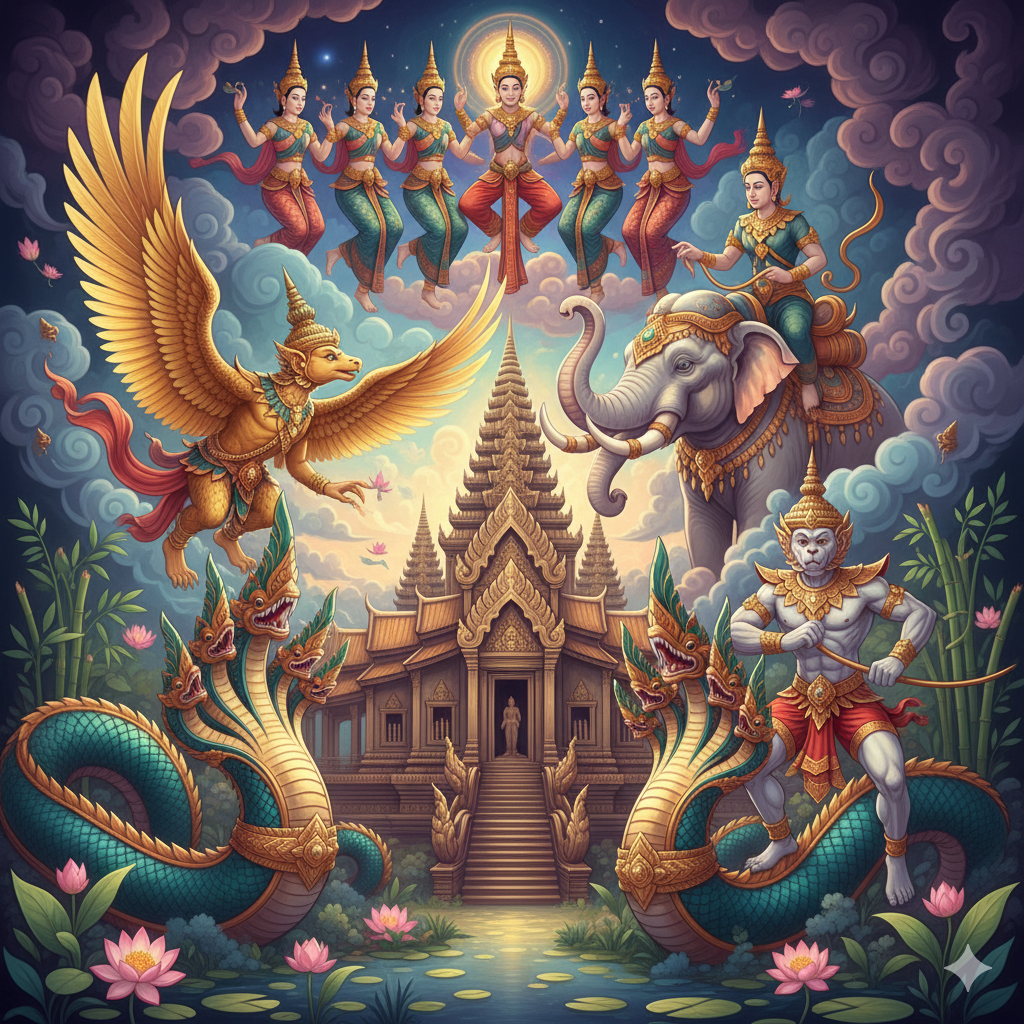
Imagine a world where celestial dancers grace temple walls, where serpent-gods guard sacred treasures beneath ancient rivers, and where the boundary between divine and human is as fluid as water itself. This is Southeast Asian mythology—a living, breathing tradition that has shaped the spiritual landscape of nations from Thailand to the Philippines, from Myanmar to Indonesia.
Unlike mythologies that exist primarily in ancient texts, Southeast Asian myths continue to pulse through festivals, dance performances, temple rituals, and daily spiritual practices. These stories emerged from a remarkable synthesis: when Hindu and Buddhist traditions journeyed across the Indian Ocean, they didn’t simply replace indigenous beliefs. Instead, they merged with local spiritual practices, creating something entirely unique—a mythological tapestry where Indian gods adopted new names and roles, where Buddhist enlightenment coexisted with nature spirits, and where each culture added its own distinctive threads.
This guide will take you on a journey through this fascinating mythological landscape, exploring creation stories that begin with dragons and fairies, gods who ride three-headed elephants, celestial beings who dance between heaven and earth, and spirits both benevolent and terrifying that reflect humanity’s deepest hopes and fears.
The Beginning: Creation Myths Across Southeast Asia
Vietnam’s Dragon-Fairy Heritage
In Vietnamese mythology, creation begins not with cosmic battles or divine commands, but with love across boundaries. The Dragon Lord Lạc Long Quân, sovereign of the waters, encountered Âu Cơ, a mountain fairy of extraordinary beauty. Their union represented something profound in Vietnamese cosmology—the marriage of water and mountain, lowland and highland, two opposing but complementary forces.
From this divine couple came one hundred eggs, which hatched into one hundred sons. Yet the Dragon Lord belonged to the sea, while the fairy was a creature of mountains. They parted peacefully, each taking fifty children. Those who followed their father to the coastal regions became the Vietnamese people of the lowlands, while those who accompanied their mother to the mountains became the highland tribes.
This creation narrative reveals core Vietnamese values: the importance of both land and sea, the harmony of opposing forces, and the shared ancestry of all Vietnamese people despite geographical and cultural differences. The dragon remains Vietnam’s most powerful symbol, representing not just royal power but the very origin of the nation.
The Philippine Islands: Bathala’s Cosmic Victory
Philippine creation mythology presents a more dramatic cosmic struggle. In the beginning, three powerful beings existed in isolation: Bathala, the supreme creator residing in the sky; Ulilang Kaluluwa, a massive serpent dwelling in the clouds; and Galang Kaluluwa, a winged god who wandered between realms.
When Bathala and Ulilang Kaluluwa finally encountered each other, conflict was inevitable. Two supreme beings could not share existence. Their battle shook the foundations of the cosmos until Bathala emerged victorious, slaying the serpent god.
Later, Bathala befriended Galang Kaluluwa, and they shared companionship until the winged god’s death. In his grief, Bathala buried his friend where Ulilang Kaluluwa had fallen. From this grave—where both enemy and friend rested—grew the first coconut tree. The coconut became humanity’s most valuable resource, its hard shell reminiscent of Ulilang Kaluluwa’s serpentine armor, its white meat like Galang Kaluluwa’s wings, and its water a gift of life itself.
This myth beautifully illustrates transformation: death becomes sustenance, enemies provide unexpected gifts, and divine sacrifice creates human prosperity.
Cambodia’s Bamboo Origins
Cambodian mythology, heavily influenced by Hindu cosmology, tells of Preah Thaong and Neang Neakare emerging from a bamboo stalk—an origin story that resonates with similar traditions across Southeast Asia. The bamboo, with its hollow center and segmented structure, symbolizes the connection between earth and sky, emptiness and fullness, human and divine.
These diverse creation myths share common themes: the union of opposing forces, divine beings sacrificing or transforming to benefit humanity, and the deep connection between natural elements and human origins.
The Divine Pantheon: Hindu Gods in Southeast Asian Context
Brahma: The Creator Across Cultures
When Hinduism spread to Southeast Asia during the classical period, Brahma arrived as the cosmic creator, the first of the Trimurti (the trinity of supreme gods). In Thailand, he became Phra Prom, a deity of immense cultural significance.
The famous Erawan Shrine in Bangkok’s bustling commercial district serves as a testament to Brahma’s enduring relevance. Despite its name referencing the three-headed elephant Erawan, the shrine actually houses a magnificent golden statue of Phra Prom. Here, in the heart of modern Bangkok, people from all walks of life pause to offer prayers, flowers, and traditional Thai dances, seeking safety, prosperity, and blessings.
This juxtaposition—ancient Hindu deity worshipped in contemporary urban space—perfectly captures how Southeast Asian mythology remains vibrantly alive rather than relegated to history.
Indra: Thunder King and Rain Bringer
Indra, known as Phra In in Thai or Thao Amarintharathirat in formal contexts, rules as king of the gods. His domain encompasses thunder, rain, and celestial authority—powers crucial to agricultural societies dependent on monsoons.
In Thai mythology, Indra rides Erawan (Airavata in Sanskrit), a majestic three-headed elephant whose ivory tusks symbolize clouds heavy with rain. Each of Erawan’s three heads possesses distinct significance, together representing power, wisdom, and the cosmic order that Indra maintains.
For farming communities across Southeast Asia, Indra’s favor meant survival. His thunderstorms brought life-giving rain but also demonstrated divine power that could destroy as easily as it nourished. This duality made him both beloved and feared—a god to be honored through ritual and moral living.
Vishnu: The Cosmic Preserver
Vishnu, the preserver and protector of universal order, holds particular prominence in Cambodian culture. The magnificent Angkor Wat—one of humanity’s greatest architectural achievements—was designed as Preah Pisnulok, “the realm of Vishnu.”
When King Suryavarman II commissioned this temple city in the 12th century, he intended it as both a state temple and eventual mausoleum. Upon his death, he was posthumously honored as Vishnu himself, reflecting the Southeast Asian tradition of divine kingship where earthly monarchs served as manifestations of cosmic order.
Angkor Wat’s intricate bas-reliefs depict Vishnu’s avatars and cosmic battles, frozen in stone yet seeming to move with perpetual divine energy. The temple’s orientation, proportions, and alignment all reflect Hindu cosmological principles adapted to Khmer understanding.
Shiva: Destroyer and Transformer
Shiva, known as Phra Iswara in Khmer, completes the Trimurti as the god of destruction and transformation. While “destroyer” might sound ominous, Shiva’s role is essential—destruction that allows renewal, transformation that enables progress, endings that make new beginnings possible.
Southeast Asian rulers often associated themselves with Shiva, recognizing that effective governance sometimes requires breaking old systems to build better ones. His worship intertwines with Vishnu’s, the two representing complementary cosmic forces: preservation and transformation, stability and change.
Ganesha: The Beloved Elephant God
Perhaps no Hindu deity has been more warmly embraced across Southeast Asia than Ganesha, the elephant-headed god of wisdom and remover of obstacles. His distinctive appearance—rotund human body topped with an elephant’s head, often holding sweets—makes him instantly recognizable.
In Thailand, Ganesh shrines appear everywhere: outside homes, in shopping centers, on university campuses. Students pray to him before examinations, merchants seek his blessing for new business ventures, and travelers request his protection. His association with auspicious beginnings makes him the deity to consult before any important endeavor.
The elephant itself holds deep cultural significance across Southeast Asia—intelligent, powerful, yet gentle when treated with respect. Ganesha embodies these qualities while adding divine wisdom and the ability to remove obstacles that block human progress.
Lakshmi: Goddess of Prosperity
Lakshmi, goddess of wealth, fortune, and prosperity, appears throughout Southeast Asia, though often with local names and characteristics. In Thailand, she’s known as Nang Kwak, particularly in business contexts. In Indonesia, she transforms into Dewi Sri, goddess of rice and fertility.
Traditional depictions show her seated on a lotus flower—itself a symbol of purity rising from murky water—holding coins or rice, with golden light radiating from her presence. Her worship reflects humanity’s eternal desire for material security and the recognition that prosperity flows from divine favor rather than effort alone.
Business owners across Southeast Asia maintain Lakshmi shrines, offering flowers, incense, and prayers. This isn’t seen as superstition but as acknowledging that success requires both human diligence and cosmic blessing.
Saraswati: Patroness of Learning
Saraswati, goddess of knowledge, learning, wisdom, music, and the arts, receives particular devotion from students and scholars. In Myanmar, where she’s called Thuyathadi, students preparing for important examinations make offerings and prayers, seeking not just good grades but genuine understanding and wisdom.
She’s typically depicted holding a veena (stringed instrument), representing harmony in knowledge, and often accompanied by a swan or peacock. Her association with the arts reflects the Southeast Asian understanding that true education encompasses not just intellectual knowledge but aesthetic sensitivity and creative expression.
Mythological Creatures: Guardians and Monsters
Nagas: The Serpent Sovereigns
Few creatures are more central to Southeast Asian mythology than nagas—divine serpent beings that embody water, fertility, and cosmic balance. Neither purely good nor evil, nagas represent nature’s power: life-giving yet potentially destructive, beautiful yet dangerous.
Nagas can assume human form or appear as magnificent multi-headed serpents, with seven-headed nagas considered especially powerful and royal. They guard treasures at the bottom of rivers and seas, protect sacred places, and serve as bridges between earthly and divine realms.
The most famous naga narrative appears in the Churning of the Ocean of Milk. In this cosmic creation story, gods and demons needed to churn the primordial ocean to obtain amrita (the nectar of immortality). They used the serpent king Vasuki as a rope, wrapping him around Mount Mandara, which served as a churning stick. The gods pulled one end, demons the other, and as they churned, the ocean yielded both treasures and poisons, including the sacred amrita.
At Angkor Wat and Angkor Thom in Cambodia, seven-headed nagas appear everywhere—in balustrades, temple entrances, and massive bas-reliefs. At Angkor Thom’s southern gate, 54 gods and 54 demons pull a naga rope in eternal reenactment of the cosmic churning, reminding viewers of the perpetual struggle between opposing forces that maintains universal balance.
Apsaras: Celestial Dancers
Among the most enchanting beings in Southeast Asian mythology are apsaras—celestial nymphs who inhabit heavenly realms and serve as divine entertainers. Created during the Churning of the Ocean of Milk, these graceful beings emerged from the foam, fully formed and breathtakingly beautiful.
Apsaras dance for the gods, their movements embodying divine grace and cosmic harmony. In Khmer tradition, apsaras differ from devatas (static guardian figures); apsaras are always depicted in dynamic dancing poses, their bodies curved in impossible grace, their hands positioned in precise mudras (symbolic gestures).
At Angkor Wat, over 3,000 individual apsara carvings adorn the temple walls, no two exactly alike. Each wears elaborate jewelry, intricate headdresses, and the traditional Khmer sampot (wrapped garment). They smile mysteriously, their fingers curved in dance positions that have been passed down through generations.
Today, Apsara Dance preserves this ancient tradition. Dancers train for years to master the controlled, balletic movements—turned-back fingers, curved torsos, slow, deliberate steps. Performing an apsara dance isn’t merely entertainment; it’s a living link to Cambodia’s mythological heritage and spiritual identity.
Garuda: The Eagle King
Garuda, the enormous bird-deity, possesses the body of a human warrior but the wings, talons, and beak of an eagle. As Vishnu’s vahana (divine vehicle), Garuda represents divine protection, martial prowess, and victory over chaos.
The eternal nemesis of the nagas, Garuda engages in perpetual cosmic conflict with the serpent race. This enmity isn’t personal hatred but represents fundamental cosmic opposition: sky versus water, bird versus snake, celestial power versus earthly force. Their ongoing battle maintains universal balance through eternal tension.
Both Indonesia and Thailand have adopted Garuda as their national emblem. In Thailand, the Garuda appears on government buildings and official seals. Indonesia’s Garuda Pancasila—Garuda holding the national shield—symbolizes the nation’s greatness and embodies the five principles of Indonesian state philosophy. That both nations chose this mythological creature for their highest symbol demonstrates how mythology continues to shape national identity.
Hanuman: The Monkey God Hero
Hanuman, the monkey-god warrior, embodies courage, loyalty, strength, and devotion. As the devoted companion of Rama in the Ramayana epic, Hanuman performed impossible feats: leaping across the ocean to Lanka, carrying an entire mountain of healing herbs, and fighting demons with supernatural martial prowess.
What makes Hanuman particularly beloved across Southeast Asia is his combination of divine power and humble devotion. Despite his incredible abilities—he can change size at will, fly through the air, and possess strength exceeding any demon—he remains utterly devoted to Rama, considering himself merely a servant rather than a hero in his own right.
In Cambodian Angkor Wat carvings, Hanuman appears in intricate battle scenes, his monkey face distinctive amid human warriors. In traditional Southeast Asian mask dances and shadow puppet theater, Hanuman wears a white mask, and his martial adventures captivate audiences just as they have for centuries. His character offers a model of ideal devotion: powerful yet humble, capable yet loyal, divine yet accessible.
Ravana: The Complex Demon King
Ravana, the ten-headed demon king of Lanka, presents one of mythology’s most complex antagonists. A rakshasa (demon), Ravana isn’t merely evil incarnate. He was extraordinarily learned, a devoted follower of Shiva, an accomplished musician and scholar, and a powerful king who made Lanka prosperous.
His ten heads symbolize his mastery of the four Vedas and six shastras (ancient texts), representing supreme knowledge. His twenty arms demonstrate martial prowess and the ability to accomplish multiple tasks simultaneously. By all accounts, he should have been a model king.
Yet desire proved his downfall. When he abducted Sita, Rama’s wife, he set in motion the events that would lead to his destruction. The Ramayana’s entire war narrative centers on Rama’s quest to rescue Sita and punish Ravana.
What’s fascinating is how different Southeast Asian versions portray Ravana with varying degrees of sympathy. In Malaysia’s Hikayat Seri Rama, Ravana appears as a just and loyal king, complicating the simple hero-villain dynamic. This variation reflects Southeast Asian storytelling traditions that often recognize complexity and moral ambiguity even in antagonists.
Fearsome Female Spirits: Embodiments of Cultural Fears
Southeast Asian mythology features particularly terrifying female spirits that embody cultural anxieties about death, childbirth, female sexuality, and moral transgression. These entities serve both as cautionary tales and as expressions of genuine fear about dangers women faced in traditional societies.
Krasue: The Floating Horror
The Krasue appears in Thai, Cambodian, and Laotian folklore as one of the most disturbing spirits imaginable—a disembodied woman’s head floating through the night, trailing internal organs and intestines from her severed neck, accompanied by an eerie greenish glow.
According to legend, the Krasue is a cursed woman, punished for sins in a previous life—typically infidelity, practicing dark magic, or violating social taboos. By day, she appears as an ordinary woman (or remains hidden as just a head), but at night, her head detaches to hunt for blood and raw flesh. She particularly targets pregnant women and newborns, representing anxieties about childbirth dangers and infant mortality.
The Krasue can only be destroyed by finding and burning her separated lower body before sunrise, or by surrounding it with thorny branches so she cannot reunite with it. In some versions, she’s accompanied by a tik-tik bird whose distinctive call warns of her approach, giving intended victims precious moments to hide.
Modern horror films and folklore collections continue to feature the Krasue, demonstrating how this ancient fear still resonates. She represents not just horror for horror’s sake but embodied anxieties about moral transgression, the vulnerability of women in childbirth, and the thin boundary between human and monstrous.
Pontianak: The Vengeful Mother
The Pontianak (called Kuntilanak in Indonesia) emerges from a particularly tragic origin—the spirit of women who died violently during childbirth or pregnancy. In traditional societies where maternal mortality was terrifyingly common, the Pontianak embodied both grief and fear surrounding pregnancy.
She appears as a beautiful woman with long dark hair and pale skin, often wearing white. Her beauty serves as a trap, luring men to isolated places. Once alone with her victim, her appearance transforms: her eyes turn blood red, her fingernails extend into long claws, and she tears open the victim’s stomach to feast on internal organs.
The Pontianak’s violence isn’t random cruelty but revenge. She targets men because, in cultural understanding, women die in childbirth bringing men’s children into the world. Her attacks represent female trauma transformed into vengeance, the pain of dying in childbirth redirected outward.
Traditional protection involves driving an iron nail into the back of her neck, which temporarily returns her to human form. But only proper ritual burial and religious ceremonies can finally put a Pontianak to rest. This reflects the cultural belief that proper death rituals are essential—denied these, the dead cannot rest peacefully but must wander in torment.
Manananggal: The Mother’s Nightmare
From Philippine folklore comes perhaps the most disturbing creature—the Manananggal. By day, she appears as a beautiful woman living normally within a community. But at night, her upper torso detaches from her lower body at the waist, growing enormous bat-like wings.
The Manananggal flies through the night seeking pregnant women. Using a long, thread-like tongue, she attempts to suck the fetus from the womb or feed on the heart. She represents every pregnant woman’s deepest fear—losing her child to inexplicable tragedy.
The only way to destroy a Manananggal is to find her separated lower half and sprinkle it with salt, garlic, or ash before dawn. Unable to reunite with her lower body, she dies when sunlight touches her. Like the Krasue, she’s often accompanied by a tik-tik bird (or makes the sound herself), whose distinctive call grows quieter as she approaches—a terrible reversal where silence signals greatest danger.
These female spirits—Krasue, Pontianak, and Manananggal—share common elements: female-bodied horror, association with childbirth and pregnancy, nocturnal hunting, and the need to hide or destroy a part of them before sunrise. They reflect historical realities where childbirth was dangerous, infant mortality high, and women’s bodies sites of both life-giving and mortal danger.
The Ramayana Across Southeast Asia: One Epic, Many Voices
The Ramayana, originally composed in Sanskrit in ancient India, tells the story of Prince Rama, his wife Sita’s abduction by the demon king Ravana, and Rama’s quest to rescue her with the help of the monkey-god Hanuman. This epic spread throughout Southeast Asia, but rather than being simply transplanted, it was reimagined by each culture, creating distinct national versions that reflect local values, geography, and spiritual traditions.
Thailand’s Ramakien: The Glory of Rama
Thailand’s Ramakien (meaning “Glory of Rama”) was officially compiled by King Rama I in the late 18th century, though oral traditions existed long before. The Thai version relocates Rama’s adventures to Thai geography—Ayutthaya (meaning Ayodhya) serves as the capital, and various Thai locations appear throughout the narrative.
The Ramakien holds special status as Thailand’s national epic. Scenes from the story adorn the walls of the Temple of the Emerald Buddha in Bangkok’s Grand Palace, where 178 murals depict the entire epic in intricate detail. These paintings, regularly maintained and restored, demonstrate the story’s continuing cultural importance.
Khon, traditional Thai masked dance-drama, brings the Ramakien to life through elaborate performances combining dance, drama, and music. Performers wear magnificent costumes and masks, their movements stylized and precise, telling the story without words through choreographed gesture and dance. Khon performances once entertained only royalty but now represent Thailand’s cultural heritage on international stages.
Cambodia’s Reamker: Buddhist Influences
Cambodia’s Reamker incorporates significant Buddhist elements while maintaining the core narrative. The epic emphasizes moral and spiritual teachings aligned with Buddhist worldview, particularly the concepts of karma, dharma, and righteous action.
Cambodian versions introduce unique characters absent from the original Sanskrit epic. Notably, Sovann Maccha, a mermaid princess, appears as Hanuman’s love interest in episodes that explore themes of love across boundaries and the harmony of opposing elements—water and land, divine and mortal.
Like Thailand, Cambodia preserves the Reamker through traditional dance, particularly classical Khmer dance where apsara-like movements tell the story with exquisite grace and precision.
Indonesia’s Wayang Kulit: Shadow and Spirit
Indonesia’s approach to the Ramayana proves particularly innovative through Wayang Kulit—shadow puppet theater. Leather puppets, intricately carved and painted, are manipulated behind a backlit screen, creating moving shadows that tell the story.
The first half of Javanese Wayang Kulit follows the Sanskrit Ramayana relatively closely. But the second half introduces indigenous elements and characters, most notably Semar—a divine clown who provides both comic relief and profound moral guidance. Semar, appearing as a rotund, humble servant, is actually a deity who chose to live among humans, offering wisdom disguised as foolishness.
Wayang Kulit performances incorporate Javanese mystical themes, gamelan musical accompaniment, and philosophical concepts unique to Indonesian spiritual traditions. The dalang (puppet master) doesn’t merely perform but serves as spiritual guide and community teacher, interpreting ancient wisdom for contemporary audiences.
Myanmar and Laos: Buddhist Rama
Myanmar’s Yama Zatdaw and Laos’s Phra Lak Phra Ram adapt the epic to Theravada Buddhist contexts. In these versions, Rama is understood as a previous incarnation of the Buddha, and the story emphasizes dharma (righteous duty) and the path to enlightenment.
The wars and battles become less about martial glory and more about the struggle between right and wrong, between desire and discipline, between ignorance and enlightenment. Ravana’s defeat represents not just the triumph of good over evil but the victory of wisdom over ignorance, self-control over desire.
These varied adaptations demonstrate how mythology adapts to local contexts while maintaining core themes. Each Southeast Asian culture claimed the Ramayana as its own, reshaping it to reflect national values while preserving the universal truths about heroism, loyalty, love, and the eternal struggle between good and evil.
Local Spirits and Nature Worship: The Invisible World
Beyond the great gods and epic narratives, Southeast Asian mythology remains deeply rooted in belief in local spirits inhabiting every aspect of the natural and human-made world. These spirits require recognition, respect, and regular offerings to maintain harmony between human and spiritual realms.
Myanmar’s Nats: An Elaborate Spirit System
Myanmar developed the most elaborate spirit veneration system in Southeast Asia. The Thirty-Seven Nats represent the most important spirits—humans who died violent, tragic, or untimely deaths and were subsequently elevated to spirit status.
These aren’t abstract supernatural beings but historical (or semi-historical) individuals whose life stories are known and retold. There’s the Nat of students, the Nat of travelers, the Nat of musicians, each with distinct personalities, preferences, and areas of influence.
Beyond the famous Thirty-Seven, countless nature nats inhabit rivers, trees, mountains, and specific locations. Every Burmese village has a nat shrine protecting the community from illness, wild animals, bandits, and other dangers. These shrines receive regular offerings, and festivals honor the nats with music, dance, and food.
Individual households honor Min Mahagiri, the house nat, by hanging a coconut from the southeast pillar of their home. This coconut represents the nat’s presence, and maintaining it properly ensures the household’s prosperity and protection.
Thagya Min (equivalent to the Hindu Indra) rules as king of the nats. During Thingyan, the Burmese New Year festival, Thagya Min descends from heaven to earth, observing human behavior and recording good and evil deeds. This period involves water-throwing festivals and merit-making as people demonstrate virtue to earn the king nat’s favor.
Thailand’s Phi: Pervasive Spirit Beliefs
Thai culture recognizes countless phi (spirits) inhabiting virtually everything—trees (particularly banyan trees), houses, rice fields, rivers, and crossroads. These spirits aren’t necessarily good or evil but must be respected and appeased.
Spirit houses—miniature temple-like structures on poles—appear outside virtually every Thai home and business. These house the local phi, providing them a dwelling so they won’t enter the human residence. Daily offerings of food, flowers, and incense maintain good relationships with resident spirits.
Particular trees, especially large or ancient ones, often have brightly colored cloth wrapped around their trunks and shrines at their base. These mark the dwelling places of especially powerful tree spirits who must be honored before cutting nearby vegetation or building.
Indonesia’s Diverse Spirit World
Indonesia’s vast archipelago hosts incredible spiritual diversity, with different islands and ethnic groups maintaining distinct spirit beliefs. These range from benevolent guardian spirits to dangerous entities that must be warded off through specific rituals and offerings.
Across all these traditions runs a common thread: the natural world isn’t empty or neutral but inhabited by conscious beings with whom humans must maintain respectful relationships. Illness, misfortune, crop failure, or accidents often result from offending spirits, whether deliberately or accidentally. Maintaining harmony requires constant attention, appropriate offerings, and respectful behavior.
Sacred Rituals and Festivals: Mythology in Practice
Southeast Asian mythology isn’t confined to ancient texts or temple carvings—it lives through festivals, rituals, and ceremonies that bring mythological narratives into the present.
Diwali: Celebrating Light and Prosperity
While originating in India, Diwali celebrations across Southeast Asia honor Lakshmi, celebrating the victory of light over darkness, good over evil, knowledge over ignorance. Homes are cleaned and lit with oil lamps or candles, inviting the goddess of prosperity to enter and bless the household.
This festival demonstrates how Hindu mythology maintains vitality in Southeast Asian contexts, adapted to local customs while preserving core spiritual meanings.
Thingyan: Myanmar’s New Year
Thingyan, Myanmar’s water festival celebrating the New Year, centers on Thagya Min’s descent to earth. The festival’s water-throwing isn’t merely playful but symbolically washes away the old year’s sins and misfortunes, providing a clean start.
Merit-making activities intensify during Thingyan—feeding monks, releasing captive fish and birds, cleaning temples—as people demonstrate virtue under the king nat’s observing gaze. The festival combines Buddhist practices with nat veneration, perfectly illustrating Southeast Asian religious syncretism.
Hung Kings Festival: Honoring Dragon-Fairy Heritage
Vietnam’s Hung Kings Festival honors Lạc Long Quân and Âu Cơ, celebrating the mythological founding of the Vietnamese nation. Pilgrims travel to temples dedicated to the Hung Kings (legendary descendants of the dragon-fairy couple), offering incense and prayers, reconnecting with their mythological heritage.
These festivals aren’t historical reenactments but living traditions that maintain cultural identity and spiritual connection across generations.
Conclusion: Living Mythology in Modern Southeast Asia
Southeast Asian mythology represents far more than ancient stories preserved in dusty texts. It constitutes a living, evolving tradition that continues to shape how hundreds of millions of people understand themselves, their nations, and their place in the cosmos.
When Thai people pause before a Ganesh shrine to pray for success in new ventures, when Cambodian dancers embody apsaras with movements unchanged for centuries, when Vietnamese celebrate their dragon-fairy heritage during the Hung Kings Festival, when Myanmar communities honor their village nat with offerings and festivals—mythology lives.
This mythology arose from a unique historical synthesis. When Hindu and Buddhist traditions spread from India across maritime Southeast Asia, they didn’t conquer or erase indigenous beliefs. Instead, they merged with local spiritual practices, creating something unprecedented: religions where Hindu gods coexist with nature spirits, where Buddhist enlightenment incorporates spirit veneration, where Indian epics tell distinctly Southeast Asian stories.
The great gods—Indra riding his three-headed elephant, Vishnu preserving cosmic order, Brahma creating worlds—found new homes in Southeast Asian temples and hearts. Epic heroes like Rama and Hanuman were reimagined through local lenses, their stories adapted to reflect regional values and geography. Mythological creatures—the water-guarding nagas, the celestial apsaras, the mighty Garuda—became national symbols and artistic inspiration.
Even the frightening spirits—the hunting Krasue, the vengeful Pontianak, the child-stealing Manananggal—serve essential functions, embodying cultural anxieties, teaching moral lessons, and explaining dangers that once claimed countless lives.
What makes Southeast Asian mythology particularly remarkable is its refusal to remain static. It continues evolving, incorporating new elements while maintaining core traditions. Modern films reimagine ancient demons, contemporary dancers interpret celestial movements, and urban shrines receive offerings from people navigating thoroughly modern lives.
For anyone seeking to understand Southeast Asia—its cultures, values, arts, and spiritual life—mythology provides essential context. These aren’t quaint folk tales but fundamental narratives that explain how communities understand creation, morality, power, beauty, danger, and the relationship between human and divine.
The next time you see a seven-headed serpent adorning a temple, a graceful apsara carved in stone, or a Garuda spreading its wings on a national emblem, recognize them not as decorative motifs but as ambassadors from a rich mythological tradition that continues to pulse with life, connecting modern Southeast Asians to their ancestors’ wisdom and their cultures’ deepest spiritual truths.
In Southeast Asian mythology, the sacred and mundane interweave seamlessly—gods walk among humans, humans can become spirits, celestial beings guard earthly treasures, and ancient stories illuminate contemporary lives. This is mythology as it should be: not preserved in amber but alive, breathing, and evolving, serving each new generation as it served their ancestors—as a guide to understanding the visible and invisible worlds that shape human existence.
Leave a Reply