
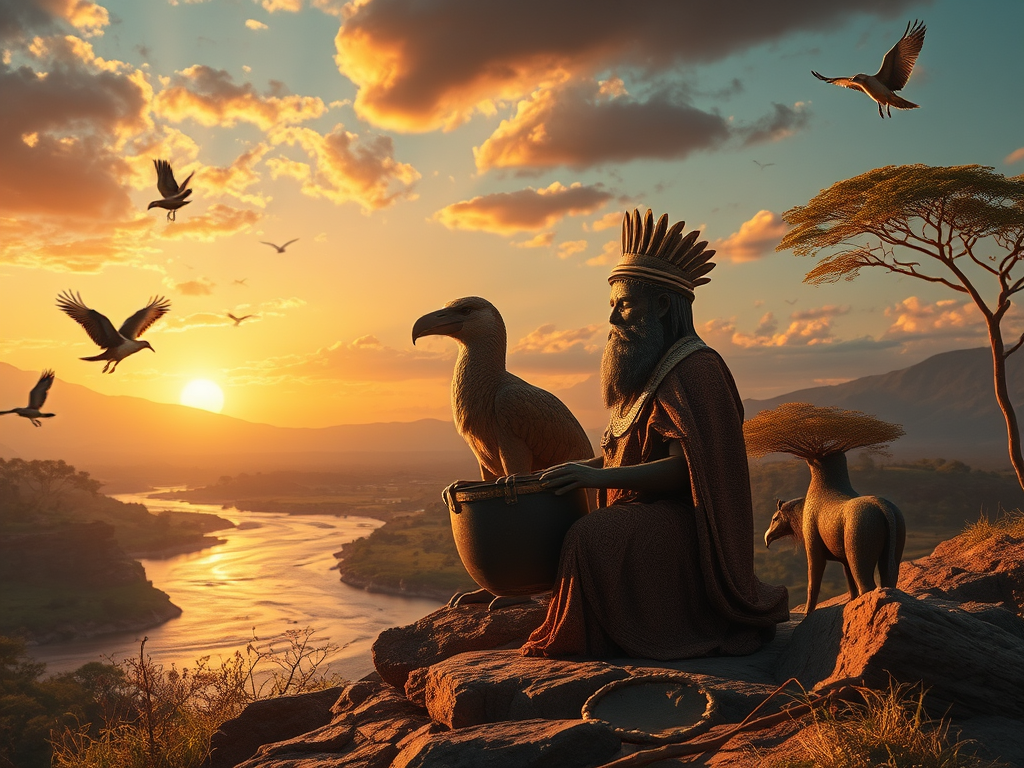
Imagine a continent where thunder is the beating of a massive bird’s wings, where rivers are guarded by beautiful spirits who demand loyalty, and where the first humans emerged from reeds or descended on golden chains from the sky. This is African mythology—not a single tradition, but a vast, interconnected web of thousands of distinct storytelling systems spanning 54 countries and countless cultures.
Unlike the relatively unified mythological systems of ancient Greece or Rome, African mythology resists simple categorization. Each region, each people, each village may hold its own unique understanding of creation, divinity, and the relationship between humanity and the cosmos. Yet within this incredible diversity, common threads emerge: the power of ancestors, the sacredness of nature, the presence of trickster figures who teach through paradox, and the belief that the spiritual and physical worlds are deeply intertwined.
This journey through African mythology will take us from West African pantheons teeming with hundreds of deities, to East African traditions centered on dual-natured creator gods, through Central African cosmologies of stunning astronomical complexity, and into Southern African tales of first ancestors and shape-shifting creatures. Along the way, we’ll discover not just ancient stories, but living traditions that continue to guide, protect, and inspire millions today.
Understanding the African Mythological Landscape
What Makes African Mythology Unique
African mythological systems possess several distinctive characteristics that set them apart from other world traditions. Most notably, these myths embrace an anthropomorphic cosmology—the human body itself is viewed as a microcosm of the universe, a living reflection of cosmic structure and divine order.
Rather than being preserved in single authoritative texts like the Greek Iliad or the Norse Eddas, African myths live within ritual practices, oral traditions passed down through generations, and the rhythms of daily life. They are not stories read in books, but narratives performed, embodied, and experienced.
The concept of twinship holds profound significance across many African cultures. Primordial beings were often twins, making human twins sacred—seen as reflections of cosmic duality and balance. Among the Asante people, even the placenta is considered a twin soul, carefully buried in the family compound and ritually watered during a newborn’s first week of life.
Perhaps most intriguing is the hierarchical yet accessible divine structure found throughout African traditions. Most recognize a supreme creator god who, after establishing the cosmos, becomes remote and largely uninvolved in daily affairs. This withdrawal isn’t abandonment—it creates space for lesser deities, nature spirits, and ancestors to interact directly with humanity, forming a dense spiritual ecosystem where divine guidance remains accessible to all.
The Living Nature of These Traditions
It’s crucial to understand that African mythology is not merely historical—these are living traditions actively practiced by millions. The Yoruba Orishas are worshipped today not only in Nigeria but throughout the African diaspora in Brazil, Cuba, Haiti, and beyond. Ancestral veneration remains central to daily life across the continent. Sacred mountains still receive pilgrimages, rivers still demand offerings, and traditional healers still intercede between the living and spiritual realms.
When we explore these myths, we’re not excavating dead civilizations but encountering vibrant, evolving traditions that continue shaping cultural identity, moral frameworks, and spiritual practice.
Creation Myths: When the World Began
West Africa: Chains, Serpents, and Divine Twins
The Yoruba Creation: Descending on a Golden Chain
The Yoruba people of Nigeria tell of a time before time, when only two realms existed: the vast sky ruled by Olorun (also called Olodumare), the supreme god, and the endless waters below, domain of Olokun. Between them stretched only emptiness—potential waiting to become.
The god Obatala gazed down at the waters and envisioned something more. He approached Olorun seeking permission to create land, and the supreme deity granted his request. But how does one create land where none exists? Obatala consulted Orunmila, the god of prophecy and wisdom, who instructed him to gather specific items: a golden chain to descend from heaven, a snail shell filled with sand, a white hen, a black cat, and a palm nut.
Obatala descended on the golden chain, dangling above the primordial waters. When the chain ended, he poured the sand from the snail shell onto the water’s surface, then released the hen. The bird immediately began scratching and scattering the sand, spreading it in all directions until it formed solid land—the first earth. Obatala named this place Ife, meaning “that which expanded,” and it became the sacred city from which all Yoruba civilization would grow.
Yet some versions add an intriguing twist: Obatala’s brother Oduduwa claimed to be the true creator. The story goes that Obatala, having made wine from palm trees, became drunk and fell asleep before completing creation. Oduduwa seized the sacred implements and finished the work himself. This tension between the two gods reflects deeper questions about credit, power, and the complex relationships between divine beings.
The Fon Creation: The Rainbow Serpent’s Dance
In neighboring Benin, the Fon people preserve a different vision. At the beginning of all things dwelt Nana Buluku, an androgynous supreme creator containing both masculine and feminine principles. From this primordial deity emerged twin children: Mawu, the moon goddess representing coolness, night, and fertility, and Lisa, the sun god embodying heat, day, and strength.
These divine twins collaborated to shape existence. Mawu often rode upon Aido Hwedo, the magnificent rainbow serpent whose body contained all the colors of creation. As Aido Hwedo moved through the formless void, his winding, serpentine motion carved the curves and contours of the earth. Mountains formed from his excrement—a reminder that even divine waste becomes sacred geography.
But as creation progressed, a problem emerged: the world became too heavy, threatening to collapse into the primordial waters below. To prevent catastrophe, Aido Hwedo coiled beneath the earth, supporting its weight like a living pillar. He holds his tail in his mouth, forming an eternal circle of support. The Fon believe that when Aido Hwedo shifts uncomfortably under his burden, earthquakes ripple across the land.
The Akan Creation: Sky and Earth United
The Akan peoples of Ghana begin their story with Nyame, the supreme sky god—omniscient, omnipotent, connected to Saturday as his sacred day. Nyame created Asase Yaa (or Asase Afua among some groups) to be both his wife and the earth goddess herself. Their union wasn’t merely symbolic but fundamental: sky and earth joining to establish the universe’s foundation.
Together, Nyame and Asase Yaa brought forth rivers, lakes, forests, and other deities to populate and govern creation. Asase Yaa, whose name means “Earth Thursday” (or “Earth Friday”), governs the planet’s fertility. No Akan farmer would dare till the soil without first offering sacrifice to her. On Thursdays (or Fridays for the Fante people), the earth rests—no plowing, no digging, no disturbing the goddess who provides all sustenance.
East Africa: Mountains, Cattle, and Dual Divinities
The Maasai Creation: God on the Mountain
The semi-nomadic Maasai of Kenya and Tanzania understand divinity differently. For them, Enkai (or Engai) is the supreme creator—a single being possessing both masculine and feminine aspects, an androgynous deity transcending human categories.
Enkai created the first humans and gifted them with cattle, establishing the Maasai as sacred custodians of these animals. This is not mere tradition but cosmic mandate: cattle are divine gifts, making pastoralism a spiritual calling rather than simply an economic practice.
Enkai manifests in two forms that reflect the duality of existence:
- Enkai-Narok, the Black God, benevolent and merciful, who brings life-giving rain and prosperity to the grasslands
- Enkai-na-Nyokie, the Red God, vengeful and fierce, who sends drought, famine, and punishing lightning bolts
Both aspects are necessary—one cannot exist without the other, just as rain and drought both shape the landscape. Enkai dwells atop Ol Doinyo Lengai (The Mountain of God) in northern Tanzania, and the Maasai direct their prayers toward this sacred peak, believing their words rise to the divine presence above.
Other East African Origins
The Abaluiya people of western Kenya tell of Wele Xakaba, who began creation by forging the heavens using lightning itself—a spectacular display of divine power that took two days to complete. He created helper deities who positioned the moon, stars, sun, clouds, and rainbows before forming the earth and the first humans, Mwambu and his wife Sela.
The Kikuyu people regard Ngai as the supreme deity who created the first man, Gikuyu, and the first woman, Mumbi. Ngai brought them to Mount Kenya and gave them all the land visible from its peak—establishing both their territory and their sacred connection to the mountain.
Central Africa: Cosmic Speech and Star Knowledge
The Dogon people of Mali possess one of the world’s most sophisticated cosmological systems. At its center stands Amma, the supreme creator god who fashioned the universe through divine speech—reality itself emerging from sacred words and syllables.
Amma created the Nommo, primordial water beings who served as both the first ancestors and culture heroes. These beings brought essential knowledge, taught agriculture and blacksmithing, and established the foundations of Dogon civilization.
What makes Dogon mythology particularly fascinating is its integration of advanced astronomical knowledge. The Dogon have long understood complex phenomena related to the Sirius star system, including details about Sirius B that weren’t confirmed by Western astronomy until the 20th century.
In the Democratic Republic of Congo, the Efé people tell of Tore, a god who created the first human, Baatsi, from clay with the moon’s assistance. Tore established only one rule: never eat from the Tahu tree. When humans inevitably broke this prohibition, Tore decreed mortality—humans would no longer live forever but would know death, making their time precious and their choices consequential.
Southern Africa: Reeds, Trees, and First Ancestors
The Zulu Genesis: Breaking from the Reeds
Unkulunkulu—”the greatest one”—emerged from the primordial reeds as both the first man and the supreme creator. He broke away from the reed bed, an act of separation that paradoxically created connection: by distinguishing himself from the source, he enabled existence to unfold.
Unkulunkulu created everything: mountains that pierce the sky, streams that water the valleys, animals that fill the land, and finally, people to inhabit this world. But he didn’t simply create and abandon humanity—he taught the Zulu essential survival skills. He showed them how to hunt, how to make fire, how to cultivate crops, how to forge iron tools. He was simultaneously creator god and culture hero, divine and ancestral.
The San Creation: The World Tree
The San peoples of Southern Africa, among the continent’s oldest continuous cultures, believe in Kaang, a benevolent creator god who made all things. In the beginning, people and animals lived together beneath the earth’s surface in harmony with Kaang, who dwelt among them.
Kaang decided to create a new world above. He grew a massive tree whose branches stretched across the entire sky, its roots plunging deep into the underground realm. At the tree’s base, he made a hole—a passage between worlds. He called the people and animals to climb up into the new world he’d prepared.
Kaang established one rule: do not make fire. But humans, curious and cold, disobeyed. They created fire, and its light revealed differences between creatures that had been invisible in the darkness below. Animals saw humans and fled. Trust broke. Evil entered the world—not as an external force but as a consequence of broken harmony and violated boundaries.
The Great Pantheons: Gods Who Shape Reality
The Yoruba Orishas: 400+1 Divine Powers
The Yoruba recognize Olodumare as the supreme, formless, eternal creator who transcends human comprehension. Too vast and remote for direct worship, Olodumare delegated earthly affairs to the Orishas—divine beings who govern specific domains, embody particular forces, and interact directly with humanity.
Tradition speaks of “400+1” Orishas, where the “+1” represents infinity—there are always more than can be counted. Several major Orishas dominate worship and stories:
Obatala, the sky god who descended on the golden chain to create land, rules as king of the Orishas. He fashioned the first humans from clay, carefully molding each body. His domain includes purity, wisdom, clarity, and justice. He protects the weak and champions the disabled, whom he considers specially marked by divine attention.
Shango commands thunder, lightning, fire, and war. His weapon is a double-headed axe that splits the sky when he strikes, sending lightning bolts earthward. He represents one of Africa’s most powerful deities—simultaneously a bringer of justice and destruction, vengeance and social order.
Oshun, goddess of fresh water, rivers, fertility, love, and beauty, flows through Yoruba mythology like the rivers she governs. She embodies sweetness, sensuality, and feminine power. But beneath her beauty lies formidable strength: without Oshun’s blessing, life cannot flourish.
Yemaya (or Yemonja) commands the oceans. She’s the Divine Earth Mother, protector of women and children, embodiment of maternal love and fierce protection. Mythology tells that the oceans formed when Yemaya’s water broke during childbirth—the amniotic fluid of the goddess becoming the world’s seas.
Oya governs winds, storms, transformation, and rebirth. She’s the goddess of change—sometimes gentle as a breeze, sometimes violent as a hurricane. Oya guards the gates between life and death, accompanying souls on their final journey.
Ogun, god of iron, metallurgy, war, and healing, governs all technology and transformation. He’s the patron of blacksmiths, warriors, surgeons, mechanics—anyone who works with metal or transforms raw materials into useful tools.
Esu (or Eshu) is the divine messenger who carries prayers from earth to heaven and brings blessings from gods to humans. He presides over crossroads, doorways, boundaries—all liminal spaces where choice and change occur. He tests human character through challenges and paradoxes, teaching wisdom through confusion.
Orunmila embodies divination, wisdom, and prophecy. He was present at creation, witnessing Olodumare’s plans for each human soul. As the first oracle priest, he taught the system of Ifa divination that reveals divine will and provides guidance.
Other African Pantheons
The Akan pantheon centers on Nyame, the omniscient sky god, and Asase Yaa, the earth goddess who receives the first offering in all rituals. Their most famous figure is Anansi, the trickster spider who uses cunning and intelligence to overcome larger, stronger opponents. His stories teach that wit trumps strength.
The Fon worship centers on Mawu-Lisa, the supreme creator duo representing moon and sun, female and male aspects. Above even these twins stands Nana Buluku, the potent supreme goddess, grandmother of all divine beings. Legba serves as trickster god and divine messenger, similar to Esu.
The Maasai recognize only Enkai—the androgynous supreme being with dual manifestations as Black God (benevolent) and Red God (vengeful).
Legendary Creatures and Spirits
Dangerous Predators
Impundulu: The Lightning Bird
Among the Zulu and Xhosa peoples of Southern Africa, thunder announces not just a storm but the arrival of the Impundulu—a vampiric thunderbird serving witches. By day it appears as an ordinary bird, unremarkable and easily overlooked. But when darkness falls, it transforms into a handsome man who seduces women or attacks travelers on lonely roads.
The Impundulu creates lightning by beating its massive wings, generating electrical discharges that split the sky. Its presence brings storms, its hunger brings death.
Grootslang: The Great Snake-Elephant
South African legend tells of a primordial creature from creation’s early days—a being with an elephant’s body, intelligence, and strength, combined with a snake’s length, flexibility, and cunning. Realizing their mistake (this creature possessed too much power), the gods attempted to destroy it. But one Grootslang escaped, fleeing to the Wonder Hole cave where it guards a massive hoard of diamonds. It devours elephants and any humans foolish enough to seek its treasure.
Other Dangerous Beings
The Congo Basin harbors stories of Mokele-Mbembe—a massive river creature with a long neck and reptilian body, often compared to the Loch Ness Monster.
West African waterways are said to hold the Ninki Nanka, a dragon-like serpent that can grow as large as a palm tree. Unlike many dangerous creatures, it brings good fortune to those who find its shed scales.
The Nunda of Tanzania is a deadly cat creature larger than any lion, with gray and brindled fur. Legend recounts a sultan who raised a Nunda cub as a pet, only to have it consume first his livestock, then his servants, then his soldiers—until the entire kingdom lived in terror.
Shape-Shifters and Tricksters
In Angolan tradition, the Kishi walks among humans with a handsome face that charms and deceives. But on the back of its head lurks a hyena’s face—teeth sharp, hunger endless. The Kishi specifically targets unfaithful spouses, punishing those who break marriage vows.
Tanzania’s Popobawa is an evil shapeshifter favoring the form of a half-man, half-bat creature with a single glowing eye. Unlike many spirits who serve purposes or teach lessons, Popobawa simply seeks fame through cruelty.
Across East and North Africa, stories circulate of were-hyenas—people who deliberately transform to hunt humans. Unlike European werewolves who change involuntarily, were-hyenas choose when to become beasts.
Water Spirits
Perhaps the most widespread African mythological figure, Mami Wata appears throughout West and Central Africa as a powerful water spirit manifesting as a beautiful woman attended by serpents. She offers wealth, beauty, and fertility to her devotees—but demands absolute, undivided loyalty. Those who serve her faithfully prosper; those who disrespect her drown in the rivers she governs.
Parents warn children away from riverbanks by invoking her name: “Don’t go near the water—Mami Wata will take you.” This warning serves a practical purpose (keeping children safe from drowning) while teaching respect for nature’s dangerous beauty.
The Tokoloshe of Southern Africa appears as a diminutive, hairy water spirit that attacks those who disrespect ancestors. It can become invisible by swallowing a pebble and is often invoked to explain misfortune.
Other Notable Beings
West African peoples describe the Adze, a vampire spirit that takes the form of a firefly to enter homes undetected. Once inside, it sucks blood from sleeping victims, causing illness and death. When captured, it transforms into human form.
The Aziza are fairy-like forest spirits living in anthills and silk-cotton trees, providing magic and knowledge to hunters who treat them respectfully.
The Spirit World: Ancestors, Nature, and Sacred Balance
Ancestors as Spiritual Guardians
In African spirituality, death doesn’t sever relationships but transforms them. The deceased become “living-dead”—ancestors who remain actively involved in their descendants’ lives, providing guidance, protection, and blessings from the spiritual realm.
This relationship requires maintenance through ritual. Libation ceremonies involve pouring water or palm wine on the ground while calling ancestors’ names, inviting them to witness important events. Burial practices reflect the importance of proper transition to ancestral status. Days of rest honor both earth goddess and ancestors—the Asante observe Thursday as sacred, forbidding farming and earth-disturbing activities.
Nature Spirits and Sacred Beings
African cosmology perceives nature not as inanimate matter but as densely populated with spirits requiring respect and propitiation. Forest spirits inhabit sacred groves. Mountain spirits dwell on sacred peaks. River spirits govern waters. Animal spirits connect individuals to specific creatures that serve as personal guardians.
Spirits are typically classified as benevolent (protective ancestors and helpful nature spirits), harmful (witches and malevolent entities), or tricksters (like Esu, Legba, and Anansi) who occupy an ambiguous middle ground—neither purely good nor evil but challenging humans to think, adapt, and grow.
Common Themes: The Philosophical Heart
The Remote Creator
Nearly universally across African traditions, the supreme creator god establishes the cosmos then retreats from daily involvement. This isn’t abandonment but delegation: the supreme deity creates a system capable of self-regulation, governed by lesser gods, spirits, and natural laws.
This concept has profound implications. It suggests that ultimate divine power doesn’t require constant intervention, that the cosmos possesses inherent order, and that humanity has real agency rather than being puppets of divine whim.
Cosmic Balance and Harmony
African mythology emphasizes maintaining balance between human, natural, and spiritual realms. These aren’t separate domains but interpenetrating realities forming a single, interconnected whole.
Disrespecting this balance brings consequences: drought when rain spirits are offended, disease when ancestors are neglected, misfortune when taboos are violated. This worldview promotes ecological consciousness and sustainable living. If rivers house spirits, you don’t pollute them. If forests contain sacred beings, you harvest sustainably. Environmental stewardship becomes spiritual obligation.
The Power of Speech and Naming
Many African creation myths feature divine speech as the mechanism of creation—the universe speaking itself into existence through sacred words. This concept extends beyond mythology into daily practice. Knowing something’s true name grants influence over it. Words possess creative power, capable of blessing or cursing, healing or harming.
Moral Instruction Through Story
The creatures of African mythology aren’t random terrors but pedagogical tools. The Kishi punishes infidelity. The Tokoloshe attacks those who disrespect ancestors. The Impundulu serves witches, warning against malevolent spiritual practices.
Stories teach humility, reinforce community values, and transmit ethical principles across generations. Monsters enforce social norms. Tricksters reward cleverness and punish rigidity. Creation myths establish humanity’s proper relationship with divinity and nature.
Interconnectedness
Humanity, nature, and divinity form an interconnected web. Animals serve as messengers, co-creators, or siblings to humans. Plants, rivers, and mountains contain spirits. This worldview recognizes that everything affects everything else—actions have consequences, relationships require maintenance, and balance must be preserved.
Cultural Significance and Modern Influence
African mythology continues shaping contemporary culture in profound ways. Orisha worship thrives in Brazil (Candomblé), Cuba (Santería), and throughout the Caribbean, preserving Yoruba traditions across the Atlantic. Modern African writers draw on mythological themes to explore identity, history, and meaning. Traditional healers use mythological knowledge to intercede between living and spiritual realms.
These myths remain living guides for ethical behavior, social conduct, and environmental stewardship. They’re not museum pieces but active forces in millions of lives—shaping decisions, providing comfort, explaining misfortune, and connecting people to ancestors, community, and the sacred.
Beginning Your Journey
Starting to explore African mythology can feel overwhelming given its vast diversity. Here are some suggestions:
Start with accessible stories. Begin with Anansi tales or simplified Orisha stories that teach through narrative rather than complex theology. These entertaining stories provide entry points into deeper understanding.
Respect regional diversity. Remember that “African mythology” encompasses thousands of distinct traditions. Never assume one story represents the entire continent. Each culture, each region, each people maintains unique perspectives.
Understand cultural context. Myths are not just stories but living beliefs intertwined with ritual, social structure, and worldview. Understanding mythology means understanding how it functions within specific cultural systems.
Explore primary sources when possible. Seek collections of actual oral traditions rather than simplified retellings, to appreciate the authentic voice and complexity of these traditions.
Approach with humility and openness. These are sacred traditions for millions of people. Approach them with the respect you’d want others to show your own cultural heritage.
Conclusion: Living Wisdom for Modern Times
African mythology offers profound insights into humanity’s relationship with cosmos, community, and nature. Its stories, gods, and creatures form a vibrant tapestry that continues inspiring, teaching, and guiding people across Africa and its diaspora.
These myths remind us that the world is enchanted—filled with spirits, alive with meaning, demanding respect and reciprocity. They teach that ancestors remain present, that nature deserves reverence, that words carry power, and that balance must be maintained between competing forces.
In an age of environmental crisis, social fragmentation, and spiritual hunger, African mythology provides wisdom worth contemplating: that humans are not separate from nature but embedded within it, that community extends across generations linking living and dead, that the spiritual and material are inseparable, and that maintaining right relationships—with ancestors, nature, community, and divinity—is essential for flourishing.
Whether you’re drawn to the thunder of Shango’s axe, the wisdom of Anansi’s tricks, the beauty of Oshun’s rivers, or the mystery of the Grootslang’s cave, African mythology invites you into a world where every mountain, every river, every storm carries meaning—where humanity is never alone but always embedded in a vast web of relationships requiring care, respect, and reciprocity.
This is the gift of African mythology: not answers to all questions, but a way of seeing the world as alive, interconnected, and sacred—a vision desperately needed in our modern age.
Disclaimer: This post represents my current understanding based on research and may contain errors or interpretations that differ from other sources. I’m continually learning, and I welcome corrections or additional insights from readers.
Leave a Reply