
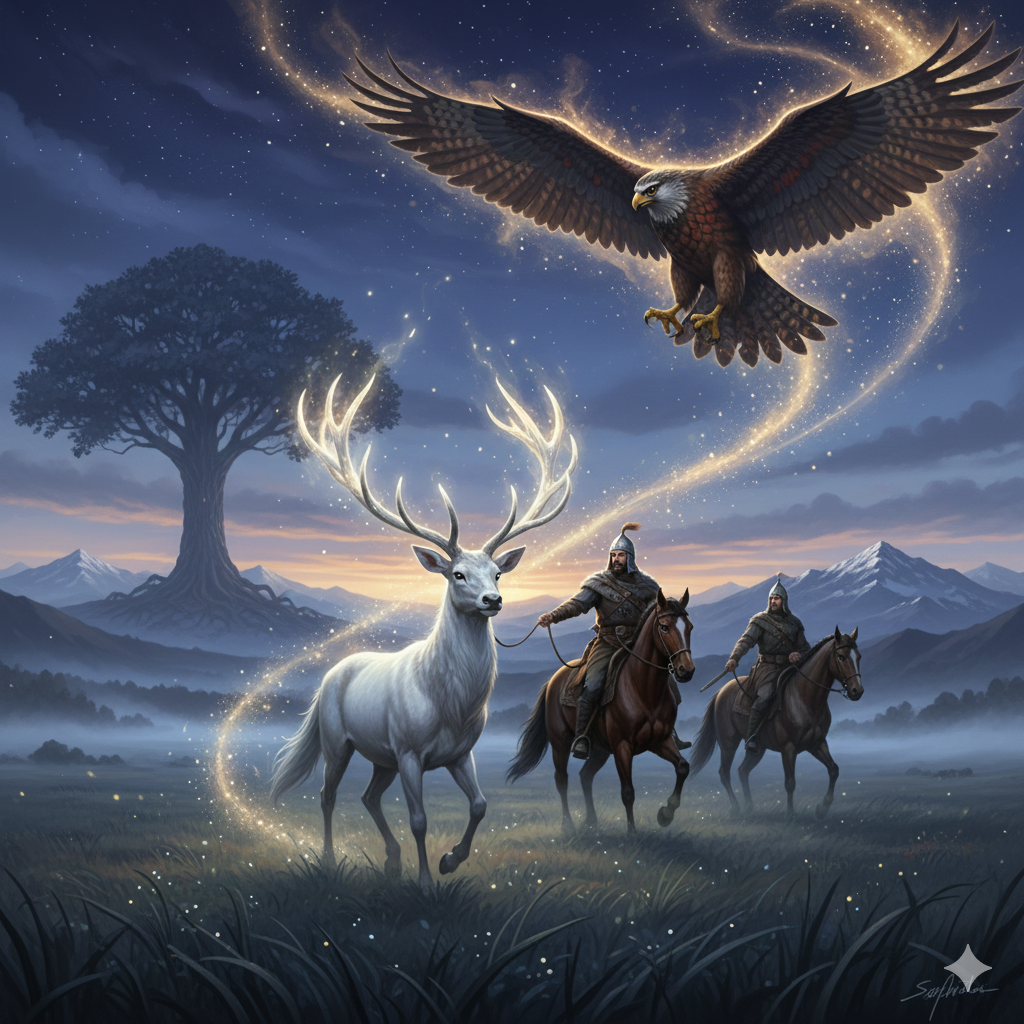
In the depths of ancient Hungarian tradition lies a mythology rich with sacred animals, divine interventions, and cosmic journeys. Unlike many European origin stories shaped primarily by Indo-European traditions, Hungarian mythology carries the distinctive imprint of the Eurasian steppes—a worldview where shamanic visions guide entire peoples, where sacred birds perch atop world trees, and where a miraculous white stag leads brothers across continents to their destined homeland.
Two fundamental legends form the backbone of Magyar origin mythology: the tale of the White Stag that guided the ancestral brothers Hunor and Magor to Scythia, and the prophetic vision of the Turul bird that foretold the birth of Álmos and the founding of the Hungarian nation. Together, these intertwined narratives reveal not merely stories, but a comprehensive spiritual worldview that connected the ancient Magyars to broader Eurasian shamanic traditions.
The Legend of Hunor and Magor: Following the White Stag
The foundational myth of Hungarian origins begins not in the Carpathian Basin, but in the distant lands of ancient Mesopotamia. According to medieval chronicles, particularly the Gesta Hungarorum written in the early 13th century, a legendary hunter-king named Nimród fathered two sons: Hunor and Magor. From Hunor would descend the Huns; from Magor would come the Magyars.
One fateful day, while pursuing their father’s passion for the hunt, the brothers encountered an extraordinary creature—a white stag whose antlers seemed to glow with otherworldly luminescence. This was no ordinary prey. The magnificent animal refused capture, yet it did not flee into obscurity. Instead, it led the brothers on an endless chase across vast territories, drawing them ever forward through forests, across grasslands, and beyond the horizons of their known world.
The Sacred Hunt
The pursuit of the white stag was not merely a hunt, but a divine calling. In Hungarian mythology and related Scythian traditions, this radiant creature represented a manifestation of the gods’ will—a mystical being whose purpose was to guide the people toward their destined homeland. The brothers understood instinctively that this was a sacred chase, a spiritual journey disguised as a hunt.
The white stag led them through unknown lands, across rivers and mountains, never allowing itself to be caught yet never disappearing entirely from view. This dance between hunter and hunted continued until finally, the brothers found themselves in a land of extraordinary beauty and abundance: Scythia.
The Promised Land
When Hunor and Magor finally ceased their pursuit, they realized the stag had not eluded them—it had delivered them. Scythia offered fertile plains, abundant resources, and everything necessary for a thriving civilization. The brothers established their people in this paradise, eventually encountering and marrying the daughters of local Scythian rulers, thereby founding the ancestral lines of the Huns and Magyars.
The white stag had fulfilled its divine purpose: guiding the chosen people to their homeland through what appeared to be chance and instinct, but was in truth sacred providence.
The Turul’s Prophetic Vision: Emese’s Dream
While the white stag legend speaks to ancient migrations and territorial discovery, the story of the Turul bird connects directly to the founding of the Hungarian royal dynasty and the nation’s spiritual protection.
A Dream That Changed History
In the 9th century, a noblewoman named Emese slept in her yurt beneath the starlit steppes. Emese was the consort of Ügyek, a chieftain who claimed descent from Attila himself—a genealogical connection that linked the Magyars to the legendary Hun empire and legitimized their claims to the lands of Pannonia.
During this fateful night, Emese experienced a vision of profound significance. The Turul—a magnificent falcon-like bird of divine origin—descended from the heavens and appeared before her. The sacred bird descended into her lap, laying its head upon her breast in an act of mystical intimacy.
What followed transformed the vision into prophecy: from Emese’s breast flowed a crystal-clear stream that grew into mighty rivers, flowing westward across fields and forests toward a distant, beautiful land bathed in golden light.
The Interpretation
When Emese awoke and recounted her dream to the tribal shamans and leaders, the wise men immediately recognized its significance. The vision was interpreted as a divine prophecy: Emese would bear a son destined to lead the Magyar people to a glorious new homeland, and her descendants would become great rulers.
The symbolic union with the Turul represented more than fertility—it signified divine selection and blessing. The gods themselves had chosen Emese’s lineage to guide the Magyars to their destiny in the Carpathian Basin.
The Dreamt One
Emese indeed gave birth to a son, whom she named Álmos—a name derived from the Hungarian word álom, meaning “dream.” His very name proclaimed his miraculous origin: he was “the Dreamt One,” conceived through divine vision and destined for greatness.
Álmos grew to become the leader of the Magyar confederation of tribes. Through him came his son Árpád, the legendary chieftain who orchestrated the Hungarian conquest of the Carpathian Basin around 895-900 CE. The Árpád dynasty that followed ruled Hungary for centuries, establishing the foundations of the medieval Kingdom of Hungary and fulfilling the prophecy shown in Emese’s dream.
The Turul: Guardian of the Nation
The Turul transcends the boundaries of a single legend to become the central spiritual symbol of Hungarian mythology. This divine bird represents far more than a messenger—it is the eternal guardian of the Magyar people.
The Cosmic Guardian
The word “turul” likely derives from Turkic origins (toğrul or toġrïl), referring to a large falcon or goshawk native to the Eurasian steppes. In Hungarian cosmology, the Turul perches atop the World Tree (Világfa or Életfa)—the cosmic axis connecting three realms of existence:
- The Upper World: home of the gods and celestial beings
- The Middle World: the realm of humans and physical reality
- The Underworld: the domain of ancestors and chthonic powers
This cosmological structure reflects the ancient shamanic worldview shared across Siberian and Central Asian cultures. The Turul, positioned at the apex of the universe, watches over the Hungarian people from its divine vantage point. The bird did not merely prophesy—it actively guided the Magyars through their arduous migration, protecting them as they journeyed through the Carpathian Mountains and beyond.
A Living Symbol
Today, the Turul remains Hungary’s national animal and a powerful symbol of national identity. Its image adorns monuments, shields, and cultural emblems throughout the country, representing divine leadership, ancestral connection, and the unwavering spiritual protection that has watched over the Hungarian people since their mythological origins.
The Deer and the Feminine Divine
The white stag carried profound symbolic weight in ancient Hungarian spirituality beyond its role as guide and herald. The deer represented femininity, fertility, and divine motherhood—themes deeply embedded in the pre-Christian Hungarian worldview.
Historians like Gyula László have identified evidence suggesting that ancient Hungarians viewed their principal goddess in the form of a deer, a tradition with deep Scythian roots. This sacred deer goddess embodied the generative powers of nature and the nurturing aspects of the divine feminine.
The stag’s antlers—its most striking physical feature—symbolized eternal renewal and rejuvenation. As antlers are shed and regrown annually, they became powerful emblems of cyclical rebirth and the eternal return of life from death. After the Magyars’ conversion to Christianity in the 11th century, this antler imagery was reinterpreted through a Christian lens, becoming associated with the sun, immortality, long life, prosperity, and spiritual agility.
Historical Chronicles and Medieval Documentation
The legends of the white stag and the Turul were first systematically recorded in medieval Hungarian chronicles compiled centuries after the actual Magyar settlement in the Carpathian Basin. These written accounts served crucial political and cultural purposes.
Primary Sources
The earliest surviving account appears in the anonymous Gesta Hungarorum (The Deeds of the Hungarians), likely written in the early 13th century by a court clerk serving King Béla III. Later, the chronicler Simon of Kéza expanded upon these legends in his Gesta Hunnorum et Hungarorum (Deeds of the Huns and Hungarians), written around 1282-1285.
Political Functions
These chronicles served a strategic purpose: they legitimized Hungarian claims to the Carpathian Basin by establishing genealogical and mythological continuity. By tracing Magyar ancestry back to legendary figures like Hunor and Magor, and connecting them through Attila to even more ancient biblical genealogies descending from Noah, the chroniclers created a narrative of rightful inheritance.
The message was clear: the Hungarians were not invaders but returning heirs, reclaiming ancestral lands that their forebears had held centuries before. This mythological legitimation proved essential for a people establishing themselves in a region surrounded by competing kingdoms and empires.
Connections to Broader Eurasian Traditions
Hungarian mythology reveals striking parallels to other Indo-European and Siberian traditions, suggesting ancient shared religious practices among the nomadic peoples of northern Eurasia.
The World Tree Archetype
The concept of a cosmic tree with a guardian bird appears across numerous cultures:
- Norse mythology: Yggdrasil with the eagle Veðrfölnir perched at its crown
- Persian mythology: The divine Simurgh resting on the sacred tree
- Siberian shamanism: Various traditions featuring cosmic trees connecting worlds
- Central Asian traditions: The tree of life as the axis of the universe
These commonalities suggest that before the separation of distinct ethnic groups, ancient steppe peoples shared fundamental cosmological concepts that each culture later adapted to its own narrative needs.
The Sacred Deer
Similarly, the figure of the miraculous deer appears throughout Eurasian mythology—in Scythian traditions, Sumerian mythology, and among various Asian peoples. The white stag legend likely represents an ancient cultural inheritance that the Hungarians brought with them from their origins in the Ural region and the Eurasian steppes, preserving it through oral tradition for centuries before it was finally committed to written form.
The Shamanic Worldview
Understanding Hungarian mythology requires recognizing its foundation in shamanic spirituality. Unlike the anthropomorphic pantheons of Greek or Norse mythology, Hungarian pre-Christian religion centered on a cosmos inhabited by spirits, where shamans served as mediators between the human world and the divine realms.
Key Elements of Hungarian Shamanism
Animal Spirit Guides: Sacred animals like the Turul and the white stag were not merely symbols but spiritual entities that could guide, protect, and communicate divine will to humans.
Cosmological Structure: The three-tiered universe (Upper World, Middle World, Underworld) connected by the World Tree provided the framework for understanding existence and spiritual travel.
Divine Communication: Visions, dreams, and altered states of consciousness served as primary methods for receiving divine guidance—as demonstrated in Emese’s prophetic dream.
Sacred Migration: The journey of the Magyar people was understood not as random wandering but as a spiritually guided pilgrimage toward a divinely appointed homeland.
Legacy and Enduring Significance
The legends of the white stag and the Turul continue to resonate powerfully in contemporary Hungarian culture. They maintain their potency as symbols of national identity, spiritual resilience, and the enduring connection between the Hungarian people and their ancestral homeland.
These myths represent a worldview in which the sacred and mundane intertwine seamlessly—where animal spirits communicate divine will, where dreams carry prophetic truth, and where migration itself becomes a spiritually guided pilgrimage toward a promised land. The white stag and the Turul are not mere folklore curiosities but living symbols that connect modern Hungary to its ancient past.
For those interested in comparative mythology, these narratives offer rich material for exploring how cultures transmit historical memory through symbolic imagery, how spiritual beliefs shape collective identity, and how ancient shamanic traditions from the Eurasian steppes found permanent home in the heart of Europe.
The Magyar people, guided by a luminous stag and protected by a divine falcon, claimed their destiny in the Carpathian Basin over a millennium ago. Yet the spiritual journey these legends represent continues to unfold in the cultural consciousness of Hungary, reminding each generation that they are heirs to a sacred covenant between their ancestors and the divine powers that first guided them home.
Leave a Reply