
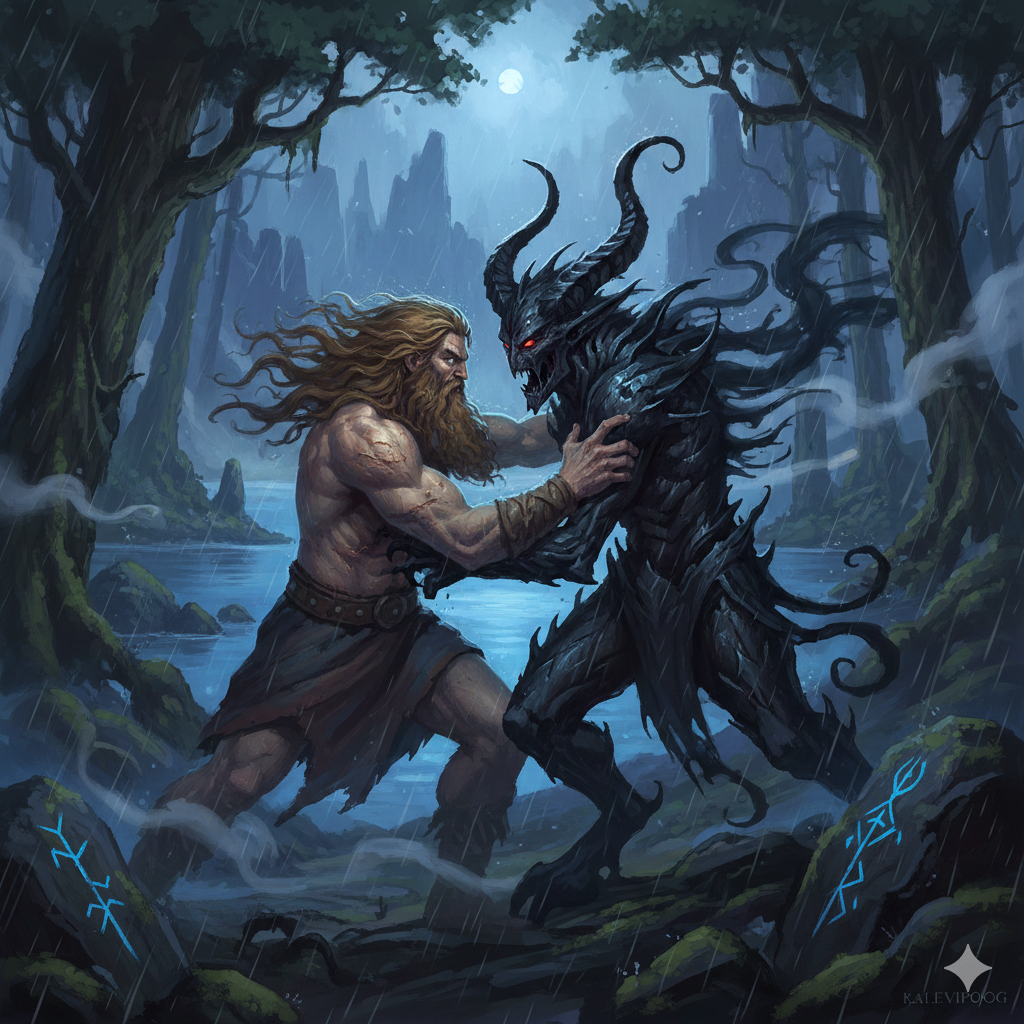
In the misty forests and along the dark waters of Estonia, where ancient spirits once roamed freely, there emerged a hero whose strength could match giants and whose courage could challenge even the powers of Hell itself. Kalevipoeg, the towering warrior of Estonian mythology, stands as one of the most compelling demon-fighting heroes in world folklore—a figure whose battles against supernatural forces reveal profound truths about struggle, identity, and the human condition.
The Giant Son of Kalev: Origins of a National Hero
Kalevipoeg, whose name literally means “Son of Kalev,” is the central figure of Estonia’s national epic, compiled in the 19th century by Friedrich Reinhold Kreutzwald from fragments of older oral traditions. This compilation served a purpose similar to Finland’s Kalevala or the Anglo-Saxon Beowulf—binding scattered legends into a unified mythic narrative that gave the Estonian people a heroic ancestor and cultural touchstone.
Born to Kalev, a great chieftain-giant, and Linda, an earth-mother figure whose tears would become Estonia’s lakes, Kalevipoeg embodied the essential qualities of Estonian identity: immense strength, deep connection to the land, endurance through hardship, and fierce resistance to oppression. He was not merely a warrior but a giant among mortals, a protector whose very existence was intertwined with the fate of the Estonian landscape itself.
Unlike the polished, idealized heroes of classical mythology, Kalevipoeg was deeply flawed—impulsive, volatile, driven by passions that could lead to both triumph and tragedy. This complexity made him a more authentic representation of the human struggle, a hero whose battles with demons would reflect not only external conflicts but internal ones as well.
A World Inhabited by Darkness: The Demonic Realm
The universe of Kalevipoeg is far from the rational world of human civilization. Estonian folklore presents a landscape teeming with supernatural entities—spirits dwelling in every forest, lake, and stone, demons lurking at the boundaries of the known world, and devils ruling over shadowy underworld realms.
The Supernatural Pantheon
This mythological world contained several categories of threatening beings:
Water-demons and spirits inhabited the depths of Estonia’s many lakes and rivers, dangerous entities capable of drowning the unwary or ensnaring travelers who ventured too close to their domains. These beings represented the untamed power of water, the fundamental chaos that civilization had not yet subdued.
Forest and underground spirits permeated the natural landscape. Unlike many mythologies where nature is simply a backdrop, Estonian belief held that forests, stones, and waters were actively inhabited by powerful entities—neither wholly good nor evil, but dangerous to those who did not respect their power.
Vanapagan, the Old Devil, emerged as a folkloric devil figure distinct from Christian conceptions of Satan. This being appeared throughout Estonian tales as a trickster, an adversary, and the ruler of Põrgu—the Estonian underworld or Hell.
Demonic servants and creatures of greed, such as the kratt—a demonic familiar created through diabolic pacts to steal wealth for its master—reflected moral dangers inherent in human weakness: greed, dishonesty, and the temptation to gain power through corruption.
Kalevipoeg’s world thus extended beyond the physical boundaries of Estonia into liminal realms where the rules of ordinary existence broke down, where demons held sway, and where a hero’s courage would be tested against forces that defied mortal comprehension.
Wrestling Chaos: Kalevipoeg’s Battle with the Water-Demon
One of the most vivid episodes in the epic illustrates Kalevipoeg’s demon-fighting prowess through a direct confrontation with a water-demon. The encounter begins when a servant is sent to the creature’s lair, only to flee in terror after being mocked or threatened by the supernatural being.
Where the servant failed, Kalevipoeg succeeded through raw courage and strength. The hero ventured to the demon’s domain and engaged the creature in direct combat—not with weapons, but in a primal wrestling match that pitted human will against supernatural power. Through sheer determination and overwhelming strength, Kalevipoeg defeated the water-demon, establishing human dominance over a dangerous spirit that had terrorized the people.
This victory carries layered symbolism. On the surface, it represents the triumph of courage over fear, the assertion that supernatural threats could be confronted and overcome through heroic action. More deeply, it reflects humanity’s struggle to impose order on the wild, threatening forces of nature—to transform lakes from demon-haunted dangers into resources that could sustain communities.
The water-demon battle also reveals a fundamental truth about Kalevipoeg’s role: his heroism was never purely personal. Each victory against a demon or spirit made the land safer for ordinary people, pushing back the boundaries of chaos and expanding the realm where human life could flourish.
Descent into Darkness: Journey to Hell
Perhaps the most profound of Kalevipoeg’s demon-fighting exploits is his journey into Põrgu—the Estonian underworld—to confront demons and devils on their own territory. This mythic descent follows a pattern found across world mythologies: the hero must venture into the realm of death and darkness to face ultimate tests of courage and will.
In the epic tradition and modern retellings, Kalevipoeg’s journey begins in the familiar landscapes of Estonia but gradually transforms into something far more ominous. The hero travels through increasingly strange and threatening territories until he reaches the gates of Hell itself.
Confronting the Devil and His Demons
Within the depths of Põrgu, Kalevipoeg faces multiple demonic adversaries. The exact nature of these battles varies across versions, but several consistent elements emerge:
The confrontation with Vanapagan, the Old Devil, represents the ultimate test—a face-to-face challenge to the ruler of the underworld. This is not merely physical combat but a battle of wills, a test of whether the hero’s spirit can remain uncorrupted even in the heart of corruption itself.
The battle with Sarvik, a horned demonic figure prominently featured in Estonian demonology, has become particularly significant in modern interpretations. This demon embodies primal evil—a creature of pure malevolence that must be overcome through strength, courage, and determination. The image of Kalevipoeg locked in combat with Sarvik has become an iconic representation of the eternal struggle between light and darkness, order and chaos.
These underworld battles serve multiple narrative functions. They demonstrate that Kalevipoeg’s heroism extends beyond the mortal realm—he can challenge even the powers of Hell. They also represent a journey of transformation: by descending into darkness and emerging victorious, the hero proves his worthiness and gains deeper understanding.
The Symbolic Depths: What the Demon Battles Mean
Kalevipoeg’s struggles against demons and devils operate on multiple interpretive levels, revealing meanings that resonate far beyond simple adventure narratives.
External Enemies: Demons as Invaders
In the 19th-century context of the epic’s compilation, when Estonia existed under foreign domination, the demons and devils that Kalevipoeg battled carried clear allegorical weight. These supernatural enemies could be read as symbolic representations of foreign oppressors—German, Russian, and other powers that had conquered and ruled Estonian lands.
The demons become stand-ins for any force that threatens the Estonian people: their land, their culture, their freedom, their very existence. Kalevipoeg’s victories against these creatures thus represented a wish-fulfillment narrative—a mythic space where Estonian strength could triumph over the powers that dominated the real world.
This interpretation gives the epic a deeply political dimension. The hero defending his land from demons mirrors the hope that Estonia itself might one day drive out its oppressors and reclaim sovereignty. The supernatural threat becomes a safe way to express resistance against very real historical forces.
Internal Demons: The Darkness Within
Yet Kalevipoeg is not a simple hero-versus-villain narrative. The epic’s tragic conclusion reveals that the hero’s greatest enemy may be himself. Impulsive, prone to rage, sometimes reckless in his strength, Kalevipoeg’s own character flaws ultimately lead to his downfall. Through his actions and the curses they bring upon him, he is maimed and doomed—transformed from a triumphant warrior into a restless, guarding spirit bound to protect the land but unable to enjoy victory.
This tragic dimension suggests that the demons Kalevipoeg fights are not only external. His anger, his rashness, his pride—these inner demons prove as dangerous as any supernatural adversary. The hero who could wrestle water-demons and challenge Hell itself could not overcome his own nature.
Modern Estonian projects have explicitly embraced this interpretation. Community art initiatives use the image of Kalevipoeg battling the demon Sarvik as a metaphor for young people confronting their own struggles—addiction, trauma, self-destructive behaviors, psychological darkness. The ancient hero becomes a symbol for the internal battles everyone must fight: the personal demons that threaten to destroy us from within.
Primal Chaos: Taming the Wild World
Many of Kalevipoeg’s supernatural adversaries are fundamentally tied to raw nature—water, darkness, untamed wilderness. By defeating these beings, the hero enacts a mythic pattern found across cultures: the transition from a world ruled by chaotic natural forces to one governed by human order and law.
The water-demon that Kalevipoeg wrestles represents the dangerous, unpredictable power of water itself. The demons of forest and underworld embody the threat of wild places where human rules do not apply. By confronting and defeating these entities, Kalevipoeg symbolically transforms the landscape—making it safer, more comprehensible, more suitable for human habitation.
This interpretation reveals the epic as a narrative of civilization itself: the ongoing struggle to impose order on chaos, to make sense of a world that often seems hostile and arbitrary, to create safe spaces within a fundamentally dangerous existence.
The Living Legend: Kalevipoeg in Modern Estonia
Far from being relegated to dusty academic texts, Kalevipoeg’s demon-fighting adventures continue to inspire contemporary Estonian culture in diverse and evolving ways.
Visual artists have created new illustration cycles for the epic, reimagining the hero’s battles with fresh emotional intensity and contemporary artistic sensibilities. These works emphasize the psychological depth of the struggle—the loneliness of the hero, the terror of confronting supernatural evil, the beauty and danger of Estonia’s natural landscapes.
Technology has breathed new life into ancient stories. Virtual reality experiences like “Kalevipoeg’s Journey to Hell” allow participants to explore digitally recreated Estonian landscapes before descending into a virtual underworld to battle demons and face the Old Devil firsthand. These interactive narratives transform passive legend into active experience, making the hero’s journey viscerally immediate.
Community murals and workshop projects use scenes of Kalevipoeg fighting Sarvik as therapeutic symbols. Young people recovering from addiction or trauma engage with the imagery as a representation of their own internal battles—the demons they must confront and overcome to reclaim their lives. The ancient hero becomes a contemporary guide for personal transformation.
Scholars continue to analyze how Estonian beliefs about devils, demons, and supernatural beings shaped the epic and how these motifs evolve as they move into modern media—novels, films, operas, video games. The academic study of Kalevipoeg reveals ongoing negotiations between traditional folklore and contemporary concerns.
Through all these iterations, Kalevipoeg remains what he has always been: a symbol of resistance, endurance, and the courage to confront darkness—whether that darkness comes from outside invaders, supernatural forces, or the shadows within ourselves.
Comparative Echoes: Demon-Fighters Across Mythologies
Kalevipoeg’s battles against demons place him within a global tradition of heroes who confront supernatural evil. Yet each culture’s demon-fighter reveals unique values and concerns.
Thor, the Norse thunder god, battles giants who threaten the cosmic order—his conflicts are fundamentally about maintaining the structure of existence against forces of chaos. His victories are celebrated triumphs without the tragic overtones that shadow Kalevipoeg’s story.
Heracles (Hercules) defeats monsters as part of his labors—supernatural challenges that test and prove his heroism. Like Kalevipoeg, Heracles is flawed, prone to rage, and ultimately tragic, but his struggles are more individualistic, less tied to the fate of a specific land or people.
Mahishasura-mardini, the demon-slaying form of the Hindu goddess Durga, represents divine feminine power destroying evil. Her victory is absolute, cosmic, and celebratory—a sharp contrast to Kalevipoeg’s mortal struggles and ultimate doom.
Beowulf battles monsters (Grendel, Grendel’s mother, the dragon) that threaten human communities, similar to Kalevipoeg’s protective role. Both heroes are bound to their people and lands, both face tragic ends, and both embody the values of their cultures through physical combat with supernatural threats.
What distinguishes Kalevipoeg is the intimate connection between his battles and Estonian identity specifically—the way his demon-fighting is inseparable from the landscape, history, and psychological struggles of the Estonian people. His victories and failures become national metaphors in ways that transcend simple hero narratives.
Enduring Truths: Why Kalevipoeg Still Matters
The appeal of Kalevipoeg’s demon-fighting exploits extends beyond their dramatic excitement. These ancient stories continue to resonate because they address fundamental human experiences:
The struggle against forces larger and more powerful than ourselves—whether those forces are political oppression, natural disasters, or personal demons—is universal. Kalevipoeg’s willingness to confront supernatural evil despite the odds embodies the courage required simply to face overwhelming challenges.
The tension between strength and wisdom, between power and restraint, runs through the entire epic. Kalevipoeg’s tragedy stems not from weakness but from the inability to master himself—a lesson that remains perpetually relevant.
The connection between individual heroism and collective survival reminds us that personal battles often have broader significance. When Kalevipoeg fights demons, he protects not just himself but his entire people—a recognition that our struggles are interconnected, that individual courage can serve communal needs.
Perhaps most powerfully, Kalevipoeg’s story acknowledges that not all battles end in clean victory. The hero defeats many demons but is ultimately destroyed by forces he cannot overcome—including his own nature. This honest confrontation with tragedy, with the limits of even heroic strength, gives the epic emotional depth that purely triumphant narratives lack.
Conclusion: The Hero in the Darkness
Kalevipoeg stands at the boundary between worlds—the realm of human civilization and the chaos that constantly threatens to overwhelm it. His battles against water-demons, underworld devils, and supernatural forces represent the eternal human struggle to create meaning, order, and safety in a world that offers no guarantees.
Whether understood as a national symbol of Estonian resistance, a psychological metaphor for internal struggles, or a mythic representation of humanity’s relationship with nature and the unknown, Kalevipoeg’s demon-fighting legacy remains vital. The giant warrior who descended into Hell and wrestled chaos itself speaks to something fundamental: the need to confront darkness wherever it appears—in the world around us, in the systems that oppress us, and in the shadows of our own hearts.
In that confrontation, victory is never certain. But in the willingness to fight despite uncertainty, in the courage to face demons even knowing the cost, Kalevipoeg offers a model of heroism that transcends his specific cultural context. He becomes, ultimately, a universal figure—the hero who battles demons not because victory is assured, but because the battle itself defines what it means to be human.
Leave a Reply