
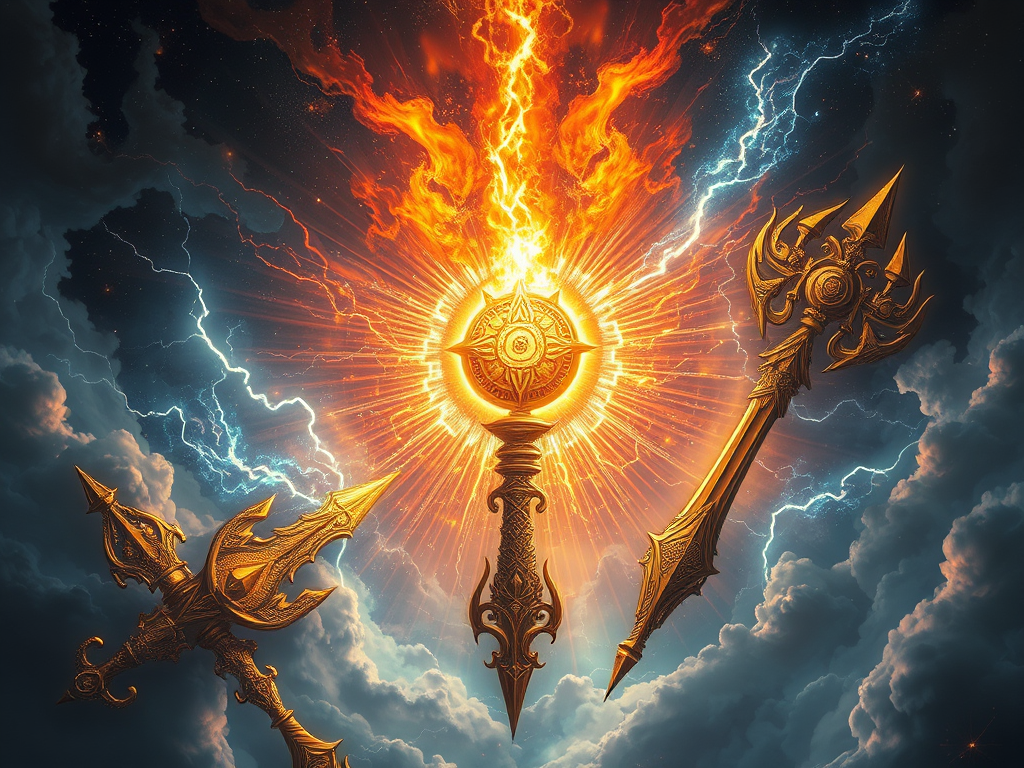
In the vast cosmos of Hindu mythology, where gods walk among mortals and dharma shapes the very fabric of existence, there exists a class of weapons that transcend the boundaries of ordinary warfare. These are the astras—celestial armaments that blur the line between divine intervention and devastating power, between cosmic justice and apocalyptic destruction.
The Nature of Celestial Warfare
Unlike the crude weapons of mortal combat, astras represent a sophisticated understanding of warfare that operates on multiple planes of existence. The very word “astra” derives from the Sanskrit root meaning “to throw” or “to shoot,” yet these weapons were far more than projectiles—they were conscious entities imbued with divine essence, activated through sacred mantras, and governed by cosmic principles.
The distinction between astras and conventional weapons (shastra) reveals a profound philosophical divide. While shastras relied on physical force and human skill, astras drew their power from the very fabric of creation itself. They could be invoked into any object—a blade of grass could become as deadly as the finest arrow when charged with celestial energy, as demonstrated when Ashwatthama used mere vegetation to devastating effect in the Mahabharata.
The Sacred Knowledge: Mantras and Mastery
The activation of an astra required three precise mantras: one to arm the weapon, another to direct it toward its target, and a third to disarm it. This trinity of control ensured that these weapons remained tools of cosmic justice rather than instruments of mindless destruction. The knowledge was so sacred that it was passed down exclusively through oral tradition from guru to disciple, creating an unbroken chain of wisdom that linked human warriors to divine will.
Only the most spiritually advanced warriors could master these weapons. The astras themselves were said to be conscious—they could refuse to activate if the wielder lacked moral fitness or if the cause was unrighteous. This created a natural safeguard against the misuse of ultimate power.
The Ultimate Destroyers: Brahmastra and Brahmashirastra
At the apex of divine weaponry stands the Brahmastra, Lord Brahma’s supreme creation. When discharged, it manifests not merely as a weapon but as a fundamental force of universal dissolution. Witnesses describe it as a fierce fireball blazing with terrible flames and countless thunder flashes, causing all of nature to tremble in recognition of its cosmic authority.
The earth itself responds to the Brahmastra’s presence: trees wither, oceans boil, animals flee in terror, and the very sky ignites with flame. Glaciers melt instantaneously, mountains crumble to dust, and the natural order temporarily suspends itself before such overwhelming power.
Yet even the Brahmastra pales before its evolved form—the Brahmashirastra. This weapon represents the ultimate expression of destructive force in all of Hindu literature. Its effects extend far beyond immediate devastation: any area targeted by the Brahmashirastra becomes utterly barren for 12 Brahma years, equivalent to approximately 37.32 trillion human years. In such places, not even a blade of grass will grow again, creating wastelands that serve as eternal monuments to the consequences of cosmic warfare.
The knowledge of these weapons was restricted to a sacred few: Parashurama, Rama, Kalki, Meghanada, Bhishma, Drona, Karna, Ashwatthama, Arjuna, and Lakshmana. Each of these figures represents a different aspect of dharmic responsibility, suggesting that the power to unmake creation itself should only rest with those who understand the deepest principles of cosmic order.
Shiva’s Wrath: The Pashupatastra
While the Brahmastra represents the power of creation turned destructive, the Pashupatastra embodies pure cosmic dissolution. Named after Shiva’s title “Pashupati”—the Lord of all creatures—this weapon stands apart from all others in its versatility and philosophical depth.
The Pashupatastra’s unique characteristic lies in its activation methods. It could be discharged through thought alone, through sight, through spoken words, or through traditional archery. This flexibility reflected Shiva’s nature as the destroyer who transcends all conventional limitations. The weapon could nullify other celestial armaments and disrupt the very fabric of the universe itself, earning its place among the six Mantramukta weapons—those that cannot be resisted by any force in creation.
Arjuna’s Divine Encounter
The story of how Arjuna acquired the Pashupatastra reveals the weapon’s true nature. During his exile, Arjuna encountered a wild boar and shot at it simultaneously with another hunter. When the hunters met to claim their prey, Arjuna found himself in combat with what appeared to be a common woodsman. Only after an intense battle did Arjuna realize he had been fighting Lord Shiva himself in disguise.
Impressed by Arjuna’s strength and unwavering commitment to dharma, Shiva revealed his true form and granted the Pashupatastra to the Pandava prince. This tale illustrates that divine weapons are not merely tools of war but tests of character—they come to those who prove themselves worthy through action rather than ambition.
The Paradox of Power: Narayanastra
Lord Vishnu’s Narayanastra presents one of the most philosophically intriguing weapons in the Hindu pantheon. When deployed, it fires millions of deadly missiles simultaneously, creating an seemingly inescapable barrage of destruction. However, its most remarkable feature lies not in its offensive capability but in its response to resistance.
The Narayanastra’s intensity increases in direct proportion to the resistance it encounters. The more fiercely a target fights back, the more devastating the weapon becomes. This creates a paradox that reveals profound truths about the nature of conflict itself: sometimes the only path to survival lies in complete surrender.
The weapon’s singular weakness demonstrates this principle. Complete submission before the missiles strike causes them to stop and spare the target. When Ashwatthama deployed the Narayanastra against the Pandava forces, Krishna’s advice was immediate and uncompromising: surrender completely or face total annihilation. This counsel saved countless lives while teaching a fundamental lesson about the relationship between ego and survival.
Elemental Fury: The Natural Forces
The Hindu understanding of cosmic balance manifests beautifully in the elemental astras, weapons that harness the fundamental forces of nature while maintaining equilibrium through their interactions.
Agneyastra: The Consuming Fire
Agni’s signature weapon, the Agneyastra, represents fire in its most primal and devastating form. Unlike ordinary flames, this celestial fire cannot be extinguished through conventional means. When discharged, it unleashes firepower equivalent to thousands of flaming arrows, reducing entire armies to ash in moments.
During the Kurukshetra war, Ashwatthama deployed the Agneyastra with devastating effect, incinerating an entire akshauhini—a military formation consisting of 218,700 warriors. The weapon’s power was so overwhelming that only its natural opposite could counter it.
Varunastra: The Cleansing Waters
The cosmic balance maintained itself through the Varunastra, Varuna’s water weapon. This astra possessed the unique quality of being amorphous like water itself, capable of assuming any weapon’s shape as needed. Upon activation, it conjured torrential volumes of water capable of washing away massive armies while simultaneously neutralizing fire-based attacks.
The Varunastra’s description as requiring “great care and skill” hints at deeper truths about elemental power. Water, while life-giving and cleansing, can also be catastrophically destructive when misused. Any slight mistake in the weapon’s deployment could result in the user’s own destruction, reflecting the dangerous nature of forces that seem benevolent on the surface.
Vayavyastra: The Liberating Wind
Vayu’s wind weapon, the Vayavyastra, demonstrates the multifaceted nature of elemental astras. Beyond its obvious capability to generate powerful winds capable of lifting entire armies, it possessed the subtle power to break through illusions and dispel mystical deceptions.
During the great war, Ashwatthama used the Vayavyastra to penetrate illusions created by Ghatotkacha’s son, revealing truth through the metaphorical “winds of change” that sweep away false perceptions. This dual nature—both physically devastating and spiritually clarifying—typifies the sophisticated symbolism embedded in these divine weapons.
Serpents and Eagles: Ancient Enmity
The relationship between the Nagastra and Garudastra reveals one of the most enduring themes in Hindu mythology: the eternal conflict between serpents and eagles, representing the struggle between earthbound illusion and transcendent truth.
Nagastra: The Binding Coils
Associated with the Naga deities, the Nagastra manifests as venomous serpentine projectiles capable of binding and paralyzing enemies. When Indrajit used this weapon against Rama and Lakshmana in the Ramayana, it demonstrated the power of maya (illusion) to entrap even divine beings through attachment and spiritual paralysis.
The weapon’s binding nature extends beyond physical restraint—it represents the coils of karma and desire that keep souls trapped in cycles of suffering and limitation.
Garudastra: The Liberating Flight
The Garudastra serves as the perfect counter to serpentine power, embodying Garuda’s natural enmity with snakes and his role as Vishnu’s divine mount. This weapon represents the triumph of spiritual aspiration over material bondage, the soul’s flight toward liberation from the coils of worldly attachment.
The interplay between these weapons illustrates the cosmic principle that every force has its counter-force, every binding has its liberation, and every spiritual challenge carries within it the seeds of transcendence.
Divine Symbols: Beyond Mere Weapons
Sudarshan Chakra: The Wheel of Time
Lord Vishnu’s Sudarshan Chakra transcends the category of weapon to become a symbol of cosmic justice itself. This spinning discus, equipped with two rows of ten million spikes moving in opposite directions, maintains perpetual motion and represents the wheel of time—kalachakra—that governs all existence.
The weapon’s most profound characteristic is its response to surrender. It can only be stopped by complete submission to its power, after which Lord Vishnu may grant mercy. This feature transforms a weapon of destruction into a teacher of humility and devotion, demonstrating that even divine wrath can become divine grace for those who approach it with the proper consciousness.
The Sudarshan Chakra’s ability to travel great distances and return only after completing its mission reflects the inexorable nature of karma—actions set in motion must reach their natural conclusion before balance can be restored.
Trishul: The Triple Mystery
Lord Shiva’s Trishul represents the most symbolically complex weapon in the Hindu pantheon. Its three prongs embody multiple trinities: creation, preservation, and destruction; past, present, and future; the three gunas (sattva, rajas, and tamas); and the three states of consciousness (waking, dreaming, and deep sleep).
The legend of its creation adds another layer of meaning. Vishwakarma, the divine architect, crafted the Trishul from solar energy after Surya Dev reduced his heat for his wife Sanjana’s comfort. This origin story connects the weapon to themes of sacrifice, transformation, and the channeling of overwhelming power into manageable forms.
The Trishul’s power to “destroy illusion and ego while developing spirituality” reveals its true purpose. Like all of Shiva’s attributes, it serves not merely destructive but ultimately purifying functions, clearing away the false to reveal the eternal truth beneath.
The Philosophy of Restraint
Perhaps the most remarkable aspect of the astras lies not in their devastating power but in the consistent message of restraint that accompanies their use throughout Hindu epics. Time and again, the greatest warriors are those who choose not to use their ultimate weapons, recognizing that true strength lies in the wisdom to know when power should remain unused.
The astras themselves embody this principle through their conscious nature—they can refuse to activate when misused or when employed against unworthy opponents. This characteristic transforms weapons of war into teachers of dharma, constantly reminding their wielders that power without righteousness becomes mere destruction.
The Burden of Knowledge
Those who possessed knowledge of the ultimate astras carried a tremendous burden. They held in their consciousness the power to unmake creation itself, yet they were bound by the highest principles of dharma to use this power only as a last resort. This creates a profound psychological tension—the weight of ultimate responsibility combined with the restraint required by ultimate wisdom.
The few individuals entrusted with such knowledge represent different aspects of this burden: Arjuna’s moral conflict, Karna’s noble suffering, Ashwatthama’s tragic fall, and Rama’s perfect adherence to dharma. Each story illustrates different facets of how conscious beings respond to the possession of ultimate power.
Cosmic Balance and Universal Harmony
The astras collectively represent a sophisticated understanding of cosmic balance that extends far beyond warfare. The interplay between opposing forces—fire and water, serpent and eagle, creation and destruction—reflects fundamental principles of existence that govern not only battle but all aspects of life.
This system of checks and balances ensures that no single force, no matter how powerful, can dominate the cosmic order indefinitely. Every astra has its counter, every power its limitation, every strength its corresponding vulnerability. This creates a dynamic equilibrium that maintains the essential harmony of the universe while allowing for the play of cosmic forces.
The Teaching Function
Ultimately, the astras serve as vehicles for profound spiritual teachings. They demonstrate that:
- True power requires moral fitness
- Ultimate strength often lies in restraint
- Cosmic justice operates through natural law rather than arbitrary force
- Balance is maintained through the interplay of opposing forces
- Surrender can be more powerful than resistance
- Consciousness shapes reality more than physical force
Legacy of the Celestial Arsenal
The divine astras continue to fascinate contemporary readers not merely as mythological curiosities but as profound symbols of humanity’s relationship with power, responsibility, and cosmic order. They represent an ancient understanding that true strength comes not from the ability to destroy but from the wisdom to preserve, not from the power to dominate but from the restraint to protect dharma.
In our modern world, where the power to destroy has reached unprecedented levels, the lessons embedded in these celestial weapons become increasingly relevant. They remind us that the greatest warriors are those who fight not for personal glory but for cosmic justice, who wield their power not in service of ego but in alignment with universal harmony.
The astras stand as eternal symbols of the principle that with great power comes great responsibility—and that the highest expression of that responsibility is often the choice not to act, to hold back the ultimate weapon in service of a greater good that transcends immediate victory or defeat.
In this way, the divine weapons of Hindu mythology continue to serve their highest purpose: not as instruments of war, but as teachers of wisdom, guides to righteousness, and reminders that true strength lies in the perfect balance between power and restraint, between action and non-action, between the ability to destroy and the wisdom to preserve.
Leave a Reply