
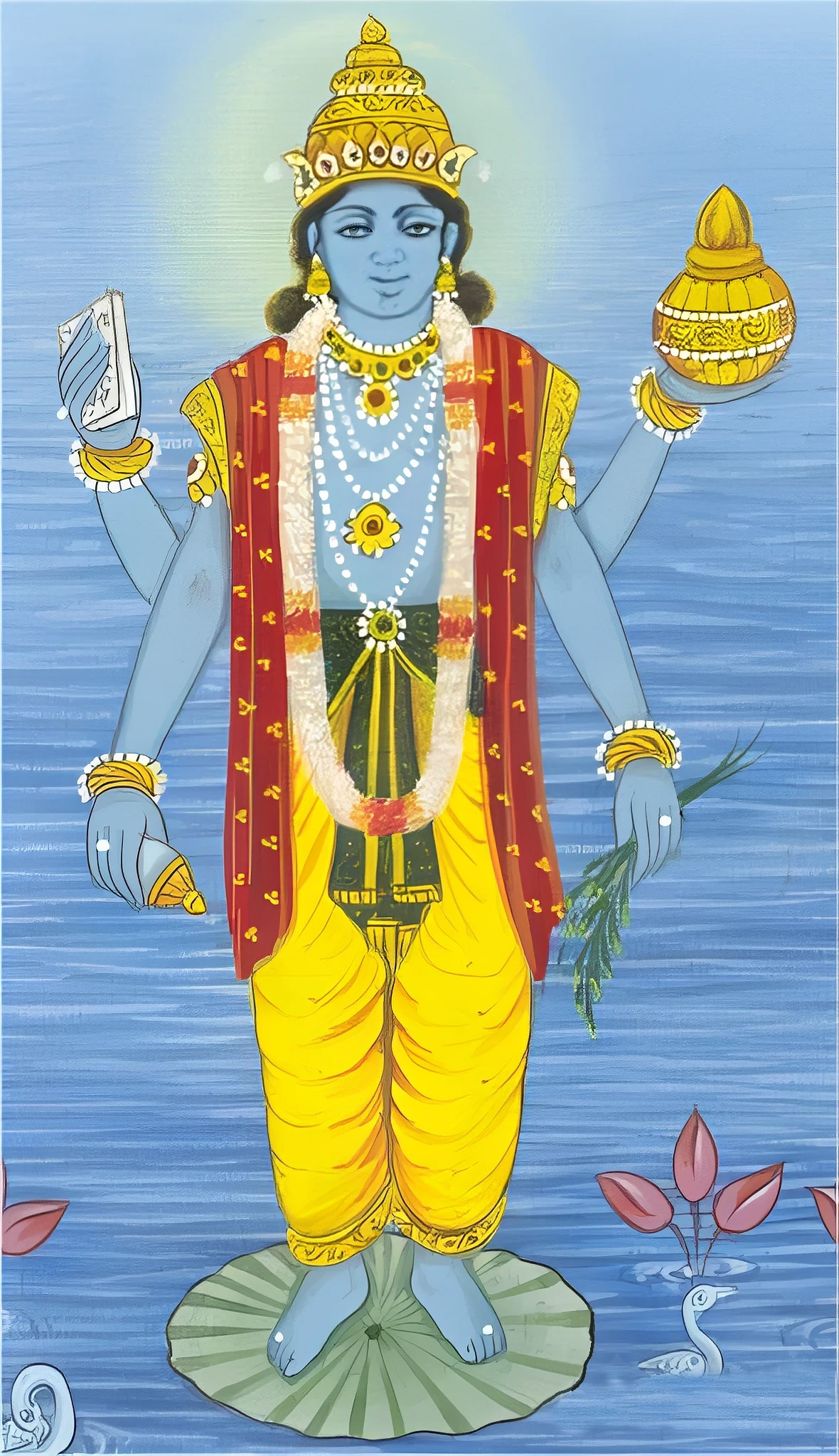
In the rich cosmology of Hindu tradition, few deities embody the intersection of divine power and practical wisdom as profoundly as Dhanvantari. Revered as the celestial physician and the progenitor of Ayurveda, Dhanvantari represents humanity’s ancient quest to understand healing, health, and the delicate balance between mortality and divine grace. His mythology weaves together cosmic drama, medical knowledge, and spiritual philosophy into a narrative that continues to resonate across centuries.
The Cosmic Birth: Emergence from the Primordial Waters
Dhanvantari’s appearance in Hindu mythology is inseparable from one of its most dramatic cosmic events—the Samudra Manthan, or the churning of the cosmic ocean. This pivotal episode reveals not just the origin of a deity, but a fundamental truth about the nature of healing itself: that medicine and wellness emerge from the depths of divine effort and cosmic struggle.
In this foundational myth, devas (celestial beings) and asuras (powerful demons) formed an uneasy alliance to churn the vast ocean of milk. Their goal was singular and compelling—to extract amrita, the nectar of immortality that promised eternal life and undiminished vitality. Using Mount Mandara as a churning rod and the serpent Vasuki as a rope, they set the cosmic waters into motion.
From this primordial churning emerged numerous treasures and beings: Lakshmi, the goddess of prosperity; Kamadhenu, the wish-fulfilling cow; the deadly halahala poison; and finally, Dhanvantari himself. His emergence marked a transformative moment—he rose from the churning waters radiant and divine, bearing in his hands a golden vessel filled with the precious amrita.
This dramatic appearance established Dhanvantari’s essential role in the cosmic order. He was not merely a bystander in the quest for immortality but its bearer, the divine intermediary who could grant the gods their strength and vitality. Through his hands flowed the power to transcend death itself.
Sacred Iconography: The Symbols of Healing
The visual representation of Dhanvantari carries profound symbolic meaning, each element speaking to different aspects of healing wisdom. Traditional depictions show him with four arms, each hand bearing objects that represent distinct dimensions of medical knowledge and divine power.
In one hand, he holds the pot of amrita—the ultimate symbol of life-preserving knowledge and the power to overcome mortality. This vessel represents not just physical medicine but the deeper wisdom that sustains existence itself.
The leech in another hand symbolizes one of Ayurveda’s traditional therapeutic methods—the practice of bloodletting and purification. This seemingly humble creature represents the principle of removing impurities and restoring balance to the body’s systems.
Medical herbs, particularly sacred plants like Tulsi (holy basil) or Amalaki (Indian gooseberry), appear in his third hand. These herbs embody the natural world’s healing potential and the knowledge of how to harness botanical properties for therapeutic purposes.
The fourth hand typically holds either a shankha (conch shell)—a symbol of divine sound and the primordial vibration that underlies all existence—or sacred scriptures, representing the codified knowledge and systematic approach that defines Ayurvedic medicine.
This four-armed form is significant beyond mere symbolism. It demonstrates the multifaceted nature of healing: the divine grace (amrita), the practical techniques (leech), the natural medicines (herbs), and the systematic knowledge (texts or conch). True healing, the iconography suggests, requires integration of all these dimensions.
The Earthly Descent: Founding the Science of Life
Beyond his cosmic origins, mythology tells of Dhanvantari’s incarnation on earth as a king of Kashi, the ancient city known today as Varanasi. This terrestrial manifestation served a crucial purpose—to share the divine knowledge of Ayurveda with humanity.
As an earthly king and teacher, Dhanvantari became the first great systematizer of medical knowledge. He imparted the profound principles of Ayurveda to sages and physicians, most notably to Sushruta, who would become renowned as the father of surgery. The relationship between divine teacher and mortal student established a sacred lineage of medical knowledge that continues through generations of practitioners.
The Sushruta Samhita, one of Ayurveda’s foundational texts, explicitly acknowledges Dhanvantari’s teachings. This ancient medical treatise covers extraordinary ground—from surgical procedures and instruments to anatomical knowledge and therapeutic approaches. It represents the crystallization of divine wisdom into practical, teachable methods that could alleviate human suffering.
This descent narrative carries important philosophical weight. It suggests that medical knowledge is not merely empirical discovery but revealed wisdom, a gift from the divine realm to mortal practitioners. The physician, in this understanding, becomes a conduit for sacred healing power, not simply a technician manipulating physical remedies.
Dhanvantari as Vishnu’s Avatar: The Healing Preserver
In several regional traditions and interpretations, Dhanvantari is understood as an avatar of Vishnu, the great preserver deity who maintains cosmic order and protects the universe from dissolution. This connection deepens Dhanvantari’s theological significance considerably.
Vishnu’s fundamental role is preservation—maintaining the balance of existence, protecting dharma (cosmic law), and ensuring the continuity of life. Dhanvantari, as a manifestation of this preserving force, channels that divine function specifically toward health and healing. Illness, in this framework, represents a form of disorder and imbalance; healing restores proper order both in the individual body and in the larger cosmic pattern.
This avatara (incarnation) status elevates medical practice from mere technique to sacred duty. Physicians and healers, by extension, participate in Vishnu’s preserving work when they relieve suffering and restore health. The practice of medicine becomes, in essence, a form of divine service.
Dhanteras and Dhanvantari Jayanti: Festivals of Health and Prosperity
The living tradition of Dhanvantari worship finds its most visible expression during Dhanteras, the first day of the Diwali festival. On this auspicious occasion, households across India honor Dhanvantari alongside Lakshmi, the goddess of wealth. The juxtaposition is telling—true prosperity includes not just material abundance but robust health and freedom from disease.
Devotees clean their homes, light lamps, and offer prayers for health and well-being. Medical practitioners, Ayurvedic physicians, and hospitals often conduct special pujas (worship ceremonies) invoking Dhanvantari’s blessings for healing work throughout the year. This festival reinforces the cultural understanding that health is fundamental wealth, perhaps the most precious treasure of all.
Dhanvantari Jayanti, celebrated on the day of his emergence during the ocean churning, provides another occasion for honoring the divine physician. These observances keep his mythology alive, not as historical curiosity but as living spiritual practice with practical implications for community health and well-being.
Regional Devotion: Sacred Sites of Healing
Throughout India, particularly in the southern regions, temples dedicated to Dhanvantari serve as focal points for healing rituals and medical devotion. The Dhanvantari temple in Thiruvananthapuram, Kerala, stands as a prominent example, drawing devotees seeking relief from ailments and practitioners seeking blessing for their medical work.
These temples function as more than worship sites—they represent the integration of spiritual and physical healing. Devotees often combine temple visits with Ayurvedic treatments, understanding that wellness requires attention to both material and spiritual dimensions of existence. The temple environment itself, with its rituals, prayers, and sacred atmosphere, becomes part of the healing process.
Regional variations in Dhanvantari worship reveal how different communities have adapted his mythology to local healing traditions while maintaining core elements of his identity as divine physician and preserver of life.
The Living Legacy: Dhanvantari in Contemporary Practice
Dhanvantari’s influence extends far beyond ancient texts and temple rituals. His image appears in hospitals, clinics, Ayurvedic dispensaries, and medical schools throughout India and beyond. This visual presence serves as both inspiration and reminder—that medicine involves not merely technical skill but compassion, wisdom, and connection to something greater than individual practice.
Modern Ayurvedic practitioners often begin their work with invocations to Dhanvantari, seeking guidance and blessing. Medical organizations and Ayurvedic institutions frequently use his image in their emblems and publications. National Ayurveda Day in India is celebrated on Dhanteras, explicitly connecting contemporary medical practice with ancient mythological foundations.
This continuing reverence demonstrates how mythology functions not as obsolete folklore but as living tradition that shapes professional identity and ethical orientation. Dhanvantari provides a model of the ideal healer—knowledgeable, compassionate, connected to divine wisdom, and dedicated to preserving life.
The Philosophy of Divine Healing
At its deepest level, Dhanvantari’s mythology articulates a comprehensive philosophy of healing that integrates multiple dimensions of human experience. Physical ailments are not seen in isolation but as manifestations of imbalance that may have spiritual, emotional, or karmic dimensions.
The amrita he carries symbolizes the ultimate healing—transcendence of mortality itself. Yet this transcendence is not achieved through rejecting the body but through understanding and working with its natural patterns. Ayurveda, as transmitted through Dhanvantari, emphasizes harmony with natural rhythms, balance among bodily elements, and integration of lifestyle with cosmic cycles.
This holistic vision stands in instructive contrast to purely mechanical or reductionist approaches to medicine. It suggests that complete healing requires attention to the whole person—body, mind, spirit—and recognition of the individual’s connection to larger patterns of existence.
Conclusion: The Bridge Between Worlds
Dhanvantari’s mythology accomplishes something rare and valuable—it bridges the transcendent and the practical, the divine and the therapeutic. His stories remind us that healing knowledge is both gift and responsibility, that physicians participate in sacred work, and that health represents a form of grace.
In an era when medicine grows increasingly technical and specialized, Dhanvantari offers an integrative vision. He reminds practitioners that healing involves not just intervention but preservation, not just technique but wisdom, not just treating disease but nurturing wellness. His emergence from the cosmic ocean suggests that genuine healing knowledge comes from deep sources, requiring effort and dedication to access.
For patients and seekers of health, Dhanvantari represents hope—the promise that divine grace can flow through human hands, that knowledge exists to alleviate suffering, and that wellness is possible through the integration of spiritual awareness and practical wisdom. His mythology remains vital because it addresses the timeless human concern with health, mortality, and the quest for balance in an uncertain world.
The divine physician who emerged from primordial waters bearing the nectar of immortality continues to inspire, guide, and bless those who seek healing in all its dimensions—physical, mental, and spiritual. In this way, Dhanvantari’s ancient mythology speaks with remarkable relevance to contemporary concerns, offering a vision of medicine as sacred art and healing as divine grace made manifest in the world.
Leave a Reply