
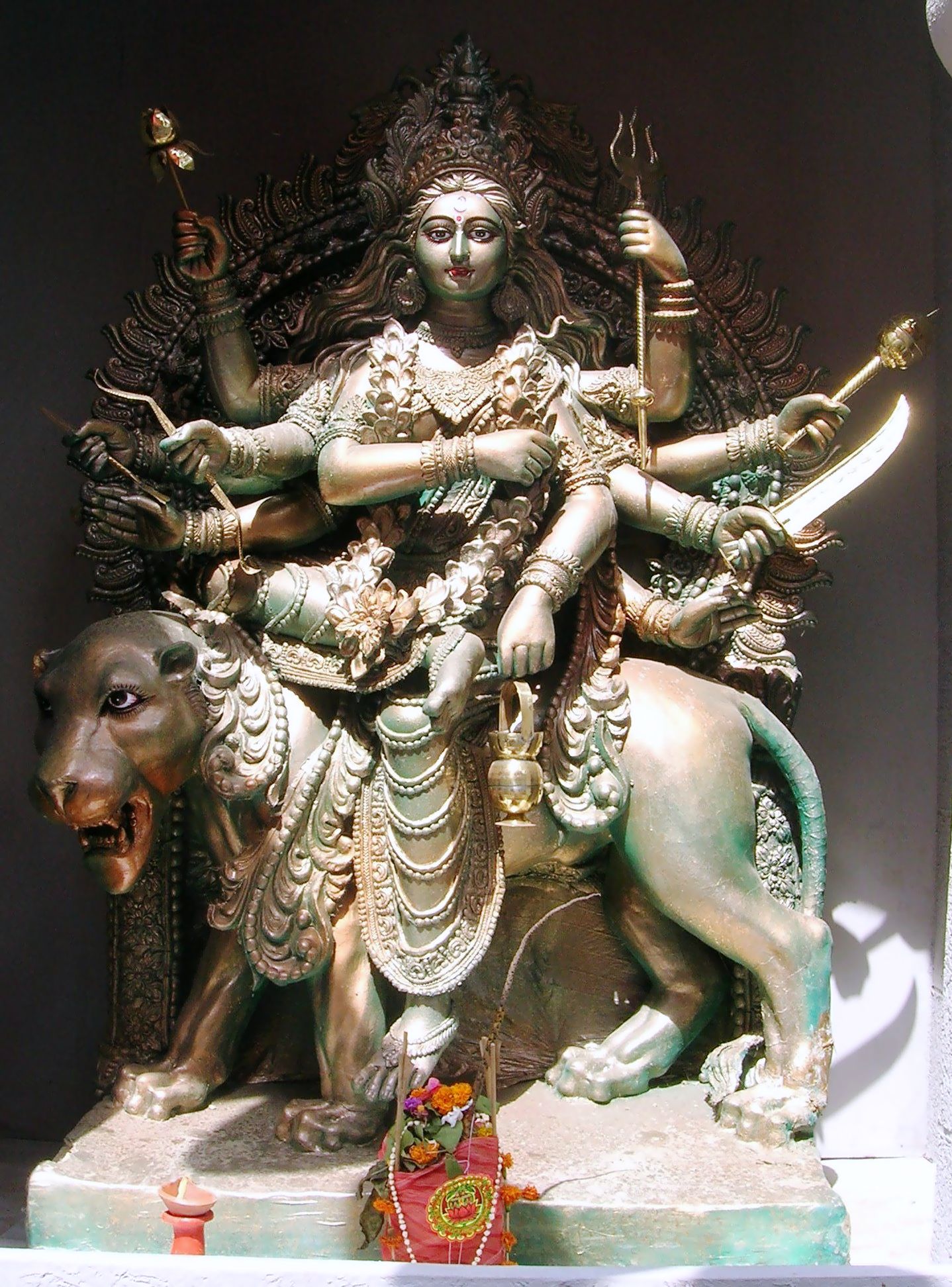
The Third Divine Manifestation of Navdurga
In the sacred cycle of Navratri, when the divine feminine energy manifests through nine distinct forms, the third day brings forth Chandraghanta—a goddess whose very name echoes with celestial music. Her appellation derives from “Chandra” (moon) and “Ghanta” (bell), referring to the distinctive crescent moon adorning her forehead that resembles a temple bell, creating a visual symphony between lunar serenity and divine resonance.
Chandraghanta represents a profound paradox that lies at the heart of divine feminine power: the harmonious fusion of fierce protection and gentle grace. She embodies the warrior who fights not from anger, but from love; the protector whose strength emerges from compassion rather than aggression.
The Wedding of Cosmic Proportions
The most captivating legend surrounding Chandraghanta unfolds during one of mythology’s most dramatic wedding ceremonies. After Goddess Parvati completed intense penance to win Lord Shiva as her consort, their divine marriage was arranged. However, what followed became a cosmic drama that would test the very fabric of family harmony.
When Shiva arrived at the wedding venue, he appeared in his most fearsome ascetic form—covered in ash, adorned with skulls and serpents, accompanied by his terrifying retinue of ghosts, ghouls, and otherworldly beings. His appearance was so overwhelming that Parvati’s mother, Menavati, fainted from shock, and panic spread throughout the wedding party.
In this moment of cosmic crisis, Parvati’s divine wisdom manifested. Rather than accepting the chaos or demanding Shiva change, she transformed herself into Chandraghanta—a form so radiant and powerful that even Lord Shiva was startled by her divine luminescence. Through this transformation, she demonstrated that true strength lies not in domination, but in the graceful management of challenging situations.
Chandraghanta then prayed to Shiva to assume a more pleasant form, which he did, appearing as a handsome prince adorned with jewels. This divine negotiation allowed the wedding to proceed peacefully, establishing a mythological template for how courage and diplomacy can resolve even the most impossible situations.
The Demon-Slaying Chronicles
Beyond her role as a divine bride, Chandraghanta emerges as a formidable warrior goddess in the cosmic battle against evil. Ancient texts describe her confrontation with the demon Mahishasura, where her very presence became a weapon of divine justice. In some variations of the legend, she battled Jatukasura, using the crescent moon on her forehead as illumination to pierce through darkness.
The most striking aspect of her warrior nature was her voice—described as resonating like a thunderous bell that could make demons tremble with fear. In her battle against Jatukasura, she used a massive bell whose sound cleared the sky of bats that empowered the demon, demonstrating how divine sound itself becomes a weapon against chaos and ignorance.
These battles were not merely physical confrontations but cosmic struggles between order and chaos, light and darkness, knowledge and ignorance. Chandraghanta’s victories represent the triumph of divine consciousness over the destructive forces that threaten cosmic harmony.
Divine Iconography: A Visual Scripture
Chandraghanta’s physical form serves as a complex spiritual text written in symbols and sacred geometry. She appears with a golden complexion that signifies divine radiance and spiritual purity, mounted upon a lion or tiger that represents fearless dharma (righteousness). Her ten hands create a mandala of divine power, each carrying weapons and symbols that correspond to different aspects of spiritual protection and guidance.
The Sacred Arsenal
Her ten hands bear a carefully orchestrated collection of divine implements:
The Trident (Trishul) represents the three fundamental forces of creation, preservation, and destruction, reminding devotees of the cyclical nature of existence.
The Mace (Gada) symbolizes the authority to uphold justice and the strength to protect the innocent from oppression.
The Bow and Arrow indicate the precision required for spiritual focus and the ability to hit the target of self-realization.
The Sword (Khadak) serves as the cutting tool for ignorance, slicing through the veils of maya (illusion) that obscure truth.
The Lotus (Kamala) represents purity emerging from muddy waters, symbolizing how spiritual consciousness can bloom even in challenging circumstances.
The Bell (Ghanta) produces the divine sound that dispels negative energies and calls forth positive vibrations.
The Water Pot (Kamandalu) signifies spiritual purification and the containment of sacred wisdom.
The Prayer Beads (Japa Mala) emphasize the importance of continuous devotion and meditative practice.
Her two remaining hands form the Abhaya Mudra (gesture of fearlessness) and Varada Mudra (gesture of blessing), creating a divine promise of protection and grace for all devotees.
The Spiritual Geometry of Power
Perhaps most significantly, Chandraghanta’s influence extends into the subtle energy system of human consciousness through her connection to the Manipura Chakra—the Solar Plexus Chakra located at the navel and governed by the element of fire. This energy center, literally called “The Fortress of Gems,” represents the seat of personal power, confidence, and decision-making ability.
When devotees meditate upon Chandraghanta’s form, they activate this crucial energy center, developing:
- Inner Warrior Consciousness: The courage to face life’s challenges without fear
- Mental Clarity: Enhanced ability to make decisions with wisdom and foresight
- Spiritual Protection: A divine shield against negative energies and psychic attacks
- Leadership Qualities: The development of natural authority combined with compassion
- Balanced Strength: The harmonious integration of power with serenity
Sacred Sound and Divine Vibration
The worship of Chandraghanta involves the recitation of specific mantras that create vibrational alignments with her divine energy. The primary mantra “Om Devi Chandraghantayai Namah” serves as a direct invocation of her protective presence.
For deeper spiritual practice, devotees employ the advanced mantra “Om Hreem Kleem Shreem Chandraghantaayai Namah”, which incorporates powerful seed syllables (bija mantras) that invoke specific divine qualities: Hreem for cosmic energy, Kleem for divine attraction and protection, and Shreem for abundance and prosperity.
The traditional dhyana (meditation) mantra creates a complete visualization:
“I worship the one mounted on the best of flesh-eating animals (tiger), equipped with fierce weapons, who grants blessings and is renowned as Chandraghanta.”
This mantra encapsulates her entire symbolic presence, from her fierce mount to her protective weapons, creating a complete mental image for contemplation.
Contemporary Relevance: Ancient Wisdom for Modern Challenges
In our contemporary world, Chandraghanta’s teachings offer profound guidance for navigating the complexities of modern life. Her story demonstrates that true leadership emerges not from aggressive domination, but from the balanced integration of strength and compassion. Her transformation during Shiva’s wedding provides a template for conflict resolution that honors all parties while maintaining dignity and grace.
Her association with the Solar Plexus Chakra makes her particularly relevant for developing the kind of self-confidence and decision-making ability required in today’s rapidly changing world. In an era where individuals often struggle with self-doubt and fear, Chandraghanta’s energy empowers people to stand firm in their convictions while remaining open to wisdom and compromise.
The goddess teaches that protective action and nurturing love are not contradictory forces, but complementary aspects of divine feminine power. This integration offers a model for balanced living that honors both strength and tenderness, providing a path for authentic empowerment that serves not only personal growth but the greater good.
The Eternal Bell of Awakening
Chandraghanta’s bell continues to ring through the ages, calling humanity to awaken to its own divine potential. Her crescent moon reminds us that even in darkness, there is always light; her weapons assure us that we possess the tools needed for any spiritual battle; and her grace promises that courage and compassion can transform any situation.
In worshipping Chandraghanta, devotees don’t merely seek external protection—they awaken the inner warrior goddess who can face any challenge with both fierce determination and boundless love. She represents the divine truth that real strength emerges not from hardness, but from the flexible resilience of a spirit that remains unbreakable because it knows how to bend without breaking.
Through her eternal presence, Chandraghanta continues to guide seekers toward the recognition that they already possess everything needed for spiritual victory: courage, wisdom, and the divine grace that transforms every challenge into an opportunity for growth and awakening.
Leave a Reply