
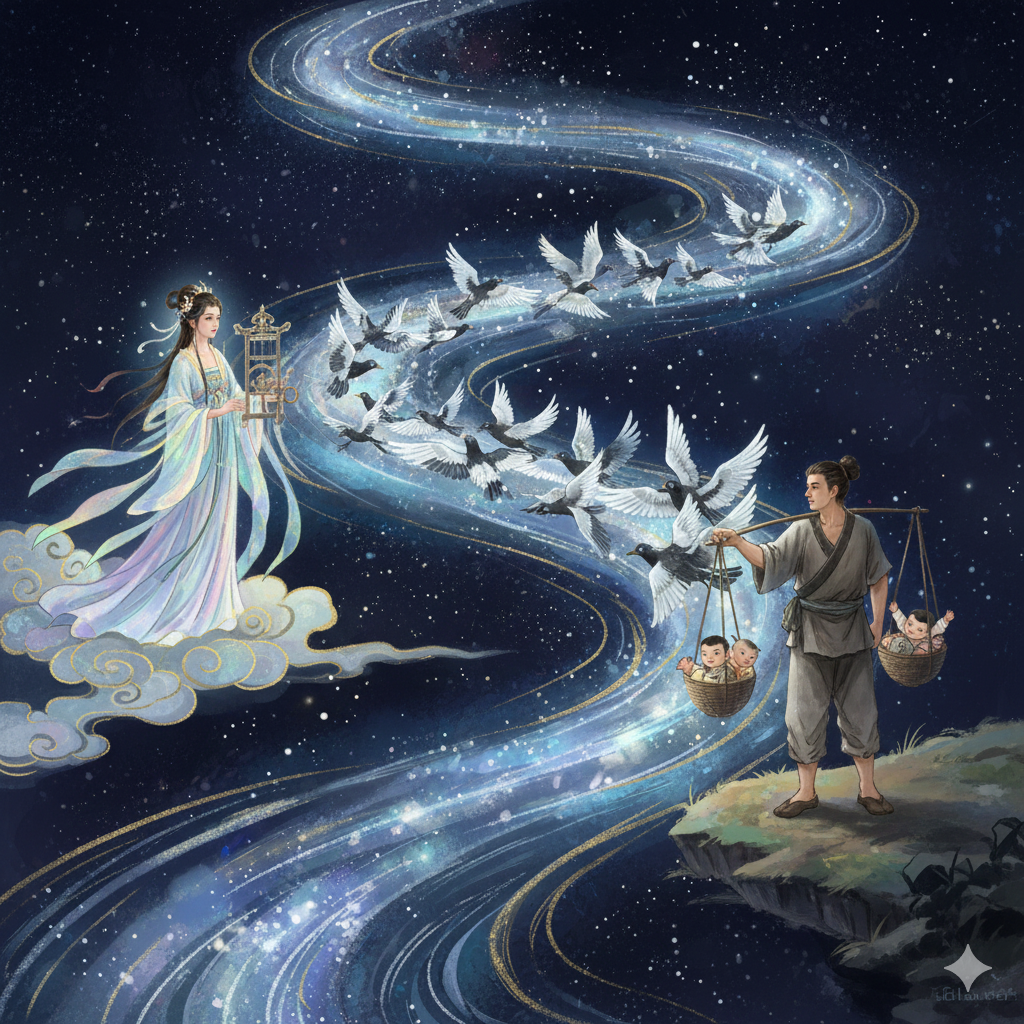
In the night sky above ancient China, two stars shine across the luminous expanse of the Milky Way—forever separated, forever longing. This celestial divide mirrors one of the most enduring love stories in Chinese mythology: the tale of Zhinü, the Weaver Girl, and Niulang, the Cowherd. For over 2,600 years, this myth has captivated hearts, shaped cultural traditions, and transformed astronomical observations into profound narratives about love, separation, and hope.
The Ancient Origins
The story first appeared in written form during the Han Dynasty in the Classic of Poetry, though oral traditions likely extend even further into antiquity. Unlike many myths that fade with time, this narrative has grown richer across millennia, becoming a living cultural phenomenon celebrated annually through the Qixi Festival—often called China’s Valentine’s Day.
What distinguishes this myth from other love stories is its remarkable fusion of celestial observation and human emotion. The ancient Chinese didn’t merely tell stories about stars; they wove cosmic geography into narratives that explained both the heavens above and the hearts within.
The Mythological Narrative: A Tale of Two Worlds
The story unfolds in the heavens, where Zhinü, granddaughter of the Heavenly Empress, worked at her celestial loom creating clouds and garments for the gods. Her skill was unmatched, her dedication absolute—yet something vital remained absent from her existence.
Meanwhile, in the mortal realm below, Niulang tended cattle with quiet diligence. Once a celestial being himself, he had been banished to earth, his divine nature stripped away. His only companion was an old ox who would later reveal himself as the Golden Ox Star, a heavenly being who had been punished for advocating on Niulang’s behalf.
The Fateful Encounter
One day, seven fairy sisters descended from heaven to bathe in Bi Lian Lake, their laughter echoing across the water. The old ox, sensing destiny’s approach, spoke to Niulang with ancient wisdom: hide the red dress of the seventh sister, and she would be compelled to remain on earth.
Niulang followed this guidance, concealing Zhinü’s celestial garments. Unable to return to heaven without them, she agreed to marry the humble cowherd. What began as circumstance blossomed into genuine love.
Their life together embodied simple contentment: they built a home, cultivated fields, and welcomed two children—a son and daughter. In this domestic harmony, celestial and mortal merged into something neither had known before.
Divine Intervention and Cosmic Separation
But transgression against heavenly law cannot remain hidden forever. When the Heavenly Empress discovered the secret marriage, her fury manifested immediately. Guards descended to retrieve Zhinü, tearing her from her family and returning her to the celestial loom.
Devastated, Niulang received one final gift from his dying ox companion: its hide would grant the power of flight. Donning the magical skin and carrying his children in baskets, Niulang pursued his beloved into the heavens, desperation driving him across the boundary between earth and sky.
As he drew closer to Zhinü, the Heavenly Empress acted decisively. With a single wave of her hairpin, she carved an impenetrable barrier through the cosmos—the Milky Way, known in Chinese as the Heavenly River or Tiānhé. The family stood separated by an infinite stellar divide, able to see each other but never touch.
The Magpie Bridge: Compassion Across the Cosmos
Their anguished tears moved both heaven and earth. Magpies witnessed the family’s suffering and gathered in unprecedented numbers, their bodies interlocking to form a living bridge across the galactic expanse. This act of collective compassion touched even the hardened hearts of the divine rulers.
The Jade Emperor and the Empress, moved by such transcendent devotion, showed mercy. They granted the couple permission to reunite once each year—on the seventh day of the seventh lunar month. This became Qixi, a day when magpies across the realm ascend to form their bridge, when lovers are briefly whole, and when hope triumphs over separation.
Astronomical Foundations: When Myth Meets the Stars
The poetic power of this myth deepens when we understand its astronomical basis. Zhinü corresponds to Vega, the brightest star in the Lyra constellation, while Niulang represents Altair in Aquila. These luminous points remain separated by the dense stellar field of the Milky Way—a cosmic barrier that mirrors their mythological separation.
The third star in this celestial triangle, Deneb, symbolically forms the bridge connecting them. For centuries, observers gazed skyward during the seventh lunar month to watch these stars shine in proximity, finding in their brightness validation of the ancient tale.
This astronomical foundation transformed the myth from folklore into cultural astronomy. The relationship became bidirectional: the myth explained the stars, and the stars perpetually narrated the myth. Each generation that looked upward saw their ancestors’ stories written in celestial fire.
The Symbolic Depth of the Magpie
Central to the myth’s resolution is the magpie, known as xǐquè, whose very name contains the character for “joy” or xǐ. In Chinese symbolism, magpies traditionally herald good news and fortune. Within this legend, however, the magpie transcends mere symbolism—it becomes an active agent of hope and reconciliation.
The formation of the magpie bridge represents more than miraculous intervention. It embodies a profound truth: that compassion and collective action can bridge even cosmic distances. Two magpies together symbolize “double happiness” or shuāngxǐ, representing eternal joy between lovers—a visual metaphor that extends from the myth into wedding iconography and celebratory art throughout Chinese culture.
Thematic Explorations: Universal Truths in Ancient Stories
The myth operates on multiple interpretive levels, each revealing different aspects of human experience.
Love Beyond Boundaries
At its core, this is a romance that defies social hierarchy. Celestial and mortal, goddess and peasant—their love transgresses established order. This theme resonates across cultures and eras, speaking to anyone who has loved across dividing lines of class, culture, or circumstance.
The Inevitability of Separation
The forced parting reflects universal experiences of loss and longing. Whether through migration, war, social prohibition, or circumstance, lovers throughout history have faced separation. The myth elevates this personal tragedy into cosmic significance, suggesting that even the greatest love stories are touched by sorrow.
Enduring Devotion
What distinguishes this tale from other tragic romances is its refusal to embrace total despair. The annual reunion transforms the narrative from complete loss into something more nuanced—a love that persists through hardship, remaining vital despite physical separation. Niulang’s desperate pursuit, carrying his children toward his receding wife, embodies the determination to reconnect at any cost.
The Transformative Power of Sympathy
The compassion of magpies, the reluctant mercy of the Empress, and the Jade Emperor’s ultimate relenting all suggest that suffering is not meaningless when witnessed by others. The myth articulates a vision where emotional authenticity—expressed through tears and unwavering devotion—possesses transformative power capable of moving even the divine.
The Qixi Festival: Myth Made Living Tradition
The seventh day of the seventh lunar month crystallizes the myth into lived experience through rituals that have persisted for millennia.
Traditional Observances
Young women traditionally gathered on Qixi evenings to display needlework and threading skills. The most prestigious accomplishment was threading seven needles by moonlight without error—a feat believed to invoke Zhinü’s blessing for dexterity and marital happiness.
Worshippers arranged offerings of tea, wine, and specific fruits—longans, red dates, hazelnuts, peanuts, and melon seeds—before representations of Vega, gazing upward while reciting prayers for love and domestic contentment. Children honored the faithful ox by adorning it with wildflowers, acknowledging the creature’s pivotal role as guardian and guide.
Food held ceremonial significance. Qiǎo guǒ or “skill fruit”—delicate fried pastries shaped to demonstrate the maker’s craftsmanship—were prepared and consumed. Young women carved elaborate botanical and zoological designs into melon skins, transforming simple gourds into temporary art objects that celebrated both skill and beauty.
Modern Celebrations
Contemporary Qixi observances blend ancient ritual with modern romance. Urban celebrations feature elaborate lantern festivals where thousands of paper magpies form massive installations representing the legendary bridge. Couples exchange gifts, flowers, and romantic cards; special dinners and outings have become standard expressions of affection.
These modern iterations strip away some agrarian specificity while maintaining the festival’s essential focus on celebrating love. The myth adapts to each era, remaining relevant by honoring its core while embracing contemporary expressions of devotion.
Regional Variations: One Story, Many Voices
The myth’s durability stems partly from its adaptive capacity. Communities across China and East Asia have customized the narrative to reflect local conditions, occupations, and cosmologies.
Agrarian Interpretations
In rice-growing regions, the story emphasizes diligent labor and humble loyalty, positioning the couple’s separation as emblematic of broader peasant hardships. The weaving and farming become metaphors for the rhythms of agricultural life—seasons of plenty followed by seasons of absence.
Highland Adaptations
In southwestern highlands inhabited by ethnic minorities, shamanic versions portray the Weaver as a mountain spirit requiring ritual trials and ancestral permission. These transformations stress reciprocity with the natural world rather than heavenly jurisdiction, reflecting communities where spirits inhabit peaks and valleys rather than distant celestial realms.
Maritime Versions
Fishing communities reimagined the myth in nautical terms. Zhinü becomes a goddess of nets and sails, her weaving transforming into the intricate knots securing boats and masts. Niulang becomes a fisherman; the Milky Way becomes an ocean channel; and magpies morph into seabirds—terns or gulls—whose wings form a living corridor across the waves.
These variations demonstrate that the core narrative—separation, perseverance, and reunion—remains emotionally resonant across vastly different material circumstances. Each adaptation is not a corruption of an original but a creative translation, bending the narrative to reflect local weather, gender customs, labor practices, and spiritual systems.
Border Town Transformations
In trade centers and island communities, the Weaver Girl occasionally appears as a trader’s daughter or a woman educated in classical arts. Her departure from heaven transforms from punishment into cross-cultural marriage—a subtle reframing that reflects local attitudes toward intermarriage and cultural exchange.
East Asian Influence: A Myth That Travels
The story’s influence extended throughout East Asia, generating distinct yet connected traditions.
Japan adapted the narrative into the Tanabata festival, celebrated on July 7th of the modern calendar. The Japanese version emphasizes wishes and personal aspirations, with people writing desires on colorful strips of paper (tanzaku) and hanging them from bamboo branches.
Korea developed Chilseok, incorporating elements of harvest festival alongside the romantic narrative. Korean versions often emphasize the practical skills of weaving and farming, celebrating craftsmanship as expressions of devotion.
Vietnam recognizes the festival as Thất Tịch, perpetuating the story within its own cultural framework while adapting elements to local spiritual practices and seasonal observances.
These regional variations indicate that the Cowherd and Weaver Girl myth functions as a portable framework—a story structure flexible enough to accommodate different cultural values while maintaining emotional integrity.
The Myth’s Enduring Power
The persistence of this story across more than two millennia reveals something fundamental about its archetypal nature. It addresses universal human experiences: love that transcends social boundaries, separation imposed by forces beyond individual control, the longing for connection, and the hope that devotion persists despite adversity.
What the Myth Teaches
The Cost of Love: True connection often requires transgressing boundaries, accepting risks, and enduring consequences. The lovers’ willingness to face separation rather than abandon each other speaks to love’s transformative power.
The Value of Perseverance: Niulang’s desperate flight across the heavens, the magpies’ annual migration, and the couple’s centuries-long patience all suggest that constancy possesses its own dignity, regardless of outcome.
The Necessity of Hope: The annual reunion prevents the story from collapsing into pure tragedy. Even one day together each year affirms that love survives, that waiting has meaning, and that separation is not abandonment.
The Power of Community: The magpies’ intervention demonstrates that individual suffering becomes collective responsibility. Their bridge suggests that hope is built not through isolated strength but through communal compassion.
Contemporary Relevance
The myth continues to resonate in modern contexts where physical and emotional separation remains common. Long-distance relationships, migration for work, forced departures due to conflict or economic necessity—all find echoes in this ancient tale.
The Qixi Festival’s evolution into a major commercial holiday mirrors Valentine’s Day’s trajectory, yet maintains distinctive cultural elements. The celebration demonstrates that this ancient myth remains culturally vital—not preserved in amber but alive in contemporary celebrations, adapted into films and performances, and retold by each generation in language and imagery that speaks to their own understanding of love, sacrifice, and hope.
Conclusion: Stars That Still Shine
On every seventh day of the seventh lunar month, observers can look skyward and see Vega and Altair shining across the Milky Way’s luminous expanse. These stars have remained in their positions for millennia, unchanging witnesses to countless human generations who have looked up and found meaning in their light.
The Cowherd and Weaver Girl myth transforms these distant points of light into something intimate and profound. It reminds us that separation is not the end of love, that waiting can be an act of devotion, and that hope persists even across cosmic distances.
In an era of instant communication and immediate gratification, this ancient story offers a different wisdom: that some loves are worth waiting for, that devotion endures through absence, and that the most profound connections transcend even the boundaries between heaven and earth.
The magpies still build their bridge each year. The lovers still meet. And we still look upward, finding in distant stars the reflection of our own hearts’ longing—proof that some stories never grow old, because they speak truths that remain forever young.
Leave a Reply