
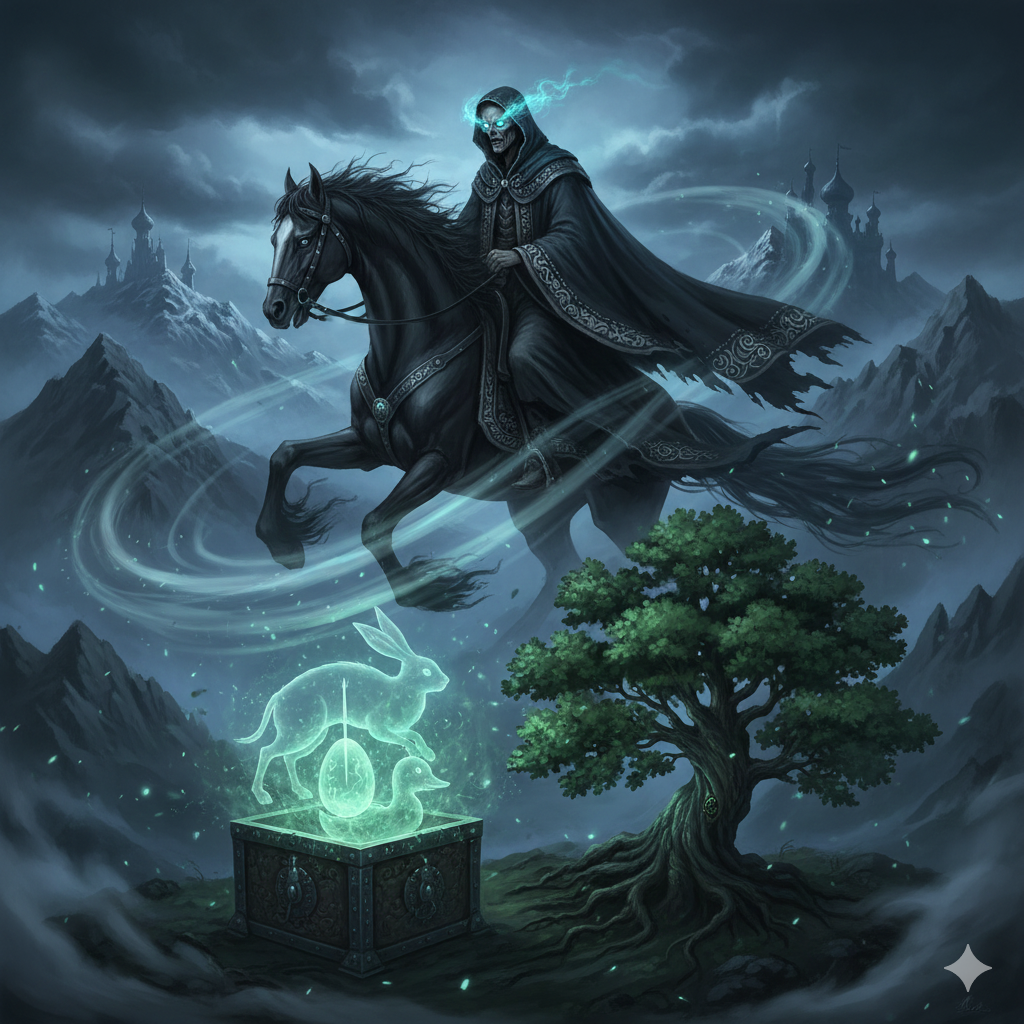
In the shadowy corners of Eastern Slavic mythology, few figures inspire as much fascination and terror as Koschei the Deathless. This skeletal sorcerer, consumed by an overwhelming fear of mortality, represents one of folklore’s most compelling paradoxes: a being who achieved immortality through the very act that would ensure his downfall.
The Paradox of Immortality
At the heart of Koschei’s legend lies a profound irony. So terrified was he of death that he removed his own soul from his body, hiding it in an elaborate series of nested vessels. This external soul—concealed within a needle, inside an egg, inside a duck, inside a hare, locked within an iron chest, and buried beneath a green oak on the distant island of Buyan—was meant to guarantee his survival forever.
Yet this carefully constructed failsafe contained a critical flaw. The very act of separation that granted him immortality also created a singular point of vulnerability. In his desperate attempt to transcend death, Koschei inadvertently forged the instrument of his destruction.
The Terrifying Appearance and Dark Powers
Koschei manifests as a figure of nightmarish proportions—gaunt, skeletal, and profoundly repugnant. Tales describe him riding naked through Russian mountains on an enchanted horse, his bony frame a testament to his unnatural existence. Beyond his disturbing appearance, Koschei wields formidable supernatural abilities that make him a genuinely fearsome antagonist.
Shape-Shifting Mastery
The sorcerer possesses extraordinary transformative powers, appearing variously as:
- A monstrous creature of undefined horror
- A deceptively human figure
- Most frequently, a whirlwind tornado used to abduct victims
This shape-shifting ability serves both his predatory nature and his capacity to evade capture, making him an elusive and unpredictable threat.
Transformative Curses
Koschei demonstrates the power to transform his enemies into inanimate objects or vegetation—turning adversaries into stone, walnut shells, or plants. This ability to strip others of their agency while maintaining his own immortal form speaks to his fundamental relationship with control and fear.
The Womanizer and Seducer
Despite his repulsive appearance, Koschei is characterized as a cunning womanizer who employs both seduction and dark magic to win the affections of young women. This aspect of his character reveals a complex psychology—a being so consumed by fear of death that he simultaneously craves life’s pleasures and connections, yet remains fundamentally incapable of genuine relationship.
The Mechanism of the External Soul
The concept of the external soul appears across Eurasian folklore, but Koschei’s version represents perhaps the most elaborate execution of this motif. Each layer of protection was designed as a failsafe: if an adversary found the chest, the hare would flee when threatened; if the hare was caught, the duck would fly away; if the duck was captured, the egg would need to be retrieved.
However, Koschei’s paranoid desperation led him to construct an imperfect spell. Simple possession of the egg containing the needle proved sufficient to control and ultimately destroy the sorcerer. Every sequence in the nested hierarchy could be breached by a determined adversary. The immortality he sought became a vulnerability he couldn’t escape.
The Central Tale: Prince Ivan and Princess Marya Morevna
The most celebrated narrative featuring Koschei comes from Alexander Afanasyev’s monumental collection of Russian fairy tales, later popularized in Andrew Lang’s The Red Fairy Book. This version has become the archetypal Koschei story, weaving together themes of forbidden curiosity, redemptive love, and the limits of magical power.
The Forbidden Chamber
After Prince Ivan Tsarevich marries the formidable warrior princess Marya Morevna, she entrusts him with her castle but provides one strict instruction: never open a particular closet. This forbidden room motif—resonant across cultures from Bluebeard to Pandora—embodies the tension between obedience and human curiosity.
Ivan’s compassion proves his undoing. Upon discovering Koschei chained and weakened after ten years of captivity, Ivan provides the desperate sorcerer with water. Each drink revitalizes Koschei until, after the third bucket, his magical powers fully restore. The sorcerer breaks his chains, transforms into a whirlwind, and vanishes—carrying Marya away with him.
The Cycle of Pursuit and Defeat
Ivan’s quest to rescue Marya unfolds through a series of failures and resurrections that mirror the cyclical nature of Slavic cosmology:
First and Second Attempts: Ivan catches up to Koschei, but the sorcerer’s superior magical horse allows him to overtake the prince and recapture Marya. Koschei demonstrates mercy twice, attributing this clemency to Ivan’s earlier kindness—a complex moral economy where even villains acknowledge debts.
The Death and Resurrection: On the third attempt, Koschei’s patience expires. He slices Ivan into pieces, seals the remains in a barrel with pitch and iron hoops, and casts it into the sea. This brutal dismemberment would mark the end for any ordinary hero, but Ivan’s sisters and their wizard husbands intervene. Using mystical silver artifacts that turned black to signal mortal peril, they locate the barrel. The eagle retrieves it from the sea, the falcon brings the Water of Life, and the raven provides the Water of Death—two magical substances that together can reassemble and revive the dead.
The Superior Horse and Final Victory
Resurrected, Ivan recognizes that he requires a horse superior to Koschei’s own. This realization marks a crucial turning point: victory will not come through courage alone but through obtaining the proper magical tools. Following his brothers-in-law’s advice, he seeks Baba Yaga, the fearsome old sorceress who guards magical horses.
Baba Yaga agrees to provide a steed in exchange for three days of herding her supernatural mares—an impossible task without magical aid. Ivan succeeds through a combination of compassion and strategy:
- On the first day, an outlandish bird prevents the mares from escaping
- On the second, a lioness he previously spared gathers them back
- On the third, a queen bee he saved brings them home
The bee advises him to steal a small, unprepossessing colt from the stables. After fattening in green meadows, this colt transforms into a magnificent flying horse capable of surpassing Koschei’s own steed.
The Final Confrontation
In the decisive battle, Koschei’s horse stumbles and admits defeat—a moment that acknowledges the shifting cosmic balance. Even supernatural power has limits when confronted with superior magic. Ivan’s enchanted horse strikes Koschei with such force that the sorcerer’s skull shatters. Ivan delivers the final blow with a club, then builds a pyre to burn Koschei’s body to ash, scattering the remains to the wind—a thorough destruction that prevents any possibility of return.
Thematic Layers and Cultural Significance
The Koschei narrative encompasses multiple interconnected themes that reveal fundamental aspects of Slavic worldview and universal human concerns.
Compassion as Catalyst
Ivan’s act of compassion—providing water to a suffering prisoner—directly enables the villain’s escape and all subsequent tragedy. This moral complexity challenges simplistic notions of virtue. The tale suggests that compassion without wisdom can be dangerous, yet it’s precisely this compassion that later earns Ivan Koschei’s initial mercy and the magical aid necessary for victory.
The External Soul Motif
While particularly associated with Koschei, the external soul concept appears in folklore from Ireland to India, suggesting deep archetypal roots. This motif explores fundamental questions about the nature of life, vulnerability, and what it means to be truly alive. Can one preserve life by separating it from lived experience? The answer, consistently, is that such separation creates its own form of death.
Forbidden Knowledge and Curiosity
The forbidden chamber represents the tension between trust and the human drive to understand. Ivan’s transgression mirrors Eve’s in the Garden of Eden, Pandora’s opening of the box, and Psyche’s lighting of the lamp. These stories acknowledge that curiosity is both humanity’s greatest gift and a source of potential catastrophe.
Cyclical Transformation
The pattern of death, dismemberment, and resurrection through magical waters reflects pre-Christian Slavic beliefs about the cyclical nature of existence. Life and death are not absolute opposites but complementary forces that can transform into one another through the proper rituals and interventions.
Historical Origins and Evolution
Scholars have proposed intriguing theories about Koschei’s historical and mythological genesis that illuminate how folklore transforms over time.
The Khan Konchak Connection
Some historians connect Koschei to Khan Konchak, a 12th-century Polovtsian (Turkic) leader. As Christianity spread through Slavic territories, storytellers may have demonized this pagan ruler, distorting the historical complexity of his interactions with Russian princes. The name itself offers etymological clues: in Slavic languages, the root kost means “bone,” while Koshey and its variants can mean “camp,” “military officer,” “captive,” or “slave.”
This transformation—from historical figure to folkloric villain—demonstrates how cultures process encounters with outsiders through narrative. The threatening foreign other becomes literalized as a supernatural monster, allowing communities to express anxieties about external threats while maintaining a sense of moral superiority.
Connection to Veles
Scholars also recognize parallels between Koschei and Veles (or Volos), a pre-Christian Slavic deity associated with the underworld, magic, and wealth. This connection suggests that Koschei represents a demonized folk interpretation of ancient Slavic death-gods—a transformation reflecting the religious upheaval that followed Christianization.
By framing Koschei as pure evil rather than a neutral supernatural force, Christian Slavic societies reinterpreted pagan divine figures through a moral lens incompatible with their new faith. The god who once mediated between life and death became simply the enemy of life itself.
The Archetypal Antagonist
Within Russian and Eastern Slavic folklore, Koschei functions as the quintessential male antagonist—a figure embodying death, greed, lust, and the danger of unbridled magical power divorced from wisdom or connection to others.
Unlike Western witches or ogres often depicted as more grotesque or pitiable, Koschei retains an aura of malevolent intelligence and supernatural potency. He is not defeated through luck or simple virtue but through the convergence of multiple heroic qualities:
- Compassion that creates moral debts
- Determination across repeated defeats
- Receipt of magical aid from extended family
- Willingness to undertake arduous quests for seemingly impossible goals
The Psychology of Fear
Koschei’s terror of death—which drives the immortality spell—paradoxically ensures that he encounters an adversary willing to risk everything to save a beloved. This irony permeates the narrative: the sorcerer’s greatest precaution becomes his greatest vulnerability. His inability to accept mortality isolates him from the very connections that give life meaning.
In many cultural traditions, such stories function as meditations on hubris and the limits of power divorced from wisdom. Koschei’s fate suggests that immortality without vulnerability is not true life but a kind of living death—existence without the risks that make existence meaningful.
Regional Variations and Global Parallels
Over 50 regional variants of the Koschei tale exist across Eastern Europe, the Balkans, Baltic nations, and Central Europe. Each inflects the core narrative with local cultural elements, yet the fundamental structure remains consistent—suggesting its deep resonance with universal human concerns.
Some versions emphasize the “external soul” mechanic more directly than Afanasyev’s rendition. In these alternatives, defeating Koschei requires not merely martial victory but the discovery and destruction of the object harboring his life force. The hero must undertake a parallel quest: one to battle the villain physically, another to locate the hidden vulnerability.
This dual quest structure mirrors psychological reality—external confrontation with threats requires parallel internal work to identify and address root causes. Victory comes not just from strength but from understanding.
Legacy in Contemporary Culture
The enduring resonance of Koschei’s legend has spawned numerous modern adaptations across multiple media, testifying to the persistent cultural vitality of this centuries-old figure.
Literary Reimaginings
Contemporary authors including Gene Wolfe, Catherynne M. Valente, Mercedes Lackey, and others have reimagined the legend in various genres:
- Fantasy literature that explores moral complexity
- Cyberpunk science fiction that translates the external soul to digital consciousness
- Young adult fiction that examines fear of mortality through contemporary lenses
Film and Visual Media
Alexander Rou’s 1944 film “Kashchei the Immortal” stands as a classic Soviet cinematic rendering. Modern adaptations continue to appear in:
- Animated films that introduce the character to new generations
- Television series that expand the mythological universe
- Video games that allow players to interact with the legend directly
Gaming and Interactive Storytelling
Koschei appears in tabletop role-playing games, webcomics, and anime projects, often serving as a template for immortal antagonists whose weakness lies in their very method of achieving immortality. This translation into interactive media allows participants to explore the moral complexities of the narrative firsthand.
Enduring Questions
The legend of Koschei the Deathless continues to resonate because it addresses fundamental human anxieties and aspirations that transcend cultural boundaries:
Can immortality be achieved without losing what makes life worth living? Koschei’s answer is a resounding no. His immortality isolates him from genuine connection, leaving him a predator who can only take, never truly receive.
What is the relationship between vulnerability and vitality? The tale suggests they are inseparable. Life requires risk, and the attempt to eliminate all vulnerability transforms existence into mere survival.
How do fear and desire shape destiny? Koschei’s terror of death and hunger for control create the very circumstances that lead to his destruction. The prophecy is self-fulfilling precisely because he tries to avoid it.
What role does compassion play in heroism? Ivan’s compassion both enables the tragedy and ultimately contributes to its resolution. The tale refuses to offer simple moral lessons, instead presenting a complex reality where virtue and consequence intertwine unpredictably.
Conclusion: The Immortal Fear
Koschei the Deathless endures in cultural memory not despite his defeat but because of it. His story reminds us that the quest for absolute security is itself a form of death—that life requires risk, connection, and ultimately, acceptance of our own mortality.
The skeletal sorcerer riding naked through Russian mountains represents more than an antagonist to be defeated. He embodies a fundamental human temptation: the desire to transcend limitation, to exist without vulnerability, to control absolutely. His inevitable destruction serves as a cautionary tale about the costs of such ambitions.
In the end, Koschei’s immortality proves to be the most mortal thing about him. By attempting to remove himself from the natural cycle of life and death, he ensures his place within it—not as a god beyond mortality, but as a cautionary tale about the price of trying to become one.
The legend persists because it speaks to something eternal in the human condition: the tension between our desire for security and our need for connection, between survival and truly living, between the fear that drives us to isolate ourselves and the courage required to remain vulnerable in a dangerous world.
Koschei the Deathless, in his desperate quest to never die, forgot how to live—and therein lies both the terror and the wisdom of his tale.
Leave a Reply