
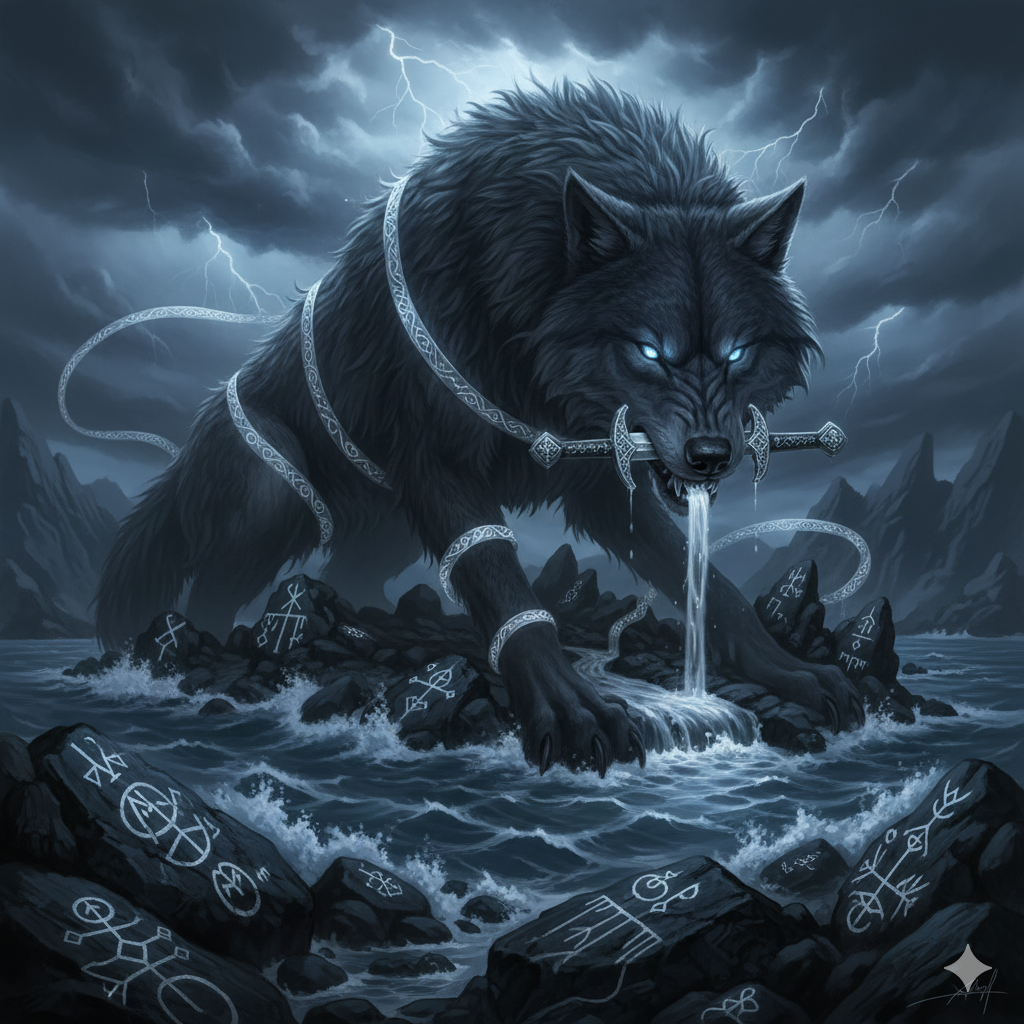
In the intricate cosmology of Norse mythology, few figures embody the tension between order and chaos as powerfully as Fenrir, the monstrous wolf whose very existence threatened the gods themselves. This is not merely a tale of a dangerous beast—it is a profound meditation on fate, betrayal, sacrifice, and the cyclical nature of destruction and renewal that defined the Norse understanding of existence.
The Ominous Bloodline
Fenrir’s story begins with a parentage that marked him for catastrophe from the moment of his birth. Known in Old Norse as Fenrisúlfr (“Fenrir’s wolf”) and also called Hróðvitnir (“fame-wolf”), he emerged from the union of two beings synonymous with danger: Loki, the cunning trickster god whose deceptions would ultimately contribute to the gods’ downfall, and Angrboða, a fearsome giantess dwelling in Jötunheimr, the realm of giants.
This partnership produced not one but three harbingers of apocalypse. Alongside Fenrir came Jörmungandr, the Midgard serpent destined to encircle the world, and Hel, the dual-natured being who would rule over the realm of the dead. When ancient prophecies reached the Æsir—the ruling gods of Asgard—warning of the devastation these three siblings would unleash, Odin himself dispatched emissaries to seize them before they could mature into their full, catastrophic potential.
The fates dealt to each sibling revealed the gods’ desperate attempts to contain prophesied doom. Odin hurled Jörmungandr into the vast ocean surrounding Midgard, where the serpent would grow so large it could grasp its own tail. Hel was cast into Niflheim and granted dominion over nine worlds and all those who died of age or sickness. But for Fenrir, the Æsir chose a different, more audacious approach—they brought the wolf pup home to Asgard itself, raising him within their own realm. Only Týr, the god of war and justice, possessed courage enough to approach and feed the growing predator.
The Escalation: When Iron Chains Shatter
Each day, Fenrir expanded in size and strength, his growth outpacing even the gods’ most pessimistic predictions. As prophecies repeatedly affirmed his destined role in their destruction, the Æsir recognized that containment had become a matter of survival. What followed was an increasingly desperate series of attempts to bind the wolf—each more powerful than the last, and each spectacularly overcome.
Leyding: The First Failure
The gods commissioned their finest smiths to forge Leyding, a massive iron chain of impressive strength. Approaching Fenrir with apparent casualness, they framed the binding as a test—a game to demonstrate his power. The confident wolf, perhaps flattered by the challenge or simply assured of his own strength, agreed to be bound.
When the gods declared themselves ready, Fenrir simply kicked against Leyding with full force. The great chain shattered into fragments, pieces scattering across the ground. The wolf’s victory was so effortless that “to loose from Leyding” became a Norse proverb for achieving something through great exertion—an ironic tribute to how easily Fenrir had accomplished the feat.
Dromi: Doubling Down on Failure
Undeterred but increasingly anxious, the gods forged Dromi—a fetter crafted to be twice as strong as Leyding. They returned to Fenrir with renewed confidence, noting both the chain’s formidable construction and the wolf’s own increased power since his previous triumph. This psychological appeal to his pride proved effective; Fenrir reasoned that while Dromi was certainly stronger, the fame to be gained from breaking it justified any risk.
Once bound, Fenrir shook himself violently, kicked against the bonds, and strained with all his titanic might. Dromi exploded into fragments that flew far across the landscape, leaving the gods to confront an uncomfortable truth: no chain forged of iron, no matter how strong, could restrain this creature. His strength transcended the physical realm entirely.
The Dwarven Solution: Gleipnir’s Impossible Construction
Facing a genuine existential crisis, Odin dispatched Freyr’s messenger Skírnir on an urgent mission to Svartálfaheimr, the subterranean realm of the dwarves beneath Yggdrasil’s roots. The commission was simple yet seemingly impossible: create a binding that even Fenrir could not break.
The dwarven craftsmen, masters of occult knowledge and arcane smithing, produced something unprecedented. Rather than forging another chain of metal, they wove Gleipnir—a ribbon as smooth and soft as silk, yet possessing supernatural strength that defied all physical logic. The name itself means “the entangled one” or “the deceiver,” hinting at its deceptive nature.
Gleipnir’s power derived not from physical materials but from six impossible, paradoxical elements:
- The sound of a cat’s footfall — silence itself, imperceptible and weightless
- The beard of a woman — legendary for its non-existence
- The roots of a mountain — insubstantial yet foundational
- The sinews of a bear — embodying strength and resilience
- The breath of a fish — intangible and elusive
- The spittle of a bird — ephemeral yet binding
Through sorcery and ancient wisdom, these immaterial components were woven into a binding that possessed a remarkable property: the more one struggled against it, the tighter and stronger it became. This was magic that responded to resistance itself, turning the victim’s own strength into the instrument of their captivity.
The Deception on Lyngvi: Týr’s Sacrifice
When the gods brought Gleipnir to the island of Lyngvi in the lake Amsvartnir, they faced their most delicate challenge yet—convincing a suspicious wolf to accept this binding. They approached with the ribbon displayed openly, passing it among themselves while pulling on it, marveling at its strength despite its delicate appearance. They assured Fenrir it was stronger than it looked, yet expressed confidence that he—who had already broken chains of iron—would easily tear it apart.
But Fenrir had inherited his father Loki’s cunning. He studied the silken band and perceived the dangerous contradiction in their words. If this delicate ribbon was truly stronger than massive iron chains, it had been “made with art and trickery”—with sorcery rather than honest craft. And if created through magic, it might represent a trap from which no physical strength could provide escape.
The wolf refused, declaring his suspicion openly: “It looks to me that with this ribbon as though I will gain no fame from it if I do tear apart such a slender band, but if it is made with art and trickery, then even if it does look thin, this band is not going on my legs.”
The gods responded with psychological pressure and veiled threats—if the ribbon was so weak he feared it, surely he posed no threat to them and could be released. But Fenrir demanded a guarantee of their good faith: one of them must place their hand in his jaws as a pledge that they intended to release him if he broke free.
The Æsir hesitated. None would risk their hand. The silence stretched uncomfortably until Týr, the god who had fed Fenrir throughout his captivity, stepped forward. With an act embodying the highest Norse ideals of courage and honor, he placed his right hand between the wolf’s jaws.
As Gleipnir tightened around Fenrir’s legs, the magical fetter’s true nature revealed itself. The harder the wolf struggled, the more securely the ribbon bound him. Realizing the deception, understanding that the gods had never intended to release him, Fenrir’s fury erupted. His jaws closed with crushing force, severing Týr’s hand cleanly at the wrist—a location forever after called the “wolf-joint.” The god of justice bore this mutilation for eternity, marked as one-handed and thus no longer considered a truly impartial arbiter of disputes.
The Final Imprisonment: An Island of Binding
With Fenrir secured by Gleipnir, the gods moved swiftly to make his imprisonment absolute. They took a cord called Gelgja hanging from the magical ribbon and threaded it through a massive stone slab named Gjöll, meaning “scream.” This stone they drove deep into the earth as an anchor. Not satisfied with even this, they placed an enormous rock called Thviti—”hitter”—even further into the ground as a secondary peg, creating layers of containment.
Fenrir’s rage was primal and all-consuming. His jaws gaped wide as he attempted to bite his captors, but the gods thrust a sword deep into his mouth—its hilt pressing against his lower jaw while its point extended into his upper jaw, forcing his jaws perpetually apart and rendering him unable to close them. From the wolf’s gagged mouth flowed saliva continuously, forming a river the Norse called Ván, meaning “hope”—a poignant and deeply ironic name for the river flowing from the bound instrument of apocalypse.
There on the desolate island of Lyngvi, Fenrir would remain through countless ages: bound by magic, gagged by steel, waiting through the turning of seasons and centuries for the fated day prophesied since the world’s beginning.
Ragnarök: The Breaking of All Bonds
Yet the Norse understood that no imprisonment, no matter how secure, could be eternal. Ancient prophecies spoken by seeresses made clear that Fenrir’s binding would endure only until Ragnarök—the twilight of the gods, when the cosmic order itself would unravel and all existence would face destruction and transformation.
When that cataclysmic epoch arrives, the fundamental laws of reality destabilize. The earth trembles with such violence that mountains crumble into dust. Trees are torn from their roots. Throughout the cosmos, every fetter and bond strains against forces greater than any magic. Even Gleipnir, woven from impossible elements and empowered by dwarven sorcery, begins to weaken as the cosmic order collapses.
Fenrir senses this dissolution. Straining against his bonds with renewed fury and the desperation of countless captive ages, he finally breaks free. The ribbon that had held him tears apart, the sword falls from his jaws, and the wolf rises to his full apocalyptic proportions.
When Fenrir emerges, he manifests as a creature of pure destruction. His jaws open to span the distance between earth and sky—his lower jaw touching the ground while his upper jaw reaches toward the heavens themselves, creating a gateway of annihilation. Flames burst from his eyes and nostrils as he leads an army of giants and monsters toward Asgard for the final battle that will end the age of the gods.
The Fulfillment of Prophecy: Death Meets Death
On the plain of Vígríðr, the appointed battlefield of Ragnarök, Fenrir encounters Odin, the Allfather who had orchestrated his capture and imprisonment. Despite all of Odin’s wisdom—his sacrifice of an eye for knowledge, his consultation with seers and the dead, his preparation for this inevitable moment—the confrontation unfolds exactly as prophecy foretold.
Fenrir’s jaws, spanning from earth to sky, close around Odin. The wolf swallows the chief of the gods whole, ending the life of the wisest and mightiest of the Æsir. This represents not merely a death but the collapse of cosmic order itself—the destruction of the god who had held existence together through knowledge and will.
Yet even this prophesied victory proves temporary. Víðarr, Odin’s son, steps forward to avenge his father. Wearing a legendary shoe crafted from materials gathered throughout all time, Víðarr places one foot against Fenrir’s lower jaw. With his hands gripping the upper jaw, he tears the wolf’s mouth apart with such force that it rends Fenrir asunder, killing the creature that had killed a god. Some sources describe Víðarr piercing Fenrir’s heart with a sword instead, but regardless of method, the apocalyptic wolf falls, his threat finally ended.
The Deeper Symbolism: Chaos and Cosmic Order
Fenrir’s mythology operates on multiple interconnected levels of meaning within Norse culture. Most fundamentally, the wolf represents the chaotic, untamed forces inherent in nature itself—the primal power that civilization attempts to contain but can never truly eliminate. The repeated failure of iron chains demonstrates that brute strength alone cannot restrain chaos; only through craft, deception, and arcane knowledge can even temporary containment be achieved.
The progression from physical fetters to magical binding reflects a sophisticated understanding that different orders of problems require different orders of solutions. Leyding and Dromi represented the gods’ initial belief that material strength could contain a material threat. Gleipnir’s success through impossible materials and paradoxical construction acknowledged that chaos transcends the physical realm and can only be bound through means equally transcendent.
Týr’s sacrifice carries profound ethical weight. The god knew the likely consequence of placing his hand in Fenrir’s mouth, yet he did not hesitate. This embodies the Norse ideal of stoic courage—accepting suffering and loss in service of the greater good, maintaining honor even when engaging in necessary deception. Týr’s maiming was not presented as tragedy but as the price of duty, a sacrifice made with full awareness and acceptance.
The myth also embodies the distinctly Norse understanding of fate and necessity. Unlike mythological traditions where heroes prevent prophesied catastrophes through cleverness or virtue, Norse mythology presents fate as absolute and inescapable. The gods know from the beginning that Fenrir will eventually kill Odin, yet they do not despair or attempt to change this destiny. They accept it as the fundamental nature of existence—not defying fate but preparing for it while understanding that preparation itself is part of fate’s pattern.
The Cycle of Destruction and Renewal
Perhaps most profoundly, Fenrir’s story reflects the Norse conception of time as cyclical rather than linear. The wolf’s binding does not represent a permanent victory of order over chaos, nor does his freedom at Ragnarök represent chaos’s ultimate triumph. Instead, the entire sequence—captivity, release, destruction, and what follows—forms a necessary cycle.
After Ragnarök’s devastation, after Fenrir has killed Odin and been killed in turn, the Norse cosmos does not end in permanent darkness. A new world emerges from the ashes of the old. Surviving gods meet on the renewed plain of Iðavöllr. Life begins again, transformed but continuous. This cyclical worldview acknowledges that destruction is not the opposite of creation but an integral part of it—that death enables rebirth, that the collapse of old orders permits new ones to arise.
In this context, Fenrir becomes not merely a monster to be feared but a necessary agent of cosmic transformation. His existence, his binding, his escape, and his destruction all serve essential functions in the grand cycle of existence. Without him, the old age could not end and the new age could not begin.
Literary and Archaeological Evidence
The detailed preservation of Fenrir’s mythology in written sources testifies to its profound importance in Norse culture. The Poetic Edda, particularly the prophetic poem Völuspá, frames Fenrir’s role in cosmic history through the words of a seeress recounting past and future. The Prose Edda, compiled by Snorri Sturluson in the 13th century, provides the most comprehensive narrative account in its Gylfaginning section, preserving details that might otherwise have been lost.
Archaeological evidence extends the myth’s reach beyond literary sources. The Thorwald’s Cross on the Isle of Man, dating to the 10th or 11th century, depicts a bearded figure with his foot in a wolf’s mouth while a bird sits at his shoulder—widely interpreted as the moment Fenrir consumes Odin while Odin’s ravens bear witness. The Gosforth Cross in Cumbria, England, presents combined Christian and pagan imagery, including a figure understood as Víðarr fighting Fenrir while a sword is thrust into the beast’s mouth, suggesting how these myths persisted even as religious traditions shifted.
These physical artifacts demonstrate that Fenrir’s story was not merely entertainment but a cosmological framework through which Norse peoples understood existence, fate, and the relationship between order and chaos.
Enduring Resonance in Modern Culture
Fenrir’s mythology continues to captivate contemporary imagination, appearing in diverse modern contexts from literature to video games. The 2022 game God of War Ragnarök incorporates Fenrir into its Norse mythological narrative, introducing the bound wolf to a new generation. Artists, writers, musicians, and filmmakers return repeatedly to Fenrir’s story as a vehicle for exploring timeless themes: inevitable fate, the clash between order and chaos, the price of security, the courage required to face unavoidable doom, and the cyclical nature of destruction and renewal.
The wolf’s enduring appeal suggests these themes remain profoundly relevant. Contemporary audiences recognize in Fenrir’s binding the same tensions visible in modern attempts to contain forces that threaten established order—whether environmental, technological, or social. His inevitable escape speaks to the futility of believing any containment can be permanent, while his role in cosmic renewal offers a framework for understanding destruction not as purely negative but as potentially transformative.
Conclusion: The Wolf in the Pattern
Fenrir represents something more complex than simple villainy. He embodies the untamable aspects of existence that resist all attempts at control, the prophesied catastrophes that come despite all preparation, and ultimately the necessary destruction that permits renewal and transformation. The gods who bound him were not foolish to attempt containment, nor were they wrong to recognize him as dangerous. They were enacting their role in a cosmic drama where all participants—wolf and god alike—moved toward fates determined before the world’s beginning.
The tragedy of Fenrir is that he was bound not for what he had done but for what he would do, punished for a destiny he had no power to change. The tragedy of the gods is that their knowledge of the future did not empower them to prevent it, only to delay it while experiencing the inevitable approach of doom. Yet Norse mythology does not present these as defects requiring correction but as fundamental truths about the nature of existence itself.
In embracing this tragic vision while maintaining hope for renewal beyond catastrophe, the Fenrir myth offers a sophisticated philosophical framework—one that acknowledges the reality of suffering and doom while refusing to surrender to nihilism, that accepts the impermanence of all order while celebrating the courage required to maintain it, and that finds meaning not in escaping fate but in meeting it with honor intact.
The bound wolf waits on his island through countless ages. The river of hope flows from his gagged mouth. And when the bonds finally break at the world’s ending, even in fulfilling the darkest prophecy, Fenrir plays his part in the pattern that permits a new world to rise from the ashes of the old.
Leave a Reply